How AI Search Is Reshaping SEO: AI Overviews, AI Mode & 7 Actionable Strategies for 2026
目次
Key Takeaways: 7 Strategies to Win in AI-Driven Search
Having spent the past year tracking how AI search engines choose their sources, I can say with confidence that the rules have fundamentally changed. In 2026, ranking on page one is no longer enough. Google AI Overviews and AI Mode now deliver answers directly in the SERP, meaning getting cited by AI is the new competitive frontier. Here are 7 actionable strategies:
- Optimize content for AI citation (APO) — Place 40–60-word answer blocks, bullet lists, and comparison tables at the top of each section so AI can extract information easily. Combine with FAQ and HowTo schema for maximum citation potential
- Implement structured data across all pages — FAQ, HowTo, Article, Product, and Review JSON-LD markup significantly increases your chances of being cited in AI Overviews. Sites with schema markup see up to 2x higher AI citation rates
- Strengthen E-E-A-T at an organizational level — Display author bios, expert credentials, primary source citations, and last-updated dates so AI recognizes your content as a trustworthy source
- Adopt GEO (Generative Engine Optimization) — Track your brand's visibility across ChatGPT, Perplexity, and Claude using "Share of Synthesis" as a new KPI alongside traditional SEO metrics
- Build a brand strategy for the zero-click era — With AI Overviews reducing organic CTR by up to 60%, brand awareness and branded search volume become your most reliable traffic channels
- Reinforce technical SEO foundations — Achieve Core Web Vitals targets (INP < 200ms, LCP < 2.5s, CLS < 0.1) and ensure AI crawlers can access your content through proper SSR and crawl directives
- Expand multimodal content — Add descriptive alt text and metadata to images and videos so AI can reference visual information in its generated answers
Below, we explore each strategy with the latest data and real-world case studies.
1. The Shift in User Behavior — Welcome to the Zero-Click Era
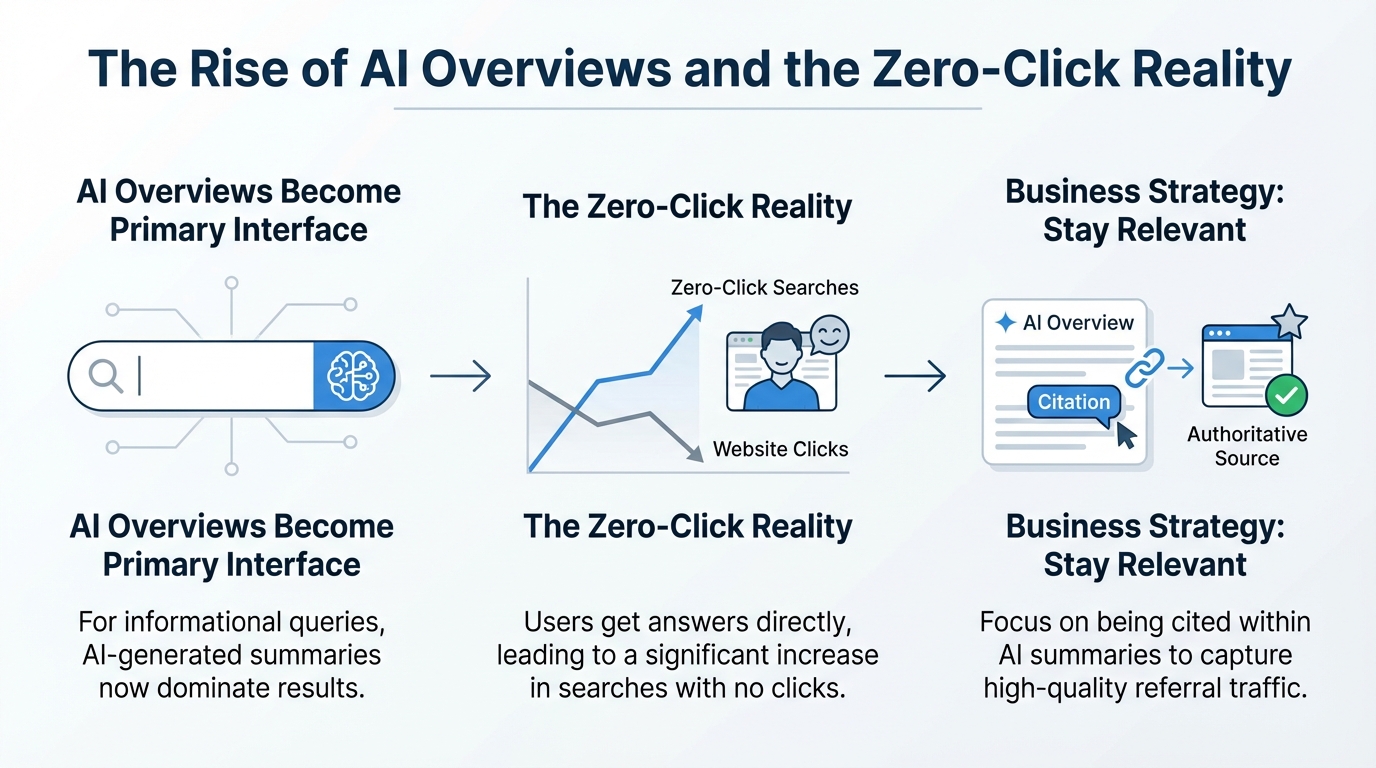
Zero-click searches are now the majority
The single most striking data point I've encountered this year is what follows. AI Overviews display summarized answers directly at the top of search results, allowing users to get the information they need without clicking any link. According to Semrush data, approximately 58.5% of Google searches in the US now result in zero clicks. When AI Overviews are present, this rate climbs even higher — early data suggests that AI Mode pushes zero-click rates to roughly 93%.
For SEO professionals, this is a fundamental shift. Ranking #1 used to guarantee a healthy click-through rate. In an AI-first search experience, even the top position may see its CTR reduced by 50–60%.
Search queries are getting longer and more conversational
With AI Mode, users are shifting from keyword-based queries to natural-language questions. Average query length has increased to around 7 words, moving from "best CRM software" to "what's the best CRM for a 50-person SaaS company with HubSpot integration." AI handles these complex, multi-condition queries natively. This shift is powered by a technique called "query fan-out," where AI decomposes one question into multiple sub-queries and searches them in parallel. For a detailed breakdown, see "What Is Query Fan-Out? A Beginner's Guide."
Generational differences in AI search adoption
AI search adoption varies significantly by age group. Younger users (18–34) are roughly 2–3x more likely to accept an AI-generated answer without visiting a website. Meanwhile, users over 55 tend to be more skeptical of AI answers and prefer visiting traditional links.
Your SEO strategy should account for the age demographics of your target audience.
Multimodal search is becoming standard
Text-only search is no longer the default. AI Mode integrates image recognition, video understanding, and text analysis into unified answers. Google Lens searches exceed 20 billion per month, and multimodal AI can now answer questions like "what plant is this?" or "how do I fix this plumbing issue?" from a photo.
Optimizing visual content has never been more important.
References: 58.5% Zero-Click Searches — Semrush (SparkToro) AI Overview CTR Impact — Seer Interactive AI Mode Zero-Click Rates — Advanced Web Ranking Generational AI Search Behavior — Pew Research Center
2. How Core Ranking Factors Are Evolving — What AI Considers "Trustworthy"
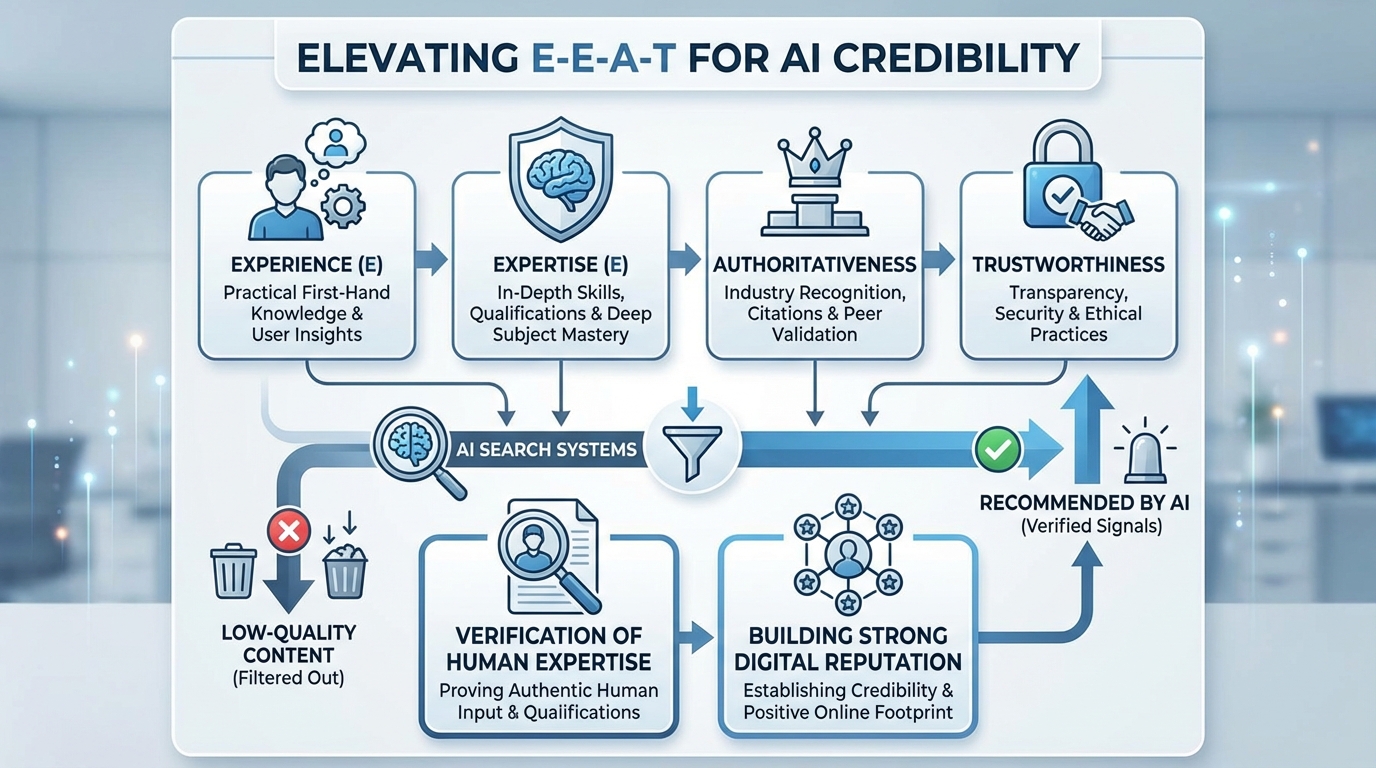
With the zero-click reality established, the next question is: what determines which sources AI actually cites? The answer comes down to trust signals.
Why E-E-A-T matters more than ever
When AI generates an answer, it selects citation sources based heavily on E-E-A-T (Experience, Expertise, Authoritativeness, Trustworthiness). Google's quality rater guidelines have always emphasized E-E-A-T, but in the AI Overviews era, these signals directly determine which sources get cited.
Trustworthiness is the most critical factor. AI systems are designed to avoid propagating misinformation, so content from recognized authorities — government agencies, peer-reviewed publications, and established industry platforms — receives preferential citation.
Brand entity recognition drives AI visibility
Brands that AI recognizes as authoritative see amplified visibility across all AI-generated results. Research from multiple SEO studies indicates that sites cited in AI Overviews see approximately 30–40% higher CTR compared to uncited results in the same SERP.
This extends the concept of "brand SEO" into new territory. Beyond keyword rankings, how well AI systems recognize and trust your brand entity is becoming a critical success factor.
| Factor | Key Takeaway |
|---|---|
| E-E-A-T signals | Experience, expertise, authoritativeness, and trustworthiness directly influence AI citation selection |
| Brand entity recognition | Brands recognized as authoritative by AI see increased visibility across all search types |
| Structured data (Schema) | FAQ, HowTo, and Article schema implementation boosts AI Overview citation probability |
| Primary source attribution | Content citing authoritative sources and original research is prioritized by AI |
| Multimodal signals | Image and video metadata contribute to AI information extraction and citation |
References: E-E-A-T and AI Overviews — Search Engine Land Brand Visibility in AI Search — Rand Fishkin (SparkToro) Ahrefs AI Overviews Impact Study
3. The New Content Standard — What Gets Cited by AI
Answer-Passage-Optimization (APO) explained
In my testing across multiple AI engines, I've confirmed that content structure matters as much as content quality for getting cited. APO (Answer-Passage-Optimization) is a content structuring methodology designed to make your content easy for AI to extract and cite. By placing concise 40–60-word answer blocks, bulleted lists, comparison tables, and step-by-step instructions at the beginning of each section, you dramatically increase the likelihood of AI citation.
Key APO principles include:
- Lead with the answer — Place the direct answer at the start of each section or article
- Use structured lists — Bullet points and numbered lists make information extraction straightforward for AI
- Present comparisons in tables — Tabular data is highly extractable and frequently cited
- Number your steps — HowTo-style content has among the highest AI citation rates
FAQ format directly addresses search intent
Question-format headings ("What is X?", "How do I Y?") followed by direct answers create ideal question-answer pairs that AI systems extract with high reliability. When combined with FAQ schema markup, this format targets both rich results and AI citations simultaneously.
Human editing and fact-checking remain essential
Publishing AI-generated content without human review carries significant risk. Always attribute primary sources and display last-updated dates to prevent hallucination from propagating. Google has stated that AI-assisted content is acceptable, but accuracy and usefulness are evaluated strictly.
Original insights are the ultimate differentiator
Proprietary case studies, original research, expert interviews, and unique data analysis are the strongest signals for AI citation. AI compares multiple sources when generating answers, and content with genuinely unique information has a significantly higher chance of being selected.
References: AI Overview Optimization — Search Engine Journal Structured Data and AI Citations — Schema.org Google's Helpful Content Guidelines Original Research and AI Citation — Moz
4. Technical SEO & Structured Data — The Foundation for AI Citation
Structured data (JSON-LD) is the most direct path to AI citation
Frankly, structured data implementation is the clearest "do it or don't" decision in SEO right now — the citation rate difference between sites with and without proper schema is too large to ignore. The single most impactful technical action you can take to increase AI citation is proper structured data implementation. The following schema types are particularly important:
| Schema Type | Purpose | AI Citation Impact |
|---|---|---|
| FAQ | Questions and answers | AI directly extracts Q&A pairs |
| HowTo | Step-by-step instructions | Used to generate procedural answers |
| Article | Article metadata | Author, date, and category trust signals |
| Product | Product information | Referenced in comparison and review answers |
| Review | Ratings and reviews | Incorporated into recommendation answers |
Sites with comprehensive schema markup see up to 2x–2.8x higher citation rates in AI Overviews compared to sites without structured data. Always validate your markup using Google's Rich Results Test.
Core Web Vitals and mobile optimization
Core Web Vitals remain essential technical SEO fundamentals in the AI search era:
- LCP (Largest Contentful Paint): Under 2.5 seconds
- INP (Interaction to Next Paint): Under 200ms
- CLS (Cumulative Layout Shift): Under 0.1
With mobile devices accounting for the majority of global web traffic, mobile page speed is especially critical. Optimize your images (consider next-gen formats and proper compression) and streamline CSS/JS delivery.
AI crawler accessibility
Ensure your robots.txt permits access to important pages, and keep your sitemap updated so AI crawlers can efficiently index your content. Many AI crawlers don't execute JavaScript, so critical content should be delivered via SSR (Server-Side Rendering) directly in the HTML.
Beyond traditional crawler access, emerging standards like Cloudflare's "Markdown for Agents" are enabling sites to serve AI-optimized formats directly. For a deep dive into these approaches and what they mean for your site, see "Cloudflare's Markdown for Agents and AI-Ready Web Optimization."
International SEO considerations
For multilingual sites, proper hreflang implementation helps AI select the right language version for citation. Clean canonical URLs and well-structured URL hierarchies ensure AI can correctly identify and attribute your content across different regions.
References: Structured Data Citation Rates — Ahrefs Schema Markup and AI Overviews — Search Engine Land Core Web Vitals 2026 — web.dev
5. Traditional SEO vs. AI-Era SEO — What's Changed and What Hasn't
With the technical and content foundations covered, let's address the question I get asked most often: "Does traditional SEO still matter?" My answer is clear — yes, and here's why. The rise of AI search is reshaping SEO strategy, metrics, and priorities. However, traditional SEO hasn't become irrelevant — rather, AI optimization is an additional layer on top of existing best practices.
| Aspect | Traditional SEO | AI-Era SEO (AIO/GEO) |
|---|---|---|
| Primary KPIs | Keyword rankings, organic CTR, backlink count | AI citation count, Share of Synthesis + traditional metrics |
| Traffic model | Click-dependent traffic | Zero-click increasing; AI provides direct answers |
| CTR impact | Relatively stable click-through rates | AI Overview presence reduces CTR by 30–60% on average |
| Brand exposure | Top rankings = primary visibility | AI cites trusted brands regardless of exact ranking position |
| ROI drivers | Content volume and link building | Schema implementation + APO deliver AI visibility at lower cost |
What is GEO (Generative Engine Optimization)?
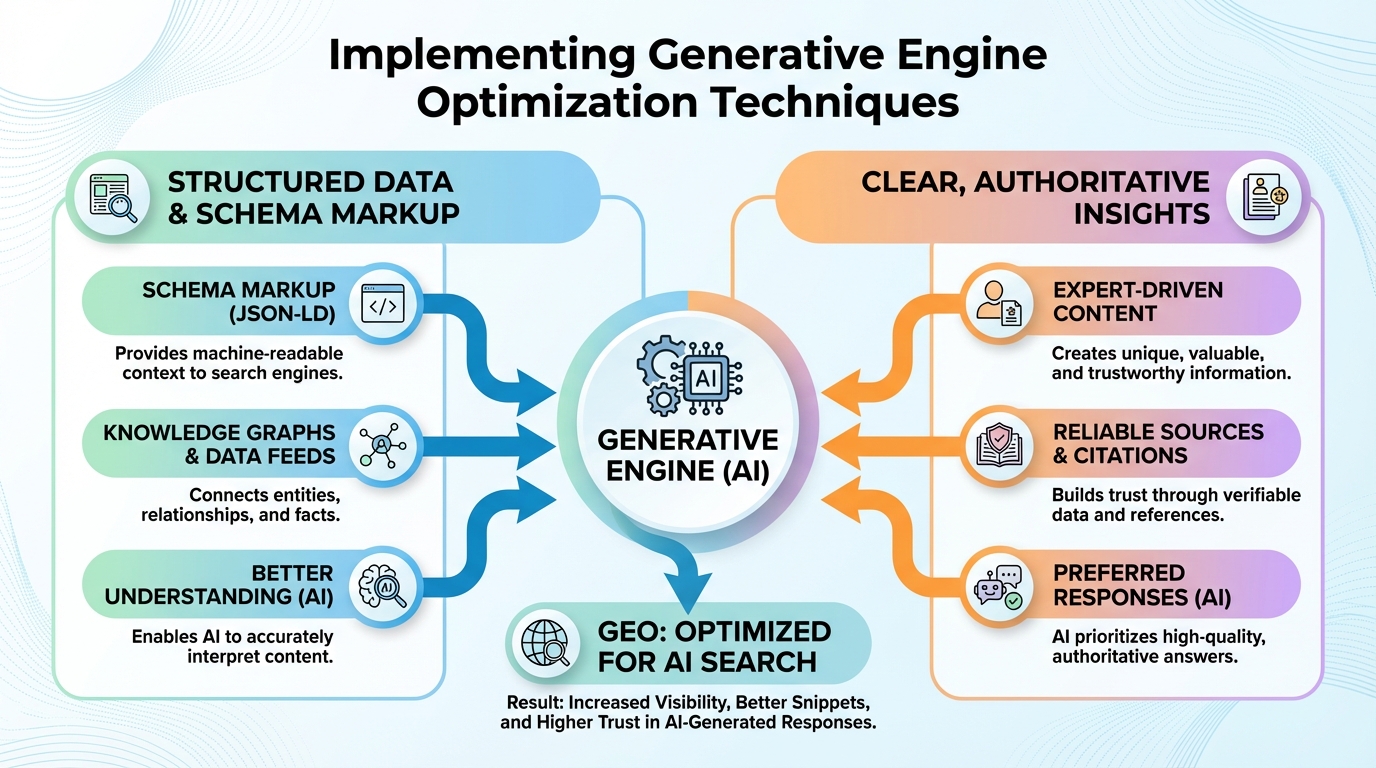
GEO is the practice of optimizing your brand's visibility across generative AI search engines — ChatGPT, Perplexity, Claude, and Google's own AI features. Where traditional SEO tracks "Share of Voice" (visibility in search results), GEO introduces "Share of Synthesis" (citation share in AI-generated answers) as a new KPI.
Share of Synthesis measures how often your brand is cited when users ask AI about topics in your category. For example, if your brand appears in 30 out of 100 AI-generated answers about "best project management tools," your Share of Synthesis is 30%.
Early GEO adopters are seeing significant results. Case studies show that brands implementing comprehensive GEO strategies have achieved 400–900% increases in AI-referred sessions within 6–12 months.
For a comprehensive breakdown of GEO technical foundations, platform-specific citation tactics, and a phased implementation roadmap, see "The Complete GEO Guide: How to Get Cited by ChatGPT, Gemini, and Perplexity."
References: Share of Synthesis — Seer Interactive GEO Framework — HubSpot AI Overview CTR Impact — Advanced Web Ranking
LinkSurge
linksurge.jp
SEO・AIO・GEO統合分析プラットフォーム。AI Overviews分析、SEO順位計測、GEO引用最適化など、生成AI時代のブランド露出を最大化するための分析ツールを提供しています。
6. Real-World Case Studies — Brands Winning in AI Search
What I find most encouraging about these examples is that smaller organizations are winning too — not just enterprises with massive budgets.
Case Study 1: B2B SaaS company increases AI-referred traffic by 527%
Cadence, a B2B design automation company, implemented a comprehensive GEO strategy including structured data optimization, APO-formatted content, and authoritative citation building. Within 12 months, they saw a 934% increase in keyword rankings appearing in AI Overviews and a 527% increase in AI-referred sessions.
Case Study 2: E-commerce brand captures AI product recommendations
A mid-size e-commerce retailer restructured their product pages with Product and Review schema, added comparison tables, and created APO-formatted buying guides. Their products began appearing consistently in AI Overview answers for "best [product category]" queries, driving a measurable increase in both branded search and direct conversions.
Case Study 3: SaaS startup outperforms larger competitors in AI citations
A 50-person SaaS startup focused on creating in-depth, expert-authored content with comprehensive FAQ schema. Despite having a fraction of the domain authority of enterprise competitors, their content was cited more frequently in AI Overviews due to superior content structure and E-E-A-T signals. This translated into a 40% increase in qualified demo requests.
Case Study 4: Publisher maintains traffic despite AI Overview expansion
A major industry publication proactively adopted APO formatting across their editorial content, implemented FAQ and Article schema, and strengthened author authority pages. While competitors saw 30–40% traffic declines as AI Overviews expanded, this publisher maintained stable organic traffic by consistently earning citation links within AI-generated answers.
| Case Study | Key Strategy | Result |
|---|---|---|
| Cadence (B2B) | GEO strategy + structured data + APO | 527% increase in AI-referred sessions |
| E-commerce retailer | Product/Review schema + comparison tables | Consistent AI product recommendations |
| SaaS startup | Expert content + FAQ schema + E-E-A-T | 40% increase in qualified demos |
| Industry publisher | APO formatting + Article schema + author authority | Stable traffic despite AI Overview expansion |
References: Cadence GEO Case Study — Seer Interactive AI Overviews Traffic Impact — Search Engine Land GEO Early Adopter Results — HubSpot Research
7. Your 7-Step Action Plan — Start Today
Step 1: Content audit and APO implementation (1–2 weeks)
Review your existing pages and add 40–60-word answer blocks at the beginning of each section. Restructure key information into bullet lists, tables, and numbered steps. Start with your top 10 traffic-driving pages for maximum impact.
Step 2: Deploy structured data across all pages (2–4 weeks)
Implement FAQ, HowTo, Article, Product, and Review schema using JSON-LD. Validate every page with Google's Rich Results Test and fix all errors. Prioritize pages that already rank for question-type queries.
Step 3: Strengthen E-E-A-T signals (ongoing)
Implement these trust signals progressively:
- Create detailed author bio pages linked from every article
- Display expert credentials, certifications, and affiliations
- Cite primary sources with URLs and access dates
- Build authoritative backlinks from recognized industry publications
Step 4: Technical optimization (1–2 weeks)
- Ensure mobile-first design across all pages
- Achieve Core Web Vitals targets (LCP < 2.5s, INP < 200ms, CLS < 0.1)
- Optimize robots.txt and XML sitemap for AI crawler access
- Implement SSR for all critical content pages
Step 5: Set up AI-era KPIs (1 week)
Establish tracking for "citation count," "AI-referred sessions," and "Share of Synthesis" using Google Search Console and specialized analytics tools. LinkSurge's AI Overview Analysis enables real-time tracking of your brand's AI citation performance.
Step 6: Invest in brand PR and third-party mentions (ongoing)
Increase your brand's mentions across authoritative third-party sites through press releases, industry media contributions, and thought leadership content. AI systems rely on cross-referencing multiple sources, so diverse authoritative mentions strengthen your citation probability.
Step 7: Expand multimodal content (ongoing)
Add comprehensive alt text and metadata to all images and videos. Create visual content — infographics, comparison charts, tutorial videos — that adds genuine value. Multimodal content is increasingly referenced in AI-generated answers, especially for product comparisons, how-to guides, and visual topics.
Short-term: Schema implementation and APO formatting deliver the fastest path to AI Overview citations. Long-term: Brand entity strengthening and organization-wide GEO adoption prepare you for a future where AI Mode is the default search experience.
References: AI Overview Optimization Guide — Search Engine Journal GEO Implementation Framework — Seer Interactive Measuring AI Search Performance — SparkToro
Frequently Asked Questions
How do I get my site cited in AI Overviews?
The most effective approach combines three elements: structured data implementation (FAQ, HowTo, and Article JSON-LD schema), APO formatting (40–60-word answer blocks placed at the beginning of each section), and strong E-E-A-T signals (author bios, primary source citations, last-updated dates). Question-format headings with direct answers are particularly effective for AI extraction.
Does the rise of zero-click search make SEO pointless?
No. While zero-click searches reduce traditional organic traffic, being cited by AI increases brand awareness and drives branded search volume. Additionally, optimizing structured data and APO formatting increases the probability of your link appearing within AI Overview answers. The most effective strategy combines traditional SEO with GEO for maximum visibility.
What's the difference between GEO and traditional SEO?
Traditional SEO optimizes for keyword rankings and click-through rates in search results pages. GEO (Generative Engine Optimization) optimizes for "Share of Synthesis" — your brand's citation rate across AI search engines like ChatGPT, Perplexity, and Google AI Overviews. GEO focuses on structured data, APO content formatting, and E-E-A-T signals, with AI citation count as a primary KPI rather than keyword position alone.
How much does AI Overview reduce organic CTR?
Studies show that when AI Overviews appear, organic CTR for top-ranking results drops by approximately 50–60%. Google's AI Mode — currently in limited rollout — shows even more dramatic zero-click rates of around 93%. However, sites that are cited within AI Overviews see their CTR relatively preserved compared to uncited competitors.
Is AI-generated content bad for SEO?
Google has stated that AI-generated content is not inherently penalized. However, content is evaluated strictly on accuracy, usefulness, and originality. Always have human editors review AI-assisted content, attribute primary sources, and add unique insights such as original data, case studies, or expert analysis. The recommended approach is to use AI as a writing assistant while ensuring human oversight and original value-add.
Conclusion: In AI Search, Citation Is the New Currency
The expansion of AI Overviews and AI Mode is shifting SEO success metrics from "rankings" to "citations." But this doesn't mean traditional SEO is dead. Technical SEO, content quality, and E-E-A-T remain foundational — GEO and APO are new layers built on top of these existing strengths.
The highest-ROI starting point is APO formatting of existing content combined with structured data implementation. These two actions are relatively low-cost and deliver the fastest impact on AI citation rates. From there, build your brand entity authority and establish GEO measurement systems for sustainable competitive advantage.
Optimizing your own site is only part of the equation. Learn why brand mentions across the web now outweigh backlinks for AI citations in "91% of AI Answers Come from Sites That Aren't Yours."
Social media posts are increasingly cited by AI search engines too. For platform-specific optimization tactics for X, Instagram, and LinkedIn, see "X, Instagram & LinkedIn AI Search Optimization."
LinkSurge's AI Overview Analysis lets you track your brand's citation performance across Google AI Overviews and ChatGPT in real time. It's the ideal first step for building an AI-era SEO strategy.