91% of AI Answers Come from Sites That Aren't Yours: A 2026 Guide to Off-Site Brand Visibility
目次
Key Takeaways: Optimizing Your Own Site Is Not Enough for AI Search
The most surprising finding in my analysis of AI citation patterns this year has been this: what happens outside your website matters far more than what's on it. AI search engines like ChatGPT, Perplexity, and Google AI Overviews don't independently crawl the web. They query traditional search engines, read snippets from the top 10 results, and synthesize answers with citations. This means your brand's presence across the entire SERP — not just your own #1 ranking — determines whether AI picks you up. Here are the five things that matter most.
- Brand mentions are the strongest predictor of AI citations — Ahrefs' study of 75,000 brands found that web brand mentions correlate with AI citations at r=0.664, while backlinks trail at r=0.10 — over 6× weaker
- Ranking #1 is not enough — AI engines read snippets from all top results. If competitors dominate positions 2-10 through roundup articles, reviews, and forums, the AI will likely cite them instead
- 91% of AI answers cite third-party sources — Your own site accounts for just 9% of brand mentions in AI-generated responses. The rest comes from Reddit, review sites, industry publications, and forums
- Each AI platform has different source preferences — ChatGPT leans on Wikipedia (7.8%), Perplexity favors Reddit (6.6%), and only 11% of cited domains overlap between the two
- Zero-click is the new normal — AI Overviews trigger 83% zero-click rates, and position-one CTR has dropped 58%. Being referenced as a source matters more than being clicked
The sections below break down each point with data and actionable steps.
1. What Is "Off-Site SEO"? — Everything You Do Beyond Your Own Website
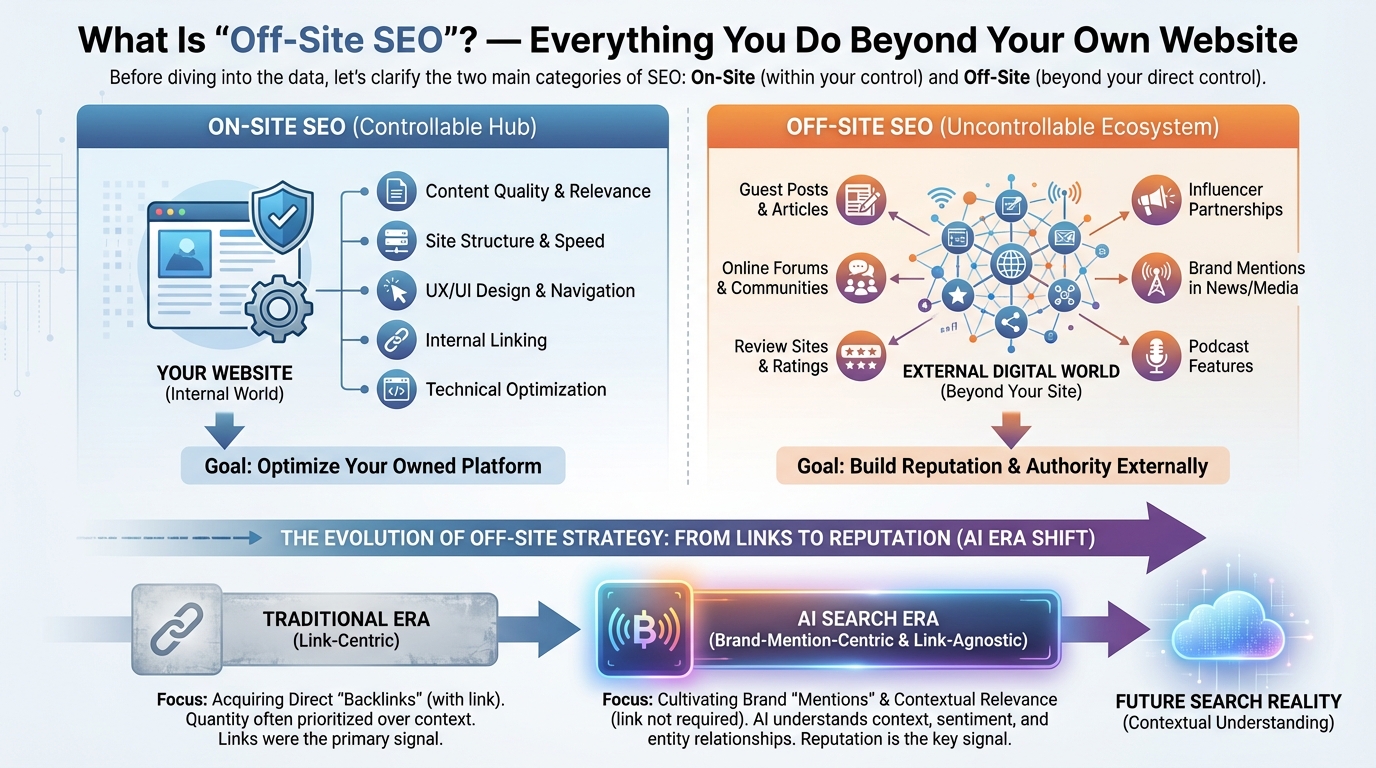
Before diving into the data, let's clarify a term that trips people up. SEO breaks down into two broad categories:
| Type | What It Covers | Examples |
|---|---|---|
| On-site SEO | Improving your own website | Page speed, meta tags, content quality, structured data, internal linking |
| Off-site SEO | Building brand presence outside your own domain | Brand mentions on other sites, guest articles in industry publications, forum participation, review site listings |
In plain terms, off-site SEO means getting your brand name talked about in places you don't control.
For years, off-site SEO was almost synonymous with link building — get other sites to link to yours, and Google rewards you with higher rankings. That playbook still has value for traditional search, but the AI search era has rewritten the rules. What matters now is not just whether other sites link to you, but whether they mention your brand name at all — with or without a hyperlink.
The rest of this article explains why that shift happened and what to do about it.
References: GEO vs SEO: What's The Difference And Why It Matters? - Writesonic Generative Engine Optimization (GEO): Is It the New SEO? - Built In
2. How AI Search Engines Actually "See" the Web
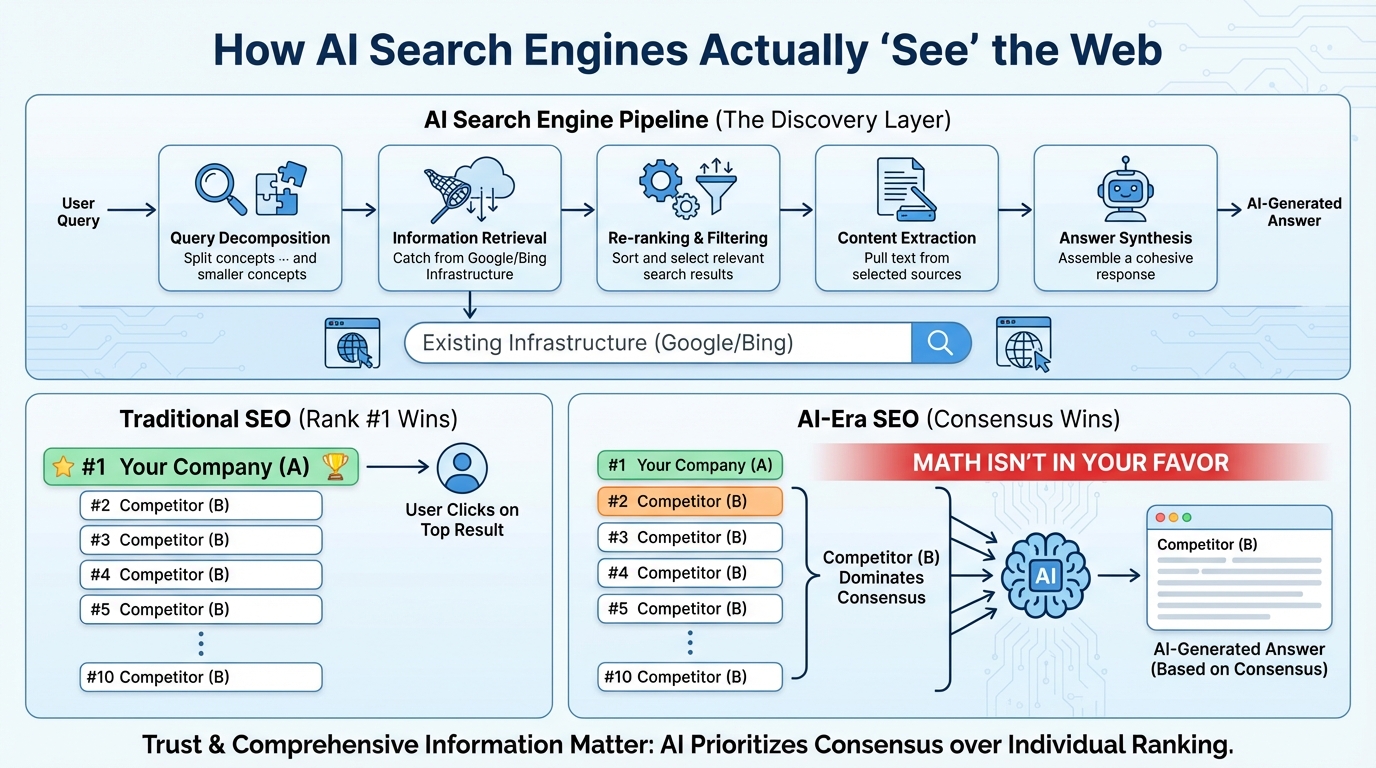
Understanding the mechanics is the starting point. From my observation of how ChatGPT and Perplexity behave in practice, here's the pipeline they follow when generating answers — and it's remarkably consistent across platforms.
The Five-Step Pipeline
- Query decomposition — The AI breaks a user prompt into 1-5 search keywords
- Search grounding — Those keywords get sent to Google, Bing, or both
- Snippet scanning — The AI reads titles and descriptions from all returned results
- Selective deep reads — When snippets aren't enough, the AI opens full webpages
- Answer synthesis — Information from multiple sources is merged into a cited response
The key insight: AI search engines don't have their own crawlers. Traditional search results act as the discovery layer. If your page doesn't appear in Google or Bing results, ChatGPT will never see it.
Why Owning #1 Isn't the Whole Game
In traditional SEO, ranking first was the finish line. AI search engines, however, scan snippets from the entire first page. They look for cross-source agreement before committing a brand name to their answer.
Picture this: your site holds position one, but positions 2 through 10 are filled with "Best SEO tools 2026" listicles, G2 reviews, and Reddit threads — all mentioning your competitor. The AI sees one source for you and nine for them. The math isn't in your favor.
References: GEO: Generative Engine Optimization — Princeton University (KDD 2024) Why Off-Site SEO Matters in GEO & AI Search — LLMrefs
3. The Data: Brand Mentions Beat Backlinks
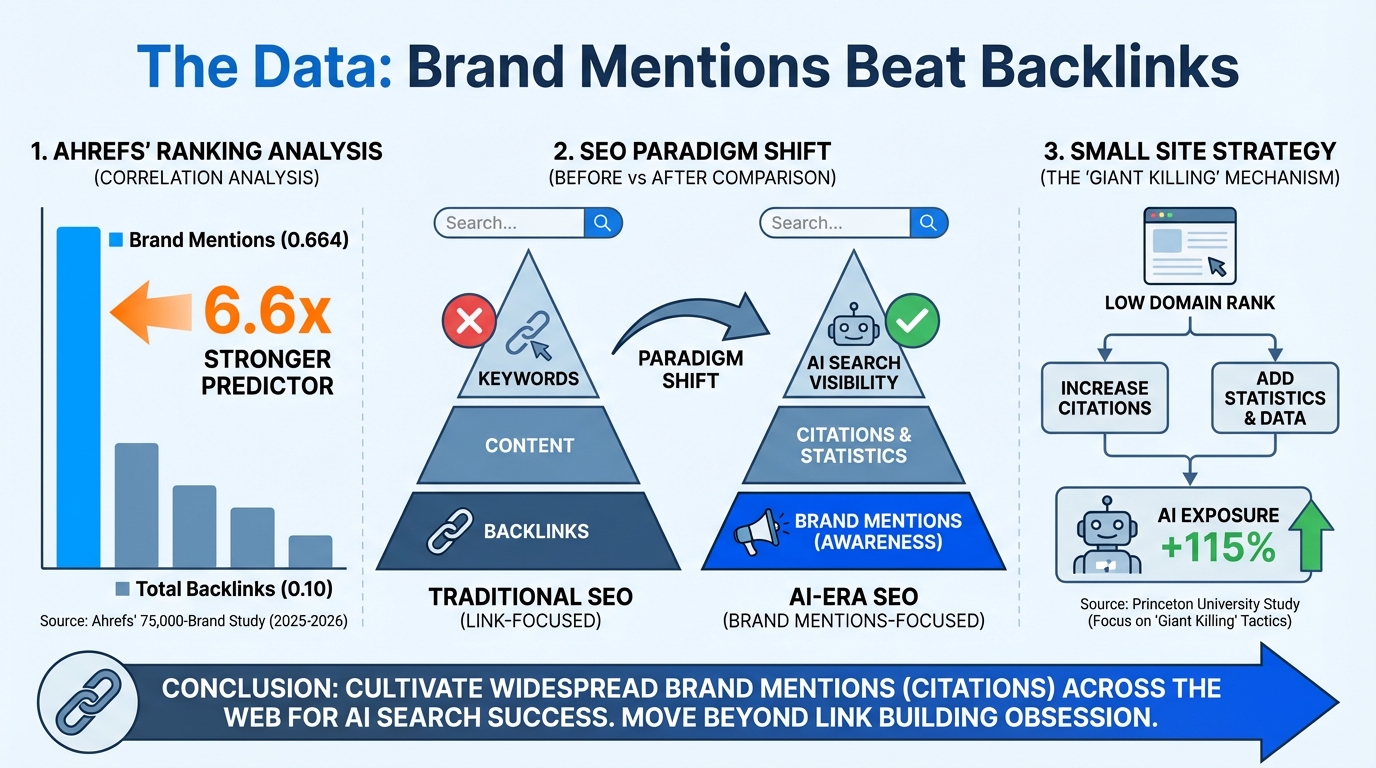
When I first saw the Ahrefs data, I was genuinely surprised — I'd expected backlinks to be a stronger factor. But the numbers tell a clear story. Multiple studies published between 2025 and 2026 confirm the same pattern. Brand mentions outperform backlinks as predictors of AI citation. This is closely tied to Google's "query fan-out" technique, where AI decomposes each search into multiple sub-queries — and your brand needs to surface across those sub-queries to get cited. For a deep dive into how fan-out works, see "What Is Query Fan-Out? A Beginner's Guide."
Ahrefs' 75,000-Brand Study
Ahrefs analyzed 75,000 brands across ChatGPT, Google AI Mode, and AI Overviews to identify what actually drives AI visibility.
| Factor | Correlation with AI Citations (r) | Takeaway |
|---|---|---|
| Brand web mentions | 0.664 | Strongest predictor by far |
| Branded anchor text | 0.527 | How your name appears in links matters |
| Brand search volume | 0.392 | Direct reflection of brand awareness |
| Domain Rating | 0.25 | Still matters, but less than expected |
| Total backlinks | 0.10 | Weakest of the five |
The top three predictors are all off-site brand signals. Backlinks — the cornerstone of traditional SEO — showed the weakest correlation at 0.10, roughly one-sixth the strength of brand mentions.
Princeton's GEO Paper: Small Sites Can Win Too
The Princeton GEO paper (accepted at KDD 2024) systematically tested which content optimizations improve visibility in generative engines. Adding citations and statistics boosted visibility by up to 40%. For sites ranked fifth in SERP, the "Cite Sources" method alone produced a 115.1% increase in AI visibility.
You don't need to be a top-three domain. If your content is structured for easy citation and your brand appears across multiple results, AI engines will find you.
Brand Mentions Are 3× More Important Than Backlinks
The Digital Bloom's 2025 AI Visibility Report puts it plainly — brand mentions carry three times the weight of backlinks for AI search visibility. Clustering brand mentions across multiple LLMs increases first-position citation likelihood by up to 2.8×.
References: Top Brand Visibility Factors in ChatGPT, AI Mode, and AI Overviews (75K Brands Studied) — Ahrefs GEO: Generative Engine Optimization — arXiv 2025 AI Visibility Report: How LLMs Choose What Sources to Mention — The Digital Bloom
4. Platform-by-Platform: Where AI Gets Its Sources
With the overall data in hand, let's drill into the platform-level differences. Not every AI engine reads the same sources. Understanding their preferences helps you prioritize where to build presence.
Citation Source Comparison
| AI Search Engine | Top Cited Source | Share | Key Trait |
|---|---|---|---|
| ChatGPT | Wikipedia | 7.8% | Encyclopedic accuracy |
| Perplexity | 6.6% | Real-time user-generated content | |
| Google AI Overviews | 2.2% | Balanced mix of authoritative sources |
Only about 11% of domains get cited by both ChatGPT and Perplexity. A brand that dominates one platform might be invisible on another. Multi-platform coverage is no longer optional.
Why Reddit Matters So Much
Reddit deserves special attention. It accounts for 21% of AI citations across platforms, and Google has given it significantly improved indexation since their 2024 partnership. Highly upvoted, detailed recommendations carry more weight than brief or negative mentions. AI systems appear to evaluate both sentiment and engagement when selecting Reddit sources.
The 9% Problem
Brand websites are directly mentioned in only 9% of AI-generated responses. The remaining 91% comes from third-party content — review sites, comparison articles, forums, industry publications, and social platforms.
This is the data point that anchors the entire thesis of this article. No amount of on-site SEO can capture the other 91%. Only off-site presence can.
For a deeper look at GEO technical implementation and platform-specific citation strategies, see our "Complete GEO Guide."
References: AI Platform Citation Patterns — Profound Reddit, Quora, and Third-Party Sites: The New Kings of AI Search — AI Marketing Labs How AI Engines Choose Brands: Citation Patterns Revealed — BrightEdge
5. The Zero-Click Acceleration
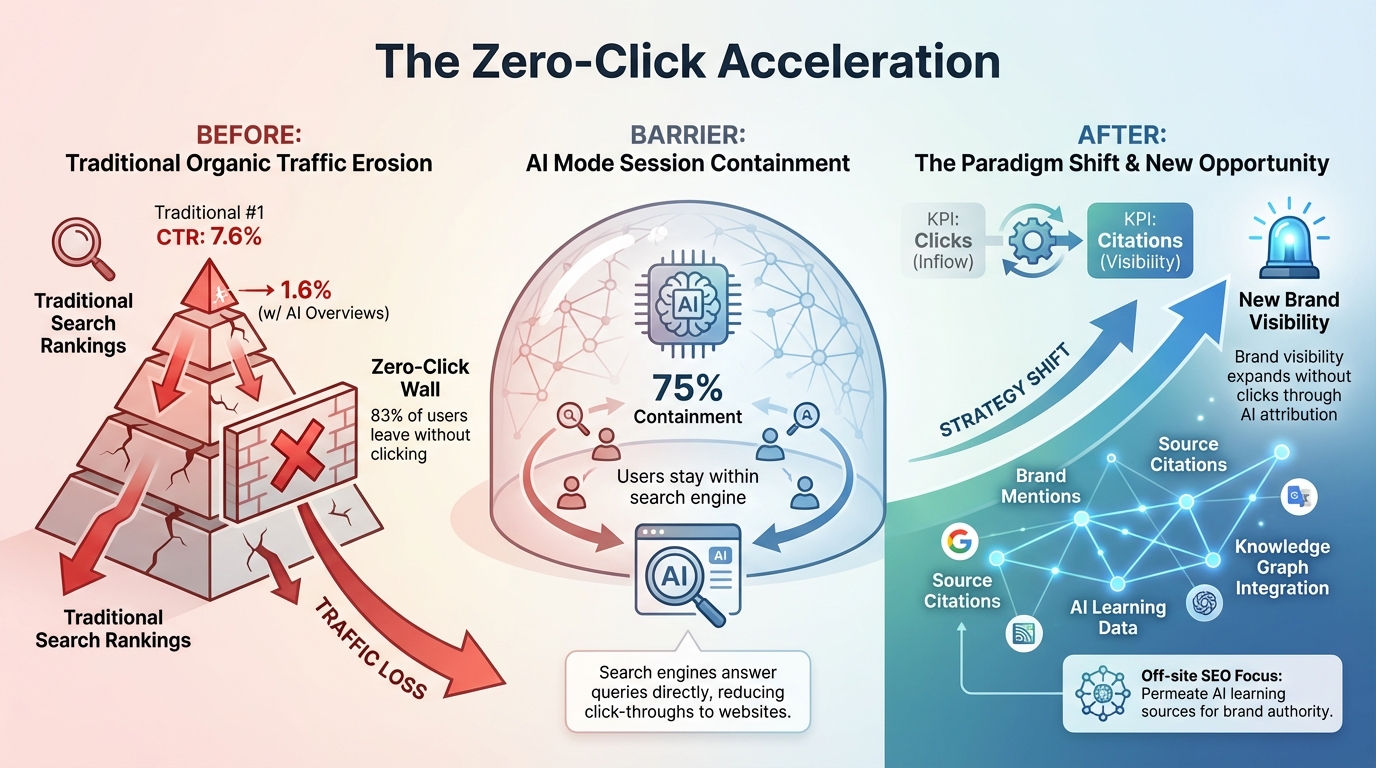
Off-site brand visibility gains urgency from another trend: zero-click searches are eating traditional organic traffic.
The Numbers Are Stark
| Metric | Value | Source |
|---|---|---|
| Overall zero-click rate (US) | 58.5% | Semrush 2025 |
| Zero-click rate with AI Overviews | 83% | Multi-study aggregate |
| Position-one CTR reduction from AI Overviews | 58% (from 7.6% to 1.6%) | Ahrefs, February 2026 |
| AI Mode session containment rate | 75% | Semrush, September 2025 |
Ahrefs' February 2026 update shows AI Overviews now reduce position-one click-through rates by 58% — nearly double the 34.5% measured in April 2025. The trend is accelerating.
Reframe the KPI: From Clicks to Citations
The zero-click trend sounds dire, but it opens a new opportunity. Even when users don't click through to any website, AI Overviews display source attributions. If your brand is referenced as a source, you gain visibility without the click.
The strategic shift: your primary asset is no longer "traffic from position one" but "brand presence across the sources AI reads." That's off-site SEO in a nutshell.
References: Update: AI Overviews Reduce Clicks by 58% — Ahrefs Semrush AI Overviews Study — Semrush Zero-Click Search 2026: AI Overviews Cut Clicks by 58% — PikaSEO
6. The Playbook: Building AI-Visible Off-Site Presence
With the data and platform analysis covered, let's get practical. Based on what I've seen work across multiple client engagements, here's the execution plan I recommend — broken into five phases.
Phase 1: Baseline Measurement (Weeks 1-2)
Measure your current "SERP share of voice" before making changes.
- Search your target keywords and count how many times your brand appears in the top 20 results — include your own site plus third-party mentions
- Use LinkSurge AI Overview analysis to check citation status across key queries
- Ask ChatGPT and Perplexity your core product questions — note whether your brand appears in responses
Phase 2: Earn Third-Party Coverage (Months 1-3)
Systematically pursue placements in the content types AI engines read most.
| Tactic | Example | Expected Impact |
|---|---|---|
| Listicle placements | Get reviewed in "Best X tools 2026" roundups on G2, Capterra, industry blogs | Multiple SERP positions carrying your brand |
| Industry publication bylines | Guest posts on Search Engine Journal, Moz Blog, HubSpot | E-E-A-T authority signals |
| Press coverage | Newswire distribution for product launches and original research | News site mentions indexed quickly |
| Podcast appearances | Interviews on industry podcasts (transcripts get indexed) | Long-form brand mentions with context |
Phase 3: Cultivate User-Generated Content (Ongoing)
Reddit, Quora, and Stack Overflow are among AI's most-cited sources. Organic presence here is high-impact.
- Participate authentically in relevant subreddits — answer questions with genuine expertise. Promotional posts backfire
- Encourage customer reviews on G2, Capterra, Trustpilot — AI engines read and cite these platforms
- Create shareable data that community members reference in their own posts and answers
A standout example of UGC driving AI citations is yutori, a Japanese D2C apparel company that designs pop-up events as UGC factories and turns TikTok comments into purchase funnels. Their full SNS-first strategy is analyzed in "How yutori Captured Gen Z with SNS-First Brand Strategy."
Phase 4: Publish Citable Original Research (Quarterly)
AI engines prioritize information that multiple sources can independently verify.
- Surveys and industry benchmarks — original data that journalists and bloggers reference
- Case studies with specific numbers — concrete results are more citable than vague claims
- Regularly updated statistics pages — 65% of AI bots access pages updated within the past year
Phase 5: Strengthen Entity Recognition
Structured entity data helps LLMs identify and trust your brand.
- Create or update your Wikidata entry — accurate metadata, aliases, and industry classifications improve entity recognition
- Maintain Schema.org markup — Organization, Product, and FAQ structured data on your site
- Keep Google Business Profile current — feeds into Knowledge Graph, which informs AI answers
References: AI Search Optimization: 12 Strategies for LLM Visibility 2026 — ALM Corp LLM Citation Trends That Matter in AI Search — Wellows LLMO: 10 Ways to Work Your Brand Into AI Answers — Ahrefs
7. Measuring What Matters: New KPIs for AI Visibility
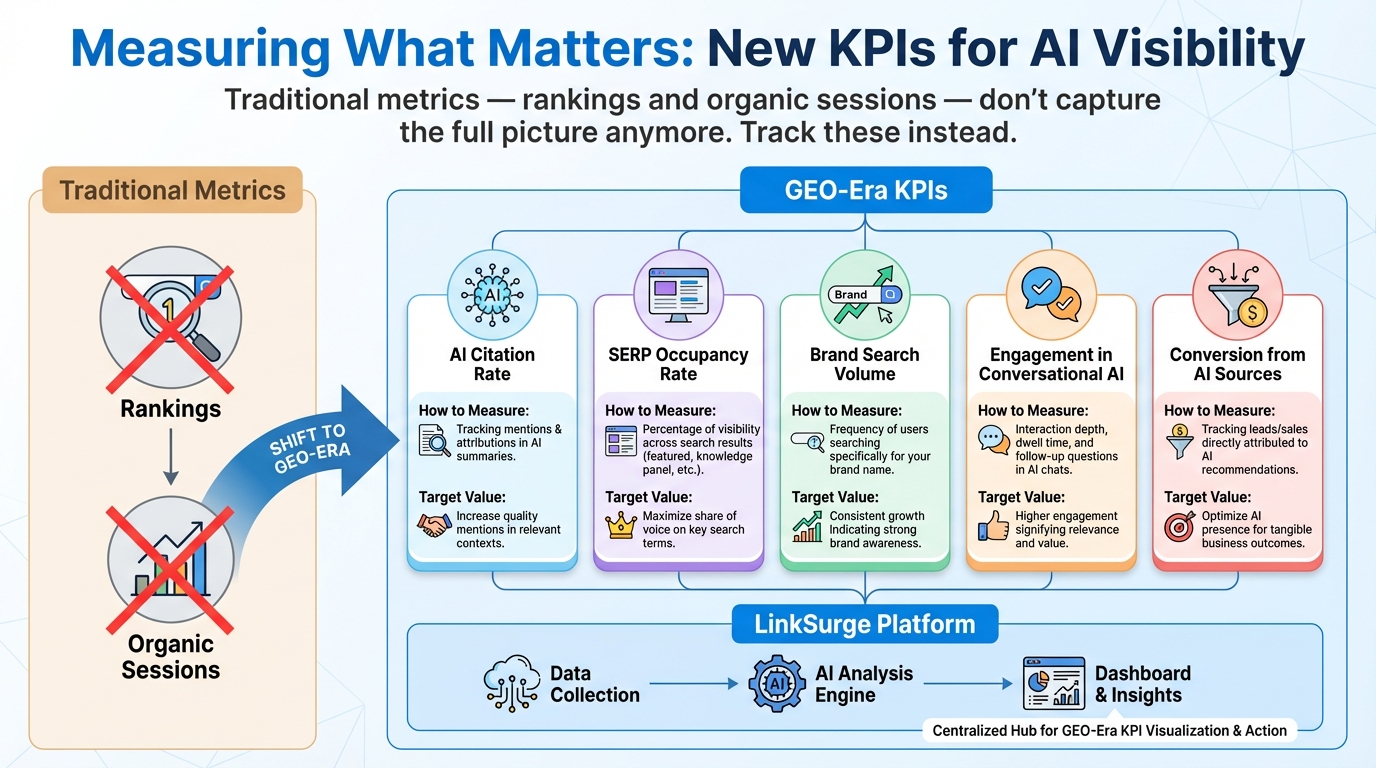
Traditional metrics — rankings and organic sessions — don't capture the full picture anymore. Track these instead.
GEO-Era KPIs
| KPI | How to Measure | Target |
|---|---|---|
| AI Citation Rate | Query target keywords in ChatGPT/Perplexity; track brand mention frequency | 30%+ of core queries |
| SERP Share of Voice | Count brand appearances across top 20 results for target keywords | Exceed primary competitor |
| Brand Search Volume | Monitor via Google Trends and Search Console | Quarter-over-quarter growth |
| Third-Party Mention Count | Track with Ahrefs Content Explorer or brand monitoring tools | Monthly upward trend |
| AI Overview Appearance Rate | Track keyword-level AI Overview presence | Monitor monthly |
LinkSurge provides dashboards that visualize AI Overview appearance rates and keyword-level citation status, making it straightforward to track off-site efforts over time.
References: GEO Metrics That Matter: How to Track AI Citations — Averi How to measure brand visibility in AI search — Search Engine Land
LinkSurge
linksurge.jp
SEO・AIO・GEO統合分析プラットフォーム。AI Overviews分析、SEO順位計測、GEO引用最適化など、生成AI時代のブランド露出を最大化するための分析ツールを提供しています。
8. Common Misconceptions
"More backlinks = more AI citations" — Not anymore
I held this assumption myself until the data changed my mind. Backlinks still matter for traditional Google rankings, but their correlation with AI citations is only 0.10. Investing all your off-site budget in link building while ignoring brand mentions is a misallocation of resources in 2026.
"Great on-site content is enough" — It's necessary but not sufficient
On-site content quality is table stakes. But with 91% of AI responses citing third-party sources, your site alone can capture at most 9% of the citation opportunity. The remaining 91% requires off-site presence.
"Old content still works" — Freshness drives AI citations
65% of AI bots access pages updated within the past year, and 79% reference content refreshed within two years. Publish-and-forget strategies lead to declining AI visibility over time.
For the broader impact of AI search on SEO strategy, see "How AI Search Is Changing SEO: 7 Practical Strategies."
References: LLM Citations vs Backlinks in AI Search Visibility — Wellows 2025 AI Visibility Report — The Digital Bloom
Frequently Asked Questions
What exactly is off-site SEO?
Off-site SEO covers all the optimization activities that happen outside your own website. It includes earning brand mentions on other sites, contributing guest articles to industry publications, building a presence in forums and Q&A communities, and getting listed on review platforms. Traditionally, off-site SEO centered on backlink acquisition. In the AI search era, however, the quantity and spread of brand mentions — with or without a hyperlink — matters far more.
Why isn't optimizing my own site enough for AI search?
AI search engines read the top 10 results for a query and look for cross-source agreement. They prioritize information confirmed by multiple independent sources. Since 91% of AI-generated answers cite third-party content rather than brand websites, even a perfectly optimized site will lose out if competitors are mentioned more frequently across the rest of the SERP.
Are backlinks still important for AI search visibility?
Backlinks retain value for traditional Google rankings, but their direct impact on AI citations is weak. Ahrefs' 75,000-brand study found brand web mentions correlate with AI citations at r=0.664, while backlinks correlate at just r=0.10. The Digital Bloom's research confirms brand mentions carry roughly three times the weight of backlinks for AI visibility.
Can small brands get cited by AI search engines?
Yes. Princeton's GEO research showed that sites ranked fifth in SERP saw a 115.1% visibility increase simply by adding proper citations to their content. You don't need to be a household name — you need citation-friendly content and brand mentions spread across multiple platforms.
Which platforms matter most for AI citations?
It varies by engine. ChatGPT cites Wikipedia most frequently (7.8% of citations), while Perplexity favors Reddit (6.6%). Google AI Overviews also leans toward Reddit (2.2%). Only about 11% of cited domains overlap between ChatGPT and Perplexity. A multi-platform strategy covering review sites, forums, industry publications, and social platforms gives you the widest coverage.
Conclusion: Look Beyond Your Own Domain
AI search has shifted the competitive landscape. Ranking well on your own site is still important, but it's no longer sufficient. The brands that win AI citations are the ones whose names appear across comparison articles, review platforms, forums, and industry publications — not just on their own homepage.
Start with a simple exercise: search your top five keywords and count how many of the top 20 results mention your brand. That number is your GEO competitiveness score.
To track your brand's AI citation status across key queries, LinkSurge's AI Overview analysis provides real-time visibility into where and how often your brand appears in AI-generated answers.
Social media is one of the highest-impact off-site channels for building AI-visible brand mentions. For platform-specific tactics, see "X, Instagram & LinkedIn AI Search Optimization."
For a comprehensive SEO strategy covering technical SEO, content, and link building alongside GEO, see our "Complete SEO Guide for 2026." And for a deep dive into why PBNs and satellite site link schemes backfire in 2026, see "Satellite Sites & PBNs Are Dead: Safe Link Building."