What Is Query Fan-Out? A Beginner's Guide to Google's AI Search Engine【2026】
目次
Key Takeaways: 5 Things You Need to Know About Query Fan-Out
If you've been hearing "query fan-out" everywhere lately, you're not alone. After digging into how Google's AI search actually works under the hood, here's what stands out: this isn't just another buzzword. It's a fundamental shift in how search engines process questions — and it changes the rules for SEO. Here are the five essentials.
- Query fan-out splits one question into many — When you search, AI automatically decomposes your query into 8–12 sub-queries, searches them in parallel, and synthesizes a single comprehensive answer. It's the core engine behind Google AI Mode
- SEO is shifting from keywords to topic coverage — AI evaluates content against a cluster of sub-queries, not just one keyword. Sites covering the full topic breadth are far more likely to get cited. Research shows a 0.77 correlation between fan-out query rankings and AI citation probability
- Zero-click searches are accelerating — About 93% of AI Mode searches end without a single click. "Ranking higher" matters less than "getting cited by AI"
- Structured data and E-E-A-T drive citations — Pages with FAQ schema are 60% more likely to appear in AI-generated answers. E-E-A-T signals show up in 96% of AI Overview citations
- You can start optimizing today — Sub-query mapping, Q&A-style headings, Atomic Answers (40–60 word answer blocks), and structured data are all actionable steps you can take right now
Let's break each of these down.
1. What Is Query Fan-Out?
The Simplest Explanation
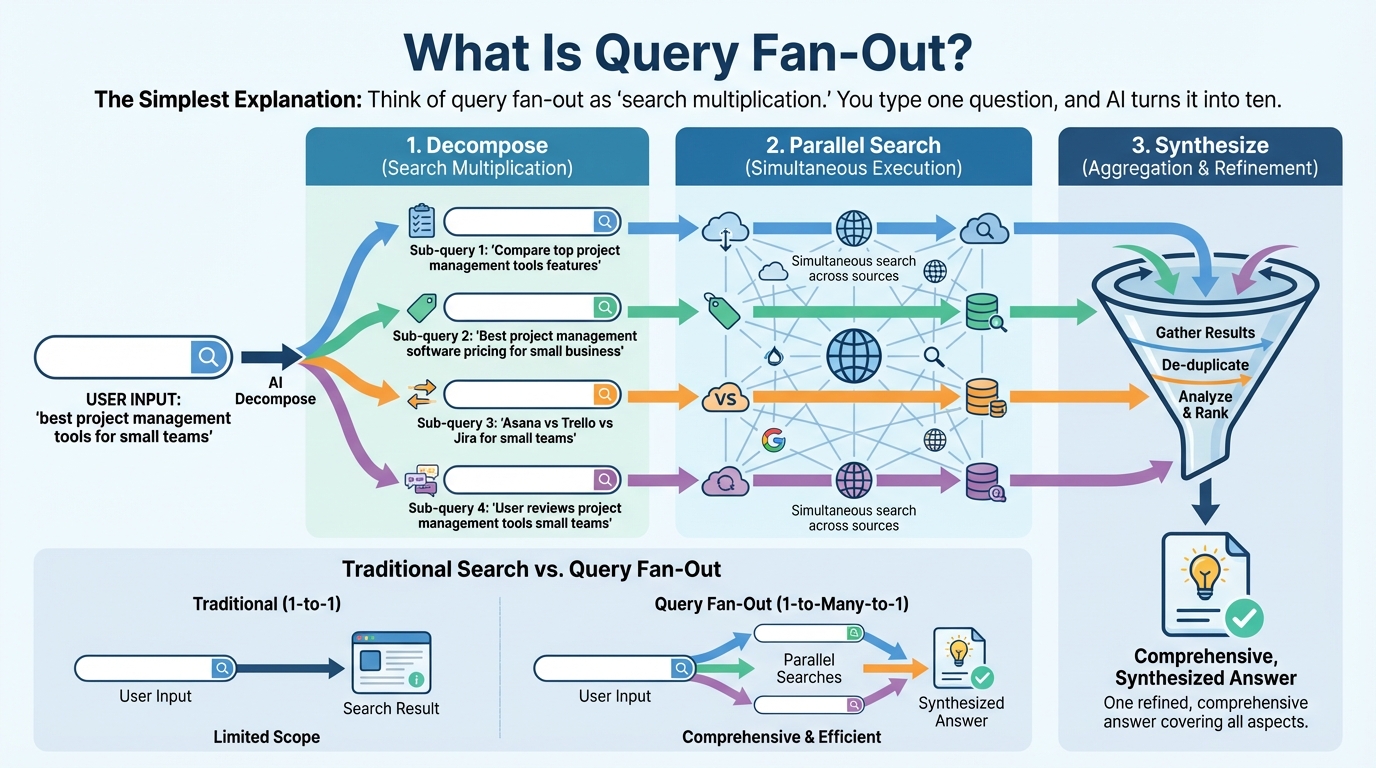
Think of query fan-out as "search multiplication." You type one question, and AI turns it into ten.
Say you search for "best project management tools for remote teams." Traditional search would process that as a single query. With query fan-out, AI breaks it down into parallel sub-queries like:
- "project management tools comparison 2026"
- "remote team collaboration features"
- "project management pricing small business"
- "Asana vs Monday.com vs Notion"
All of these run simultaneously. The results are collected, de-duplicated, and synthesized into one comprehensive answer. That three-step process — decompose, parallel search, synthesize — is query fan-out.
The Technical Name: Scatter-Gather
Inside Google, this is called "Scatter-Gather with Planning." Scatter sends sub-queries to multiple data sources at once. Gather collects and merges the results. What struck me when I looked at the scale: a single AI Mode query generates 8–12 sub-queries, and Deep Search can push that to hundreds.
That means when a user searches once, the system is running 10+ searches behind the scenes. In roughly the same time as a traditional single search.
How Sub-Queries Are Generated
Google uses a custom Gemini 2.5 model to generate sub-queries. It doesn't just split keywords — it expands across multiple dimensions:
| Dimension | What It Does | Example (seed: "startup accounting software") |
|---|---|---|
| Disambiguation | Clarifies ambiguous terms | "cloud vs desktop accounting software" |
| Latent needs | Surfaces unstated questions | "startup tax filing requirements" |
| Detail drilling | Adds specifics | "FreshBooks vs QuickBooks pricing 2026" |
| Synonym expansion | Broadens the search | "small business bookkeeping automation" |
| Intent diversification | Covers different user goals | "accounting software free trial" |
Understanding this framework makes the SEO strategies in Section 4 click into place.
References: Google's Query Fan-Out Technique - Aleyda Solis Query Fan-Out Technique in AI Mode - Search Engine Journal WTF Is Query Fan-Out - Digiday
2. Where Is Query Fan-Out Used?
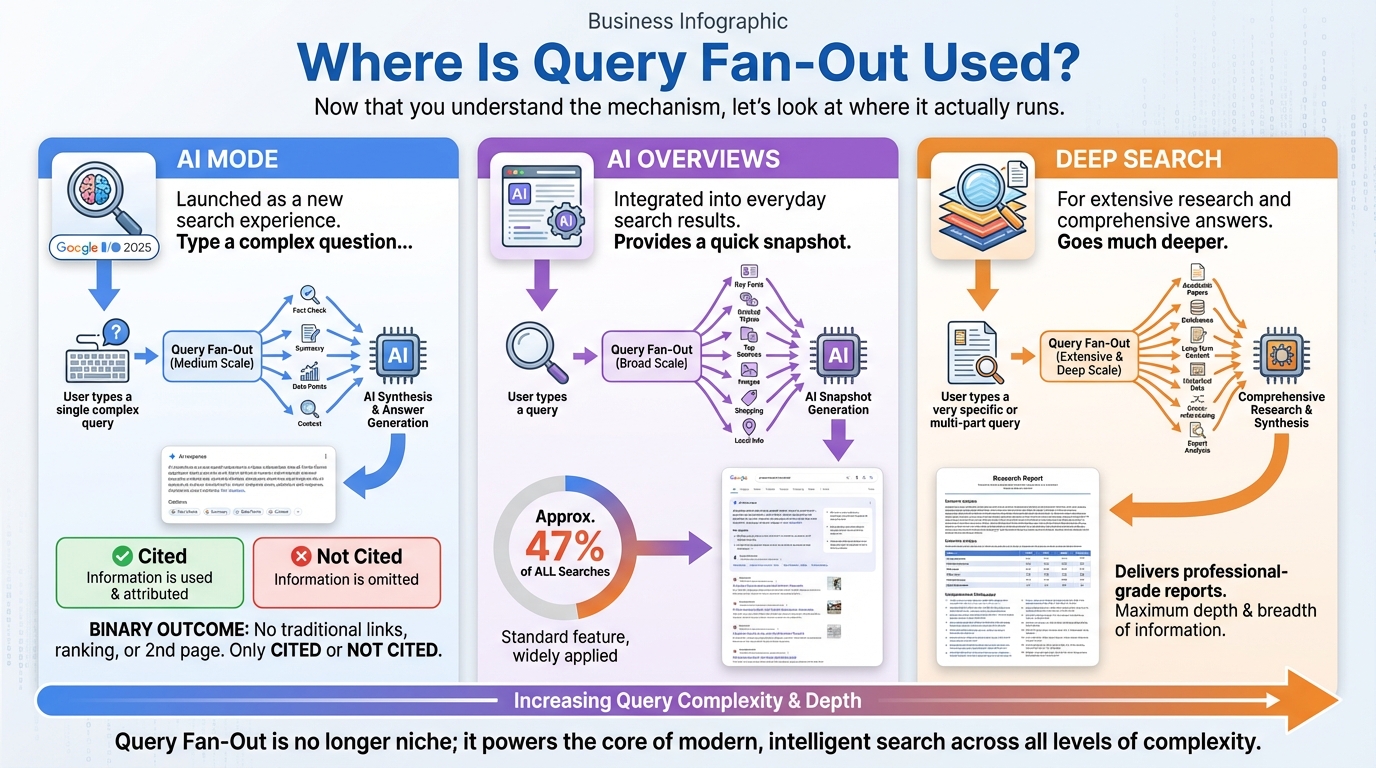
Now that you understand the mechanism, let's look at where it actually runs.
Google AI Mode
AI Mode launched at Google I/O 2025 as a new search experience. Type a complex question, and the system runs query fan-out internally — no "10 blue links." Instead, you get a synthesized, cited answer built from multiple sub-query results.
Here's the thing: AI Mode doesn't show traditional organic results at all. Your content either gets cited or it doesn't. There's no middle ground of "ranking on page 2."
The custom Gemini 2.5 model powering AI Mode was specifically designed for query decomposition and intent interpretation. In my testing, multi-layered questions consistently produce richer, more cited responses than simple keyword queries.
AI Overviews
AI Overviews (formerly SGE) also use query fan-out under the hood. When you see that AI-generated summary at the top of search results, it's pulling from sub-queries across the web, Knowledge Graph, Shopping, News, and other Google data sources.
AI Overviews now appear on roughly 47% of all Google searches. That's nearly half of all searches running some form of query fan-out.
Deep Search
Deep Search takes fan-out to an extreme — generating hundreds of sub-queries for research-grade questions. Think of AI Mode as a quick research assistant and Deep Search as a dedicated analyst producing a cited report.
| Feature | Sub-Queries | Depth | Primary Use |
|---|---|---|---|
| AI Mode | 8–12 | Standard answers | Everyday search |
| AI Overviews | Several to ~12 | Summaries | Top-of-SERP information |
| Deep Search | Hundreds | Expert-level reports | Academic & market research |
For a deeper look at how AI search is reshaping SEO broadly, see "How AI Search Is Reshaping SEO: 7 Actionable Strategies." Query fan-out is the core technology driving those changes.
References: Google AI Mode Announcement - Google Blog Google I/O 2025: AI Impact on SEO - DigiDop Google AI Mode: What SEOs Need to Know - SEO.com
3. The SEO Impact — What's Actually Changing
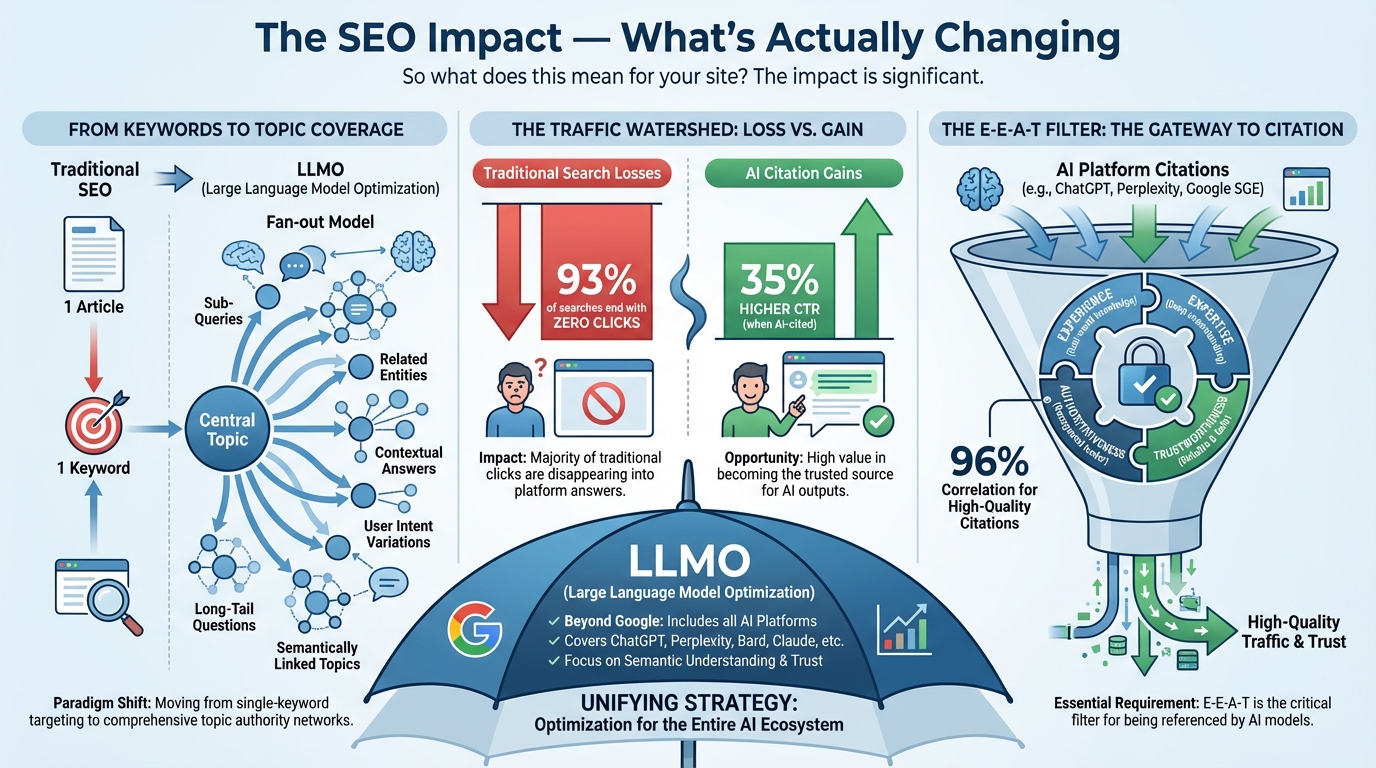
So what does this mean for your site? Let's cut straight to it. The impact is significant.
From Keywords to Topic Coverage
Traditional SEO was built on "one article, one keyword." Want to rank for "query fan-out"? Write an optimized article targeting that exact phrase.
In a fan-out world, AI generates sub-queries and searches across related topics simultaneously. A site that covers "query fan-out," "AI Mode explained," "sub-query SEO strategy," and "topic cluster design" will outperform one that only targets the head term.
The data backs this up. A SurferSEO study of 173,902 URLs found a 0.77 correlation between the number of fan-out queries a page ranks for and its probability of being cited in AI Overviews. That's a strong signal that topic clusters work.
Zero-Click Is Accelerating
The numbers are hard to ignore:
- AI Overviews: organic CTR drops ~61% when displayed
- AI Mode: ~93% of searches end with zero clicks
That 93% figure for AI Mode is striking. Nine out of ten searches, no website visit. The traditional SEO promise of "rank higher, get more traffic" is losing ground.
But here's the flip side: brands cited within AI Overviews see their CTR increase by ~35%. Getting cited puts you in a smaller, more visible pool. The opportunity is real — if you're on the right side of the citation line.
E-E-A-T Matters More Than Ever
When AI generates sub-queries, it selects the most trustworthy sources for each answer. E-E-A-T (Experience, Expertise, Authoritativeness, Trustworthiness) directly influences which content gets cited.
The data is clear: 96% of AI Overview citations carry E-E-A-T signals — author credentials, expert review, primary source attribution. Sites without these signals are effectively invisible to the citation engine, even if their content is useful.
LLMO: The Bigger Picture
LLMO (Large Language Model Optimization) is the umbrella term for optimizing across all AI-driven search and answer platforms — not just Google, but ChatGPT, Perplexity, Claude, and more.
It overlaps heavily with GEO (Generative Engine Optimization), but LLMO extends to AI platforms beyond traditional search. For platform-specific GEO strategies, see the "Complete GEO Guide."
Platforms like LinkSurge let you track which queries trigger AI Overview citations for your site, giving you visibility into how fan-out is affecting your brand.
References: Fan-Out Query Impact Study (173,902 URLs) - SurferSEO The Query Fan-Out Impact - ALM Corp 100+ AI SEO Statistics 2026 - Position Digital LLM SEO Complete Guide - LLMrefs
4. Practical SEO Strategies You Can Start Today
Let's turn insight into action. Everything here is something you can begin this week.
Step 1: Map Your Sub-Queries
Start by predicting what sub-queries AI would generate for your target keywords. Use these eight angles:
- Definition — "what is [topic]"
- Comparison — "[topic] vs [alternative]"
- How-to — "how to [do topic]"
- Pros/cons — "[topic] benefits and drawbacks"
- Examples — "[topic] case studies"
- Tools — "best tools for [topic]"
- Current trends — "[topic] 2026 trends"
- Beginner — "[topic] for beginners"
For "content marketing strategy," that might yield: "content marketing vs SEO," "content marketing tools 2026," "content marketing ROI measurement," "B2B content marketing examples."
LinkSurge and tools like Qforia can show you actual sub-query patterns generated by AI, turning guesswork into data.
Step 2: Build Topic Clusters
Once you've mapped sub-queries, structure them into topic clusters:
- Pillar page: Comprehensive coverage of the main topic
- Cluster pages: Individual articles addressing each sub-query
- Internal links: Connect pillar and cluster pages bidirectionally
Going after individual keywords without a cluster strategy is like entering a marathon with sprint training. You might win a short race, but AI rewards sustained, comprehensive coverage.
Step 3: Optimize Content for AI Citation
Three formatting changes make your content citation-ready:
Use Q&A-style headings. Instead of "Overview of Query Fan-Out," write "What Is Query Fan-Out?" AI matches sub-queries to question headings more easily.
Place Atomic Answers at the start of each section. Write a self-contained answer in 40–60 words right after the heading. This gives AI a ready-to-cite block.
Implement structured data (JSON-LD). Pages with FAQ schema are 60% more likely to be featured in AI answers. Mark up your Q&A content with FAQPage schema so AI can extract it structurally.
For technical implementation details on structured data and GEO optimization, see the "Complete GEO Guide."
Step 4: Strengthen E-E-A-T Signals
- Author attribution — Name, title, expertise area, link to author page
- Primary sources — Original research, first-hand data, specific numbers
- Citations — Link to sources within the body text
- Freshness signals — Display last-updated dates prominently
References: How to Use Query Fan-Out for SEO - SUSO Digital Google AI Overviews Ranking Factors - Wellows Optimize Content for AI Mode - Writesonic

LinkSurge
linksurge.jp
SEO・AIO・GEO統合分析プラットフォーム。AI Overviews分析、SEO順位計測、GEO引用最適化など、生成AI時代のブランド露出を最大化するための分析ツールを提供しています。
5. How Other AI Platforms Compare
Query fan-out is Google's term, but similar approaches exist across the AI search space.
- Google (AI Mode / Gemini) — Scatter-Gather with custom Gemini 2.5. Largest parallel search scale, integrated with Knowledge Graph, Shopping, Maps. Deep Search pushes to hundreds of sub-queries
- Microsoft Bing (Copilot) — Uses "Multi-Query Retrieval" for sub-query generation. Primarily text-focused, with limited image search integration
- Perplexity AI — RAG-based approach combining external search results. Smaller scale than Google, but highly transparent in source attribution
- Anthropic Claude — Sequential "Self-Ask with Search" approach. Lower parallelism than Google, but strong on answer accuracy and citation quality
What sets Google apart is scale and infrastructure integration — searching the live web, Knowledge Graph, Shopping database, and Maps simultaneously. No other platform can match that breadth.
That said, the optimization fundamentals — topic coverage, structured data, E-E-A-T — apply across all platforms. For platform-by-platform strategies, see "Complete GEO Guide." And for off-site tactics like link building and brand mentions in the AI era, check out "Off-Site SEO and GEO Strategy Guide."
References: How AI Search Platforms Expand Queries - iPullRank Query Fan-Out Original Research - Ekamoira
6. Limitations and Risks
No technology is without trade-offs. Here's what to watch for.
Hallucination Risk
When AI synthesizes information from multiple sub-queries, it can generate claims without proper evidence. This is especially dangerous in YMYL (Your Money, Your Life) areas like health and finance. As a content creator, providing clear primary sources makes it easier for AI to cite accurate information rather than hallucinate.
Latency
Running dozens or hundreds of parallel searches takes time. Deep Search can take several minutes to generate a response. There's a real trade-off between response speed and answer depth.
Traffic Decline from Zero-Click
With 93% of AI Mode searches ending without a click, ad-revenue-dependent publishers face a genuine revenue challenge. Getting cited has value — but direct traffic is declining, and that trend is unlikely to reverse.
Privacy Considerations
Complex queries broken into multiple sub-queries mean sensitive information gets sent to multiple data sources. Users should be cautious with queries containing personal or confidential information.
References: About AI Overviews - Google Help Google AI Overviews Impact on Publishers - Search Engine Journal
Frequently Asked Questions
How is query fan-out different from regular search?
Traditional search processes your keywords as a single query. Query fan-out uses AI to decompose that one query into 8–12 sub-queries, runs them in parallel across multiple data sources, and synthesizes the results into one comprehensive answer. The key difference: one search from the user triggers 10+ searches behind the scenes.
Do I need to rebuild my website for query fan-out?
No major overhaul is needed. Start by converting existing headings to Q&A format and adding Atomic Answers (40–60 word answer blocks) at the beginning of each section. FAQ schema and topic cluster design can be implemented incrementally.
Does query fan-out only apply to Google?
The term "query fan-out" is Google's, but similar sub-query decomposition exists in Perplexity AI, Microsoft Copilot, and Anthropic Claude. The optimization fundamentals — topic coverage, structured data, and E-E-A-T — are effective across all platforms.
Can small sites benefit from fan-out optimization?
Absolutely. AI evaluates topical depth and authority, not site size. Niche sites with genuine first-hand expertise on a specific topic can outperform large generalist publishers in AI citations. Focus your cluster strategy on topics where you have real expertise.
What KPIs should I track for query fan-out?
Beyond traditional keyword rankings and organic CTR, track Citation Rate — the percentage of AI-generated answers that include your URL. Tools like LinkSurge and Google Search Console's AI Overview data help you measure this new metric.
Conclusion: Start Building for the Fan-Out Era
Query fan-out is the invisible engine running behind every AI-powered Google search. Each time a user types a question, AI breaks it apart, searches across dozens of angles simultaneously, and assembles the best answer. Understanding this changes how you think about SEO.
The priority is straightforward. Map your sub-queries first. Build topic clusters around them. Structure each piece of content with Q&A headings and Atomic Answers. Implement structured data. Strengthen your E-E-A-T signals. You don't need to do everything at once — start with your highest-value topics and expand from there. For a beginner-friendly overview of the latest SEO strategies including fan-out optimization, see "SEO in 2026: A Beginner's Guide."
LinkSurge's AI Overview analysis lets you see which sub-queries are citing your content in real time. That's the natural starting point for measuring your fan-out readiness.