Safe Link Building in 2026: 5 White-Hat Strategies to Earn Backlinks Without Penalties
目次
Key Takeaways: 5 Safe Link Building Strategies for 2026
"I know backlinks matter, but I'm terrified of getting penalized." This is, honestly, the most common concern I hear when consulting on SEO strategy. In 2026, link buying and PBNs are detected with alarming accuracy by SpamBrain, but earning backlinks through legitimate methods remains one of the most effective SEO strategies available.
- Digital PR produces the highest-quality links — Provide newsworthy original data or stories to media outlets and earn editorial links. Expect DR 50–85+ placements, with ROI estimates of 250–625% according to agency case studies
- HARO and journalist matching deliver high-DR links at low cost — Respond to journalist queries as a subject-matter expert to earn DR 60–85 backlinks. Placement rates run 5–15%, so speed and quality are critical
- Original research becomes a compounding link asset — Data-driven reports and infographics continue earning citations for years. One case study reports 22 backlinks, 3 interview requests, and 156% branded search growth from a single report
- Resource page and broken-link outreach is highly repeatable — Find existing resource pages or broken links and propose your content as a replacement. Low-cost with predictable results
- Never rely on a single tactic. Diversification is the rule — No single method should account for more than 30–40% of your link profile. This is what Google recognizes as a natural backlink pattern
Here's the thing: each of these strategies has specific playbooks, costs, and timelines. Let's break them down.
1. Link Building in 2026: Why "Earning" Is the Only Sustainable Path
Google has consistently valued naturally earned editorial links above all else. Their SEO link best practices documentation specifies that crawlable <a href> links serve as search signals, while their spam policies explicitly prohibit link buying, PBNs, and large-scale guest posting campaigns.
What struck me when reviewing the latest industry data is how definitively the economics have shifted. SpamBrain analyzes link patterns, content similarity, and hosting infrastructure across entire networks, issuing bulk penalties. Even if purchased links temporarily boost rankings, the traffic lost during a penalty—and the months needed for recovery—make it a losing proposition.
Satellite Site SEO Is Dead: The Reality of Google Penalties and Safe Link Building covers why PBNs and satellite sites get detected. This article focuses on what you should be doing instead.
What makes link building "safe"?
Safe link building always starts with creating a genuine reason for third parties to link to you voluntarily. That means newsworthy content, proprietary data, expert knowledge, or practical tools—assets that provide real value to the linking site's audience. The five strategies below all satisfy this principle.
References: SEO Link Best Practices for Google - Google Search Central Why Use Digital PR For Link Building - BuzzStream 15 White Hat Link Building Tactics That Google Loves - BuzzStream
2. Digital PR: The Gold Standard for High-Quality Backlinks
Digital PR involves providing newsworthy content—original data, survey results, trend analyses—to media outlets in exchange for editorial coverage and links. Among link building experts, it's consistently rated as the method that produces the highest-quality backlinks.
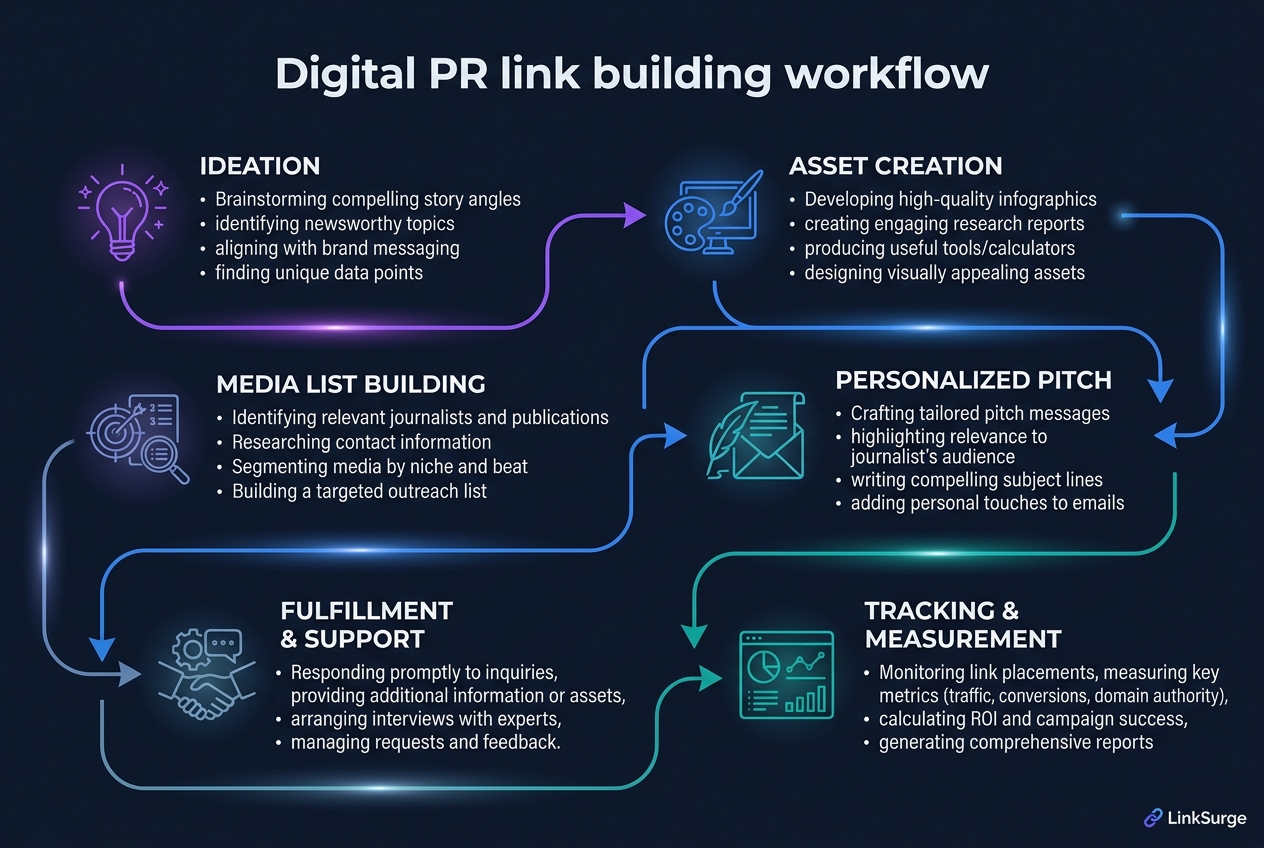
The 6-Step Digital PR Playbook
Step 1: Ideation — Monitor industry trends and analyze competitor backlinks to identify uncovered news angles. Think like a journalist: "What story would I want to write?"
Step 2: Asset creation — Build a clear headline, executive summary, visuals (charts and infographics), and a press-ready kit. Evergreen assets continue earning links long after launch.
Step 3: Media list building — Assemble a Dream-100 list of journalists and outlets. Vet targets for editorial quality, DR/traffic metrics, and audience relevance.
Step 4: Personalized pitch — A 1–2 sentence hook + 1 line of credentials. Keep emails under 150 words. Include 1–2 follow-ups spaced 48–72 hours apart.
Step 5: Fulfillment — Respond quickly to journalist follow-ups with on-record quotes, data tables, and embed codes for charts to maximize link inclusion.
Step 6: Measurement — Track placements (dofollow vs. nofollow), referral traffic, and organic ranking movements.
Cost and ROI
Digital PR isn't cheap. Per-link costs typically range from $750–$1,500+, with agency retainers running $3,000–$15,000+ per month. However, one analysis estimates that a $60K/year digital PR investment can acquire 40–80 high-authority backlinks, increase traffic by 60–150%, and deliver ROI of 250–625%.
LinkSurge's backlink analysis tools can help you visualize which media outlets your competitors are earning links from, giving you a head start on targeting.
References: Digital PR vs Link Building: ROI & Hybrid Strategies - Casey's SEO 10 Essential Digital PR Strategies for 2025 - Press Ranger Link Building Stats 2025: 50+ Data Points - RockingWeb
3. HARO and Journalist Matching: Turn Expertise Into Links
Even without original data, your expertise itself is a link-earning asset. Platforms like HARO (Help A Reporter Out) and Qwoted connect journalists seeking expert commentary with subject-matter specialists willing to be quoted.
HARO Tactics That Work
Speed is everything — Respond within 0–4 hours of a query going live. I've found that a one-day delay usually means the journalist has already received enough responses.
Response template — Keep it to 100–200 words: ①Full name, title, company, ②One-sentence credential ("10+ years in X"), ③Direct answer to the query with a specific example or stat, ④Contact info.
Realistic expectations — Placement rates run 5–15%. Expect 0–3 backlinks per month. But when you do get placed, the quality is outstanding—DR 60–85 is typical.
Platform Landscape in 2026
HARO has undergone brand transitions (Connectively and back). Alternative platforms like Qwoted and MentionMatch offer different mixes of opportunities. The best approach is to monitor multiple platforms and respond selectively to high-relevance queries.
References: HARO Link Building Playbook - uSERP HARO Link Building: A 6-Step Shortcut - LinkDoctor HARO Link Building in 2026: Worth It or Outdated? - Editorial.Link 5 Best HARO Alternatives in 2026 - Backlinko
4. Original Research and Linkable Assets: Build Once, Earn Forever
A linkable asset is any content that other sites consider worth citing and linking to. Here's the thing: once created, these assets generate backlinks on autopilot—a compounding return that no other tactic can match.
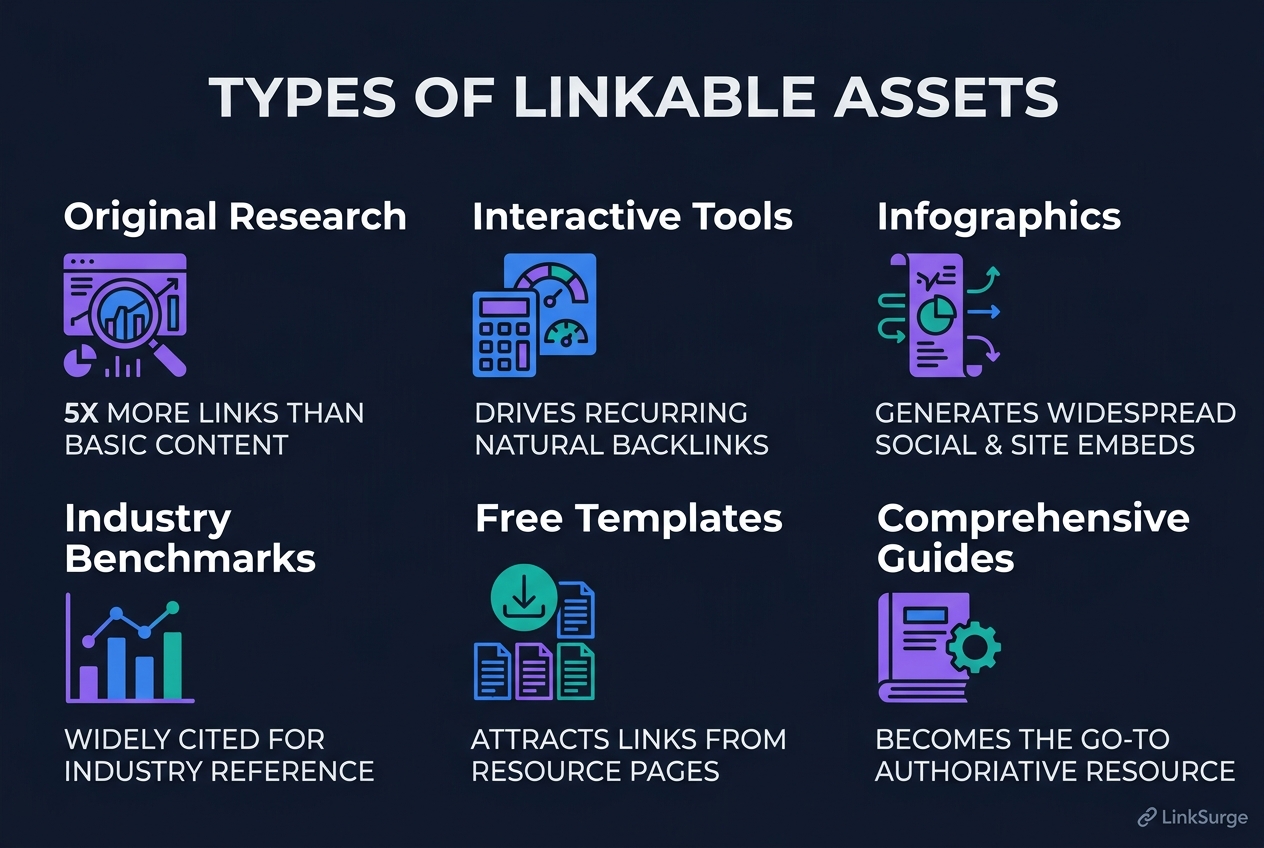
6 Types of Effective Linkable Assets
Original research reports — Surveys of 300–500+ respondents or proprietary data analysis. One case study shows a single industry report generating 22 backlinks, 3 interview requests, and 156% branded search growth.
Interactive tools — Calculators, diagnostic tools, free checkers. Tools that people use repeatedly and share naturally earn links without outreach.
Infographics — Complex data presented visually. Provide embed codes so bloggers can share them with attribution links.
Industry benchmarks — "Average conversion rate in X industry" data. Update annually for evergreen citation value.
Free templates and checklists — High-utility downloads that generate links through practical value.
Comprehensive guides — Aim to be the most thorough resource on a topic. The Complete SEO Guide is an example of a guide-format asset that earns ongoing citations as an industry reference.
From Creation to Distribution
- Define research questions and ensure statistically significant sample sizes
- Collect data, create visuals (charts, PDFs, embeddable formats)
- Offer journalists exclusive angles or embargo windows
- Publish on your site with strategic internal linking
- Amplify through social media and targeted outreach
LinkSurge
linksurge.jp
SEO・AIO・GEO統合分析プラットフォーム。AI Overviews分析、SEO順位計測、GEO引用最適化など、生成AI時代のブランド露出を最大化するための分析ツールを提供しています。
References: How To Build Linkable Assets With AI In 2026 - Search Logistics Linkable Assets: A Guide to Building Powerful Backlinks - SeoProfy Link Building Strategies 2025 - Digital Applied
5. Cost and ROI: The Real Numbers Behind Link Building
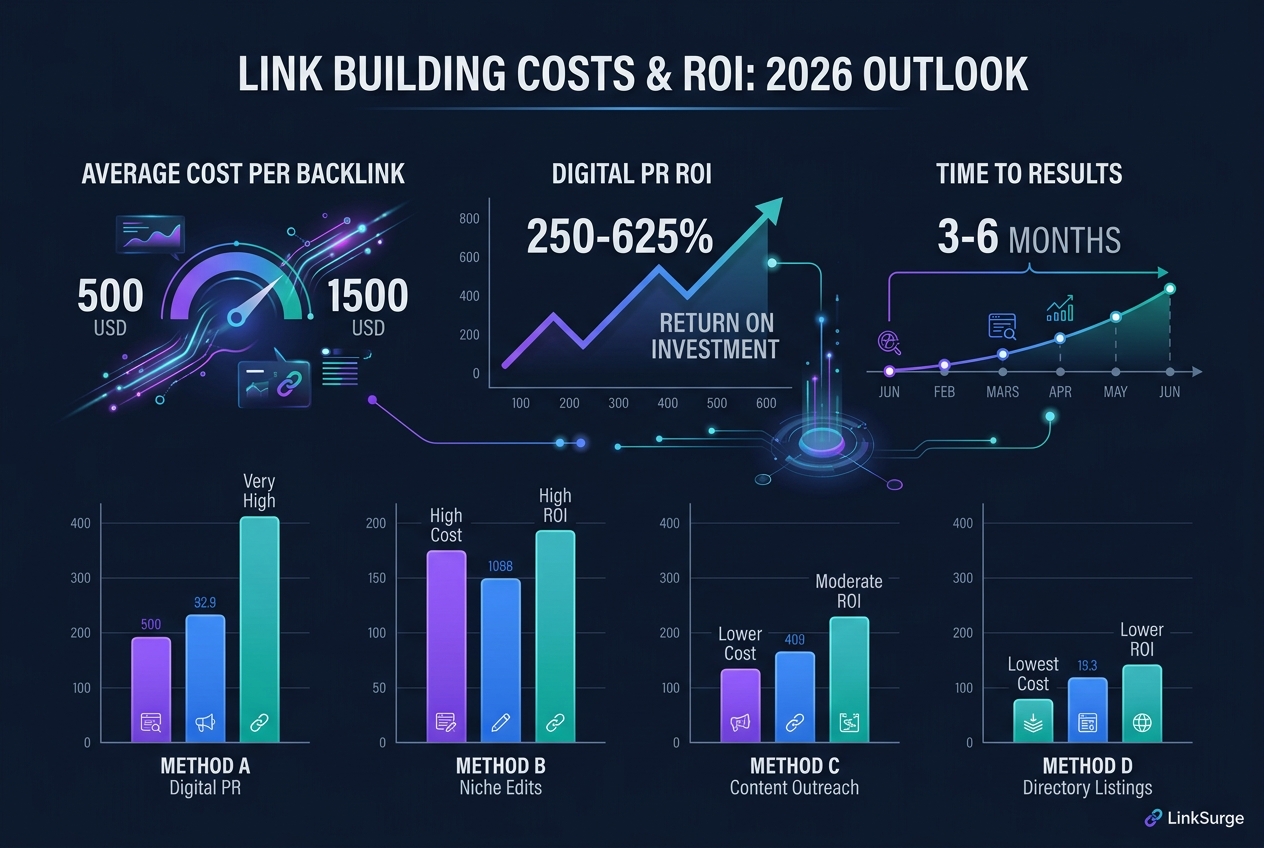
"How much does link building cost?" is the question I get asked most frequently. Here's an honest breakdown by tactic.
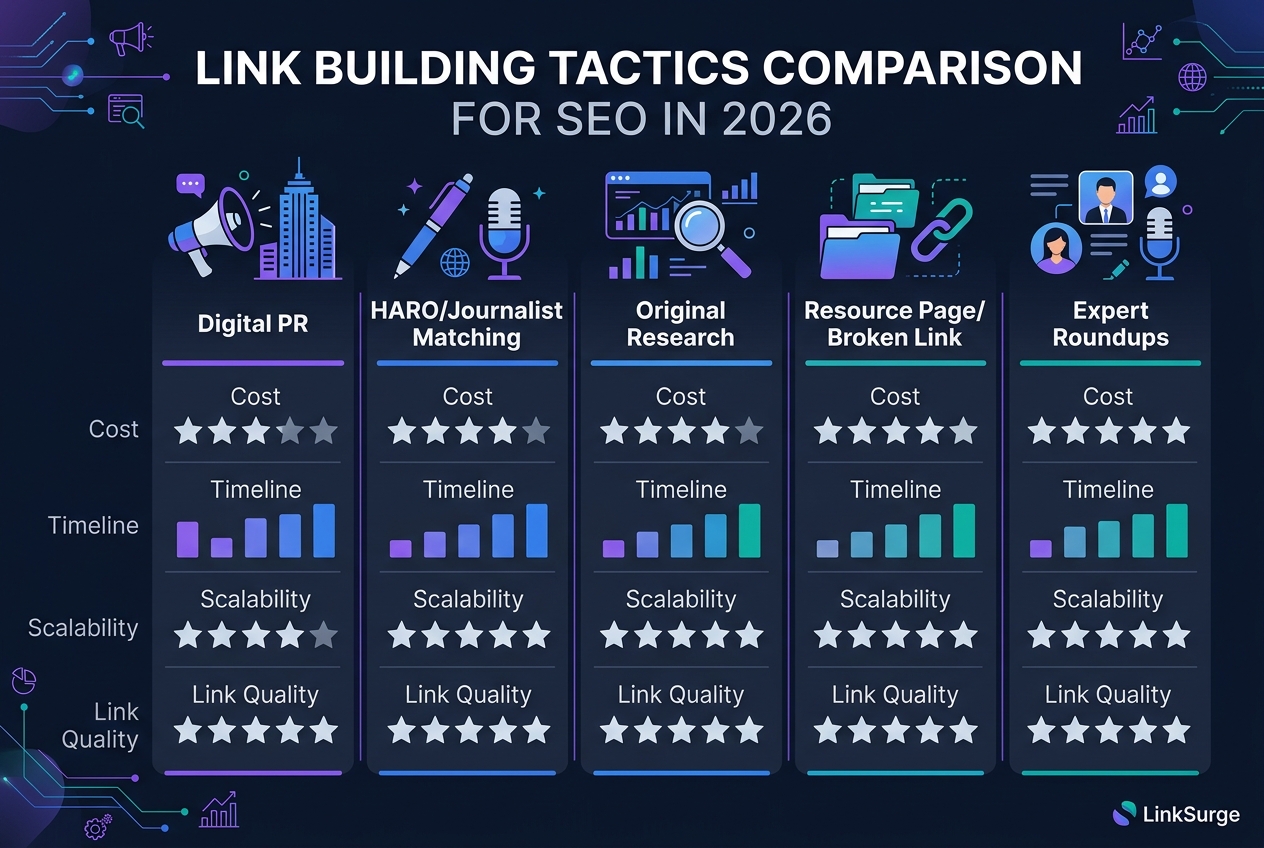
Cost, Timeline, and Expected Links by Tactic
| Tactic | Cost Per Link | Monthly Links | Time to Results | Link Quality (DR) |
|---|---|---|---|---|
| Digital PR | $750–$1,500+ | 3–7 | 3–12 months | DR 50–85+ |
| HARO/Journalist matching | $50–$200 (labor) | 0–3 | Immediate–3 months | DR 60–85 |
| Original research | $500–$2,000+ | Ongoing after launch | 3–12 months | DR 30–70+ |
| Resource/broken-link | $200–$500 | 2–5 | Weeks–months | DR 20–60 |
| Expert roundups | $100–$300 | 1–3 | 2–8 weeks | DR 20–50 |
Understanding Link Building ROI
To accurately measure ROI, compare cost-per-link against the lifetime organic traffic value each link generates. According to BuzzStream's research, a high-quality backlink costs $508–$1,000+ on average—but a single DR 50+ link can drive thousands to tens of thousands of dollars in organic traffic value annually.
Recommended Budget Allocation by Company Size
Small/local businesses — Focus on HARO responses, expert quotes, resource page and broken-link outreach. Expect 0–3 links/month with measurable results in 3–6 months.
Mid-market companies — Run periodic original research alongside digital PR and resource outreach. Target several quality links per month with consistent ROI within 3–6 months.
Enterprise — Multi-asset strategy + full digital PR campaigns + dedicated teams. Expect significant authority growth and traffic lifts over 6–24 months.
References: The True Cost of Link Building in 2025 - ReportCard Link Building Costs in 2025: Real Prices & ROI - SearchBerg 70 Link Building Statistics - BuzzStream
6. What to Avoid: The Link Building Risk Spectrum
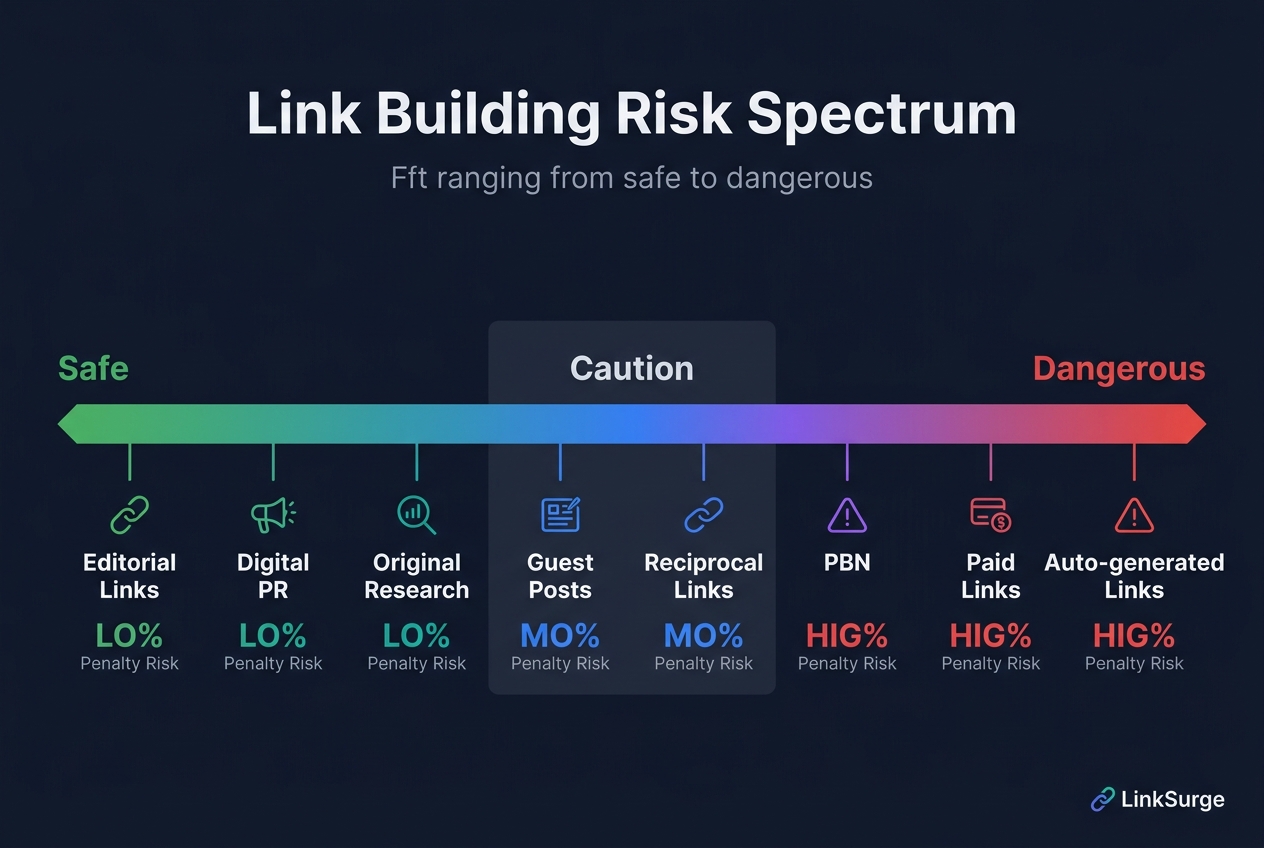
Understanding the risk spectrum is essential for making informed decisions about which tactics to use—and which to avoid entirely.
Safe (Green)
- Editorial links — Earned through journalist editorial judgment. Highest value
- Digital PR — Based on newsworthy content. Google-endorsed approach
- Original research and data — Natural citation motivation exists
Caution (Yellow)
- Guest posting — Small-scale, high-quality contributions are fine. Large-scale guest posting campaigns are explicitly defined as a link scheme by Google
- Reciprocal links — A few natural reciprocal links are normal. Organized link exchanges violate guidelines
Dangerous (Red)
- PBNs (Private Blog Networks) — Detected with high accuracy by SpamBrain. Entire networks risk deindexation
- Link purchasing — Clear Google guideline violation. Subject to manual penalties
- Auto-generated links — Comment spam, forum spam, etc. Detected and devalued immediately
The Diversification Principle
No single tactic should exceed 30–40% of your total link acquisition. Even safe methods, when overly concentrated, can create unnatural link profile signals.
The Complete Guide to Off-Site SEO and GEO covers link building within the broader context of off-site SEO strategy.
References: Why Google Penalises Certain Link Building Patterns - Hashmeta White Label Link Building for Agencies: 2025-2026 - ALM Corp
LinkSurge
linksurge.jp
SEO・AIO・GEO統合分析プラットフォーム。AI Overviews分析、SEO順位計測、GEO引用最適化など、生成AI時代のブランド露出を最大化するための分析ツールを提供しています。
Frequently Asked Questions
Is link building still effective for SEO in 2026?
Yes. Backlinks remain one of Google's primary ranking factors. However, the emphasis has shifted decisively toward quality over quantity. A single link from a DR 50+ authoritative site is worth more than 100 links from low-quality domains.
Are there free link building methods?
HARO (free plan) responses, resource page outreach, and broken-link proposals cost essentially nothing beyond time. These are the most cost-effective starting points for small businesses.
Is guest posting still viable?
Small-scale, high-quality guest contributions remain effective. However, Google explicitly defines "large-scale guest posting campaigns" as a link scheme. The litmus test: "Would I contribute to this publication even without the link?"
How long does it take to see results from link building?
HARO can produce results in days to weeks. Digital PR typically shows initial results in 3–6 months. Significant organic traffic growth usually appears after 6–12 months. LinkSurge's rank tracking lets you monitor ranking changes in real-time after acquiring new backlinks.
Do nofollow links have any value?
They don't pass PageRank directly, but they contribute to brand awareness, referral traffic, and E-E-A-T (Experience, Expertise, Authoritativeness, Trustworthiness) signals. High-authority nofollow links should not be dismissed.
Conclusion: Stop Buying Links. Start Earning Them.
Link building in 2026 is fundamentally a competition to create reasons for others to link to you voluntarily. Earn media coverage through digital PR, convert expertise into links through HARO, build compounding research assets, and steadily accumulate links through resource page and broken-link outreach.
These strategies take time, but they carry zero penalty risk and maximize the compound effect of SEO investment. Start by inventorying your strengths: proprietary data points to original research, domain expertise points to HARO, and newsworthy activity points to digital PR.
Use LinkSurge's backlink analysis tools to visualize your current backlink profile alongside your competitors'. Understanding where you stand is the first step toward building a link acquisition strategy that delivers sustainable results.