Satellite Sites & PBNs Are Dead: Google Penalties, SpamBrain Detection, and Safe Link Building in 2026
目次
Key Takeaways: 5 Risks and Realities of Satellite Site SEO
"Build a network of sites, point links at your main domain, and watch the rankings climb." That playbook had a good run — but in 2026, it's a fast track to a Google penalty. After analyzing hundreds of backlink profiles across client sites, I've seen the same pattern repeat: PBN-reliant sites lose their rankings overnight when SpamBrain catches up. Here are the five things you need to know.
- Self-built satellite sites for link manipulation violate Google's spam policies — Google explicitly defines "creating multiple sites with cross-linking for the purpose of manipulating PageRank" as link spam. The policies leave no room for interpretation
- SpamBrain's detection accuracy took a leap in 2022 and keeps improving — Google's AI-based spam detection system now cross-references link patterns, content similarity, and hosting infrastructure to identify entire PBN networks in a single sweep
- Penalties hit entire networks, not just individual sites — When Google identifies a PBN, the penalty can extend to every site in the network plus the money site. Recovery takes 3–12 months in most cases
- Legitimate multi-site operations are fine — if you know the line — Regional sites, brand-specific domains, and independently-edited media properties are perfectly acceptable. The test is simple: would the site exist without the SEO benefit?
- The 2026 playbook is "earn" links, not "build" them — Original research, digital PR, expert contributions, and linkable assets deliver sustainable results without penalty risk
The rest of this article breaks down each of these points with evidence, examples, and actionable alternatives.
1. What Google's Spam Policies Actually Say About Link Networks
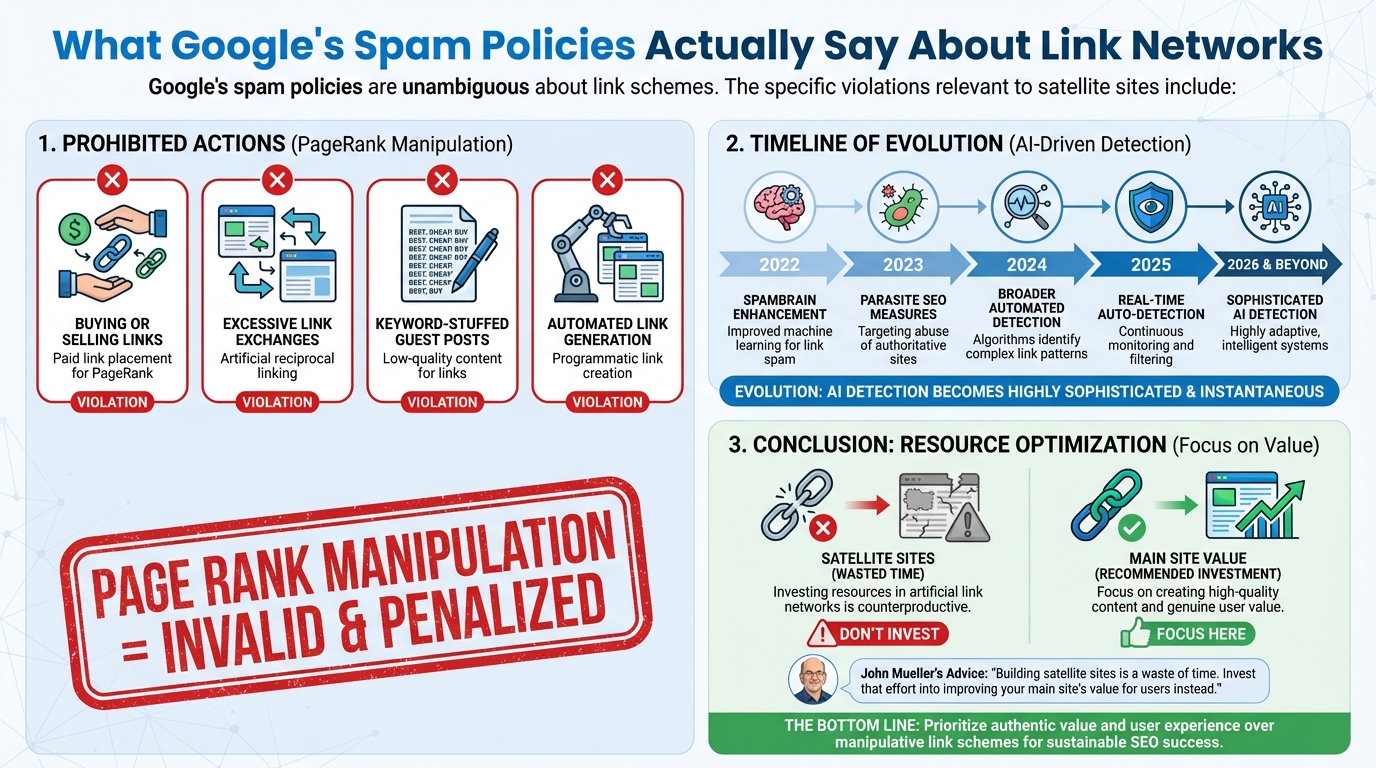
Google's spam policies are unambiguous about link schemes. The specific violations relevant to satellite sites include:
- "Buying or selling links that pass PageRank"
- "Excessive link exchanges or partner pages exclusively for the sake of cross-linking"
- "Large-scale article marketing or guest posting campaigns with keyword-rich anchor text links"
- "Using automated programs or services to create links to your site"
In short: any site network whose primary purpose is passing link equity is a violation, regardless of how sophisticated the execution.
Google's John Mueller has been equally direct in public statements, calling SEO-purpose satellite sites "a waste of time" in multiple Webmaster Hangout sessions. His consistent advice: invest those resources in making the main site better.
The Link Spam Update Timeline
Google's enforcement has accelerated year over year.
- December 2022: Link spam update launched. SpamBrain expanded to detect both link-selling and link-buying sites
- March 2024: Core update combined with spam update. Added site reputation abuse ("Parasite SEO") as a penalty target
- 2025–2026: Continuous SpamBrain improvements. Network-level detection now operates automatically without manual review in most cases
References: Google Search Spam Policies - Google Search Central December 2022 Link Spam Update - Google Search Central Blog What are Backlinks? And How to Build Them - Backlinko
2. How SpamBrain Detects PBNs
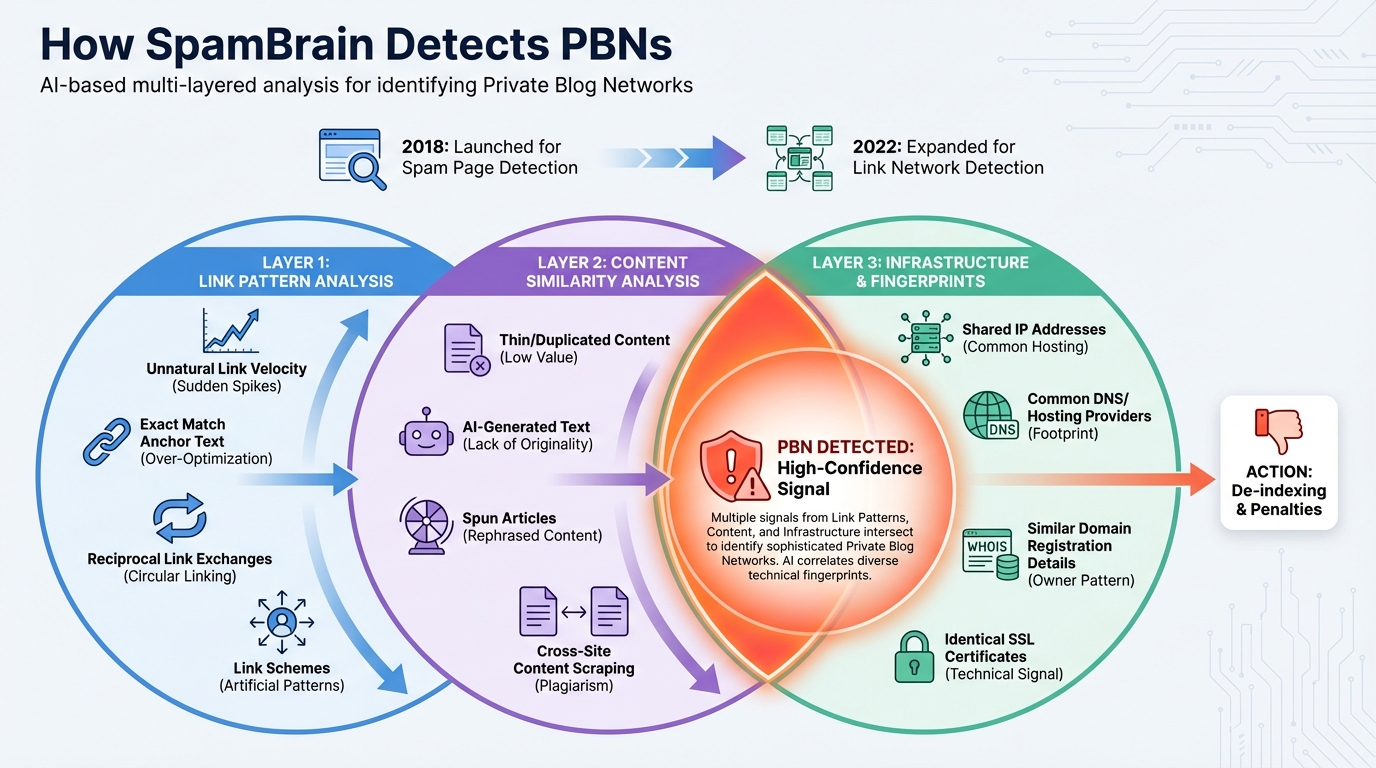
SpamBrain launched in 2018 as Google's AI-based spam detection system. Initially focused on identifying spam pages, it was significantly expanded in 2022 to detect link networks. Here's how it works in practice.
Three Detection Layers
Link pattern analysis — SpamBrain identifies unnatural link structures. A fresh domain that only links to one specific site from day one raises immediate flags. Sudden spikes in link velocity — going from zero to hundreds of referring domains in weeks — are equally suspicious.
Content similarity analysis — PBN sites tend to share templated designs and thin, AI-generated content. SpamBrain compares content across domains to identify mass-production patterns, even when surface-level details differ.
Infrastructure analysis — Same IP range, same hosting provider, similar DNS configurations, overlapping WHOIS records. Even when PBN operators use different registrars and hosts, technical fingerprints create patterns that machine learning can detect.
"They'll Never Find Mine" Is Wishful Thinking
PBN operators have traditionally relied on IP diversification and CMS variation to avoid detection. But SpamBrain doesn't rely on any single signal. It combines all three layers using machine learning models trained on millions of confirmed spam examples.
Google's 2024 Webspam Report noted that automated spam actions increased by over 60% year-over-year. The system identifies networks before human reviewers even look at them.
You can use LinkSurge's SEO analysis features to audit your own backlink profile for unnatural patterns. Visualizing domain diversity and link velocity trends helps catch PBN-related risks before Google does.
References: How Google Fights Spam – Web Spam Report 2024 - Google Google SpamBrain: What SEOs Should Know - Search Engine Journal Are Private Blog Networks Safe? - Ahrefs
3. Penalty Types and Their Real-World Impact
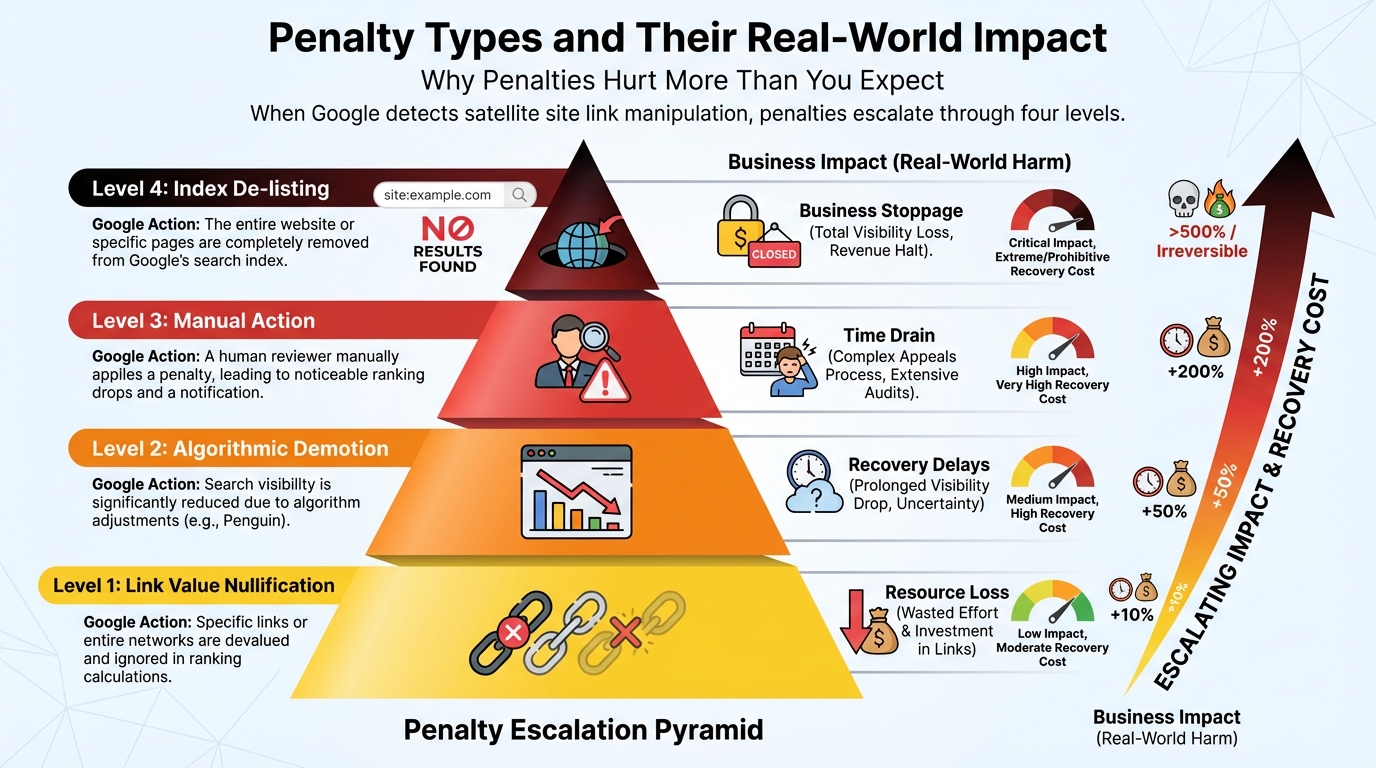
Why Penalties Hurt More Than You Expect
When Google detects satellite site link manipulation, penalties escalate through four levels.
Link value nullification (lightest) — Google recognizes the spam links and zeros out their ranking contribution. No direct penalty to the main site, but every dollar and hour spent on the PBN is wasted.
Algorithmic demotion — No notification in Search Console, but ranking drops are steep. Because there's no explicit message, site owners often misdiagnose the problem, delaying recovery.
Manual action — A "Manual Actions" notification appears in Google Search Console, typically reading "Unnatural links to your site." This requires link disavowal and a reconsideration request. The review process alone takes 2–6 weeks.
Complete de-indexing (most severe) — The entire network plus the money site gets removed from Google's index. This is essentially a death sentence for organic traffic.
Recovery Timeline
Recovering from a manual action follows a predictable but slow process.
- Full audit of problematic links (1–2 weeks)
- Disavow file creation and submission
- Shutdown or noindex of satellite sites
- Reconsideration request submission
- Google review period (2–6 weeks)
- If rejected: additional cleanup and re-submission
End to end, 3–12 months is typical. During that period, organic traffic drops to near zero. For businesses that depend on search traffic, that's an existential threat.
References: Manual Actions Report - Google Search Central Disavow Links to Your Site - Google Search Central How to Recover from a Google Penalty - Moz
4. Legitimate Multi-Site Operations vs PBNs — Where's the Line?
"Satellite site" isn't inherently negative. The issue is purpose and execution.
Acceptable Multi-Site Setups
These configurations don't violate Google's guidelines.
- Regional sites: A company with offices in New York, London, and Tokyo operates separate sites for each market with localized content and services
- Brand-specific sites: A consumer goods company runs separate domains for distinct product lines, each with unique content and audiences
- Owned media properties: An independently-edited industry blog that publishes original research and analysis, with its own editorial standards separate from the corporate site
Red Flags That Indicate a PBN
Sites with these characteristics will likely be flagged.
- Thin or duplicate content across the network
- Most articles contain links pointing to the money site
- No genuine readership or community engagement
- Irregular publishing schedule — new posts only appear when links are needed
- Templated designs shared across multiple sites in the network
The One Question That Matters
Here's the litmus test I use with every client.
"If this site generated zero SEO benefit, would you still operate it?"
If the answer is yes, you're running a legitimate multi-site business. If no, you're running a PBN by another name.
For the right approach to building brand presence across the web, see "91% of AI Answers Come from Sites That Aren't Yours — Off-Site SEO in the AI Era."
References: Are PBN Links Effective for SEO? - Semrush Private Blog Networks Explained - Ahrefs Google's John Mueller on Satellite Sites - Search Engine Roundtable
LinkSurge
linksurge.jp
SEO・AIO・GEO統合分析プラットフォーム。AI Overviews分析、SEO順位計測、GEO引用最適化など、生成AI時代のブランド露出を最大化するための分析ツールを提供しています。
5. Five Safe Backlink Strategies That Actually Work
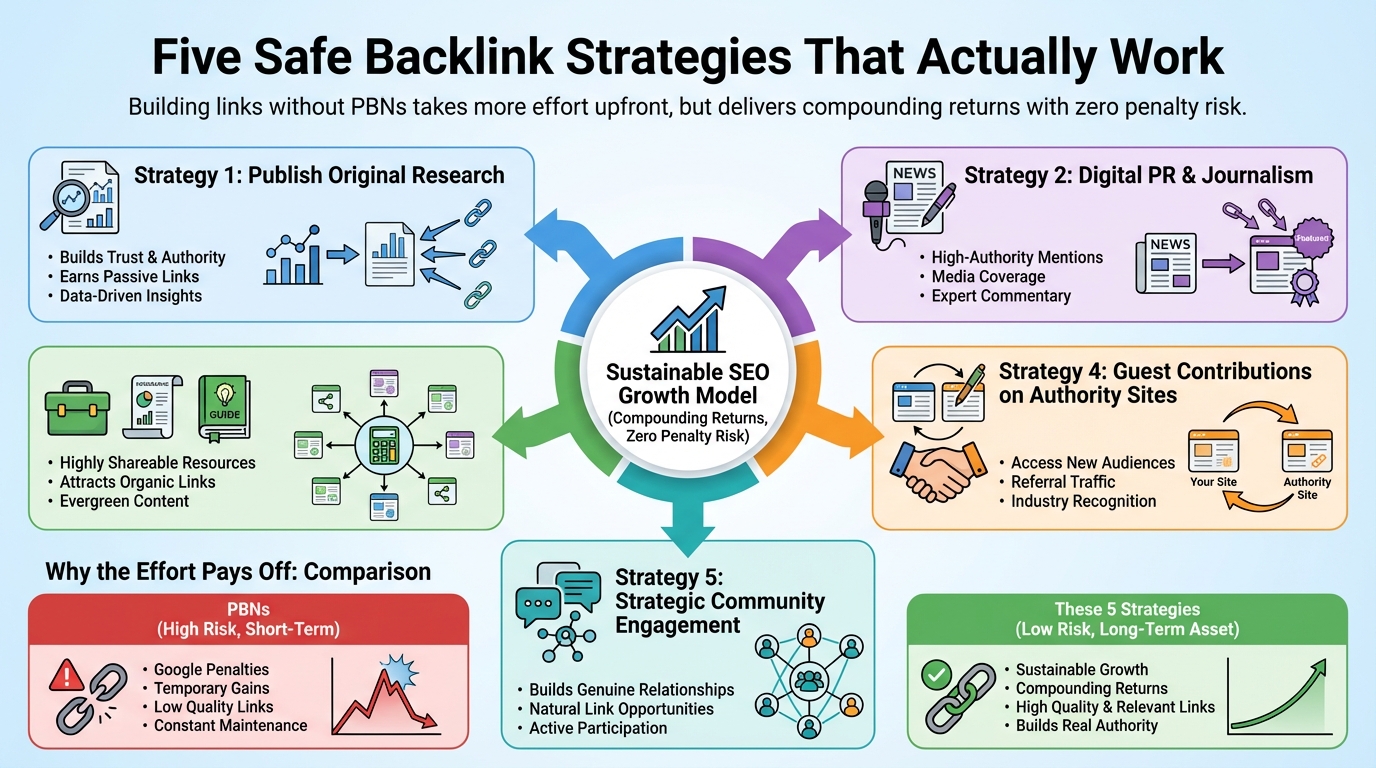
Building links without PBNs takes more effort upfront, but delivers compounding returns with zero penalty risk.
Strategy 1: Publish Original Research
Industry surveys, benchmark reports, and proprietary data attract natural links from news sites, analysts, and industry blogs. Content like "State of [Industry] 2026" or "Survey: 1,000 [Professionals] on [Topic]" gives journalists something concrete to cite.
Strategy 2: Digital PR
Go beyond press releases. Build direct relationships with journalists and industry voices. Platforms like Connectively (formerly HARO) and Qwoted connect experts with reporters looking for sources. A single expert quote in a major publication can generate dozens of follow-on links.
Strategy 3: Create Linkable Assets
Free tools, calculators, interactive data visualizations, and comprehensive databases give other sites a reason to link. Think: "Free Core Web Vitals Checker" for an SEO company, or "Mortgage Calculator" for a real estate firm. These assets earn links passively over time.
Strategy 4: Contribute to Authoritative Publications
Guest articles for respected industry sites are fundamentally different from PBN posts. Real bylined contributions go through editorial review, demonstrate expertise, and strengthen E-E-A-T signals. The key distinction: low-quality "guest post farms" that accept anything are just PBNs with better marketing.
Strategy 5: Community Participation and Knowledge Sharing
Active participation on Reddit, Quora, Stack Overflow, and industry forums builds brand mentions that matter for both traditional SEO and AI search. AI search engines heavily reference these platforms — LinkSurge data shows Reddit and Quora consistently rank among the top-cited sources in AI-generated answers.
For a comprehensive strategy covering technical SEO, content, and link building, see the "Complete SEO Guide for 2026."
References: Link Building Strategies That Actually Work - Backlinko How to Get High Quality Backlinks - Ahrefs Link Building for SEO: The Definitive Guide - Moz Digital PR for Link Building - Search Engine Journal
6. Case Studies: Penalties and Recoveries
Case 1: E-commerce Site Hit by Link Spam Update
A mid-size online retailer had built a network of 50+ satellite sites funneling links to their main domain. Rankings initially climbed, but the December 2022 link spam update wiped out 80%+ of their keyword positions. After receiving a manual action notice, recovery required shutting down the entire satellite network, filing disavow requests, and submitting a reconsideration request. The process took 4 months, with an additional 6 months before traffic returned to pre-penalty levels. Total downtime: 10 months.
Case 2: A Legitimate Owned Media Success
A B2B enterprise runs an independently-edited industry publication with its own editorial team. Links to the main corporate site appear in fewer than 10% of articles, always in natural context. The publication is frequently cited in Google AI Overviews and ranks independently for competitive industry keywords. No penalties, no risk.
Case 3: PBN to Content Marketing Pivot
A SaaS startup used PBNs as part of their early growth strategy. When an algorithmic penalty hit in 2023, organic traffic dropped 70%. They shut down the PBN sites and removed the links, pivoted to content marketing and digital PR, and rebuilt from scratch. Within 8 months, traffic recovered to pre-penalty levels. Six months later, they hit all-time highs — surpassing what the PBN had ever delivered.
The takeaway: PBN recovery is painful but possible, and the clean strategy consistently outperforms the old one over time.
For practical AI search optimization strategies that complement safe link building, see "AI Search Rewrote the SEO Playbook — 7 Tactics for 2026."
References: Google Link Spam Update Impact - Search Engine Roundtable How to Recover from a Google Penalty - Moz Community The State of Link Building 2025 - Authority Hacker
Frequently Asked Questions
What's the difference between a satellite site and a PBN?
"Satellite site" is a general term for any site operated alongside a main domain. It includes legitimate setups like regional sites, brand-specific domains, and owned media properties. A PBN (Private Blog Network) specifically refers to a network of sites created solely to manipulate link equity. PBN sites typically lack original content, genuine audiences, and independent editorial purpose.
Can you recover from a Google PBN penalty?
Recovery is possible but slow. For manual actions, the process involves auditing all problematic links, creating a disavow file, shutting down PBN sites, and submitting a reconsideration request. The full cycle typically takes 3–12 months. Algorithmic penalties are harder to diagnose and require a fundamental shift in link strategy before rankings recover.
Can small businesses build safe backlinks without a big budget?
Absolutely. Industry forum participation, local media outreach, business directory listings, and contributing expert quotes through platforms like Connectively cost nothing but time. Tools like LinkSurge help small businesses visualize their backlink profile and prioritize the highest-impact opportunities.
Is link building still necessary in the AI search era?
Yes, but the definition has expanded. Traditional backlinks still influence Google's organic rankings. However, AI search engines prioritize brand mentions over raw link counts — Ahrefs' 75,000-brand study found brand web mentions correlate with AI citations at r=0.664, while backlinks trail at r=0.10. The 2026 approach combines link acquisition, brand mention building, and E-E-A-T reinforcement.
Conclusion: From Manipulating Links to Earning Them
The risk-reward math on PBNs and satellite site link schemes has completely flipped. SpamBrain's detection accuracy means the question isn't "if" you'll get caught — it's "when." And the penalty — months of lost traffic, manual cleanup, uncertain recovery — far outweighs any short-term ranking boost.
Three things to do now.
- Audit your backlink profile for unnatural patterns and disavow anything suspicious
- Invest in content marketing and digital PR that earns links organically
- Expand beyond link building to include brand mentions and E-E-A-T signals
LinkSurge's AI Overview analysis lets you track both backlink quality and AI citation status in one place. Make the transition to safe link building with data, not guesswork.