The Complete SEO Guide for 2026: Technical SEO, Content, and GEO Strategy in the AI Search Era
目次
Key Takeaways: 5 Priorities for SEO Success in 2026
In the past 12 months, I've tracked how AI search engines select their citation sources across hundreds of queries — and the pattern is clear. SEO in 2026 is no longer just about ranking on search results pages — it's about being cited by AI. Here are the five priorities that matter most.
- Build a solid technical foundation — Achieve INP under 200ms, LCP under 2.5s, and CLS under 0.15. Implement structured data (JSON-LD) for FAQ, HowTo, and Article schemas. Use SSR to ensure critical content is available in HTML, since AI crawlers may not execute JavaScript
- Add real experience and expertise to your content — Don't publish AI-generated drafts as-is. Layer in firsthand experience, original data, and fact-checked statistics. Use question-based headings (H2/H3) and 40–60 word Atomic Answers that AI can easily cite
- Execute GEO (Generative Engine Optimization) — Track how often your brand is cited by ChatGPT, Perplexity, Claude, and other AI search engines using "Share of Synthesis" as a KPI. Industry analyses estimate that AI Overviews now appear for a significant and growing share of commercial queries
- Build authority systematically — Publish original research and industry reports to earn natural backlinks. Strengthen E-E-A-T (Experience, Expertise, Authoritativeness, Trustworthiness) across your entire site
- Automate with the right tools for your scale — Start with GSC + GA4 (free), then scale up with platforms like LinkSurge, Semrush AI Visibility, or Botify. Automate reporting to make ROI visible and run monthly improvement cycles
The sections below cover each of these areas in detail.
1. Technical SEO
Core Interaction Signals (CIS)
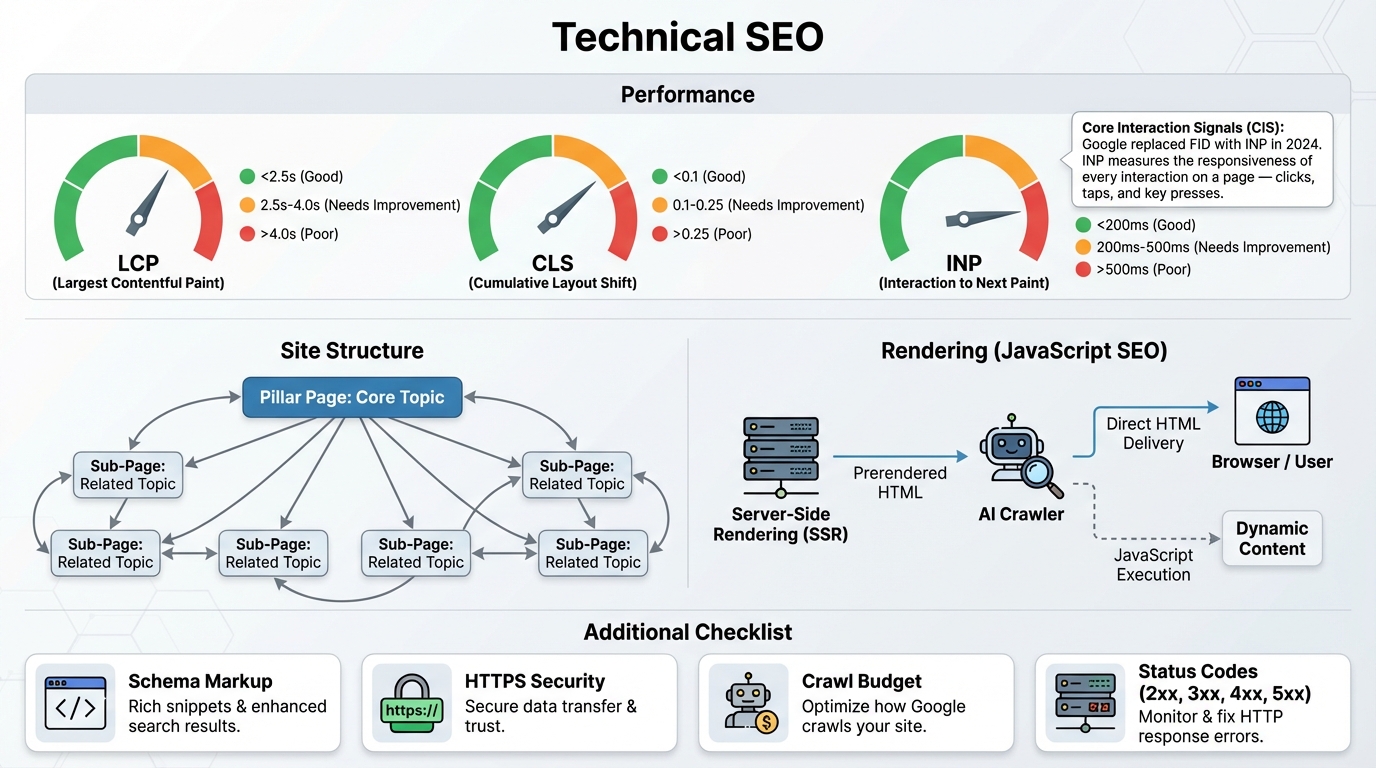
This is where I always tell clients to start, because it's the one area where improvements are measurable within days. Google replaced FID with INP (Interaction to Next Paint) in 2024. INP measures the responsiveness of every interaction on a page — clicks, taps, and key presses — with a "Good" threshold of 200ms or less. Pages exceeding 200ms face ranking penalties, making it critical to audit heavy JavaScript and animations.
Core Web Vitals: Current Benchmarks
As of 2026, the passing thresholds are:
- LCP (Largest Contentful Paint): under 2.5 seconds
- CLS (Cumulative Layout Shift): under 0.15
- INP: under 200ms
The fundamentals still work: image compression, CSS/JS minification, and CDN usage remain effective speed improvements.
Site Architecture and Internal Linking
Use topic clusters (pillar pages + supporting subpages) to keep hierarchy shallow and concentrate link equity on high-value pages. Pruning thin, low-traffic pages through deletion or noindex directives can also improve crawl efficiency.
JavaScript SEO
Use SSR (Server-Side Rendering) or dynamic rendering to ensure important content is output directly in HTML. AI crawlers may not execute JavaScript, so having information present in the HTML source is essential.
Additional Technical Considerations
- Soft 404 management: Return proper 404/410 status codes for discontinued products, or redirect to alternatives
- Schema markup: Implement Article, FAQ, HowTo, Product, and Organization structured data so AI can accurately parse your information
- HTTPS: Required for all pages. Add CSP headers to strengthen security signals
- Crawl budget optimization: For large sites, exclude URL parameters and maintain updated XML sitemaps to ensure priority pages are indexed first
References: Technical SEO Checklist - Yotpo Google Ranking Factors 2026 - Wix SEO Expert Google's Recent Changes for SEO - Whistler Billboards Core Web Vitals in 2026 - CD Studio How to Optimize Content for AI Search - Semrush
2. Content SEO
Keyword Research and Intent Mapping
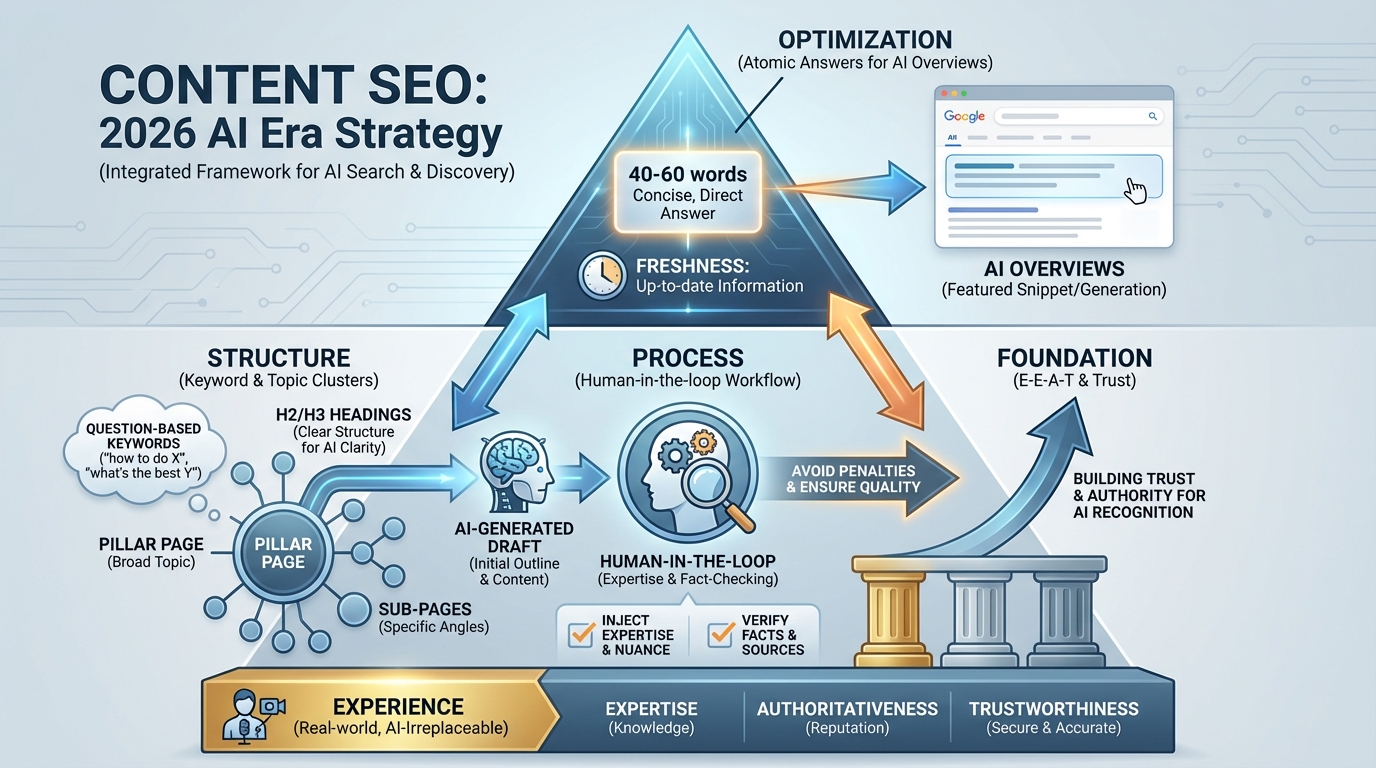
With the technical foundation in place, let's turn to the content layer — which is where most of the AI citation opportunity actually lives. With the rise of conversational search, prioritize question-based keywords like "how to do X" and "what's the best Y." Placing these as H2/H3 headings makes it easier for AI to extract answers.
Topic cluster design is equally important. Use pillar pages to cover the full scope of a topic, with subpages addressing specific questions. This structure increases the chances of being cited in AI Overviews.
Working with AI-Generated Content
As of 2026, Google does not prohibit AI-generated content. However, publishing raw AI drafts without human input is a risk. You need to add firsthand experience, expert insights, and concrete examples. Google's "Experience" signal in E-E-A-T is something AI alone cannot produce.
Frankly, I've reviewed dozens of sites that took a "publish volume first, edit later" approach with AI content — and I haven't seen a single one sustain rankings beyond 3-4 months. Editorial review and original perspective are essential before publishing.
Implementing E-E-A-T in Practice
- Experience: Include first-person accounts — "we tested this," "here's what happened when we implemented it"
- Expertise: Add author bios with credentials and track records. Include expert review badges where applicable
- Authoritativeness: Earn citations and backlinks from recognized industry publications
- Trustworthiness: Ensure HTTPS, privacy policies, editorial guidelines, and last-updated dates are visible. For YMYL topics, include medical or legal expert review disclosures
Content Freshness and Depth
Regularly update statistics, examples, and outbound links to keep content current. AI evaluates whether information is recent as part of its quality assessment.
The "Atomic Answers" technique is also effective: structure a concise 40–60 word answer as a standalone paragraph for each key question. This format makes it easy for AI to extract and cite directly.
References: SEO 2026 - LaTevaWeb Google Policy on AI-Generated Content 2026 - LinkedIn Modern Content Marketing in the Age of AI - Pod Digital SEO Cheat Sheet 2026 - LinkedIn Optimize for Google AI Overviews - Fuel Online
3. Adapting to AI-Powered Search
SGE and AI Overviews
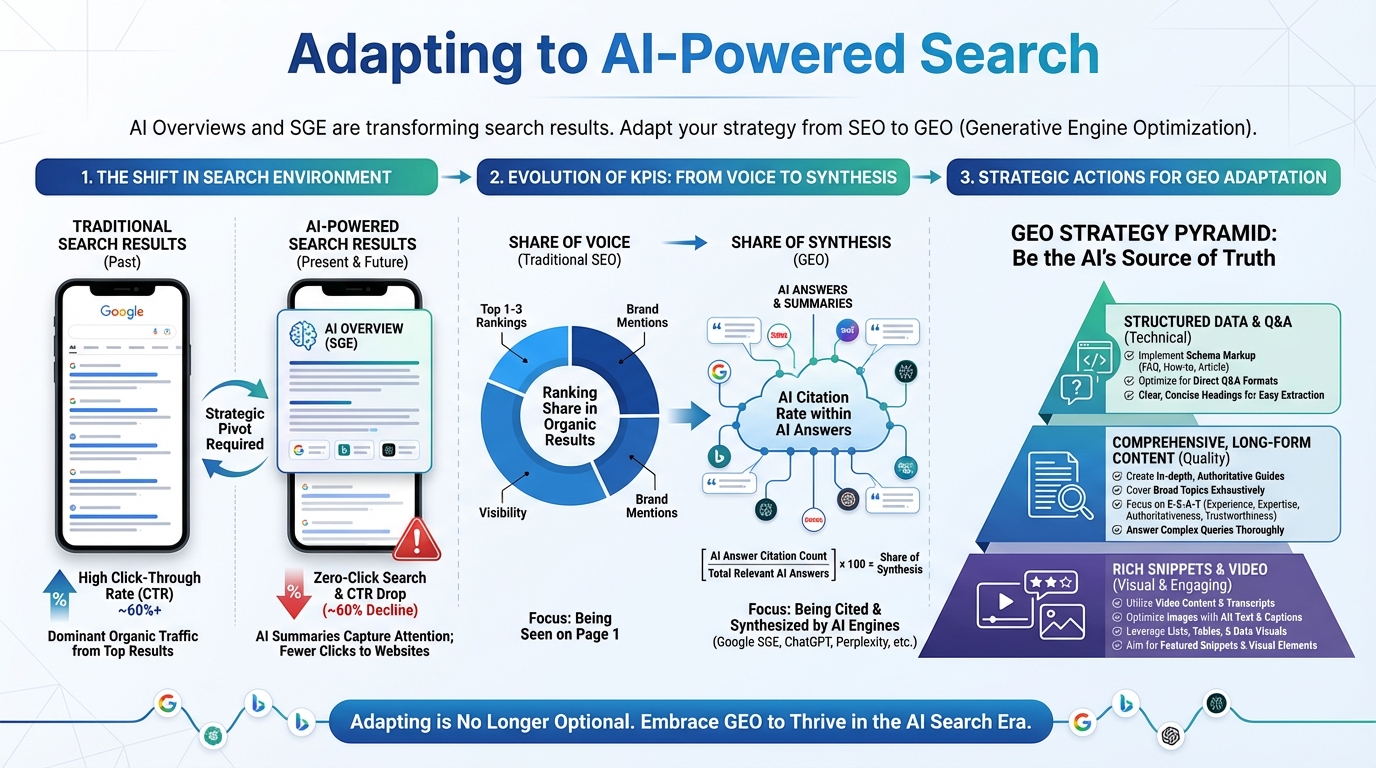
This section gets to the heart of what's changed. In my testing across hundreds of queries, I've found that being cited in an AI Overview often drives more qualified traffic than a traditional position-one ranking. Google now displays AI-generated summaries (AI Overviews) directly in search results. Multiple industry studies suggest that AI Overviews appear for a growing share of commercial queries — with some estimates placing the figure around 15–20% and rising (BrightEdge, 2025). Being cited by AI is becoming a new key to earning clicks — potentially more important than traditional position #1.
To increase citation likelihood, implement structured data, use question-based headings, and create in-depth long-form content that thoroughly covers topics.
GEO (Generative Engine Optimization)
"Share of Synthesis" has emerged as the key metric for measuring visibility in AI search engines like ChatGPT, Perplexity, and Claude. Use GEO analytics tools such as LinkSurge to monitor how often your brand is cited in AI-generated responses, and track it as a core KPI.
Share of Synthesis measures what percentage of AI-generated answers reference your brand or content when the AI synthesizes information from multiple sources. Think of it as the GEO equivalent of traditional SEO's "Share of Voice."
| Metric | What It Measures |
|---|---|
| Share of Voice (Traditional SEO) | Visibility share in search result pages |
| Share of Synthesis (GEO) | Citation share in AI-generated answers |
For example, if your site is cited in 30 out of 100 AI searches for a given category, your Share of Synthesis is 30%. Tracking this metric over time enables you to quantitatively evaluate the impact of GEO efforts.
For a deep dive into platform-specific citation strategies and a phased GEO implementation plan, see "The Complete GEO Guide: How to Get Cited by ChatGPT, Gemini, and Perplexity."
Addressing Zero-Click Search
AI-generated direct answers are significantly reducing traditional click-through rates (some analyses have reported CTR declines of up to approximately 60% for queries with AI Overviews — see Seer Interactive, 2024). To counteract this, earn rich snippets through FAQ and HowTo schemas, and provide visual value through video and infographics to stand out in search results.
References: What is SGE - Md Azizur Rahman Google SGE SEO Guide for 2026 - Promfly Generative Engine Optimization - Geoptie GEO Guide - LLM Refs
4. Link Building and Authority
Earning Natural Backlinks
Now that we've covered AI-era search adaptation, let's look at how link building strategy has shifted. The most effective approach is publishing original research, industry reports, and proprietary data. Data-driven content naturally attracts citations from other publications. Digital PR and media placements also contribute significantly to authority building.
Guest Posts and Expert Contributions
When contributing articles to reputable industry sites, keep anchor text limited to brand names and natural contextual phrases. Keyword-stuffed anchors are counterproductive and may trigger penalties.
Local SEO Link Strategy
Maintain accurate NAP (Name, Address, Phone) information across Google Business Profile, Yelp, and relevant industry directories to strengthen local signals.
Tactics to Avoid
"Parasite SEO" (domain lending) — publishing thin content on high-authority domains — is now a Google penalty target. Regularly audit your link profile and use the Disavow tool to remove spam links.
PBN (Private Blog Network) and satellite site schemes are similarly penalized. Google's SpamBrain detection has become far more accurate at identifying these tactics — for a comprehensive breakdown of the risks and safe alternatives, see "Satellite Sites & PBNs Are Dead: Safe Link Building in 2026."
References: Link Building Strategies That Work - Coalition Technologies How to Improve Google Search Ranking - Link Building HQ Link Building Strategies - Backlinko Link Building Strategies 2026 - Sky SEO Digital Parasite SEO - Junia AI
5. User Experience Metrics
Aim for a combined Core Web Vitals score of 0.92 or above. With mobile traffic now representing the majority of global web usage (Statcounter GlobalStats), keeping mobile page load times under 2 seconds is particularly critical.
Engagement signals — CTR, time on page, and scroll depth — are now factors AI uses to assess whether a page is genuinely useful. Improve the responsiveness of all interactive elements, and use FAQ, HowTo, and Product schemas to earn rich results that boost click-through rates.
References: SEO 2026 PDF - Developer Aman Core Web Vitals for Beginners - Medium
LinkSurge
linksurge.jp
SEO・AIO・GEO統合分析プラットフォーム。AI Overviews分析、SEO順位計測、GEO引用最適化など、生成AI時代のブランド露出を最大化するための分析ツールを提供しています。
6. Tools and Measurement
Essential Tools
- Google Search Console: Monitor indexing status, CIS metrics, and AI Overview impressions
- GA4 + Looker Studio: Analyze user behavior, conversions, and AI-sourced traffic
AI Visibility Tools
- LinkSurge — An integrated platform combining AI Overviews analysis, SEO rank tracking, and GEO analytics
- Semrush AI Visibility Toolkit
- Surfer SEO AI Tracker
- Rankscale.ai / OmniSEO®
These tools quantitatively measure your visibility in AI Overviews, SGE, ChatGPT, and other AI search engines, including Share of Synthesis tracking.
Technical Auditing
Use Screaming Frog, Sitebulb, or Botify for crawl error detection and schema validation.
Link Analysis
Regularly audit backlink quality and anchor text distribution with Ahrefs, Majestic, or SE Ranking.
Reporting Automation
Whatagraph (AI-powered summary reports) and Search Atlas (automated fix suggestions) can significantly reduce monthly reporting overhead.
References: AI-Driven SEO Tools for Agencies - Eesel AI Best SEO Tools - Marketer Milk AI Search Visibility Audit Tools - The Rank Masters AI SEO Tools - Whatagraph AI SEO Tracking Tools 2026 - Search Influence
7. Industry-Specific Guidance
E-Commerce
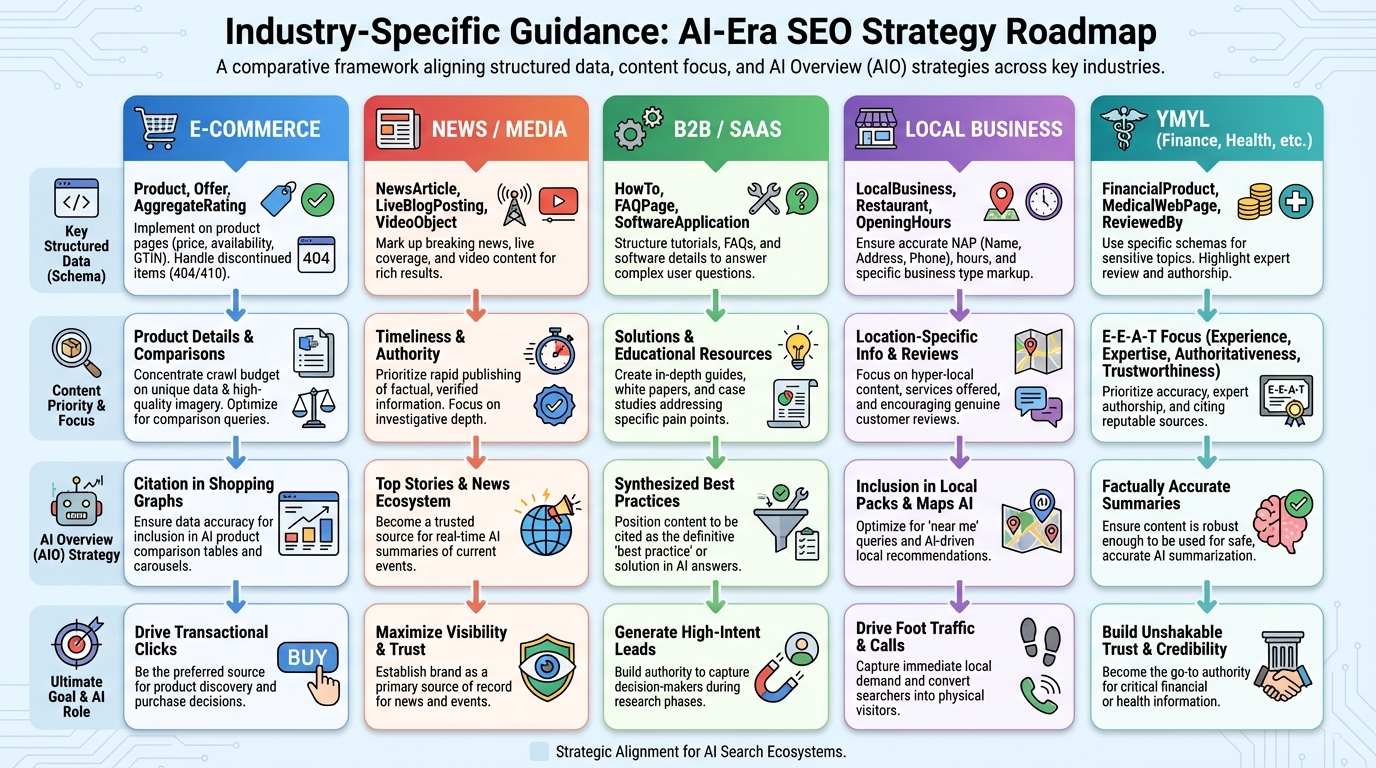
Implement Product schema (price, availability, GTIN) on product pages and handle discontinued items with proper 404/410 status codes. Concentrate crawl budget on top-level categories and optimize for AI Overview "product comparison" citations.
Blogs and Media Sites
Long-form content combining topic clusters with FAQ schema is the foundation. Add video and infographics for multimodal coverage, and schedule regular content refreshes for existing articles.
B2B and Enterprise
Deploy Organization, Person, and Review schemas on company pages. Use whitepapers and case studies to strengthen E-E-A-T, aiming to be cited as "industry best practices" in AI Overviews.
Local Business
Focus on unified NAP management, Google Business Profile optimization with LocalBusiness schema, and location-specific service pages. Local review acquisition directly impacts trust signals.
YMYL (Finance, Health, Legal)
Expert attribution is mandatory. Display practitioner credentials (medical licenses, bar admissions), publication dates, and risk disclosures prominently. All AI-assisted content must be reviewed by qualified professionals before publishing.
References: Ecommerce Website SEO - DebugBear How to Rank YMYL Finance Pages - Bruce Jones SEO SEO Best Practices for Small Business - First Ep Business SEO for Enterprise - Saffron Edge
8. Budget and Resource Planning
What I find particularly useful about thinking in budget tiers is that it prevents the common mistake of overinvesting in enterprise tools when simpler solutions would deliver the same results.
Small Scale (Freelancers & Startups) — $300–$1,000/month
Focus on basic technical audits, refreshing existing content, and local link acquisition. Use GSC and GA4 (free), Screaming Frog free edition, and handle AI content editing manually.
Mid-Market (SMBs) — $1,000–$3,500/month
Balance technical optimization, AI-assisted content creation, link building, and local SEO. Use LinkSurge for AI Overviews and GEO analytics, combined with Semrush One or Whatagraph for automated reporting — a cost-effective operational setup.
Enterprise — $3,500–$15,000+/month
Invest in programmatic SEO, GEO strategy, multi-language/multi-region management, and dashboard integration. Botify, Conductor, OmniSEO®, and Looker Studio + BigQuery integrations are well-suited for this scale.
References: SEO for Small Business - 8Spark Enterprise SEO Resolutions 2026 - Seeders Small Business SEO vs Enterprise SEO - EWR Digital
9. Implementation Roadmap
Phase 1: Quick Wins (Weeks 0–2)
- Baseline INP and LCP scores using GSC and PageSpeed Insights
- Add FAQ/HowTo schema to high-priority pages
- Noindex or remove low-quality thin pages
Phase 2: Foundation Building (Weeks 3–6)
- Redesign site architecture around topic clusters
- Implement Product/Service schema on key pages
- Add Atomic Answers to question-focused pages for AI Overview optimization
Phase 3: Content Expansion (Weeks 7–12)
- Draft content with AI, then refine with Human-First Editing (adding experience and case studies)
- Create video and infographic assets for multimodal presence
- Update statistics and links in existing content
Phase 4: Authority Building (Weeks 13–24)
- Publish industry reports and pursue digital PR for high-quality backlinks
- Commission expert contributions and influencer collaborations
- Track Share of Synthesis using LinkSurge or similar AI visibility tools
Phase 5: Continuous Optimization (Week 25+)
- Monthly review of CIS scores and AI Overview impressions
- Plan for new search algorithm updates and AI feature rollouts
- Automate operations with content calendars and SEO dashboards
References: Complete SEO Roadmap for 2026 - Pennep Actionable Tactics to Improve Google Rankings - SEOlogist
10. CMS Selection Guide
WordPress
Rich plugin ecosystem (Yoast SEO, Rank Math) with strong URL control and automated schema generation. WPML and Polylang enable multilingual support. Best for content-heavy blogs and corporate sites.
Wix / Wix Studio
Built-in SEO wizard and mobile optimization make it accessible for small sites and startups. Page speed is platform-dependent, which is a trade-off to consider.
Shopify
Automated e-commerce schema generation and fast CDN-backed hosting are key strengths. Extensive SEO app ecosystem makes it ideal for online stores with large product catalogs.
Headless CMS (Contentful, Sanity)
API-first architecture enables multi-channel content delivery with flexible schema management. Best suited for large-scale, multilingual, and multi-platform strategies.
Drupal
Advanced access control and security features make it the go-to for enterprise-scale SEO. Widely adopted by government agencies and educational institutions.
References: Which CMS is Best for SEO - SEO Locale WordPress vs Wix SEO - BT Marketing WordPress Alternatives 2026 - Creative Corner
Frequently Asked Questions (FAQ)
What is the most significant SEO change in 2026?
The rise of AI search engines (Google AI Overviews, ChatGPT, Perplexity) means that "being cited in AI-generated answers" is now as important as ranking on traditional search results. GEO (Generative Engine Optimization) has emerged as a new discipline, with Share of Synthesis becoming the standard metric for measuring AI citation rates.
Where should SEO beginners start?
Begin with Core Web Vitals optimization (INP, LCP, CLS) and implementing structured data (JSON-LD) for FAQ and HowTo schemas. Without a solid technical foundation, even the best content won't be properly recognized by Google or AI search engines. Setting up Google Search Console and GA4 should be your first priority.
How can I get featured in AI Overviews?
Content that gets cited in AI Overviews typically has three characteristics: (1) question-format headings (H2/H3) that directly address search intent, (2) Atomic Answers — standalone paragraphs of 40–60 words that AI can cite directly, and (3) clear E-E-A-T signals showing the content comes from an authoritative source. Structured data implementation also improves citation rates.
Should I use free or paid SEO tools?
Choose based on your site's scale and budget. For personal blogs and small sites, Google Search Console + GA4 (free) provides sufficient coverage. For business sites with significant traffic, platforms like LinkSurge, Semrush, and Ahrefs deliver keyword analysis, competitor research, and AI visibility tracking that substantially improve ROI.
What are practical steps to improve E-E-A-T?
Start by creating author profile pages with real names, credentials, and professional backgrounds. Then publish original research and industry data to earn natural backlinks. Contribute guest articles and secure interview placements in recognized industry publications to build off-site authority. Use Schema.org Person and Organization markup to communicate this information to Google as structured data.
Summary: Where to Start
The most practical approach is to work through the five priorities outlined at the beginning of this article, in order of impact.
Complete your technical audit and schema implementation (Phase 1) in the first two weeks. Then spend weeks 3–6 restructuring content and deploying Atomic Answers (Phase 2) while beginning GEO monitoring in parallel. Link building and PR for authority development (Phase 4) should run as an ongoing mid-to-long-term initiative, with AI visibility tools tracking quantitative results.
Whether you're optimizing a single-market site or planning global expansion, this phased approach delivers sustainable organic traffic growth and stronger brand recognition.
For a deep dive into why brand presence beyond your own site now matters more than backlinks for AI search visibility, see "91% of AI Answers Come from Sites That Aren't Yours." And for platform-specific social media tactics that drive AI citations, check out "X, Instagram & LinkedIn AI Search Optimization."
LinkSurge provides AI Overviews analysis, SEO rank tracking, and GEO analytics — the tools you need for a data-driven 2026 SEO strategy. Ready to get started?