X, Instagram & LinkedIn AI Search Optimization: The 2026 Social Media Strategy Guide
目次
Key Takeaways: 5 Ways to Get Your Social Content Picked Up by AI in 2026
After months of analyzing how AI algorithms on X, Instagram, and LinkedIn decide what to surface, one thing is clear: the platforms have quietly shifted from engagement-based to signal-quality-based ranking. Social media marketing in 2026 isn't just about reaching people — it's about getting recommended and cited by AI. Here are 5 things that matter most right now.
- Learn what each platform's AI actually rewards — X prioritizes dwell time and DM shares. Instagram rewards watch-through rates and saves. LinkedIn's semantic search favors structured expertise. If you don't know what signals each algorithm cares about, posting more won't help
- Match your content format to the algorithm — Threads on X, 30–90s Reels plus carousels on Instagram, multi-image carousels and document posts on LinkedIn. The format that AI ranks highest is different on every platform
- Use AI tools to generate and rotate hashtags dynamically — The optimal number varies: 1–2 on X, 5–8 on Instagram, 3–5 on LinkedIn. AI hashtag generators measure trend velocity and competition in real time, so stop reusing the same tags every time
- Let AI schedulers pick your posting times — Tools like Buffer, Sprout Social, and Rebrandly analyze historical engagement patterns and auto-select the best time slot for your specific audience
- Engineer your first 60 minutes of engagement — Algorithms evaluate early reactions to decide whether to amplify a post. Coordinated comments and shares from team members within the first hour can multiply your reach significantly
Below, we break down each of these areas with the latest data and real-world examples.
1. AI Algorithms Running Social Media in 2026
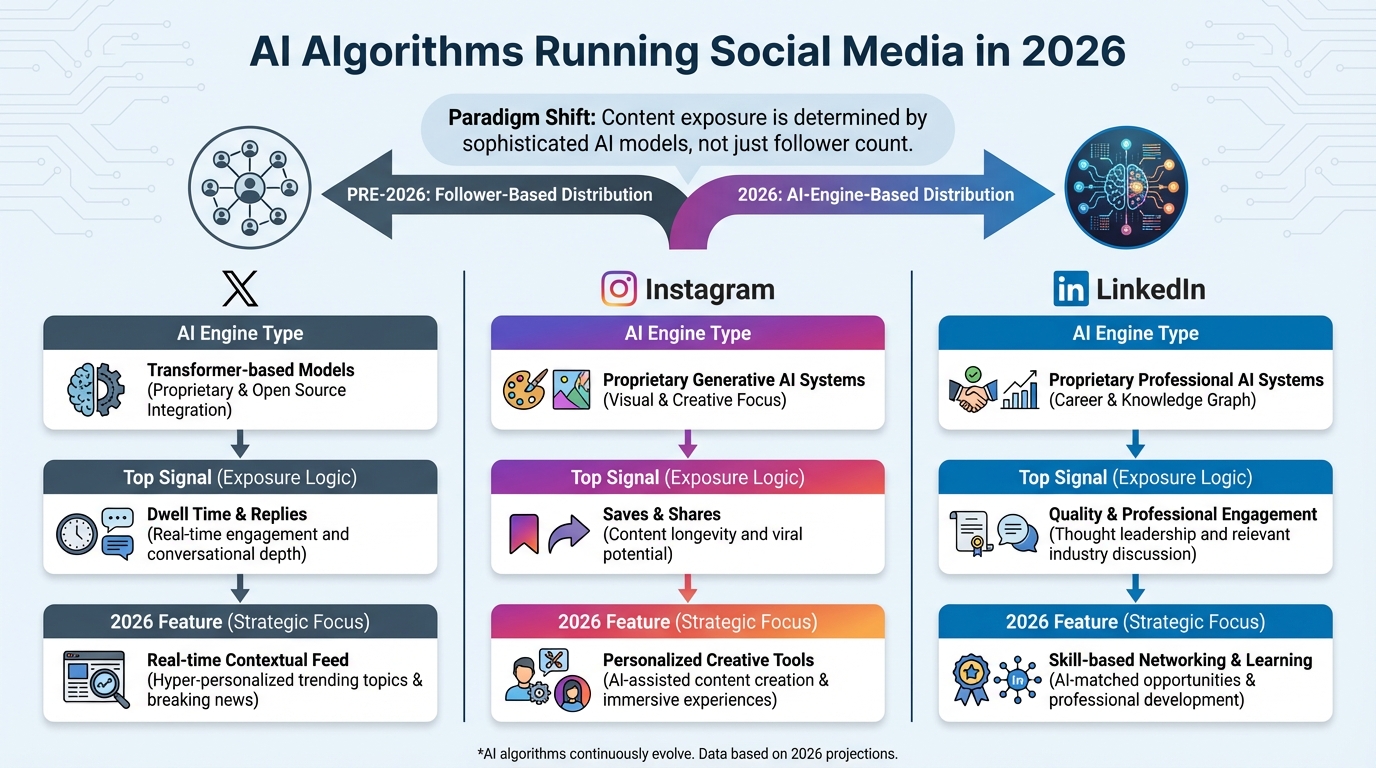
In 2026, X, Instagram, and LinkedIn all use Transformer-based models or proprietary AI systems as their core recommendation engines.
The days of "post it and your followers will see it" are long gone. Algorithms decide who sees your content, when, and in what order. In my analysis of each platform's recommendation system, I've found that understanding these decision criteria is the single biggest lever for improving reach — more so than content quality alone.
| Platform | AI Engine | Top Signals | Notable 2026 Features |
|---|---|---|---|
| X (Twitter) | Grok (Transformer-based); recommendation code open-sourced | Dwell time, DM shares | Prompt-driven search, AI content pipeline automation |
| Multiple AI systems (Feed, Reels, Stories, Explore each optimized separately) | 1–3s hook retention, watch-through rate, saves, shares | Movie Gen (text-to-video AI editing), auto-optimized hashtags | |
| 360Brew (large-scale Mixture-of-Experts), semantic search | Comment and share quality, format-specific engagement rate | AI-powered People Search, real-time engagement prediction |
X's algorithm: Grok and the dwell_time era
X's recommendation algorithm was open-sourced in 2023, giving us direct visibility into its inner workings. In 2026, it still runs on a Transformer-based model with deep Grok integration.
The key takeaway: dwell time and DM shares carry the highest scores. A simple "like" matters far less than how long someone spends reading your post, or whether they forward it to a friend via DM. Content that stops the scroll and holds attention wins.
There's also a P(not_interested) probability score. If the algorithm predicts a user will tap "Not interested," your post's distribution gets throttled. Low-quality volume posting actively hurts you.
Instagram's algorithm: multiple AI systems working together
Instagram runs separate AI systems for Feed, Reels, Stories, and Explore. In 2026, a "Your Algorithm" feature was added, letting users adjust their own content preferences.
For new reach on Reels, the single most impactful factor is hook retention in the first 1–3 seconds. Drop viewers there, and it doesn't matter how good the rest of your content is. After that, save rate and Sends per Reach (the share-to-reach ratio) are the strongest signals — content that people want to revisit or send to friends gets amplified.
LinkedIn's algorithm: a semantic search engine
LinkedIn integrated a Mixture-of-Experts model called 360Brew into its search engine in 2025, enabling meaning-level search rather than keyword matching. AI-Powered People Search was also added, automatically extracting job titles and skills from profiles to expand search queries.
On the content side, image carousels and native document posts significantly outperform text-only posts in engagement rate. Comment "quality" is also evaluated — a thoughtful reply with a specific question scores higher than a generic "Great post!"
AI search engines like ChatGPT and Perplexity are increasingly citing social media posts as sources. For more on how AI search is reshaping content strategy, see "How AI Search Is Reshaping SEO: 7 Actionable Strategies for 2026."
References: Twitter/X Algorithm Update Analysis - LinkedIn How the Instagram Algorithm Works - Hootsuite LinkedIn 360Brew Semantic Search - arXiv X Publishes AI-Powered Algorithm Code - Social Media Today
2. Content Format Strategy by Platform
With the algorithm mechanics established, let's get specific about which formats each AI rewards most.
X: threads and image posts dominate
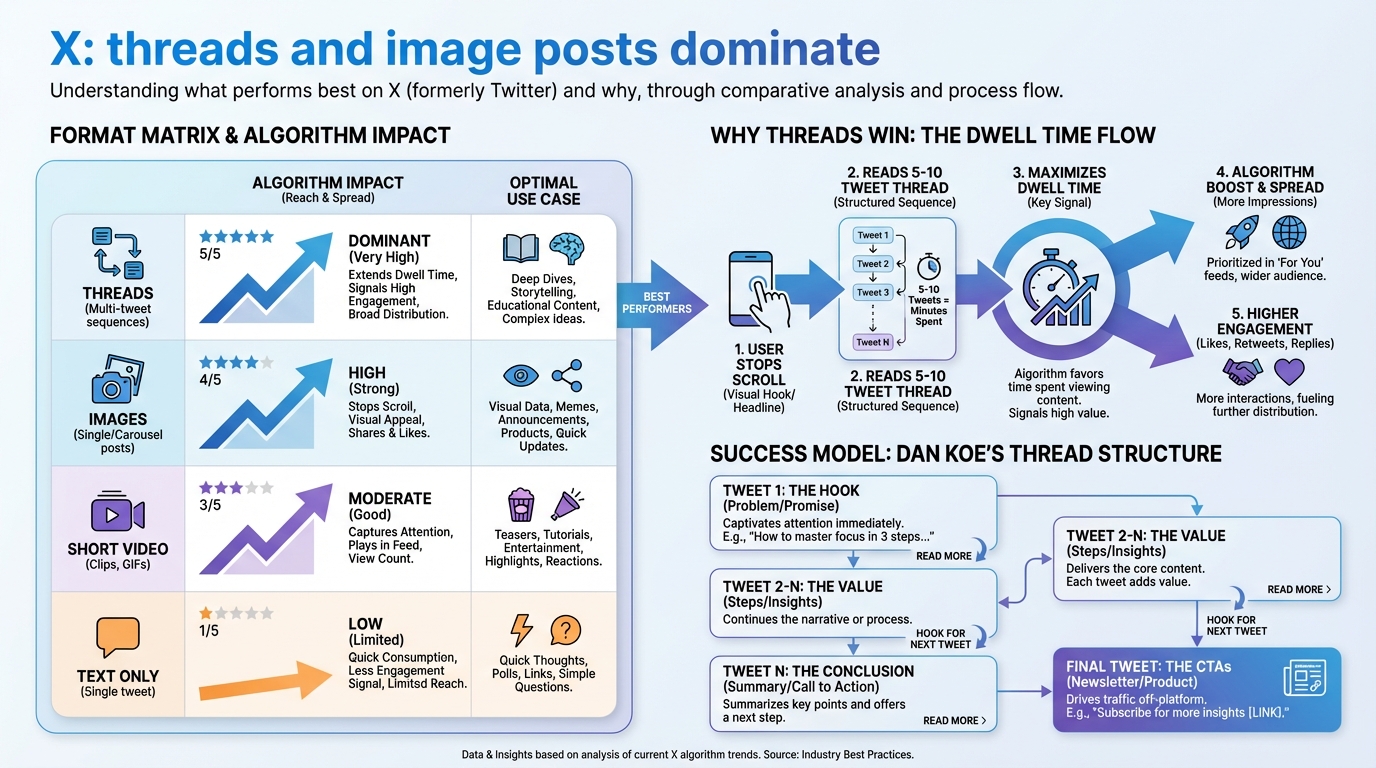
On X, threads (multi-tweet sequences) perform best. The reason is straightforward: threads extend dwell time. A user who reads through a 5–10 tweet thread gives the algorithm far more engagement signal than someone who scrolls past a single tweet.
| Format | Algorithm Impact | Best For |
|---|---|---|
| Threads (5–10 posts) | Maximizes dwell time | How-tos, data breakdowns, case studies |
| Image posts | Increases scroll-stop rate | Infographics, charts, screenshots |
| Short video (under 2 min) | High DM share potential | Tutorials, news commentary |
| Text only | Lower dwell time | Breaking news, hot takes |
Dan Koe, a creator with over 500K followers on X, consistently uses 5–7 tweet threads to break down business and psychology concepts. His threads regularly exceed 10M impressions because they're structured to reward reading — each tweet ends with a hook that pulls you into the next one, maximizing dwell time.
Instagram: the Reels + carousel combo
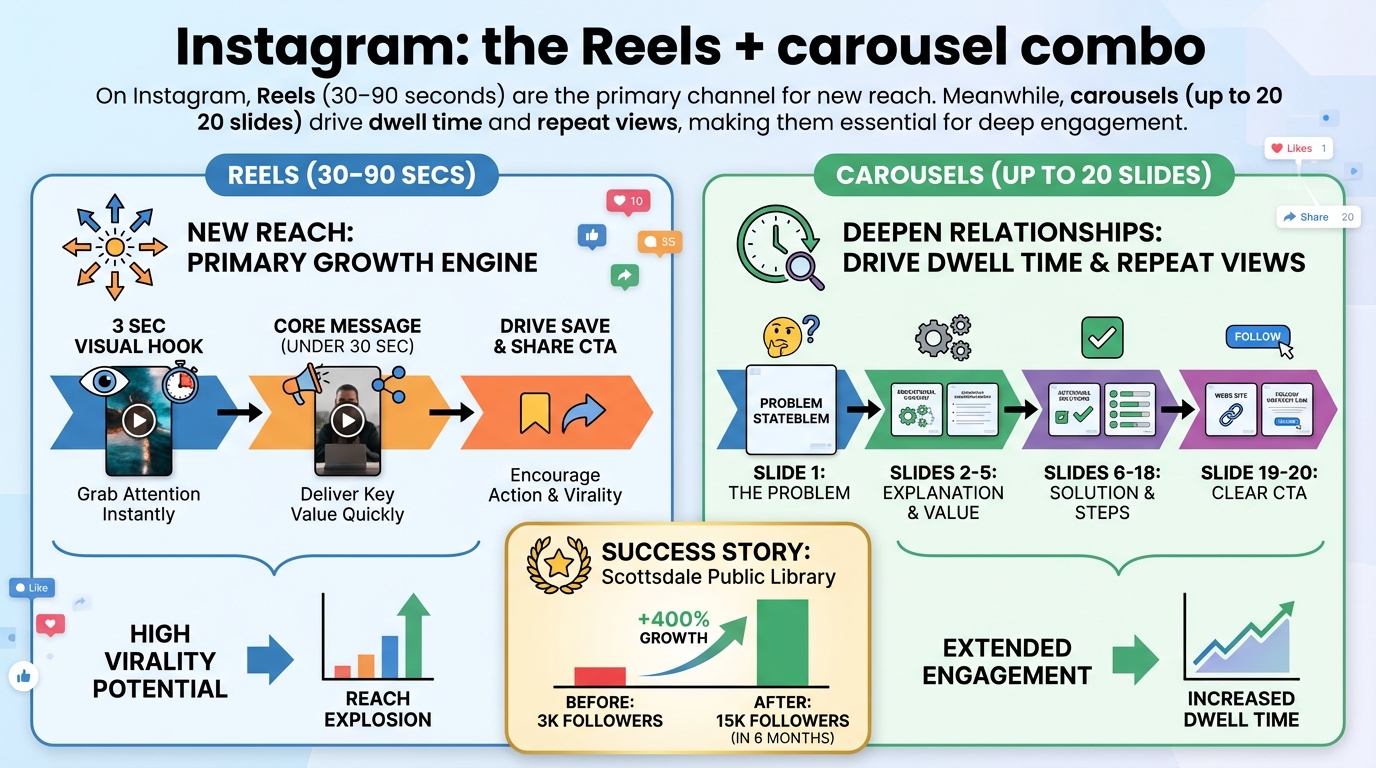
On Instagram, Reels (30–90 seconds) are the primary channel for new reach. Meanwhile, carousels (up to 20 slides) drive dwell time and repeat views, making them ideal for deepening engagement with existing followers.
Three things to nail with Reels: a visual hook in the first 3 seconds, your core message within 30 seconds, and a share-oriented CTA ("Save this for later" or "Send this to someone who needs it"). For carousels, structure your slides as "Problem → Explanation → Solution → CTA" — this arc keeps people swiping to the end.
The Scottsdale Public Library provides an unexpected example. By creating educational Reels about local history and reading recommendations, they grew from 3K to over 15K followers in 6 months. Their secret: consistent 30-second Reels with strong opening hooks and a "save for later" CTA that boosted their save rate well above the industry average.
LinkedIn: multi-image carousels and documents
On LinkedIn, multi-image carousels and native documents (PDFs) generate the highest engagement rates. Carousels are particularly effective because the "swiped to slide 2+" signal is strongly weighted by the algorithm.
Short video (under 60 seconds) also works, but most LinkedIn users browse with sound off. Captions and text overlays are essential, not optional.
References: Instagram Algorithm 2025: Which Content Formats Get the Most Reach - Atlas SEO LinkedIn Social Media Benchmarks - Social Insider Top LinkedIn Content Wins 2025 - Souvik Dutta
3. Hashtag Strategy: AI-Powered Dynamic Optimization
This is one area where I've seen the biggest gap between what people do and what actually works. Hashtags serve two purposes: they're discovery entry points for users, and they're classification signals that help AI understand your content's topic. But the optimal approach is completely different on each platform.
| Platform | Recommended Count | Key Principle |
|---|---|---|
| X | 1–2 | Character limit demands precision. Use one trending tag + one brand tag |
| 5–8 | Focus on niche/community tags. Maxing out at 30 is counterproductive | |
| 3–5 | Industry and topic tags woven naturally into the post body |
Why reusing the same hashtags hurts you
Repeating identical hashtags across posts signals "spam" to algorithms. On Instagram specifically, tag repetition has been linked to shadowban behavior — your posts get quietly deprioritized without any notification.
AI tools like Bika.ai and PostNitro can auto-generate hashtag candidates based on your post content, then score each one by trend velocity and competition level. This is faster and more accurate than manual research, and it ensures you're rotating tags with every post.
References: How to Generate Hashtags with AI - ASCN
4. Posting Time Optimization and AI Scheduling
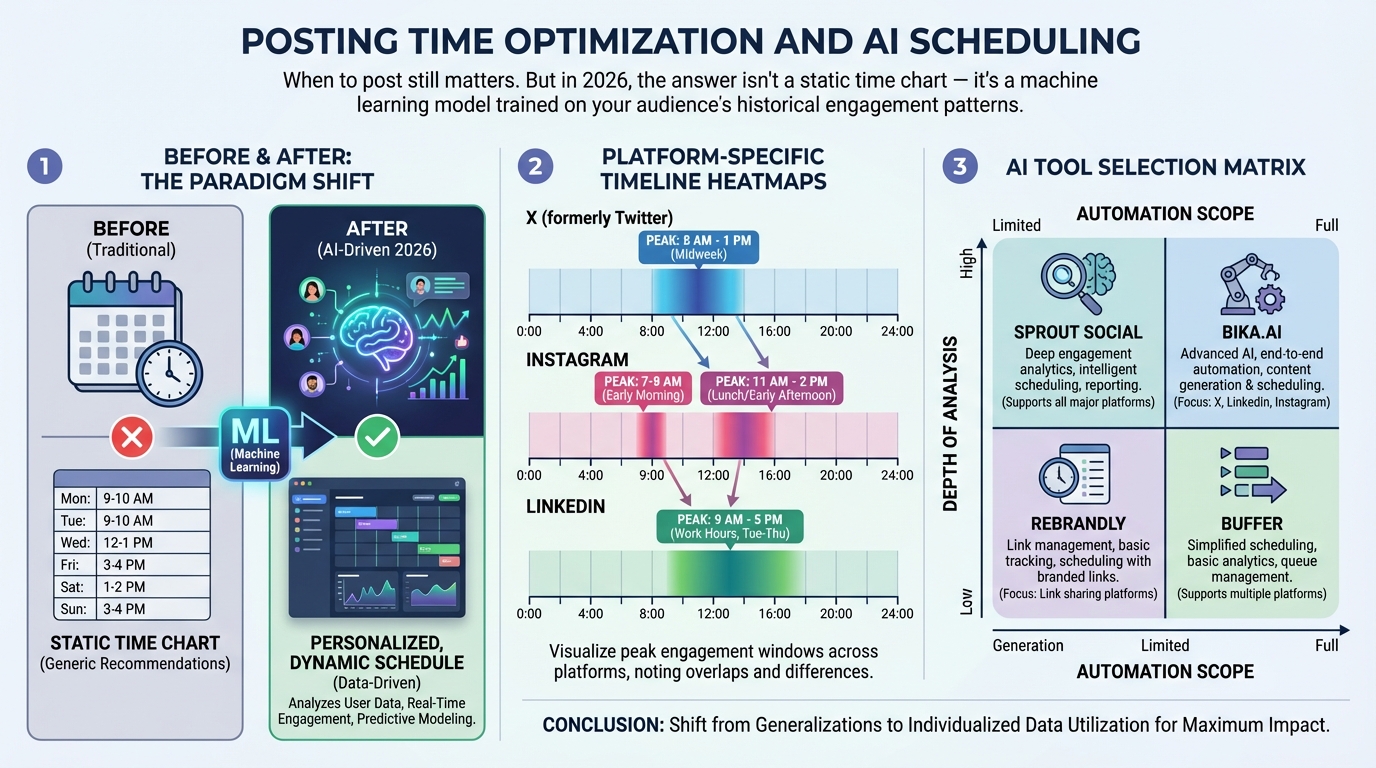
I've tested the "best posting time" recommendations from several tools, and the key lesson is this: "When to post" still matters. But in 2026, the answer isn't a static time chart — it's a machine learning model trained on your audience's historical engagement patterns.
Recommended posting windows (US Eastern Time)
| Platform | Best Windows | Best Days |
|---|---|---|
| X | 9:00–12:00 PM, 5:00–6:00 PM | Weekdays |
| 7:00–9:00 AM, 12:00–2:00 PM | Monday–Friday | |
| 7:00–8:30 AM, 12:00–1:00 PM, 5:00–6:00 PM | Tuesday–Thursday |
These are averages. Your specific audience may behave differently. That's where AI scheduling tools come in — they analyze your account's engagement data and calculate personalized optimal times.
How to choose an AI scheduling tool
| Tool | Key Strength | Platform Support |
|---|---|---|
| Buffer + Zapier | ChatGPT-generated drafts auto-queued for posting | X |
| Sprout Social ViralPost | ML-based optimal send time calculation | LinkedIn, Instagram |
| Rebrandly | Click-data-driven optimal posting time analysis | All platforms |
| Bika.ai | End-to-end: ideation → generation → scheduling | X |
References: Best Time to Post on Social Media Using AI-Backed Click Data - Rebrandly Best Times to Post on LinkedIn - Sprout Social How to Automate Twitter/X Posts with AI - Bika.ai
5. Performance Measurement: Traditional Metrics + AI-Specific KPIs
Execution without measurement is just guessing. The KPIs that matter for social media shifted significantly in 2026. On top of traditional metrics like follower growth and likes, you now need to track the signals that AI algorithms actually weight and how often AI search engines cite your social posts.
Platform-specific KPIs worth tracking
| Metric Category | X | ||
|---|---|---|---|
| Dwell/Attention | Dwell time (seconds spent reading) | Hook retention rate, total watch time | Slide completion rate, avg. view duration |
| Engagement | Retweet rate (industry avg: 0.12%) | Save rate, Sends per Reach | Engagement per impression (avg: 5.2%) |
| Sharing/Amplification | DM share count | Share count | Comment quality, influencer reshares |
| AI-Specific | AI search citation count | Semantic relevance score | Profile optimization score |
Tracking your AI citation rate
ChatGPT, Perplexity, and other AI search tools are increasingly pulling social media posts as citation sources. To track whether your social content is being referenced in AI-generated answers, LinkSurge's GEO Monitor tracks citation status across major AI platforms at the keyword level, letting you see which posts are being picked up and how your Citation Rate trends over time.
For a deeper look at how social content fits into the broader off-site SEO picture, see "91% of AI Answers Come from Sites That Aren't Yours."
References: AI Search Metrics - O8 Agency Social Media Benchmarks 2025 - Social Insider LinkedIn Social Media Benchmarks - Social Insider
6. Case Studies: What's Working in Practice
Theory is useful. Proof is better. What I find most instructive about these examples is that none of them relied on massive budgets — they won by understanding what each algorithm rewards. Here are three cases.
Case 1: B2B newsletter grows LinkedIn impressions 7x
A B2B SaaS company adopted the carousel format with a strict "Problem → Solution → CTA" structure for every LinkedIn post. They also implemented a rule: within 60 minutes of posting, 5 team members leave substantive comments and reshare. The result: weekly impressions jumped from 2,400 to 18,000 — a 7x increase — and lead generation improved by 3.5%.
The lesson isn't just "make better content." It's that engineering the first-hour engagement spike is what triggers the algorithm to amplify your post to a wider audience.
Case 2: Scottsdale Public Library's Instagram Reels strategy
The Scottsdale Public Library used 30-second educational Reels about local history, book recommendations, and community events. By leading every Reel with a strong visual hook and ending with "Save this for later," they achieved a save rate more than double the industry average and grew from 3K to 15K+ followers in 6 months.
This is a reminder that Reels optimization isn't just for brands and influencers. Any organization with interesting stories can win on Instagram if they understand what the algorithm rewards.
For a real-world D2C case study, Japanese apparel company yutori turned staff daily-life TikToks and Reels into a zero-ad-spend sales machine — with 2.89 million followers (yutori FY2025 results - fashionsnap.com) and 92% year-over-year revenue growth (yutori CEO on 30B yen growth strategy - Net Shop Forum). Their "brand account as influencer" approach and Y-League brand selection system are detailed in "How yutori Captured Gen Z with SNS-First Brand Strategy."
Case 3: Cross-platform strategy delivers 45% engagement lift
A startup integrated AI-generated hashtags with scheduling tools and ran coordinated cross-platform campaigns across X, Instagram, and LinkedIn for 3 months. The key: they adapted the format for each platform — threads on X, carousels on Instagram, documents on LinkedIn — rather than posting identical content everywhere. The outcome: 45% total engagement increase and 30% follower growth across all three platforms.
References: Top LinkedIn Content Wins 2025 - Souvik Dutta Instagram Algorithm 2025 - Enrich Labs
7. Global Audience Demographics and Platform Selection
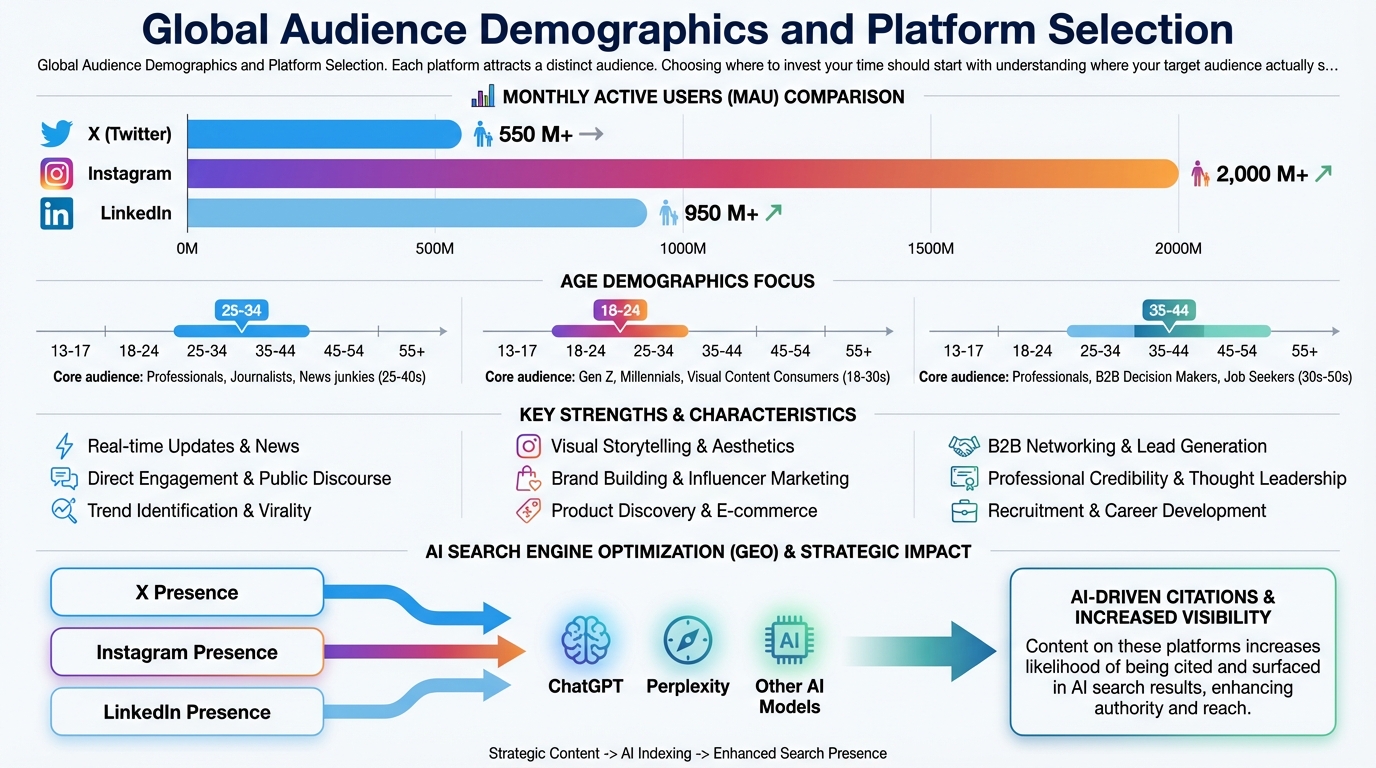
Each platform attracts a distinct audience. Choosing where to invest your time should start with understanding where your target audience actually spends theirs.
| Platform | Global MAU | Primary Age Group | Key Usage Patterns |
|---|---|---|---|
| X | ~600M | 25–49 | Real-time news, public commentary, professional networking |
| ~2B | 18–34 | Visual storytelling, lifestyle, product discovery, short-form video | |
| ~1B | 30–55 | Professional networking, B2B lead generation, thought leadership |
X is the go-to platform for real-time conversations and news commentary. Its open, public-by-default nature makes it the strongest platform for building thought leadership through consistent, high-value threads.
Instagram dominates visual-first content and product discovery. With over 2 billion monthly active users, it's where brands invest most heavily in short-form video and influencer partnerships.
LinkedIn has quietly become the most effective B2B content platform. Its semantic search means that well-structured profile data (job history, skills, certifications) directly affects how widely your posts reach beyond your immediate network.
The connection between social media visibility and AI search citations shouldn't be overlooked. For a comprehensive breakdown of how to optimize for AI citations across all channels, see "The Complete GEO Guide: How to Get Cited by ChatGPT, Gemini, and Perplexity."
References: Essential Instagram Stats - DataReportal Social Media Benchmarks - Dash Social How the LinkedIn Algorithm Works - SourceGeek
LinkSurge
linksurge.jp
SEO・AIO・GEO統合分析プラットフォーム。AI Overviews分析、SEO順位計測、GEO引用最適化など、生成AI時代のブランド露出を最大化するための分析ツールを提供しています。
8. Your 7-Step Action Plan: Start This Week
Here's how to put everything above into practice — broken into three phases.
Phase 1: Audit and baseline (1 week)
- Map algorithm signals to your current performance — Pull the last 30 days of analytics for each platform and check how your posts perform on dwell time, save rate, and share rate. Identify which formats are already working and which are underperforming
- Research competitors — Use LinkSurge and Social Insider to analyze competitors' social posts. Identify the formats, timing, and hashtags driving their highest engagement
Phase 2: Build your content system (2–3 weeks)
- Create platform-specific templates — Build a thread template for X, a "Hook → Core message → CTA" Reels script for Instagram, and a "Problem → Solution → CTA" carousel template for LinkedIn
- Set up AI scheduling — Choose a scheduling tool (Buffer, Sprout Social, or Rebrandly), connect your accounts, and enable personalized optimal time recommendations
- Build a hashtag generation workflow — Use an AI hashtag tool to generate fresh tags for every post. Set a rule: no identical hashtag sets across consecutive posts
Phase 3: Optimize and iterate (ongoing)
- Formalize the first-hour engagement rule — Designate 3–5 team members to comment and share within 60 minutes of every post. This single change can multiply reach by 3–5x
- Run monthly KPI reviews — Track dwell time, save rate, share rate, and AI citation count on a monthly cycle. Adjust content format, posting time, and hashtag strategy based on what the data shows
For the full picture on SEO, AI search, and content strategy, see "The Complete SEO Guide for 2026."
References: How to Automate Your X/Twitter So It Grows Itself - Medium/Zapier Instagram Algorithm 2025 Complete Guide for Marketers - Dataslayer
Frequently Asked Questions
How often should I post on each platform?
It depends on the platform. On X, 3–5 posts per day (including threads) is a solid cadence. On Instagram, 3–5 posts per week (aim for 2 Reels + 2 carousels). On LinkedIn, 2–3 posts per week performs well. Quality matters more than volume — prioritize posts that hit the algorithm's top signals (dwell time, save rate, share rate) over sheer posting frequency.
Is it safe to post AI-generated content directly?
Using AI for drafts is fine. Posting raw AI output without editing is risky. Algorithms can deprioritize content that reads as generic or template-based. On LinkedIn especially, posts with personal experience and original perspective are explicitly favored. Always add your own voice, examples, and insights before publishing.
Should I focus on all three platforms at once?
If resources are limited, pick 1–2 platforms where your target audience is most active. For B2B, start with LinkedIn. For younger demographics and visual content, prioritize Instagram. For real-time engagement and thought leadership, go with X. Expand to additional platforms only after you've built traction on your primary one.
Can social media posts get cited by AI search engines like ChatGPT?
Yes, and it's happening more frequently. LinkedIn long-form posts and X threads are being cited by ChatGPT and Perplexity as sources in AI-generated answers. Posts that contain structured data, specific numbers, and expert-level insights are most likely to be selected. You can track whether your content is being cited using LinkSurge's GEO Monitor, which monitors AI citation status across platforms.
What's the single highest-impact change I can make today?
Start engineering your first 60 minutes of engagement. Get 3–5 people to leave substantive comments and share your post immediately after publishing. This early engagement spike signals the algorithm to amplify your post to a wider audience. It's the fastest way to increase reach without changing your content at all.
Conclusion: In AI-Powered Social Media, Signal Design Comes First
Social media strategy in 2026 comes down to three things. First, design content that generates the signals each algorithm cares about — dwell time, save rate, share rate. Second, automate the repetitive parts: use AI for hashtag generation and scheduling so you can focus on content quality. Third, engineer your first-hour engagement to trigger algorithmic amplification.
X, Instagram, and LinkedIn each run different AI models, but they share a common principle: they measure whether people genuinely found your content valuable, then use that signal to decide how widely to distribute it. Chasing vanity metrics doesn't work anymore. Building a system that consistently delivers high-signal content, in the right format, at the right time — that's what works.
LinkSurge's GEO Monitor tracks how your social content and web pages are being cited across AI search engines in real time — the first step toward building a data-driven AI visibility strategy.