How yutori Captured Gen Z: The SNS-First Brand Strategy Behind Japan's Fastest Apparel IPO
目次
Key Takeaways: 5 Lessons from yutori's SNS Brand Strategy
yutori went from a single Instagram account to Japan's fastest apparel IPO in just five years and eight months. Revenue hit 8.3 billion yen (~$55M) in FY2025 — up 92% year-over-year. What makes this story worth studying isn't the growth numbers alone; it's the operating model behind them. Every piece of yutori's business — hiring, brand management, product development — is structured around SNS-driven feedback loops. Here are the five core principles that other brands can learn from.
- Turn brand accounts into influencers — yutori strips corporate polish from its social accounts. Staff post personal content where products appear naturally, not as ads. Followers feel like they're following a person, not a company. The group's total SNS following has reached roughly 2.89 million
- Kill underperformers fast with a league system — Their Y-League ranks brands Y1 through Y5 by monthly revenue. Brands falling below 7 million yen/month (~$47K) face automatic shutdown. Currently running 38 brands, yutori targets 70 within five years
- Turn TikTok comments into a sales funnel — Staff post casual daily-life videos wearing yutori products. When viewers comment "Where's that from?", the reply includes a purchase link. Zero ad spend, zero ad feel
- Design offline events as UGC factories — Pop-ups aren't just about in-store sales. Photo spots, limited drops, and staff interactions are engineered to generate attendee posts that become the next wave of customer acquisition
- Hire your target demographic — With an average employee age of 23.8 and roughly half the staff in creative roles, yutori doesn't research Gen Z trends — they live them. Content resonates because the creators are the audience
The sections below break down each of these strategies.
1. Who Is yutori — From "Vintage Girl" to Japan's Fastest Apparel IPO
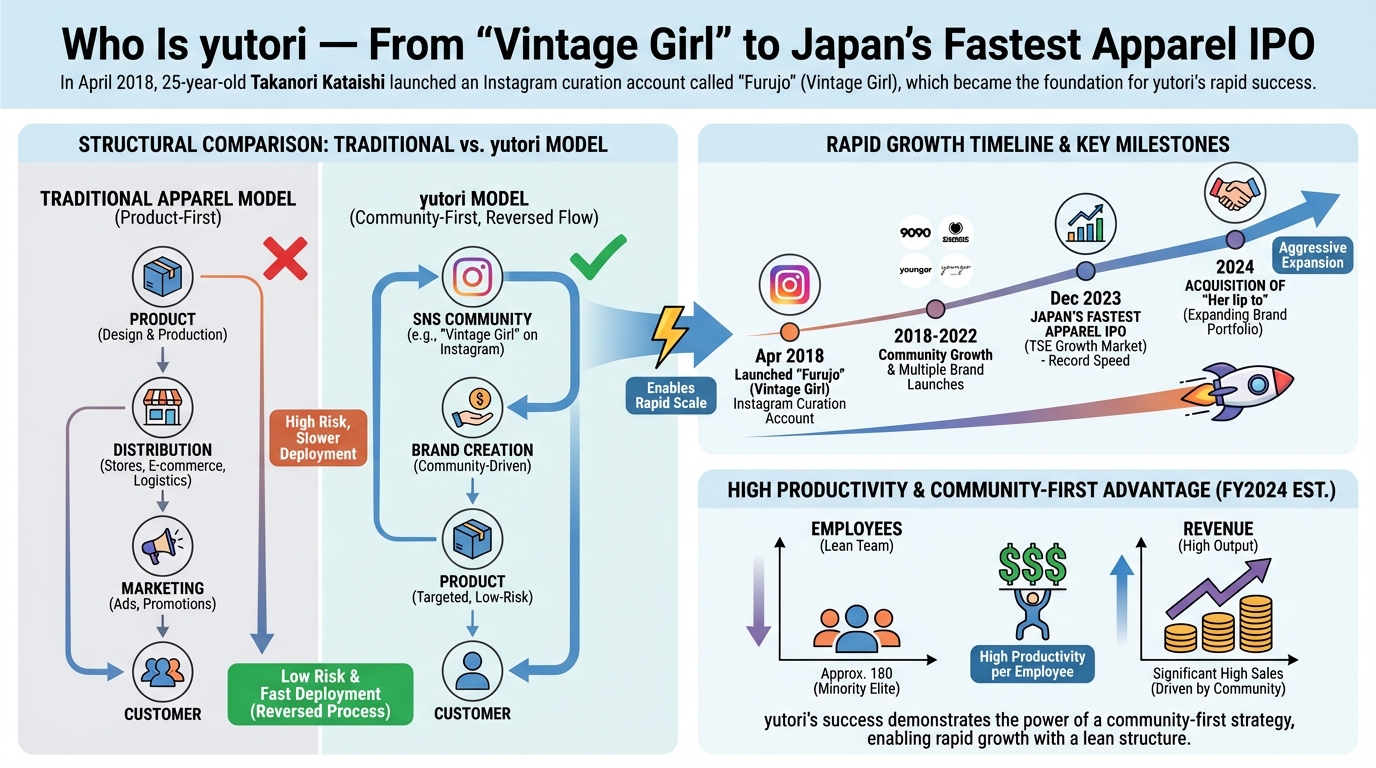
In April 2018, 25-year-old Takanori Kataishi launched an Instagram curation account called "Furujo" (Vintage Girl). That account became the seed for yutori, a company that would go on to list on the Tokyo Stock Exchange Growth Market in December 2023 — the fastest IPO in Japanese apparel history.
From roughly $67K in first-year revenue, yutori scaled through its flagship streetwear brand 9090 (Ninety Ninety), a period under the ZOZO Group umbrella (2020), and eventually independence through its IPO. In August 2024, the company acquired heart relation — the company behind former AKB48 member Haruna Kojima's "Her lip to" brand — for approximately 1.7 billion yen (~$11.3M), expanding from streetwear into feminine fashion.
FY2026 revenue is projected at 11 billion yen (~$73M). But the numbers only tell half the story.
What sets yutori apart from legacy apparel companies is the order of operations. Traditional brands start with product, then build distribution, then bolt on marketing. yutori started with community — building an SNS audience first, then launching products into that audience. This inverted sequence changes everything about how the company operates.
For Western readers, think of it as Gymshark's community-first model combined with Shein's speed-to-market — except yutori manages it with an employee base of just 180 people.
References: yutori CEO Kataishi on growth strategy targeting 30B yen - Net Shop Forum yutori IPO: Fastest in Japanese apparel history - fashionsnap.com yutori acquires Her lip to parent company for 1.7B yen - WWDJAPAN
2. The Y-League System — Don't Nurture Brands, Select Them
Why Multi-Brand Strategy Works for Gen Z
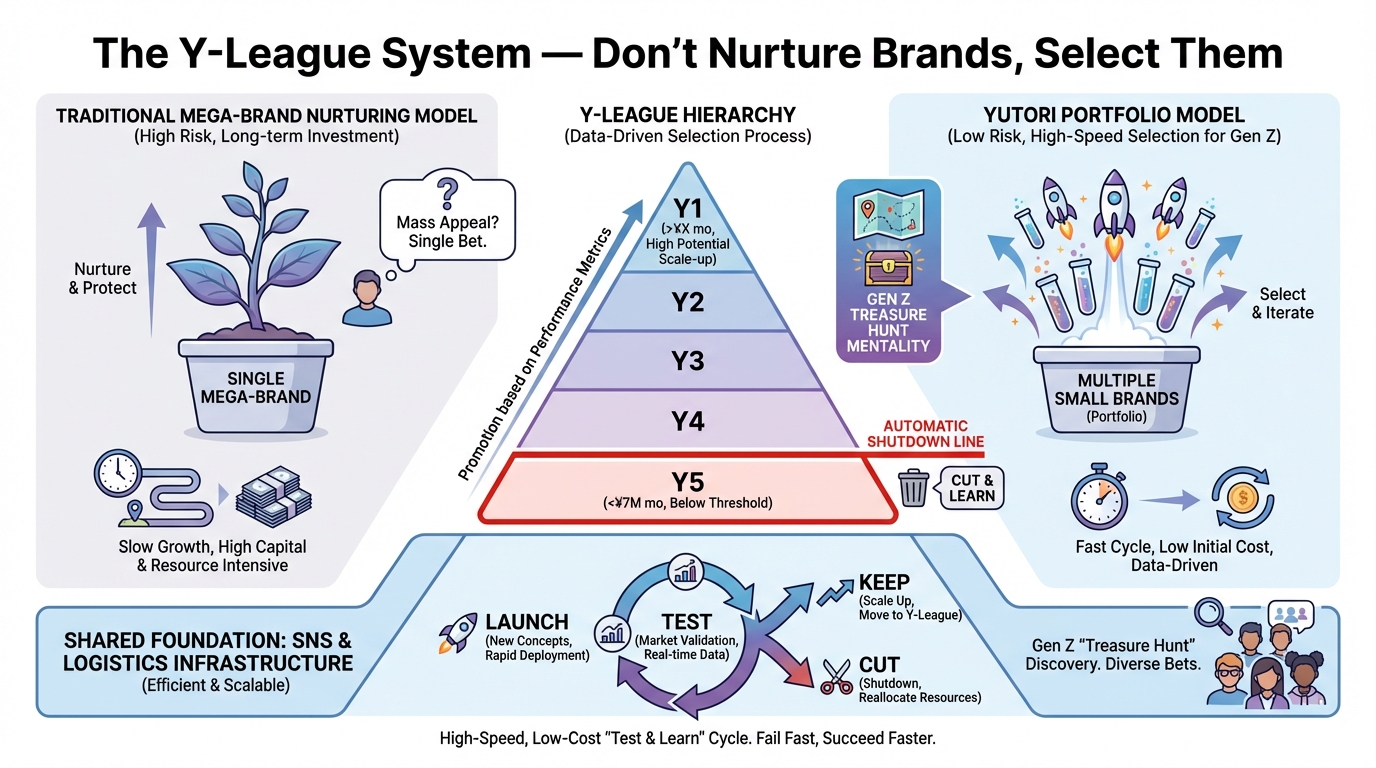
yutori doesn't bet big on a single mega-brand. Instead, it launches many small brands and lets the market decide which survive. As of March 2025, the company operates 38 brands with a 5-year target of 70.
This approach aligns with how Gen Z shops. This generation values discovery over conformity — finding a niche brand nobody else wears matters more than wearing the latest from an established label. A portfolio of small, distinct brands turns shopping into a treasure hunt.
How Y-League Works in Practice
After launch, each brand is ranked Y1 through Y5 based on monthly revenue. Y5 brands — those generating less than 7 million yen per month (~$47K) — face automatic shutdown. Decisions are data-driven, not emotional. This limits inventory risk and concentrates resources on proven winners.
The "launch, test, keep or cut" cycle works because yutori's existing SNS channels and logistics infrastructure are shared across brands. Per-brand startup costs stay low, and SNS engagement data provides fast signal on what's working.
This framework mirrors how venture portfolios operate: place many small bets, double down on winners, and cut losers quickly. It's applicable well beyond fashion — any D2C brand running multiple product lines or sub-brands can adopt a version of this approach.
For a deeper look at how SNS content strategy intersects with AI search algorithms and platform-specific optimization, see "X, Instagram & LinkedIn AI Search Optimization: 2026 SNS Strategy Guide."
References: yutori CEO on 30B yen growth strategy - Net Shop Forum yutori's next-generation brand incubation strategy - WWDJAPAN Analyzing yutori's Gen Z appeal - note
3. SNS Operations — The "Brand = Influencer" Design Philosophy
Removing Corporate Feel from Instagram
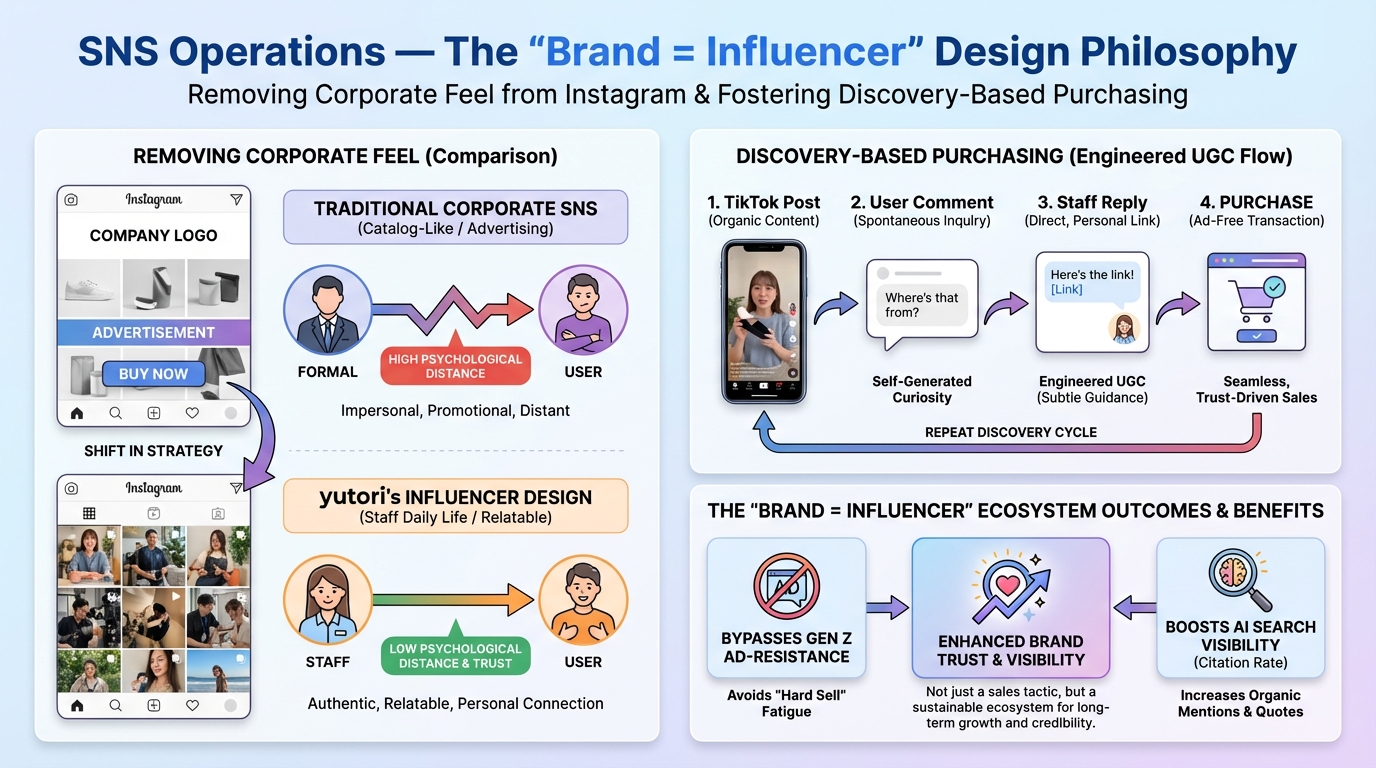
The most striking thing about yutori's Instagram accounts is that they don't look like corporate accounts at all.
Instead of product catalog shots, content shows staff going about their daily lives with yutori products woven in naturally. Captions read like personal thoughts, not brand copy. This "brand account behaves like an influencer" approach shrinks the distance between follower and brand.
Short-form video (Reels and Stories) leans heavily into trending audio to boost watch-through rates. The team designs 15-30 second clips that make you want to watch until the end, incorporating save and DM-share triggers throughout.
Turning "Where's That From?" Into Revenue
The most effective part of yutori's SNS playbook is how they use TikTok's comment section as a purchase funnel.
A staff member posts a day-in-my-life video. They're casually wearing a 9090 piece. Comments roll in: "What brand is that?" "Where can I buy it?" The reply includes a direct purchase link. The whole interaction feels organic because it is — no ad creative, no sponsored post label.
CEO Kataishi has publicly stated that "clothes sell through TikTok comments." This isn't accidental discovery; it's engineered UGC strategy. By creating a "find it yourself" experience rather than a "being sold to" experience, yutori sidesteps Gen Z's well-documented ad resistance.
Platforms like LinkSurge confirm that for Gen Z-focused brands, AI search citation rates correlate strongly with the volume of SNS-generated UGC. The "don't sell, let them discover" approach ends up boosting brand visibility in AI search results too.
References: yutori on why clothes sell through TikTok comments - App Marketing Lab Learning Gen Z SNS marketing from yutori - apparel01.com Instagram corporate account case studies - real-us.co.jp
4. Pop-Ups and OMO — Offline Events as UGC Generators
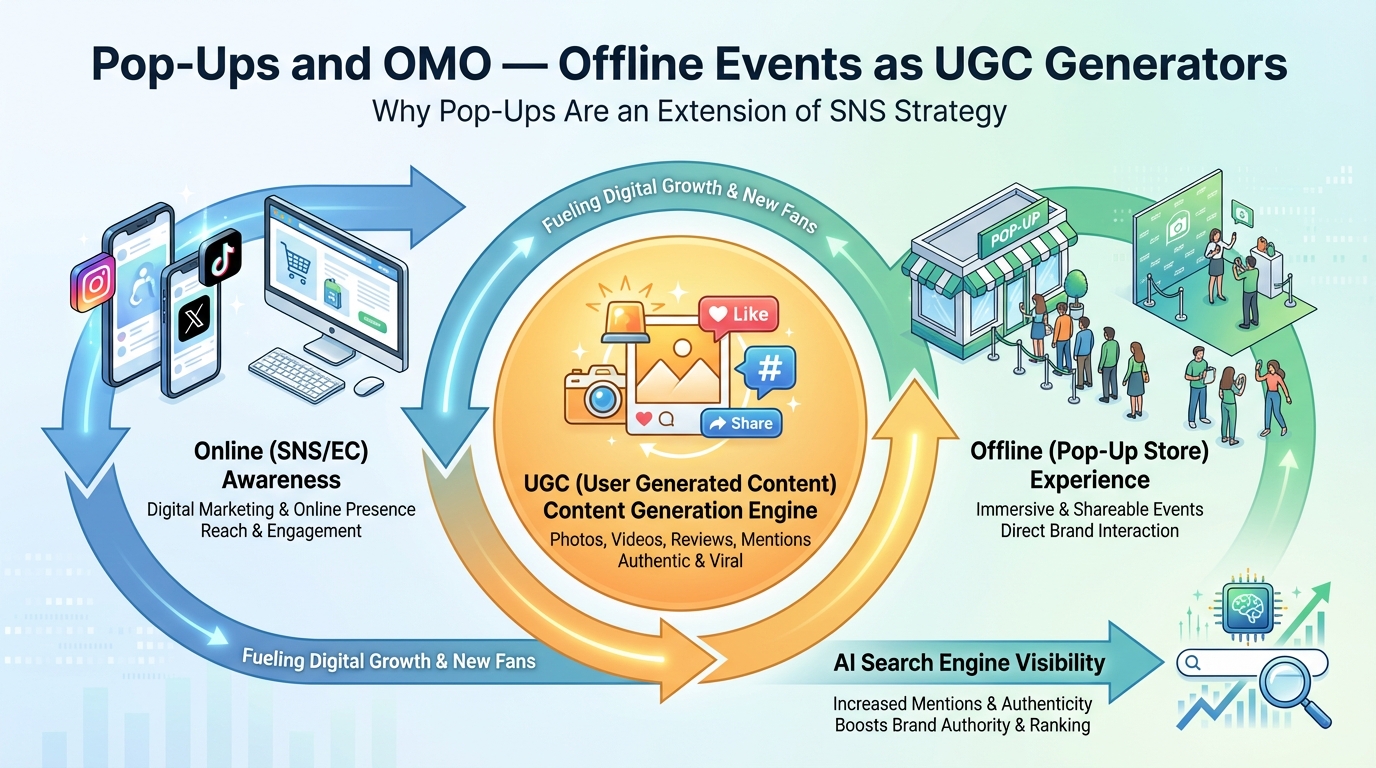
Why Pop-Ups Are an Extension of SNS Strategy
The majority of yutori's revenue comes from e-commerce, but the company is investing heavily in physical retail. Store count doubled to 46 locations by March 2025. The 9090 brand also expanded internationally with a Shanghai pop-up.
The key insight: these pop-ups aren't designed just to sell product on the floor. They're designed so that attendees post about the experience on social media. Limited-edition items, photo-worthy installations, direct staff interaction — every element is calibrated to generate "I was there" content. Each attendee's post becomes organic marketing that draws the next wave of visitors.
This is the full OMO (Online Merges with Offline) loop: SNS and e-commerce drive awareness, pop-ups deepen the experience, and attendee posts feed back into the online conversation. It's a self-reinforcing cycle that grows with each iteration.
As AI search engines increasingly weight brand mentions across social platforms, the total volume of UGC directly impacts how often a brand gets cited in AI-generated answers. For more on how off-site brand signals affect AI search visibility, see "91% of AI Answers Come from Off-Site Sources — Off-Site SEO and GEO Strategy."
References: yutori 9090 Shanghai pop-up success - PR TIMES yutori FY2025 results - fashionsnap.com yutori D2C + OMO strategy analysis - note
LinkSurge
linksurge.jp
SEO・AIO・GEO統合分析プラットフォーム。AI Overviews分析、SEO順位計測、GEO引用最適化など、生成AI時代のブランド露出を最大化するための分析ツールを提供しています。
5. Organizational Design — Gen Z Selling to Gen Z
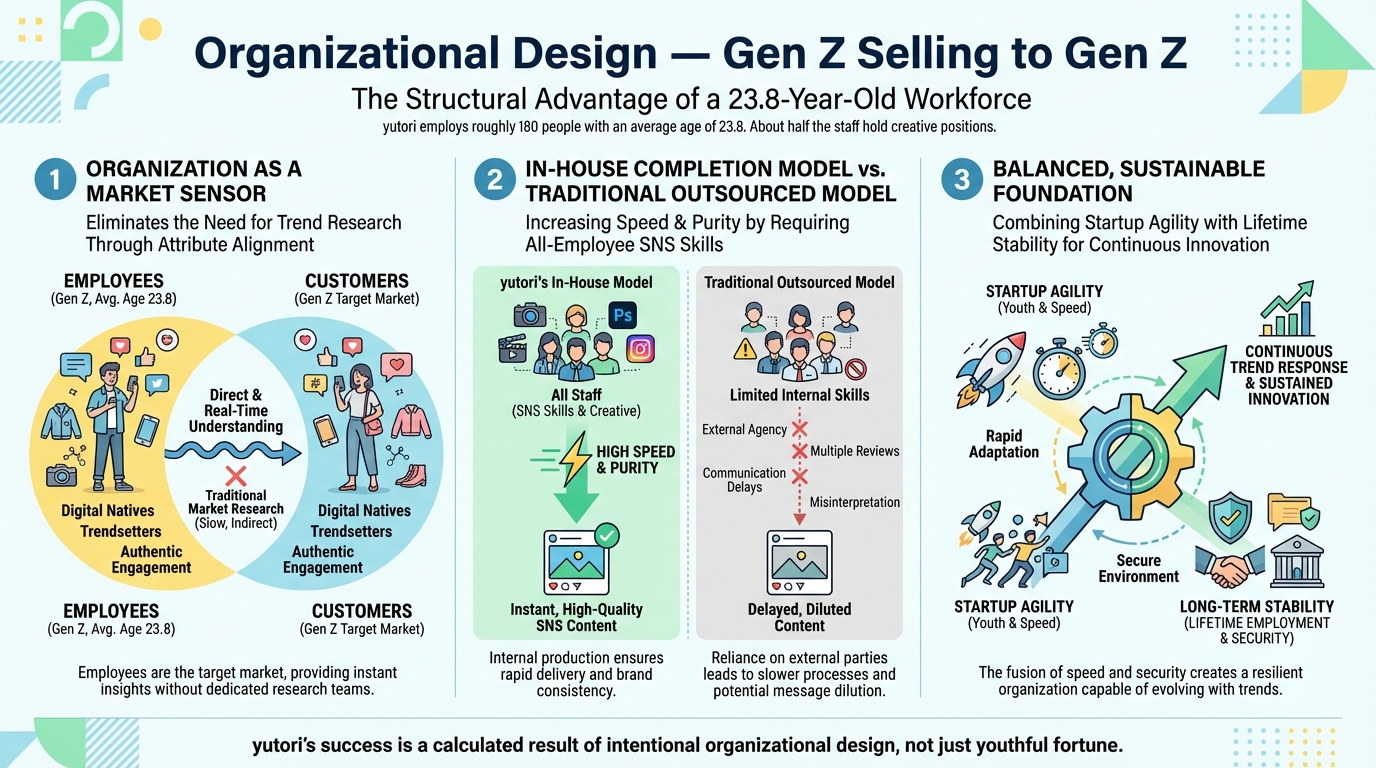
The Structural Advantage of a 23.8-Year-Old Workforce
yutori employs roughly 180 people with an average age of 23.8. About half the staff hold creative positions.
This isn't just a "young company" data point. When your creators are the same age as your customers, you don't need trend research. The team's own instincts serve as a real-time market sensor. Content resonates because it's made by people who genuinely share the audience's tastes, references, and communication style.
Hiring for SNS Content Creation Ability
yutori's hiring process explicitly evaluates "selling sense" and short-form video creation skills. This means every person involved with a brand — not just the marketing team — can create content. The result: no dependency on external creative agencies, and a dramatically faster content production cycle.
CEO Kataishi has said "lifetime employment is the best" — an unusual stance for a startup founder. While most fast-growing companies accept high turnover as a cost of business, yutori is investing in long-term retention. The combination of youthful speed and organizational stability creates a foundation for sustained trend-riding.
Compare this with Western D2C brands that outsource content creation to agencies or freelancers. The content may be polished, but it often lacks the authentic voice that comes from creators who are genuinely part of the target community.
References: CEO Kataishi: "Lifetime employment is the best" - WWDJAPAN yutori CEO Kataishi interview - Nikkei X-Trend yutori company page - Wantedly
6. Five Transferable Tactics from yutori's Playbook
yutori's case isn't just a "they were young and lucky" story. These five tactics are applicable across industries and markets.
Tactic 1: Give Your Brand Account a Personality
Strip the corporate voice. Let the person behind the account show through. Prioritize staff lifestyle content over product shots. This single shift can meaningfully change engagement rates, regardless of industry.
Tactic 2: Engineer Comment-Driven Purchase Funnels
Create posts designed to provoke "Where's that from?" questions on TikTok and Instagram. Reply with product links. This costs nothing in ad spend and works for food, beauty, home goods, and fashion alike.
Tactic 3: Apply Quantitative Kill Criteria to Projects
Adopt a Y-League-style framework: set clear revenue or engagement thresholds, and shut down initiatives that don't hit them within a defined timeframe. Remove emotion from the decision. This applies to product lines, content series, marketing campaigns — anything with measurable output.
Tactic 4: Design Events for Social Posting First
When planning any offline activation, start with the question: "What will attendees post?" Photo moments, exclusive access, and personal interactions are all UGC triggers. Plan for them deliberately rather than hoping they happen organically.
Tactic 5: Hire Creators from Your Target Demographic
Internal content creation by people who belong to your target audience produces content that feels authentic — because it is. External agencies can supplement, but the core voice should come from within.
LinkSurge's AI Overview analysis lets you track how your brand is being cited in AI search results at the keyword level. Connecting SNS activity to AI search visibility gives you a clearer picture of where your marketing investment is actually paying off.
References: yutori's brand incubation strategy - WWDJAPAN Learning marketing from yutori - note yutori growth strategy analysis - CBO Lab
7. Limitations and Risks of the yutori Model
No case study is complete without acknowledging the risks.
Brand dilution — Running 38 brands simultaneously means each individual brand story stays shallow. The Y-League system manages inventory risk, but a "test and discard" orientation can undermine the long-term fan loyalty that makes a brand durable. There's a tension between portfolio breadth and brand depth.
Governance risk in a young organization — A 23.8-year average age delivers speed but raises questions about crisis management, compliance, and institutional knowledge. No major public incidents have surfaced, but as the company scales, governance maturity will need to keep pace.
Trend dependency — Gen Z trends rotate fast. Today's hit brand can feel dated in six months. The multi-brand model diversifies this risk, but the constant pressure to stay at the bleeding edge of culture puts sustained strain on the organization.
Even with these risks, yutori's model stands out because so much of it is systematized and reproducible. It's not built on a single founder's taste — it's built on a process.
Frequently Asked Questions
What is 9090, yutori's flagship brand?
9090 (Ninety Ninety) is a streetwear brand launched in 2018 that draws on 1990s and 2000s youth culture aesthetics. It's the most recognized brand in the yutori portfolio and expanded internationally with a pop-up in Shanghai in 2025.
What is the Y-League system?
Y-League is yutori's brand evaluation framework. Brands are ranked Y1 through Y5 based on monthly revenue. Y5 brands — those generating less than 7 million yen per month (roughly $47K) — face automatic shutdown. It removes emotional attachment from business decisions and ensures resources flow to proven performers.
Why does yutori's SNS strategy resonate with Gen Z?
The biggest factor is authenticity of voice. Content is created by employees whose average age is 23.8 — the same demographic as the target customer. Combined with a deliberate strategy of making brand accounts feel like personal accounts rather than corporate channels, this produces content that Gen Z trusts rather than skips.
Can yutori's strategy work outside fashion?
Yes. The core tactics — personalizing brand accounts, using comment sections as purchase funnels, applying quantitative criteria to project decisions, designing events for UGC, and hiring from your target audience — are industry-agnostic. They're especially relevant for D2C and e-commerce businesses. To measure how SNS efforts translate to AI search visibility, tools like LinkSurge can track brand citations across AI platforms in real time.
Conclusion: Building an SNS-First Business
yutori's success isn't about being good at social media. It's about structuring an entire business around the assumption that SNS is the primary channel through which customers discover, evaluate, and advocate for brands.
Three things you can start with today: give your social accounts a genuine human voice, design your TikTok and Instagram content to generate "Where's that from?" comments, and set quantitative thresholds for every initiative so you can cut losers fast and double down on winners.
SNS activity and AI search visibility are increasingly linked. LinkSurge's AI Overview analysis lets you see exactly how your brand's social presence translates into citations in Google AI Overviews and other AI search platforms — giving you the data to connect SNS investment to measurable search outcomes.