What Is Search Intent? The 4 Types and How They Shape SEO
目次
Key Takeaways: Why Search Intent Matters for SEO
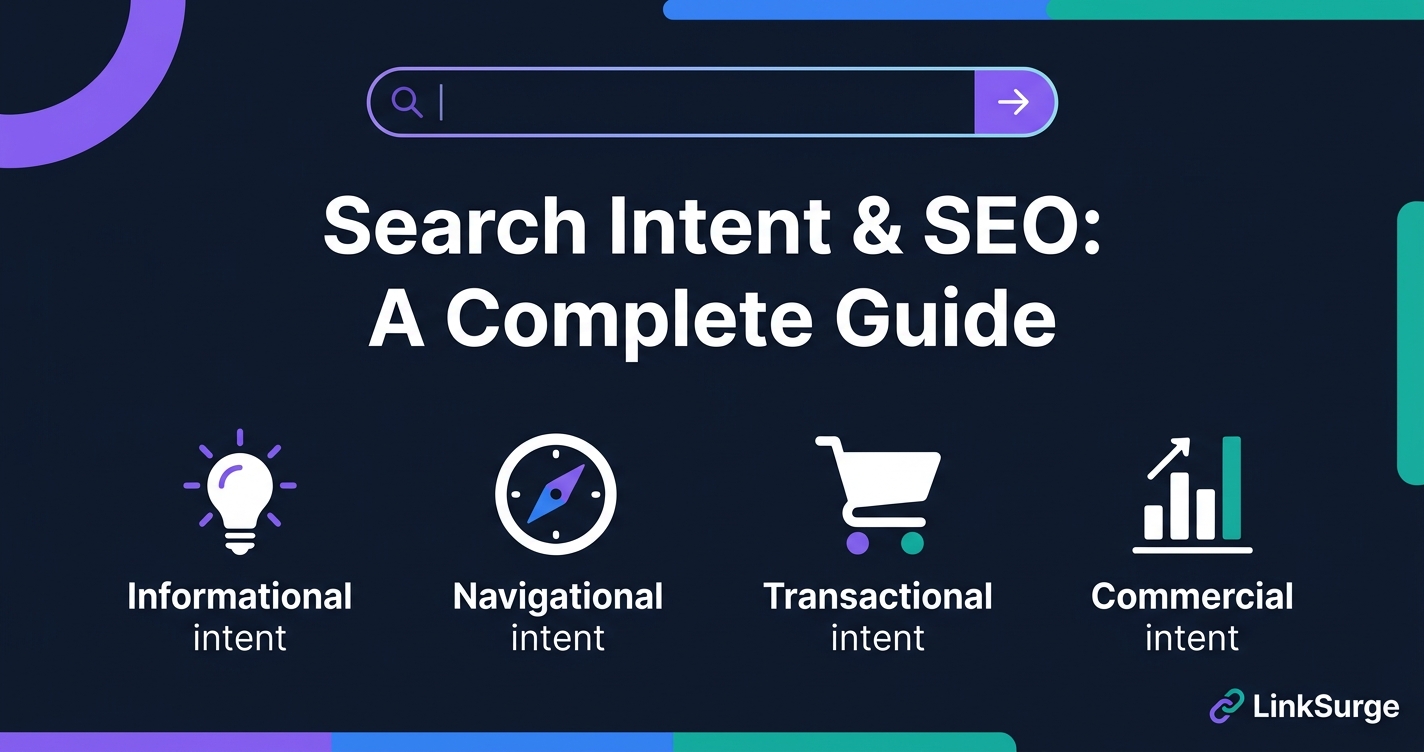
- Search intent falls into 4 categories — Informational, navigational, transactional, and commercial investigation. Understanding these categories is the foundation of modern SEO strategy
- Google prioritizes intent-matched content — Rankings increasingly depend on how well your page satisfies the purpose behind a query, not just keyword matching
- SERP analysis is the most reliable method — Searching your target keyword and examining the top 10 results reveals exactly how Google interprets intent
- Each intent type requires a different content format — Blog posts for informational, product pages for transactional, comparison articles for commercial investigation
- AI search makes intent alignment even more critical — AI Overviews and ChatGPT search understand context deeply, filtering out intent-mismatched content more aggressively
Let's explore each of these themes in detail.
1. What Is Search Intent and Why Does It Matter?
Search intent — also called user intent or query intent — is the underlying purpose behind a search query. When someone types "what is SEO" into Google, they want information. When they type "SEO tool pricing," they're evaluating a purchase. The same topic, entirely different goals.
Why Google cares about intent
Search engines have evolved from simple keyword matching to semantic understanding. Google now recognizes the goal behind a query and serves results that satisfy that goal. A page stuffed with the right keywords but misaligned with intent will consistently underperform.
What struck me during years of SEO analysis is how unforgiving this has become. You can have perfect on-page SEO, strong backlinks, and authoritative content — but if your page answers the wrong question, it won't rank.
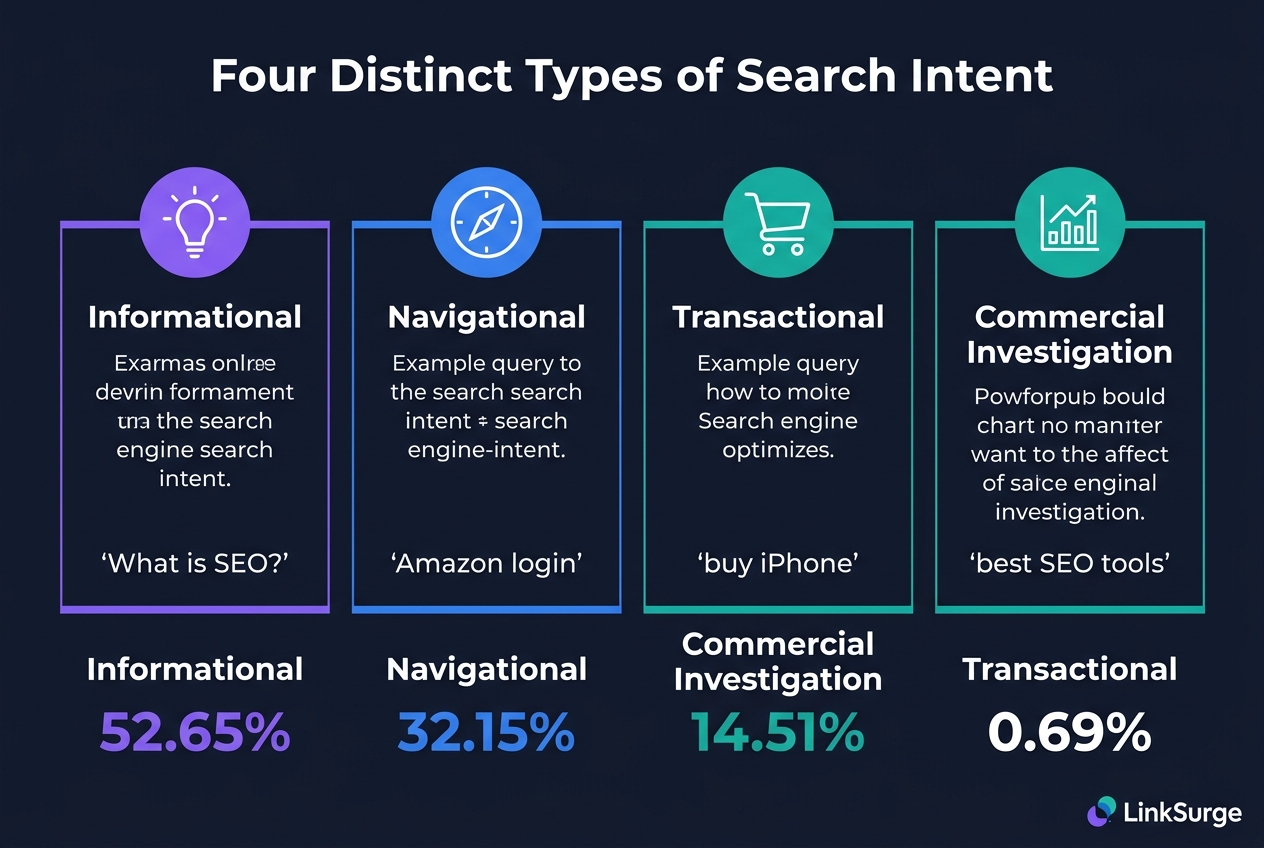
As of 2025, the breakdown of search queries by intent is: 52.65% informational, 32.15% navigational, 14.51% commercial, and just 0.69% transactional. This distribution shapes how you should allocate your content creation efforts.
Understanding intent is also critical when building topic clusters and internal linking strategies — each page in the cluster should target a distinct intent.
References: Search Intent: The New SEO Currency in 2026 - Brand Mender Search Intent in SEO and Its Impact on Rankings - Digital Sprout Search Intent Models: Why important for Modern SEO in 2026? - ClickRank
2. The 4 Types of Search Intent Explained
Informational intent
Users want to learn something. Queries like "what is search intent," "how to do keyword research," or "SEO best practices 2026" fall here. This is the largest category at 52.65% of all searches. Blog posts, guides, tutorials, and FAQ pages are the ideal content formats.
Navigational intent
Users want to reach a specific website or page. "Google Search Console login," "Amazon Prime," or "LinkSurge pricing" are navigational queries. At 32.15%, this is the second-largest category. Ensuring your brand appears correctly in search results through proper site structure and schema markup is essential.
Transactional intent
Users are ready to take action — buy, sign up, download. "Buy iPhone 15," "SEO tool free trial," or "subscribe to newsletter" signal transactional intent. Despite being only 0.69% of queries, these have the highest conversion potential.
Commercial investigation
Users are comparing options before a purchase decision. "Best SEO tools 2026," "Ahrefs vs SEMrush," or "top link building services" reflect this research phase. Comparison articles, reviews, and feature-by-feature analyses work best here.
Here's the thing: real-world queries often blend multiple intents. "SEO tools" could be informational (what tools exist?) or commercial (which should I buy?). The SERP itself is your best guide — check what Google actually ranks and match that format.
References: Search Intent in 2026: The 3 New Intent Types AI Search Created - Jeff Lenney Why Mastering Search Intent Is Essential for Ranking in 2026 - LinkNow Mastering Search Keyword Intent: A Simple Guide - Niumatrix
3. How to Analyze Search Intent: 3 Practical Methods
Accurately determining search intent requires combining multiple approaches. Here are three methods that consistently deliver reliable results.
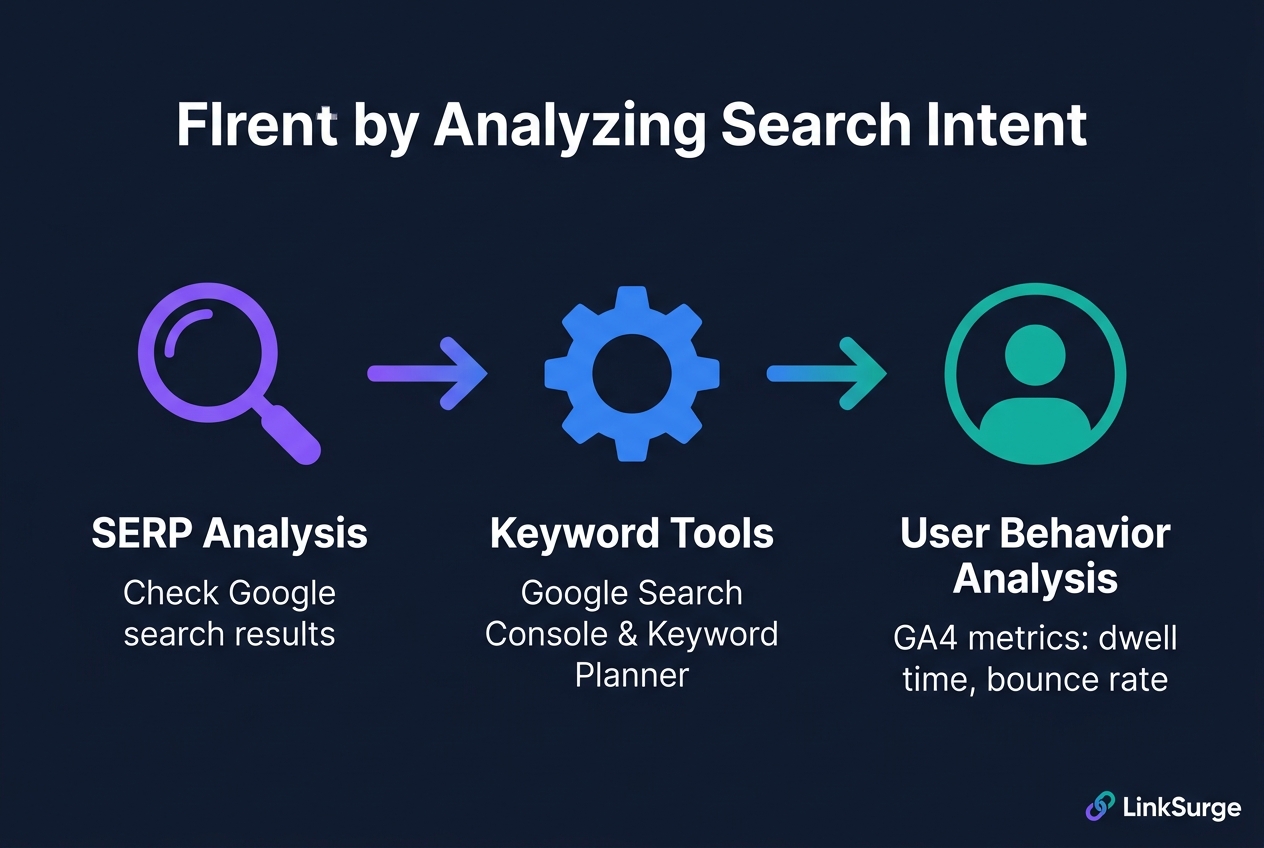
Method 1: SERP analysis (most important)
Search your target keyword on Google and examine the top 10 results. The content types that appear — blog posts, product pages, videos, comparison tables — directly reflect Google's interpretation of intent. If the top results are all how-to guides, creating a product page for that keyword won't work.
For a step-by-step beginner walkthrough, see Why You Should Look at Search Results Before You Write.
Method 2: Keyword tools
Use Google Search Console, keyword planners, and SEO platforms to examine CTR patterns and search volume. Low CTR may indicate an intent mismatch between your content and what users expect. LinkSurge provides intent classification data that helps streamline this analysis.
Method 3: User behavior analytics
Review GA4 metrics — dwell time, bounce rate, scroll depth, and conversion paths. Pages that match intent well tend to have longer sessions and lower bounce rates. High bounce rates often signal an intent mismatch that needs correcting.
Honestly, the companies I've seen succeed at intent optimization use all three methods together. Relying on a single data source gives you an incomplete picture. Cross-referencing SERP data with user behavior metrics provides the clearest view of whether your content truly satisfies user intent.
References: Integrate Search Intent Analysis Into Your Enterprise Content Strategy - Siteimprove Search Intent in SEO and Its Impact on Rankings - Digital Sprout Semantic SEO for 2026: A Practical Guide - Reddit/SEMrush
4. Content Optimization by Intent Type
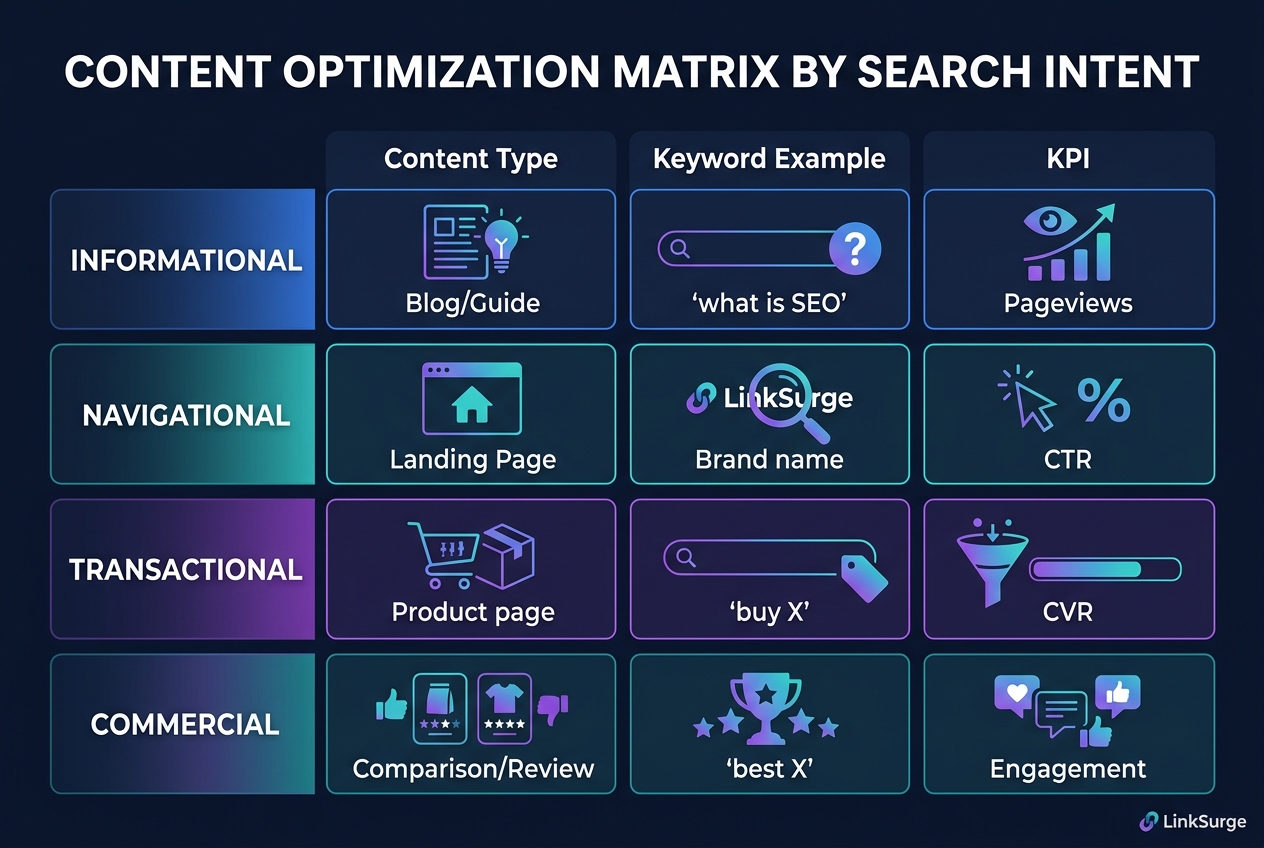
Once you've identified the intent behind your target keywords, the next step is aligning your content format, structure, and KPIs accordingly.
To signal that intent in the search results themselves, see Title Tags and Meta Descriptions.
Optimizing for informational intent
Create blog posts, comprehensive guides, and explainer articles. Use question-based headings and provide concise answers upfront — an "answer-first" structure that also performs well in AI Overviews. Track pageviews and average session duration as your primary KPIs.
Optimizing for navigational intent
Ensure your brand's landing pages rank for branded queries. Implement structured data (Organization, WebSite schema) and maintain consistent NAP (Name, Address, Phone) information. Monitor click-through rate as the key metric.
Optimizing for transactional intent
Build product pages and service landing pages with clear CTAs. Page load speed, mobile optimization, and trust signals (reviews, security badges) directly impact conversion rates. CVR is the primary KPI here.
Optimizing for commercial investigation
Develop comparison articles, in-depth reviews, and ranking content. "X vs Y" formats and feature checklists help users make decisions. Engagement metrics — time on page, pages per session — indicate whether your content assists the decision-making process.
The critical principle, as covered in our Complete SEO Guide, is one page per intent. Trying to serve multiple intents on a single page dilutes your relevance for all of them.
References: SEO in 2026: How AI is reshaping the fundamentals - Adobe SEO & AI Search Best Practices to Implement in 2026 - Svitla Systems Search Intent: The New SEO Currency in 2026 - Brand Mender
5. Search Intent in the Age of AI Search
The rise of AI Overviews, ChatGPT-powered search, and Perplexity has fundamentally changed how search intent operates. AI search engines don't just match keywords — they understand context, nuance, and the user's journey stage with remarkable precision.
New intent patterns emerging from AI search
Beyond the traditional four categories, AI search has created new behaviors: "deep exploration" intent (users wanting to go beyond the AI summary) and "verification" intent (users checking whether the AI's answer is accurate). These patterns require content that provides depth, citations, and unique perspectives that AI summaries alone can't deliver.
What SEO practitioners should do
To succeed in AI search, focus on structured data implementation, E-E-A-T signals, and answer-first content structures. As we discuss in How AI Search Impacts SEO, the pages that get cited in AI Overviews are those that most precisely match user intent with authoritative, well-structured content. LinkSurge's AI readiness analysis helps quantify how well your content is optimized for AI search visibility.
What I find most compelling about the AI search shift is this: intent alignment isn't becoming less important — it's becoming the primary ranking factor. AI systems are simply better at detecting intent mismatches than traditional algorithms ever were.
References: SEO And AI In 2026: Adapt Or Get Buried - eLearning Industry SEO & AI Search Best Practices to Implement in 2026 - Svitla Systems Search Intent in 2026: The 3 New Intent Types AI Search Created - Jeff Lenney
LinkSurge
linksurge.jp
SEO・AIO・GEO統合分析プラットフォーム。AI Overviews分析、SEO順位計測、GEO引用最適化など、生成AI時代のブランド露出を最大化するための分析ツールを提供しています。
Frequently Asked Questions
How do I determine the search intent for a keyword?
The most practical method is to search the keyword on Google and analyze the top 10 results. Look at the content types that appear — if they're mostly blog posts, the intent is informational. If product pages dominate, it's transactional. Google Search Console CTR data and tools like LinkSurge can provide additional intent classification insights.
Can a keyword have multiple search intents?
Yes. Many keywords carry mixed intent. For example, "SEO tools" could be informational (learning what exists) or commercial (comparing options to buy). In such cases, examine the SERP to determine which intent Google prioritizes, and align your content accordingly.
What happens if my content doesn't match search intent?
Users will bounce quickly because they didn't find what they were looking for. This signals to Google that your page isn't satisfying the query, leading to lower rankings over time. Auditing existing content for intent alignment is one of the highest-ROI SEO activities available.
Is search intent still relevant with AI search engines?
More than ever. AI search engines understand context and intent with greater precision than traditional algorithms. Content that doesn't align with user intent is filtered out more aggressively by AI systems like Google's AI Overviews and ChatGPT search.
Summary: Intent Understanding Is the Foundation of SEO Success
Search intent is the concept that ties together everything in modern SEO — keyword research, content strategy, site architecture, and performance measurement. Understanding the four intent types, analyzing them through SERP data and user behavior metrics, and creating intent-matched content is the path to sustainable rankings.
As AI search becomes the norm in 2026 and beyond, intent alignment isn't optional — it's the baseline requirement. Start by auditing your highest-traffic pages: does the content match what users actually want when they search those keywords?
LinkSurge's keyword analysis features help you classify search intent, analyze SERPs, and track how well your content aligns with user goals. Build your content strategy on data, not assumptions.