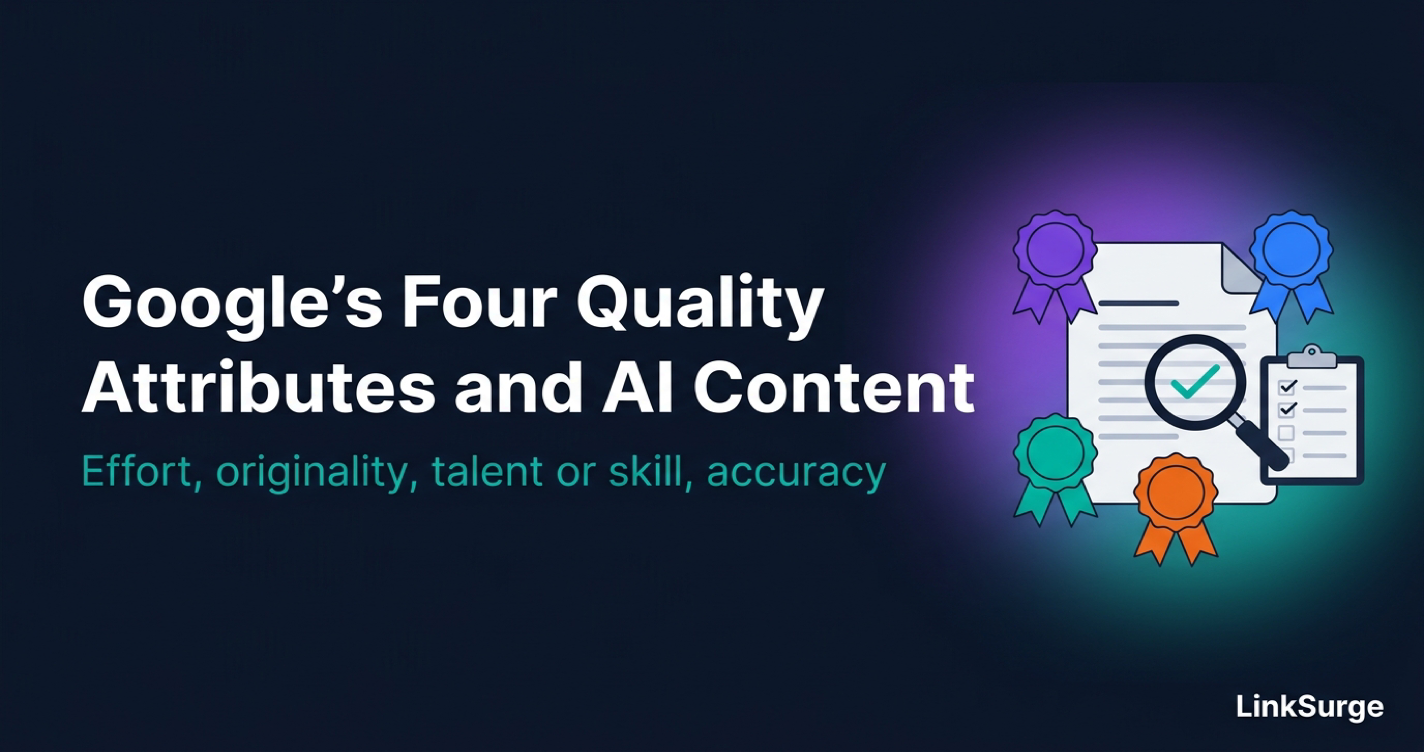
Google Spells Out Four Quality Attributes: Effort, Originality, Talent or Skill, Accuracy, Plus a Pre-Publish Checklist for AI-Assisted Content
目次
Key Takeaways: Using AI isn't the problem. Mass production without human work is
In early October 2026, Google updated two Search Central documents: the guidance on using generative AI content (October 1) and the page on creating helpful, people-first content (last updated October 5). After reading both side by side, here's what stands out.
- Quality is judged on "main content" — Google defines it as any part of a page that directly helps the page achieve its purpose. That includes text and media, but also calculators, reviews, tabbed sections, and titles and headings
- Four attributes: effort, originality, talent or skill, accuracy — Quality raters are trained to evaluate main content on these. Using generative AI to produce large amounts of text without manual oversight or curation is called out as little to no effort
- Citing sources doesn't count as effort — Google now says attribution "doesn't replace the need for original effort." Summarizing other sites and listing links isn't enough
- Fact-check AI output by hand before you publish — Generative models predict likely word sequences rather than retrieving facts, so they can be wrong. The check covers titles, meta descriptions, structured data and image alt text too
- Fake authors are deception — AI-generated headshots, made-up names and false credentials are explicitly described as deceptive and a signal of low quality
Let's break each of these down.
1. What Changed in Early October
First, the facts. Google's documentation changelog and the pages' last-updated dates show two changes.
| Date | Page | Main change |
|---|---|---|
| October 1, 2026 | Guidance on using generative AI content | Brought in material from the quality rater guidelines and made manual fact-checking before publishing explicit |
| October 5, 2026 (last updated) | Creating helpful, reliable, people-first content | Added a definition of main content, the four attributes, and a warning about deceptive authorship |
Google's stated reason for the generative AI update is "to get our documentation in sync with our presentations we use at our developer events." So this reads less like a new rule and more like ideas from the rater guidelines landing in the official docs.
The generative AI guidance points to two specific sections of the rater guidelines: scaled content abuse (4.6.5) and main content created with little to no effort, originality or added value (4.6.6).
References: Latest documentation updates - Google Search Central Google Search's guidance on using generative AI content on your website - Google Search Central Creating helpful, reliable, people-first content - Google Search Central
2. What Counts as Main Content?
Google defines main content as any part of a page that directly helps it achieve its purpose. It lists five kinds.
| Type | Examples |
|---|---|
| Primary text and media | Main text, articles, images, audio, video |
| Interactive features | Calculators, online tools, games, search |
| User-generated contributions | Forum discussions, reviews, comments, when they fulfill the page's purpose |
| Tabbed or expanded sections | Product specs, safety notes, user reviews |
| Page titles and headings | Visible titles and headings that summarize the topic |
Two easy-to-miss points
What caught my eye is that tabbed content and headings are named explicitly. You still hear claims that content behind tabs doesn't count. Google's own definition says it can be main content.
Titles and headings matter too. A heading that misrepresents the page, or a sensational title, can drag down the quality of the main content itself. The same page's self-assessment questions ask whether titles avoid exaggeration or shock value.
References: Creating helpful, reliable, people-first content - Google Search Central
3. How to Read the Four Attributes
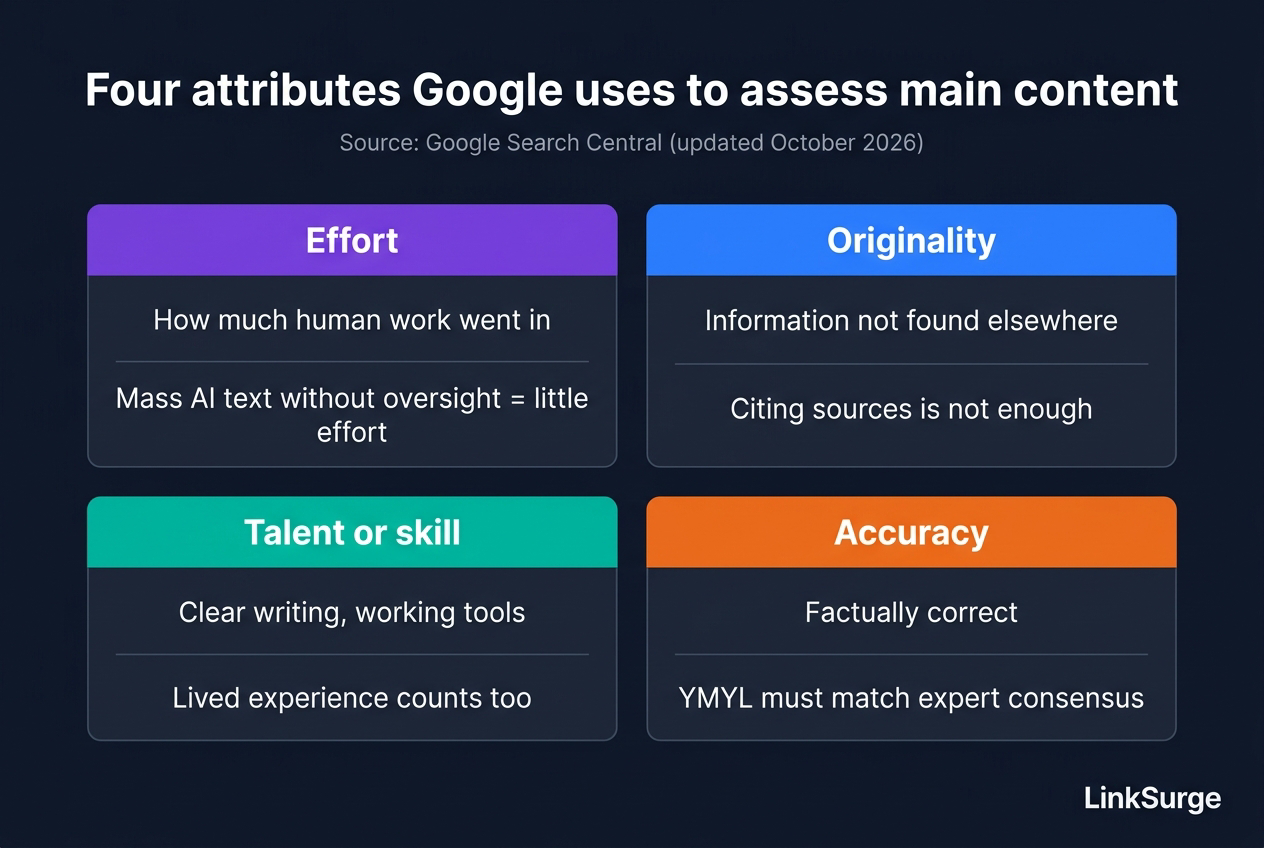
Now for the core of the update. Google says raters are trained to evaluate these fundamental attributes of main content.
| Attribute | Google's description (summarized) | Low-quality example |
|---|---|---|
| Effort | How much human work went into the content or the systems powering it | Auto-generating pages from feeds; producing large amounts of AI text without oversight or curation |
| Originality | Unique information or perspectives not available on other sites | Rewording and summarizing other pages |
| Talent or skill | The skill or expertise needed for a satisfying experience: clear writing, well-produced video, working tools | Hard-to-read text, broken tools |
| Accuracy | Factually accurate for informational pages; for YMYL topics, highly accurate and consistent with expert consensus | Easily verified factual errors |
Effort is the most pointed
Of the four, the effort attribute goes furthest in my reading. Google's high-effort examples are writing original analysis, translating a poem by hand and building a custom interactive map for a game. Then comes the line that matters: attribution or giving credit to other sources doesn't replace the need for original effort.
That sentence describes a very common workflow almost word for word: have AI summarize what's already online, then add a list of source links. Citing sources is good for readers. It just isn't effort.
Skill doesn't always mean credentials
Google adds that not all content requires specialized expertise. Its example is someone sharing how they found a new way to clear snow from their driveway. When lived experience is the value, a specific, honest account can beat a title.
Accuracy scales with the stakes
For health, finance, safety and other YMYL topics, the bar is higher: content must be highly accurate and consistent with established expert consensus.
One caveat. Rater scores don't directly change rankings. Google compares rater feedback to comment cards a restaurant collects from diners. Treat the four attributes as a description of where Google's systems are aiming, not a checklist that boosts rankings.
Experts surveyed on Google's AI features ranked original data and specific, citable facts near the top as well. More in "Google AI Ranking Factors: What 130+ Experts Scored Highest".
References: Creating helpful, reliable, people-first content - Google Search Central Search Quality Rater Guidelines - Google
4. A Pre-Publish Checklist for AI-Assisted Content
Here's how I'd turn the four attributes and the generative AI guidance into checks before you hit publish. The question isn't whether you used AI. It's where the human work shows up.
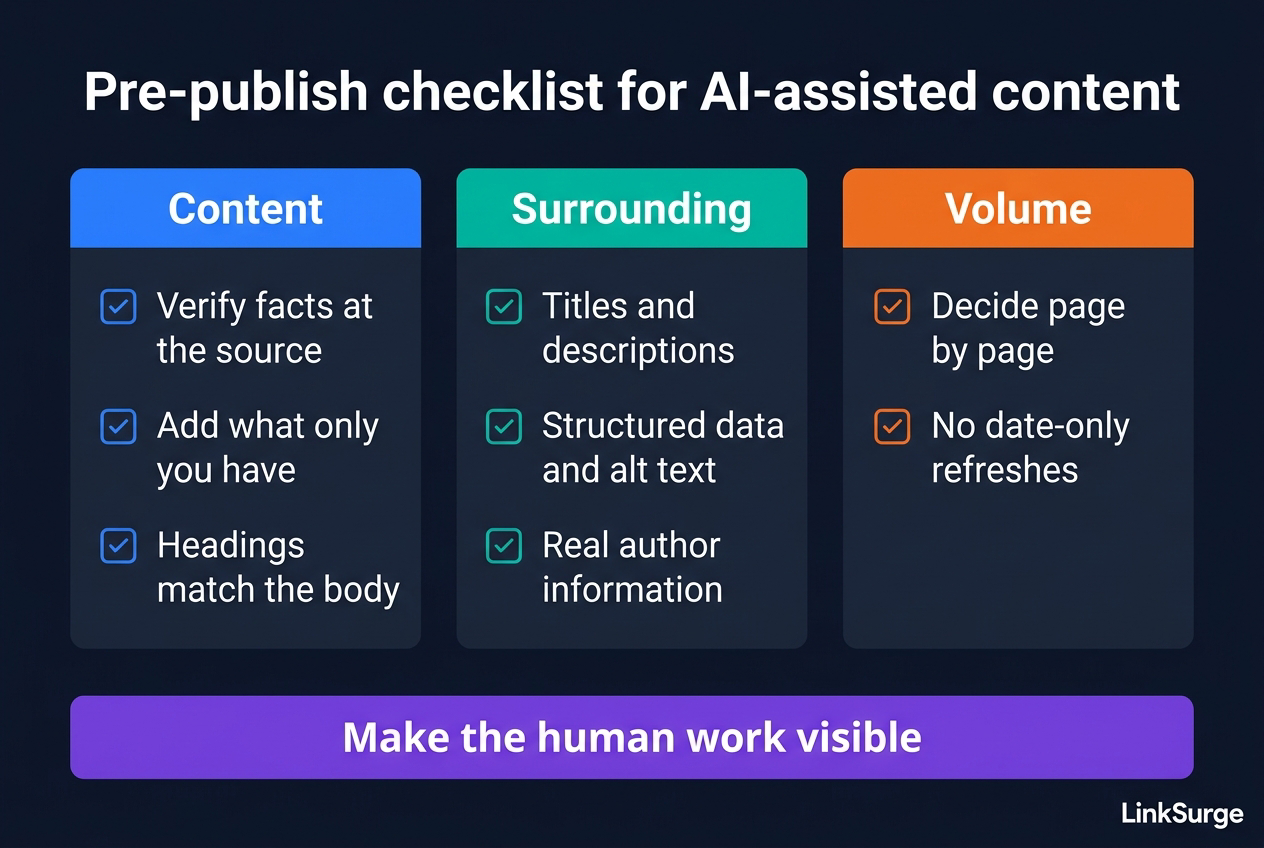
Content checks
- Verify facts against primary sources — Numbers, dates, names and quotes get checked against the original document, not taken from the AI draft
- Add something only you have — Your own data, test results, customer feedback, original photos. Don't stop at summary plus citations
- Match expert consensus on YMYL topics — Health and money content should be reviewed by a qualified person or checked against official sources
- Make headings and titles match the content — No exaggeration, no promises the body doesn't keep
Surrounding checks
- Review titles, meta descriptions, structured data and alt text — The generative AI guidance says these can appear in results and need the same review. For structured data, also check feature policies and validate the markup
- Use real authors — AI headshots, invented names and fake credentials are deception. Show who wrote and who reviewed the piece
- Explain how content was made where readers would expect it — Google recommends disclosure when someone might reasonably ask "how was this created?" For ecommerce, Merchant Center requires metadata on AI-generated images
Volume checks
- Decide page by page, not by quota — The guidance warns that generating many pages without adding value may violate the scaled content abuse policy
- Don't refresh dates without real changes — The helpful content page lists changing dates to look fresh, without substantial changes, as a warning sign
On our own blog, numbers and sources are checked against the original documents before every post goes live. It's tedious, and it's the last line of defense against AI errors. We've even pulled an unverifiable number out of our own product. That story is in "Does FAQ Schema Really Get You Cited 3.2x More?".
References: Google Search's guidance on using generative AI content on your website - Google Search Central Spam policies for Google web search (Scaled content abuse) - Google Search Central Creating helpful, reliable, people-first content - Google Search Central
5. What About the September 2026 Spam Update?
Around the same time, Google ran the September 2026 spam update. The Search Status Dashboard shows it starting September 24 at 16:15 UTC and finishing October 8 at 08:00 UTC. A separate August 2026 spam update ran from August 18 to 21.
Google hasn't said the September update targeted AI content. The timing overlaps with the documentation changes, but there's no stated link between them.
Still, if your rankings moved sharply between late September and early October, two reviews make sense. Check for pages that could fall under the spam policies, especially scaled content abuse. Then look for pages that are thin on effort and originality by the four attributes.
LinkSurge and Search Console can both help you track keyword-level ranking changes through an update window.
References: Google Search Status Dashboard - Google
LinkSurge
linksurge.jp
SEO・AIO・GEO統合分析プラットフォーム。AI Overviews分析、SEO順位計測、GEO引用最適化など、生成AI時代のブランド露出を最大化するための分析ツールを提供しています。
Frequently Asked Questions
Does Google penalize AI-written content?
Using AI isn't penalized on its own. Google's concern is mass-producing pages without added value, or producing large amounts of text without human oversight or curation. With fact-checking, original information and accurate authorship, using AI for drafts or outlines is fine.
What counts as main content?
Any part of a page that directly helps it achieve its purpose. Beyond text, images and video, that includes tools like calculators, on-purpose reviews and comments, tabbed sections, and titles and headings.
If I cite my sources, is a summary article OK?
Citing sources helps readers trust you, but Google says attribution doesn't replace original effort. Add your own measurements, test results or analysis on top of any summary.
Is fact-checking the body text enough?
No. Google's generative AI guidance says titles, meta descriptions, structured data and image alt text also need review because they can appear in search results.
Conclusion: Make the Human Work Visible
This update makes Google's expectations a lot more concrete. Start by finding AI-assisted pages that stop at summary plus citations. Then decide, one page at a time, whether you can add your own data or test results.
Next, formalize the review step. Assign owners for checking numbers and names, titles and structured data, and author information. Fewer pages with clear human work will serve you better than more pages without it.
LinkSurge's GEO citation optimization analysis checks whether a page is in good shape to be cited by AI and shows what to improve.