What Is YMYL? The Higher Bar for Health, Money and Safety Content
目次
Key Takeaways: YMYL means "if this is wrong, someone could get seriously hurt"
Credit card comparisons. Health insurance explainers. Supplement reviews. Retirement calculators. If you've just been handed content like this, the first concept I'd point you to is YMYL. Here's what you need to know.
- YMYL stands for "Your Money or Your Life" — It's Google's term for topics that could significantly impact people's health, financial stability or safety, or the welfare of society
- What makes a topic YMYL is the potential for harm — The question is whether inaccurate information or bad advice could cause significant harm. Touching on money or health isn't enough on its own. Google's rater guidelines even say that many or most topics are not YMYL
- The bar for accuracy and trust goes up — Google says its systems give even more weight to content with strong E-E-A-T on YMYL topics. Being accurate isn't enough. The content should also be consistent with well-established expert consensus
- Personal experience is welcome, but know its limits — Sharing how you got through an illness or a money crisis has real value. Specific medical treatment or investment advice, though, is the kind of information Google's guidelines say is best left to experts
Let's break each of these down.
1. What Is YMYL?
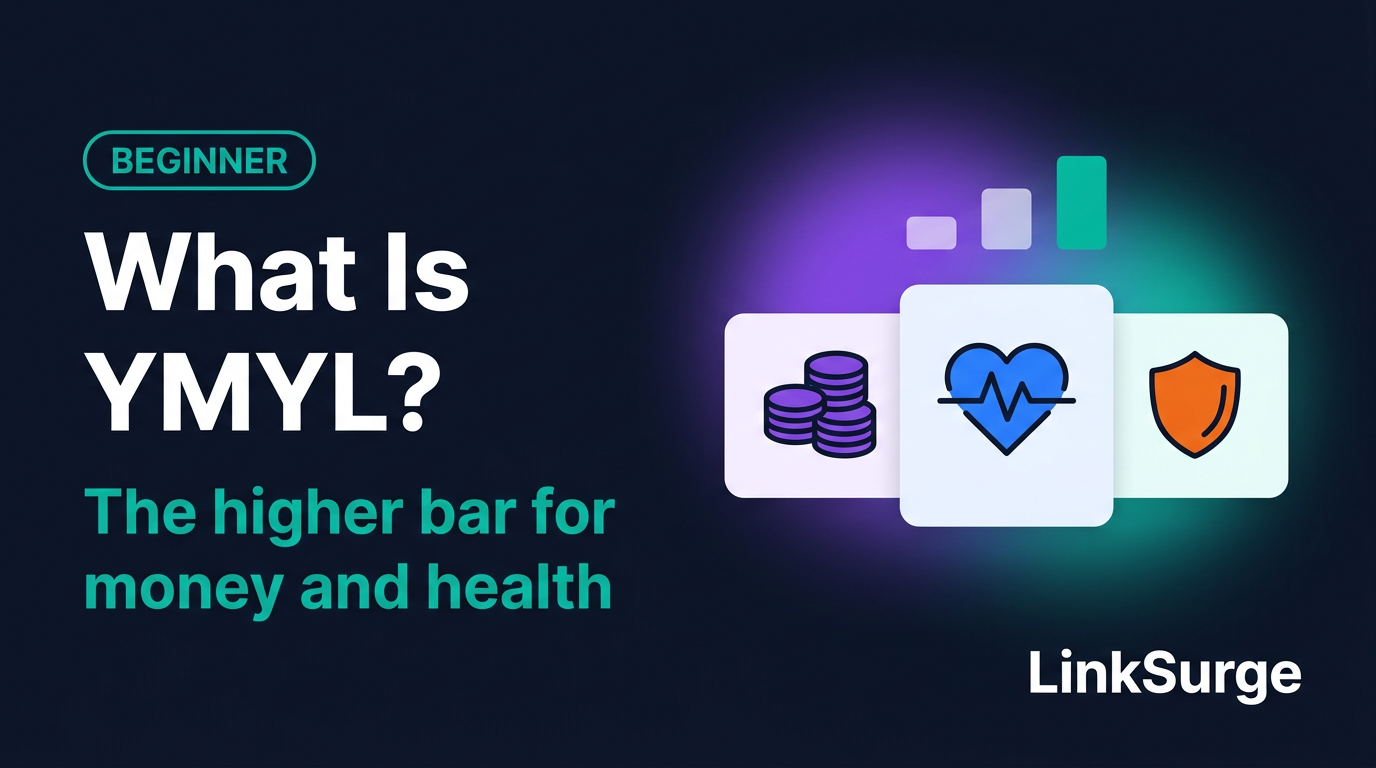
YMYL is short for "Your Money or Your Life." Google uses it for topics that could significantly impact the health, financial stability or safety of people, or the welfare or well-being of society.
Put simply: if a reader acts on this page and the page is wrong, could they get badly hurt? Pick the wrong investment and you lose savings. Misread a medication dose and you could end up in the hospital. Because the stakes are personal, these topics get special treatment.
The four types of YMYL
The Search Quality Rater Guidelines (the public handbook Google gives its search quality raters) group YMYL topics by the kind of harm involved.
| Type | The harm | Example topics |
|---|---|---|
| Health or Safety | Harm to mental, physical or emotional health, or to physical or online safety | Symptoms, medications, what to do in an earthquake |
| Financial Security | Damage to someone's ability to support themselves and their family | Investing, taxes, loans, retirement savings |
| Government, Civics & Society | Negative impact on groups of people, trust in public institutions, or election and voting information | How to vote, who is eligible, public services |
| Other | Anything else that could hurt people or harm the well-being of society | Topics that don't fit the first three |
The guidelines list examples where even mild inaccuracies could matter a lot: symptoms of a heart attack, how to invest money, what to do in an earthquake, who can vote, and what you need to get a driver's license.
References: Creating helpful, reliable, people-first content - Google Search Central Search Quality Rater Guidelines (September 11, 2025 version) - Google
2. How to Tell Whether a Topic Is YMYL
Now for the question that trips people up in practice: is my page YMYL?
Ask how much harm a mistake could cause
The guidelines don't treat YMYL as a yes-or-no label. They describe a spectrum: clearly YMYL, definitely not YMYL, and everything in between. Their own examples make the idea click.
| Question | Clear YMYL | Maybe YMYL | Not YMYL |
|---|---|---|---|
| Could inaccurate information cause significant harm? | Tsunami evacuation routes | Weather forecast (a slightly wrong forecast usually won't hurt anyone) | Music award winners |
| Could poor advice cause significant harm? | When to go to the emergency room | How often to replace a toothbrush | How often to wash jeans |
| Could this opinion harm people or society? | Claiming a racial group is inferior | Claiming one form of exercise is inferior | Claiming a rock band is inferior |
"It mentions money" doesn't make it YMYL
Here's what surprised me the first time I read this section: the guidelines go out of their way to say that many or most topics are not YMYL. Anyone could build a harmful page about rainbows or pencils by bundling in malware. That doesn't make rainbows a YMYL topic. What counts is whether the topic itself could affect people's health, finances or safety.
Two money articles can sit at opposite ends. A guide to refinancing your mortgage can cost a reader thousands if it's wrong. A post about which budgeting app has the nicest interface can't. When I plan an article, I ask one question first: if a reader trusts this and it's wrong, what happens to them?
References: Search Quality Rater Guidelines (September 11, 2025 version) - Google
3. The Standard YMYL Content Has to Meet
Once you know a page is YMYL, what changes?
Google gives more weight to strong E-E-A-T
Google says that for topics that could significantly impact people's health, financial stability or safety, "our systems give even more weight to content that aligns with strong E-E-A-T." E-E-A-T stands for Experience, Expertise, Authoritativeness and Trust, with trust being the most important. The basics are covered in "What Is E-E-A-T?"
The same page describes accuracy as one of the core quality attributes, and it raises the bar for YMYL: content needs to be highly accurate and consistent with well-established expert consensus. In other words, "not technically wrong" isn't the standard. "In line with what experts broadly agree on" is.
Google's guide to its ranking systems also describes multiple systems that work to show the most reliable information possible. Where reliable information is lacking, Search can display content advisories automatically.
Raters scrutinize YMYL pages most
In the rater guidelines, pages on clear YMYL topics "require the most scrutiny" during page quality rating. Remember, rater scores don't directly set rankings. Read the guidelines as a description of what Google's systems are aiming for.
Separate life experience from expert advice
YMYL doesn't mean only credentialed experts may write. The guidelines say pages that share first-hand life experience on clear YMYL topics can have high E-E-A-T, as long as the content is trustworthy, safe and consistent with expert consensus. Then they draw a line between the two with examples.
| Topic | Where life experience helps | Where experts are needed |
|---|---|---|
| Sleep challenges when pregnant | Safe, non-medical tips from people who struggled with it, like using pillows to sleep in a safe position | Which sleep medications are safe during pregnancy |
| Filling out tax forms | A humorous video from a non-expert about how frustrating taxes are | Step-by-step instructions for filling out the forms |
| Saving for retirement | Reviews from people who've used a retirement savings service | How much to save, what to invest in, how much you'll need |
That table works as a writing rule. Tell your story as your story. Base advice and decisions on expert and official sources. Keeping those two apart is one of the simplest ways to make a YMYL page more trustworthy.
References: Creating helpful, reliable, people-first content - Google Search Central A guide to Google Search ranking systems - Google Search Central Search Quality Rater Guidelines (September 11, 2025 version) - Google
4. A Checklist for Writing YMYL Content
Here's how that turns into pre-publish checks.
Accuracy
- Check claims against primary sources — Rates, rules, dosages and eligibility should be verified on official or government sites. Don't copy from another roundup
- Compare with mainstream expert views — If you take a different position, say so and show your evidence
- Keep it current — Rules and prices change. When you review a page, actually update the content
Authorship
- Show who wrote it and who reviewed it — Give the author's name and connection to the topic. If you list a reviewer, make sure they really reviewed it
- Make ownership clear — Readers should be able to find out who is responsible for the information
Tone and framing
- Keep experience and advice separate — "Here's what happened to me" is different from "here's what you should do"
- Don't overpromise — "This cures it" or "guaranteed returns" destroy trust on YMYL topics, and that applies to titles and headings too
- Say when readers should talk to a professional — Where the answer depends on someone's health or finances, be honest about what an article can't decide for them
For Google's newer quality attributes and a pre-publish checklist for AI-assisted drafts, see "Google Spells Out Four Quality Attributes."
5. Common Misconceptions and Mistakes
People get YMYL wrong in both directions: too scared, or too casual. Here are the patterns I see most.
Myth 1: "Small sites aren't allowed to write about YMYL topics"
There's no such rule. The rater guidelines explicitly value shared life experience on YMYL topics. The problem is giving advice beyond your experience without a solid basis.
Myth 2: "Add a doctor's name and you're safe"
Naming a reviewer who never actually reviewed the page is the opposite of trust. Google tells site owners to avoid deceptive authorship information.
Myth 3: "We're just a comparison site, so YMYL doesn't apply"
Comparisons of credit cards, insurance, loans or investment platforms feed directly into financial decisions. A ranked list is still financial content.
Myth 4: "If it's my personal story, I can say anything"
Even personal stories need to be safe and consistent with expert consensus. Recommending an unproven remedy because "it worked for me" goes beyond sharing experience.
Myth 5: "There's a special YMYL score that decides rankings"
There isn't. Rater scores don't directly affect rankings either. What Google describes is a direction: on YMYL topics, reliable information gets more weight.
6. How to Check Your Own Site
Start by sorting your pages into three buckets: clear YMYL, maybe YMYL and not YMYL. Then work through the clear YMYL pages first using the checklist above.
Next, search the main keyword for each of those pages and look at who ranks. If the top results are government agencies, professional bodies or major publishers, that tells you the bar you're up against. The sources cited in the AI Overview (Google's AI-generated summary at the top of some results) are another useful clue.
LinkSurge's AI Overview analysis shows what the AI Overview says for a keyword and which sites it cites. To find out which keywords your own site already appears for, see "Is Your Site Showing Up in Google AI Overviews?"
After you update a page, track how it moves in Search Console or with a rank tracker such as LinkSurge. Give changes a few weeks before judging them.
LinkSurge
linksurge.jp
SEO・AIO・GEO統合分析プラットフォーム。AI Overviews分析、SEO順位計測、GEO引用最適化など、生成AI時代のブランド露出を最大化するための分析ツールを提供しています。
Quick Check
Q1: What does YMYL stand for, and what kind of topics does it cover?
Answer: "Your Money or Your Life." It covers topics that could significantly impact people's health, financial stability or safety, or the well-being of society.
Q2: Is every article that mentions money a YMYL article?
Answer: No. What matters is whether inaccurate information or bad advice could cause significant harm. Many topics that touch money or health carry little real risk.
Q3: Can you share personal experience on a YMYL topic?
Answer: Yes, as long as it's safe and consistent with expert consensus. Treatment or investment advice, though, should come from expert sources.
Frequently Asked Questions
What is YMYL in SEO?
YMYL stands for "Your Money or Your Life." It's Google's term for topics that could significantly affect someone's health, finances, safety or the well-being of society, such as medical symptoms, investing, taxes and voting information.
How is YMYL content treated differently?
Google says its systems give even more weight to content with strong E-E-A-T on YMYL topics. The content should be highly accurate and consistent with well-established expert consensus.
How do I know if my page is YMYL?
Ask whether a mistake on the page could cause significant harm to a reader or to society. Google's rater guidelines treat YMYL as a spectrum and note that many or most topics are not YMYL.
Does every YMYL page need an expert reviewer?
Google doesn't publish a rule requiring expert review. But if a page gives the kind of advice that should come from experts, such as treatment or investment guidance, it needs to be grounded in expert or official sources. If you list a reviewer, they must actually review the content.
Conclusion: Sort Your Pages by Potential Harm First
YMYL is about handling high-stakes topics with extra care. Start by sorting your pages by how much harm a mistake could cause. Then, beginning with clear YMYL pages, check facts against primary sources and make authorship visible. Simply separating personal experience from advice already makes a page more trustworthy.
If you haven't read the E-E-A-T basics yet, start with the previous article, "What Is E-E-A-T? Why Google Cares Who Wrote Your Content." Up next in the series is "What Are Backlinks? Good Links vs. Risky Links." The full reading order is in the "SEO, GEO and AIO Beginner Curriculum," and the "SEO Glossary for Beginners" covers unfamiliar terms.
LinkSurge's AI Overview analysis shows what AI Overviews say for your YMYL keywords and which sites they cite.