Why Some Pages Get Cited by AI and Others Don't: A Beginner's Guide That Keeps Google and ChatGPT Separate
目次
Key Takeaways: Citation comes down to two checks, "Can the AI read it?" and "Does it answer the question?"
"Is there a special way to write so AI cites you?" It's the question I hear most about AI search. After comparing the official documentation with our own citation data, I don't think there's a trick. The difference shows up in two places: whether the AI can read the page, and whether the page actually answers the question.
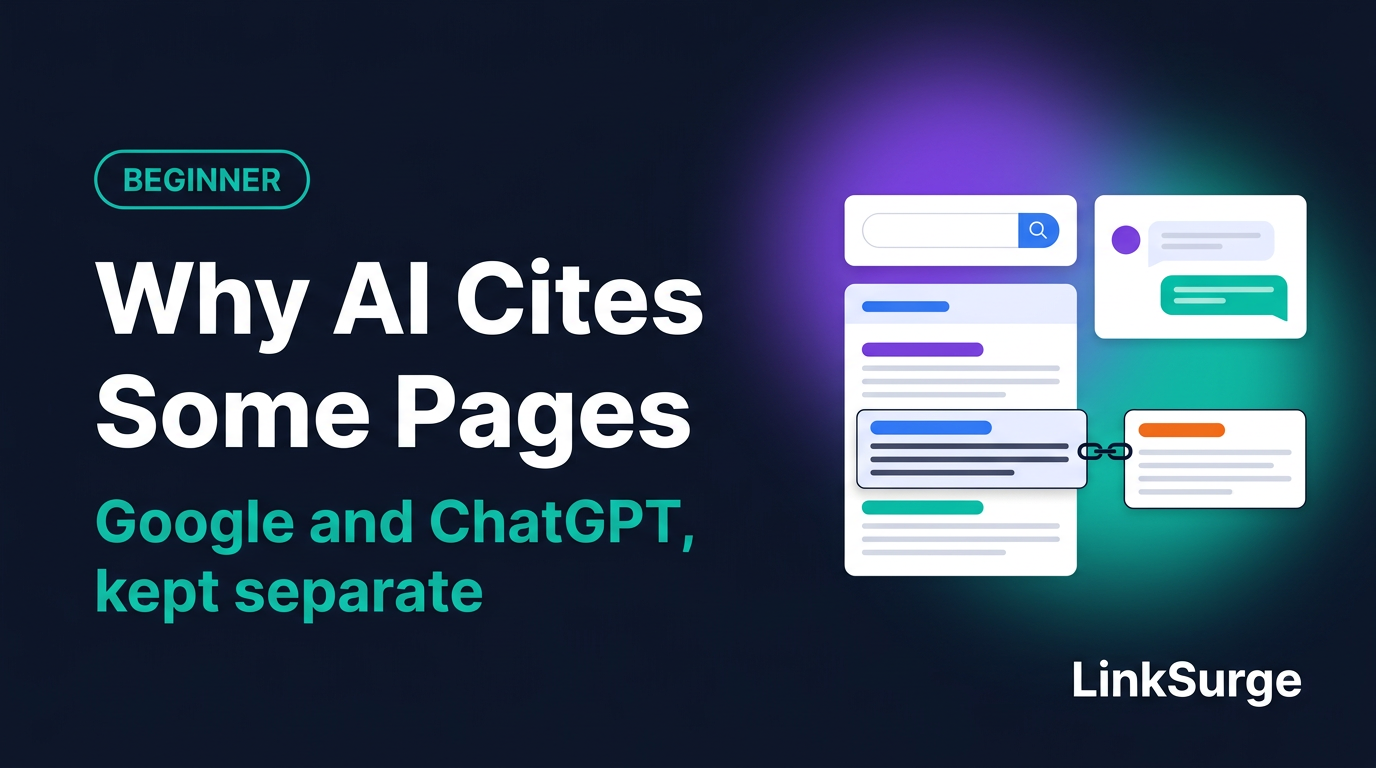
- A citation is a source link attached to an AI answer — It's different from a mention, where your name appears in the answer text. When you're cited, a link to your page shows up next to or below the answer
- Google says AI Overviews and AI Mode need no special optimization — The baseline is that your page is indexed and eligible to show a snippet. Google says you don't need to chunk your content or add special structured data
- ChatGPT and Perplexity work differently from Google — Each runs its own search crawler (a bot that reads web pages), and blocking it keeps you out of their search answers. Neither company publishes detailed rules for choosing sources
- Cited pages share three traits — They answer the question directly, include specific facts or original information, and resolve the answer within each heading's section. In our analysis of 277 real AI Overviews citations, 69.3% came from sections in the body, not the intro
- Tricks like "add FAQ schema to get cited" have no solid evidence — Google says structured data isn't required. Citations also change from one search to the next, so don't judge from a single check
Let's break down what a citation is, how Google handles it, how ChatGPT and similar tools handle it, what cited pages have in common, and the misconceptions I run into most.
1. What is an AI "citation"?
An AI citation is a link to a web page that the AI used as a source for its answer.
Search Google for "fixed vs adjustable rate mortgage" and you may see an AI-written answer at the top (an AI Overview). Next to or below it, Google lists links to the pages it drew on. ChatGPT and Perplexity do something similar: when they search the web to answer you, they attach links to their sources. Getting your page into those links is what "being cited" means.
A citation isn't the same as a mention
A related term is "mention." A mention is when your brand or product name appears in the text of an AI answer.
| Citation | Mention | |
|---|---|---|
| What happens | A link to your page is attached as a source | Your name appears in the answer text |
| Traffic | People may click through | None directly, unless there's also a link |
| Example | Your article is listed under the answer | "Brand X is a well-known option" |
You can be mentioned without being cited, and vice versa. This article focuses on citations.
Why keep Google and other AI tools separate?
This is the single most important idea in this guide. The AI in Google Search and AI assistants like ChatGPT find and choose pages in different ways. What Google says about its own AI features doesn't automatically apply to ChatGPT, and the reverse is true too. So I'll cover them one at a time. For how the different acronyms relate, see "SEO vs. GEO vs. AIO vs. LLMO."
2. What it takes to be cited by Google (AI Overviews and AI Mode)
Start with Google, which explains its approach in official developer documentation.
The baseline: Google can read the page and show a snippet
Google says, "There are no additional requirements to appear in AI Overviews or AI Mode, nor other special optimizations necessary." To be eligible to appear as a supporting link, a page needs to:
- Be indexed (stored in Google's database)
- Be eligible to show a snippet in Google Search
- Meet Search's technical requirements
Your site also shouldn't be excluded under Search Console's generative AI setting. The default is to include your site, so most people don't need to touch it. Google is clear that meeting these requirements doesn't guarantee you'll appear.
How does Google's AI pick pages?
Google's guide to generative AI search describes two techniques.
- Retrieval-augmented generation — Google uses its core Search ranking systems to retrieve relevant pages, builds the answer from them, and links to the pages that support it. Google calls this "A technique (also known as grounding) used to improve the quality, accuracy, and freshness of AI responses"
- Query fan-out — The model generates several related searches at the same time to gather more information
In other words, the way into a Google AI citation runs through regular Search. When I read this, it clicked for me why "AI Overviews optimization" and SEO aren't really separate jobs. For more on how one question becomes many searches, see "What Is Query Fan-Out?"
What Google says you don't need
The same guide lists things you can skip.
| What Google says isn't needed | What the guide says |
|---|---|
| Breaking content into small chunks for AI | "There's no requirement to break your content into tiny pieces," and there's no ideal page length |
| AI text files such as llms.txt | Google Search doesn't use them and ignores them |
| Structured data for generative AI search | "Structured data isn't required for generative AI search, and there's no special schema.org markup you need to add" |
| Chasing inauthentic mentions across the web | Not as helpful as it might seem |
A note on llms.txt: it won't help you get cited in Google Search. But some sites, including this blog, publish one as a guide for AI agents (AI tools that read the web and do tasks on someone's behalf). Think of it as a tool for agents, not a citation tactic.
References: AI features and your website - Google Search Central Optimizing your website for generative AI features on Google Search - Google Search Central Search generative AI control - Search Console Help
3. What it takes to be cited by ChatGPT, Perplexity, and similar tools
Now the non-Google side. The official documentation here is thinner, so I'll separate what's officially confirmed from what outside analysts report.
Officially confirmed: block the search crawler and you won't appear
OpenAI, which makes ChatGPT, documents a crawler called OAI-SearchBot. In OpenAI's words, it's "used to surface websites in search results in ChatGPT's search features." Sites that block OAI-SearchBot "will not be shown in ChatGPT search answers," though they can still appear as navigational links.
Perplexity publishes a similar crawler, PerplexityBot, which it describes as "designed to surface and link websites in search results on Perplexity."
Don't confuse these with training crawlers. OpenAI's GPTBot collects content that may be used to train its AI models. It's separate from OAI-SearchBot, so you can block training while still appearing in search answers.
| AI tool | Crawler for appearing in search answers | Training crawler |
|---|---|---|
| ChatGPT (OpenAI) | OAI-SearchBot | GPTBot |
| Perplexity | PerplexityBot | Perplexity's docs say PerplexityBot isn't used to crawl content for AI foundation models |
Your first step is to check that robots.txt (the file that tells crawlers what they may read) isn't blocking these by accident. OpenAI says it can take about 24 hours for its systems to pick up a robots.txt change.
What outside analysts report
ChatGPT's detailed rules for choosing which pages to cite aren't public. Outside analyses report that ChatGPT search combines results from Bing and Google with an index of OpenAI's own. Analysts have also observed it splitting pages into heading-level sections and evaluating each one. OpenAI hasn't officially confirmed either, and the system changes quickly.
For the internals, see "Inside ChatGPT Search." For the full picture of getting cited, see "How to Get Cited by ChatGPT: The Complete 2026 Guide." And for a beginner-level overview of where ChatGPT gets its information, read "Where Does ChatGPT Get Its Information?"
To track how ChatGPT and other non-Google AI tools cite and mention your site over time, LinkSurge's GEO monitoring records it on a schedule.
References: Overview of OpenAI Crawlers - OpenAI Perplexity Crawlers - Perplexity
4. Three things cited pages have in common
Once the baseline is covered, content is what separates cited pages from the rest. This section combines Google's official recommendations with patterns from our own research. None of this guarantees a citation, and I want to be upfront about that.
Trait 1: It answers the question directly
Does the page actually answer what the searcher wanted to know? Plenty of pages bury the answer under a long intro or company pitch. When an AI looks for supporting material, a clearly stated answer is the easiest thing to use.
Trait 2: It includes specific facts or original information
Numbers, dates, steps, comparison tables, your own test results, data you collected: anything that can be lifted out and used makes a page good source material. Google's guide puts it this way: "Be sure that you're writing non-commodity content that your readers will find helpful and reliable." A page that says what every other page says gives the AI no reason to pick it.
Trait 3: Each heading's section resolves its own answer
In August 2026, we published an analysis of 277 real Google AI Overviews citations from data we'd collected, tracing each one back to where it came from on the source page. 69.3% came from sections in the body (a heading plus the text under it), not from the intro. The cited sections had a median length of 476 characters, clearly longer than uncited ones at 273.
The takeaway: "polish the intro" and "keep it short" are both too simple. Every section should make sense on its own and fully answer the question its heading asks. For the full analysis and its limitations, see "Where Does AI Search Actually Quote From?" For a step-by-step check of your own article, see "Can Each Section of Your Article Stand Alone?" LinkSurge's heading optimization analysis can also flag sections that don't stand alone.
One caveat: AI Overviews was the only engine where we could trace citation positions. We haven't confirmed the same pattern in ChatGPT or Perplexity. Still, sections that stand alone and give specific answers are easier for people to read, too. They won't hurt you anywhere.
References: Optimizing your website for generative AI features on Google Search - Google Search Central
LinkSurge
linksurge.jp
SEO・AIO・GEO統合分析プラットフォーム。AI Overviews分析、SEO順位計測、GEO引用最適化など、生成AI時代のブランド露出を最大化するための分析ツールを提供しています。
5. Diagnosing why a page isn't cited: two questions
Let's put this into practice. Most reasons a page isn't cited fall into two buckets: the AI can't read it, or the page doesn't answer the question. When someone asks me why they're not cited, I check in that order.
| Stage | ChatGPT, Perplexity, and similar | |
|---|---|---|
| Can't read it | Not indexed / noindex or nosnippet applied / excluded in the generative AI setting | Search crawler blocked in robots.txt |
| Doesn't answer | Answer buried / generic content only / sections don't resolve their own answers | Same (though selection rules aren't public) |
"Can't read it" problems are usually fixed with a settings change. To check whether Google has indexed a page, use the URL Inspection tool in Search Console. For a fuller checklist, see "Why Isn't My Page on Google?"
For "doesn't answer" problems, the fastest route is comparing your page with pages that are actually cited for the same search. "What Pages Cited in Google AI Overviews Have in Common" walks through how. If you first want to know which keywords already show your site in AI Overviews, LinkSurge's AI Overview keyword report lists them.
6. Common misconceptions and mistakes
Misconception 1: "Adding FAQ structured data gets you cited by AI"
Google states that structured data isn't required for generative AI search and there's no special markup to add. Claims like "FAQ schema gets you cited X times more" tend to fall apart when you trace their sources. We removed one such number from our own product, and wrote up why in "Does FAQ Schema Really Get You Cited 3.2x More?"
Misconception 2: "Getting cited by Google and by ChatGPT works the same way"
Google retrieves pages through its regular Search systems. ChatGPT uses its own crawler and a different search setup. You can rank well on Google and still never appear in ChatGPT's search answers if you block its search crawler. Don't judge one by the other.
Misconception 3: "I searched once and wasn't cited, so the page is a failure"
AI answers and their sources change with time, user, and wording. In August 2026, outside trackers saw one major site's share of ChatGPT citations drop sharply within days (see "ChatGPT's Citation Sources Moved 86% in Four Days"). Check several times, ideally spread over weeks.
Mistake 1: Chopping pages into tiny pieces for AI
Some people assume AI prefers short text and cut every section down to a line or two. Google says chunking isn't necessary, and in our data the cited sections tended to be longer. Prioritize answering fully.
Mistake 2: Blocking the search crawler while trying to block training
People who don't want their content used for AI training sometimes edit robots.txt and accidentally block the search crawler too. For ChatGPT, GPTBot handles training and OAI-SearchBot handles search. Decide what you want to block before you change anything.
Quick Check
Q1. An AI answer names your company but doesn't link to your site. Is that a citation?
Answer: No, that's a mention. A citation means a link to your page is attached as a source.
Q2. What does Google say about special optimization for AI Overviews?
Answer: That there are no additional requirements and no special optimizations necessary. The baseline is being indexed, snippet-eligible, and meeting Search's technical requirements.
Q3. You rank well on Google but never show up in ChatGPT's search answers. What do you check first?
Answer: Whether robots.txt blocks OAI-SearchBot, ChatGPT's search crawler. OpenAI says sites that block it won't be shown in ChatGPT search answers.
Frequently Asked Questions
Do I need a special writing style to get cited by AI?
For Google, no: Google officially says AI Overviews and AI Mode need no special optimization. ChatGPT and similar tools haven't published citation-specific writing rules either. Answering the question directly, including specific information, and making each section complete on its own helps on both sides.
Will an llms.txt file help me get cited by AI?
Not in Google Search. Google's guide says Search doesn't use llms.txt and ignores it. Some sites publish one as a guide for AI agents that read their documentation, so treat it as an agent tool rather than a citation tactic.
Where should I start if I want ChatGPT to cite my site?
Check that robots.txt doesn't block OAI-SearchBot, ChatGPT's search crawler. OpenAI says sites that block it won't be shown in ChatGPT search answers. After that, the same basic principle applies as with Google: answer the question with specific information.
How can I tell whether my pages are being cited?
For Google, Search Console's Generative AI performance report shows how often your pages appeared in AI Overviews and AI Mode, though it doesn't show the queries. To see citations by keyword, or citations in ChatGPT, search manually or use an AI search tracking tool on a regular schedule.
Conclusion: Fix "can't read it" first, then work on "doesn't answer"
Start by ruling out the "can't read it" problems. Use URL Inspection in Search Console to confirm Google has indexed the page, and check robots.txt for blocked search crawlers. Then compare your article with pages that are cited for the searches you care about, and close the gap in how you answer.
Next, read the previous article, "What Is Zero-Click Search?," and the follow-up, "Does Google Penalize AI-Written Content?" For the full reading order, see "SEO, GEO and AIO for Beginners: A Reading Order From Zero."
To compare your page with the pages cited in AI Overviews for a target keyword, LinkSurge's AI Overview analysis shows them side by side.