Can Each Section of Your Article Stand Alone? AI Quotes More Than Your Intro — A Beginner's Guide
目次
Key Takeaways: AI Quotes Heading Sections, So Each One Has to Make Sense on Its Own
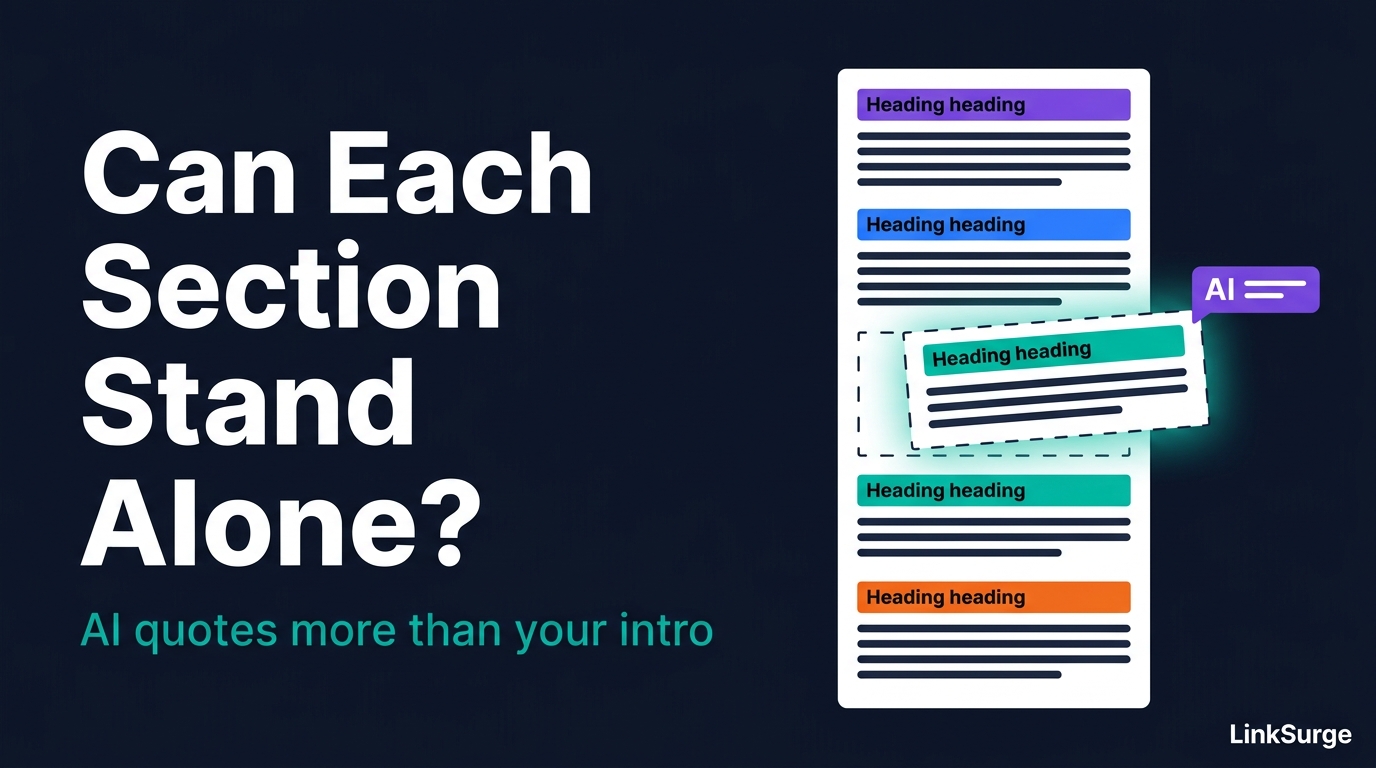
"I polished my intro, but AI still doesn't quote us." I've heard this a lot over the past few months. When I dug into our own citation data, it turned out AI quotes much more than the intro. It pulls heading sections from the middle and end of articles too. Here are the four key points.
- About 70% of citations come from body sections, not the intro — In our analysis of 277 real AI Overviews citations on Japanese-language pages, 69.3% came from heading blocks in the body, and 12.6% came from the last fifth of the page
- A quoted section is read without its surroundings — So what matters is whether a heading and the text under it make sense alone. The four typical failures are a heading-content mismatch, reliance on surrounding context, a lack of specifics and mixed topics
- Google and other generative AI search work from different assumptions — Google says you don't need to break content into small pieces. But sections that stand alone are easier for people to read too, so writing this way costs you nothing with either
- LinkSurge's heading optimization analysis checks each section from just a URL — It flags sections that don't stand alone and suggests rewrites, starting at 10 points
Below, we'll cover what a heading block is, where citations come from, the four failure types and their fixes, and how to check your pages in LinkSurge.
1. What Is a Heading Block?
A heading block is a heading (H2 or H3) plus all the text under it, up to the next heading. The text before the first heading counts as one block, the "intro."
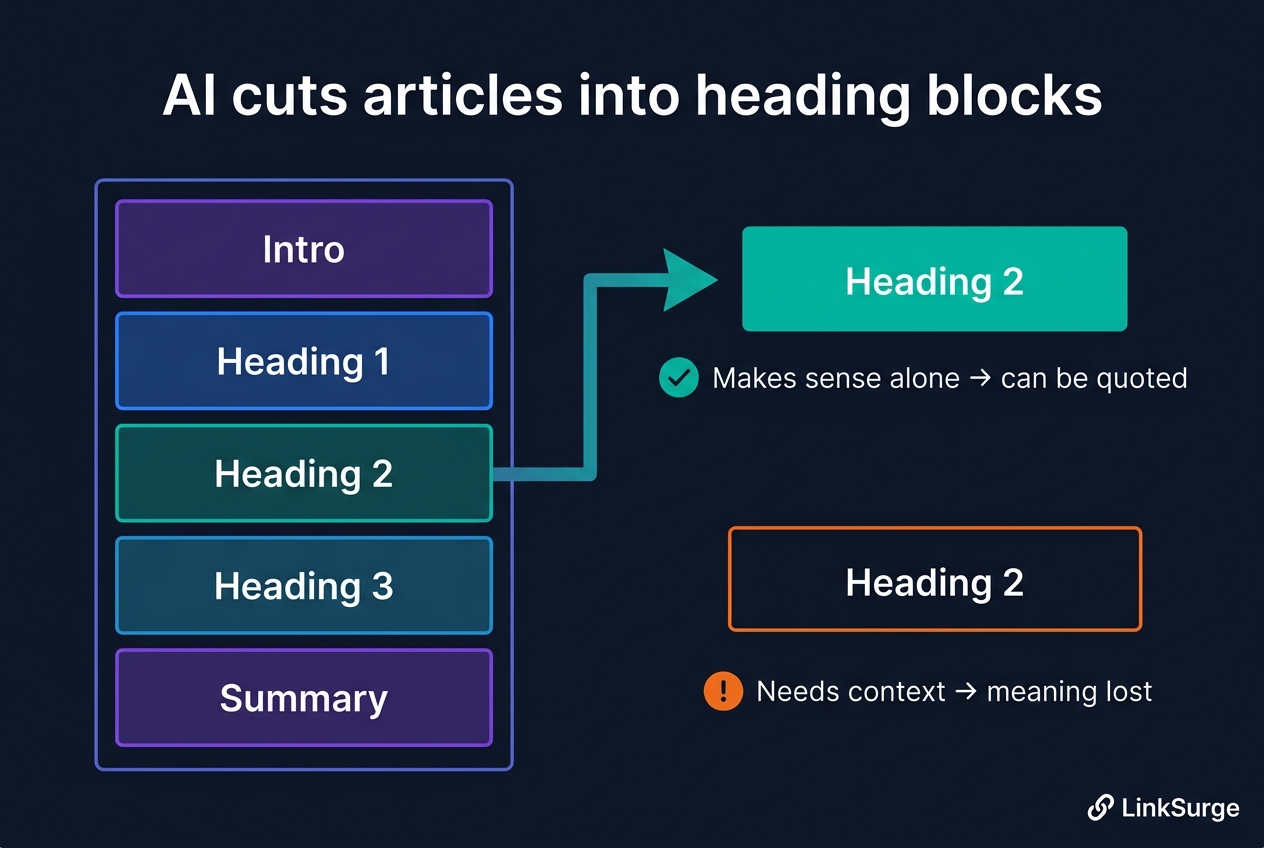
When AI search cites a page as the basis for its answer, it uses part of the page, not the whole thing. And the quoted part is placed in the answer cut off from the text around it.
That's where the problem lies: does that part make sense on its own? "As mentioned above, this method has no fees" reads fine inside the article, but lifted out, nobody knows which method it means.
2. Where Does AI Actually Quote From?
So which parts actually get quoted? Here's what we found when we analyzed our AI Overviews citation data at the level of heading blocks.
| Item | Result |
|---|---|
| Scope | 277 real AI Overviews citations in Japanese-language search (659 pages, 10,083 blocks) |
| Share quoted from the opening intro | 30.7% |
| Share quoted from heading blocks in the body | 69.3% |
| Share quoted from the last fifth of the page | 12.6% |
| Length of cited blocks (median) | 476 Japanese characters (273 for uncited blocks) |
Scope limitation: the corpus is Japanese-language pages. Whether these patterns transfer to English-language content is untested, so read the numbers as a directional signal rather than a benchmark for English pages.
Polishing the intro isn't enough. Mid-article sections, summaries and supplementary sections are all quote candidates. Cited blocks were also clearly longer, so chopping content into tiny pieces isn't the answer either.
One more surprise: blocks starting with "this" or "that" were actually more common among cited blocks (2.3% vs 1.5%). The problem isn't demonstratives themselves. It's when what they point to lives outside the block.
The method and limitations are in "Where Does AI Search Actually Quote From?"
Sources: Where Does AI Search Actually Quote From? We Analyzed 277 Real Citations - LinkSurge
3. Four Ways a Section Fails to Stand Alone, and How to Fix Them
Sections that don't stand alone tend to fall into four types. Use this as a checklist when you review your own articles.
| Type | Typical example | Fix |
|---|---|---|
| Heading-content mismatch | The heading says "How to cancel," but the text is mostly about pricing | Answer what the heading promises at the start of the section. Move anything else under its own heading |
| Doesn't stand alone | "As mentioned above, this method has no fees" | Name the thing inside the block: "Paying by direct debit has no fees" |
| Not specific enough | It ends with "there are many benefits" | Add facts that can be lifted and used as-is: numbers, conditions, steps, sources |
| Mixed topics | One heading covers pricing, support and cancellation | Give each topic its own heading |
A useful test: if this section alone were shared on social media, would readers get it? Don't drop the subject or the thing you're talking about, and finish answering the heading within the section.
"This" and "that" are fine. If what they refer to is in the same block, the meaning survives being lifted out. What to cut back on is handing the answer off to another section, as in "more on this later" or "as explained above."
4. Treat Google and Generative AI Separately
One caveat. In its official guide to generative AI features such as AI Overviews, Google says there's no requirement to break your content into small pieces. For Google, you don't need to chop your content into AI-sized blocks.
Generative AI search engines such as ChatGPT and Perplexity, on the other hand, are reported to handle pages in paragraphs or heading sections. Checking whether each section stands alone is mainly about them.
Still, writing that stands alone is writing that's easy for people to read. It works for someone who starts reading halfway down, or who jumps to a heading from the table of contents. You don't need to change how you write for Google, but finishing each answer within its heading is an improvement that costs you nothing with either.
For what pages cited in AI Overviews have in common, see "What Pages Cited in Google AI Overviews Have in Common."
Sources: Optimizing your website for generative AI features on Google Search - Google Search Central
5. Step by Step: LinkSurge's Heading Optimization Analysis
Reviewing an article with more than ten headings by eye is tedious. Here's how the process looks in LinkSurge's heading optimization analysis. The interface is in Japanese. For an overview, see the heading optimization analysis feature page (in Japanese).
Step 1: Enter a URL and choose the scope
Enter the URL of the article you want to check, then pick a scope.
| Scope | What you get | Points |
|---|---|---|
| Fixing what's written | Checks whether each heading block stands alone, and shows what to fix with rewrite examples | 10 points |
| + What's missing | All of the above, plus the questions AI search actually searched for that no block in your article answers (requires a target keyword) | 85 points |
You can't add scope later, so choose before you run it. For what AI search searches behind the scenes, see "How Many Searches Hide Behind One Question?" If you're new, start with "fixing what's written." After logging in, the "view sample results" button shows what the results look like without using any points.
Step 2: Check that AI can read your page
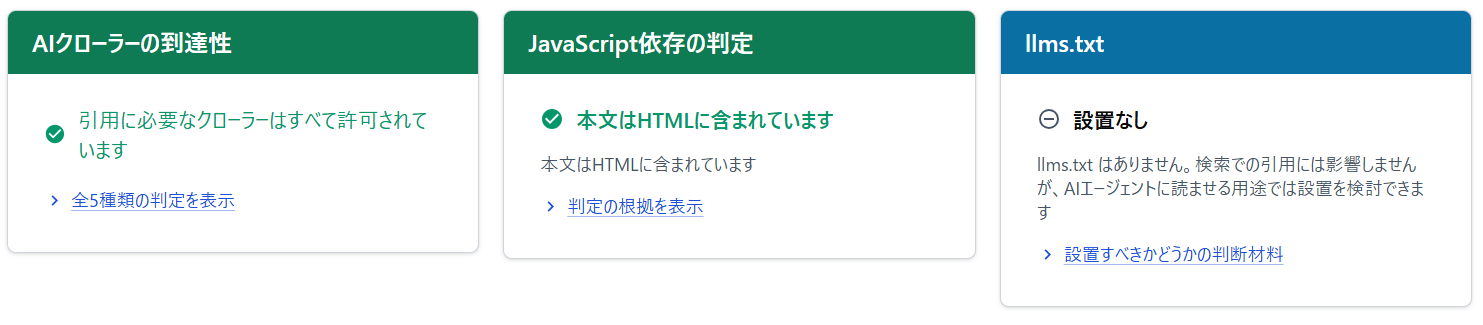
The analysis first checks the basics, before any rewriting.
- AI crawler access: whether the AI crawlers needed for citations are blocked in robots.txt
- JavaScript dependency: whether the body text is in the HTML the server returns. If it isn't, fixing the text may not help, because AI may never read it
- llms.txt: whether you have one. It doesn't affect citations in search, but you may want one for AI agents
Pages built from repeating cards or rankings, and pages whose body can't be fetched, stop here with a notice. No points are used.
Step 3: Look at the heading block distribution
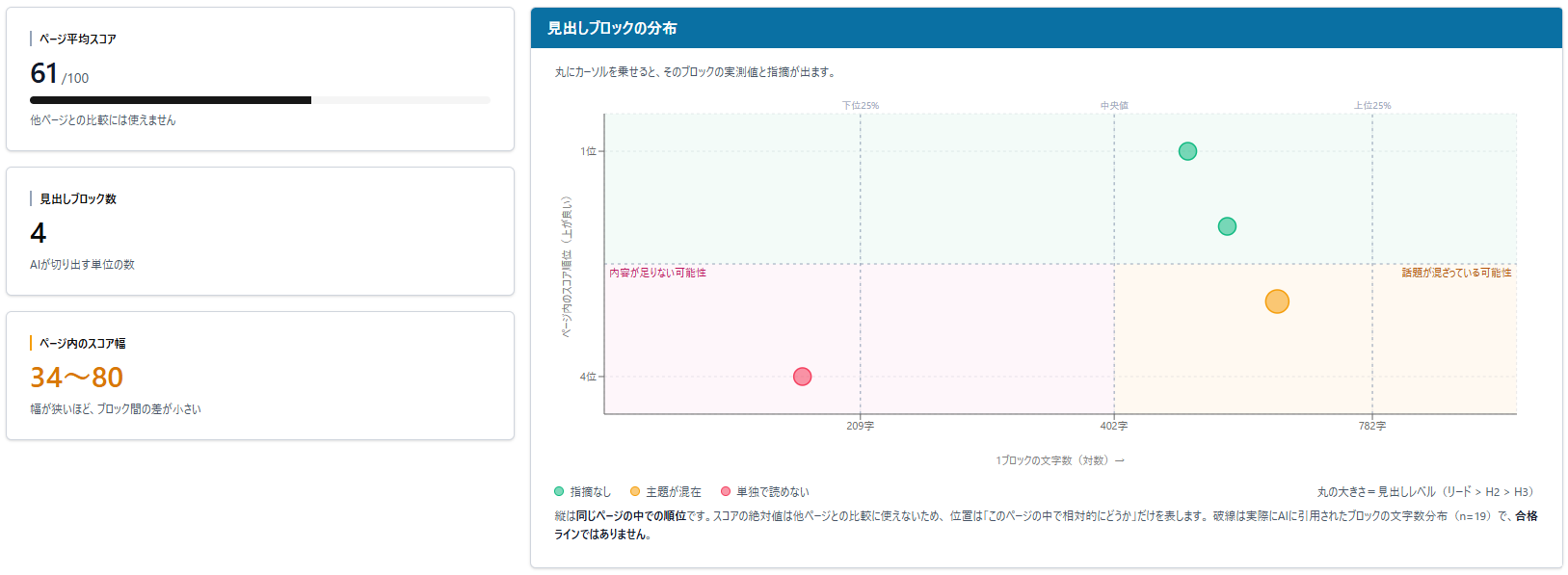
Next you'll see the article's overall picture.
- Page average score: the average of each block's 0–100 "stands alone" score
- Number of heading blocks: how many units AI can cut out
- Score range within the page: the gap between the lowest and highest block. The wider it is, the more uneven the sections are
In the chart on the right, the horizontal axis is block length and the vertical axis is rank within the page. Dot colors show the type of issue, with green meaning no issue (in the example, yellow is mixed topics and red is doesn't stand alone). Start with the dots that aren't green.
Step 4: Use the heading block map to find what to fix
Below that, the heading block map shows your article's outline on the left and details for the selected block on the right. You'll see the type of issue (heading-content mismatch, doesn't stand alone, not specific enough, mixed topics) and example rewrites.
Under the results is ready-made text you can paste into ChatGPT or Claude along with the findings, so your own AI can handle rewriting flagged sections or filling in what's missing.
If no block could be judged, no points are used. If only the "what's missing" part couldn't be retrieved, you're charged just the 10 points.

LinkSurge
linksurge.jp
SEO・AIO・GEO統合分析プラットフォーム。AI Overviews分析、SEO順位計測、GEO引用最適化など、生成AI時代のブランド露出を最大化するための分析ツールを提供しています。
6. Caveats
- Scores are for comparing sections within the same page. Don't compare them across pages
- The score doesn't predict citations. Whether higher-scoring blocks actually get quoted more hasn't been confirmed yet. Use it as a pointer to what to fix
- It isn't suited to listing or ranking pages. It's built for explainers, columns and how-to articles where each heading covers a complete idea
- Depending on how a page is built, you may see issues unrelated to the text. Number badges or labels can end up at the end of the previous block in the HTML, producing notes like "a lone number remains at the end." Skip those and focus on the notes about the text
Frequently Asked Questions
If I put the conclusion at the top of my article, will AI quote it?
The top alone isn't enough. In our analysis of 277 real AI Overviews citations on Japanese-language pages, 30.7% came from the opening intro and 69.3% came from heading blocks in the body. Mid-article sections and summaries are quote candidates too, so finish each answer within its heading.
Should I avoid words like "this" and "that"?
No. In our data, blocks starting with "this" or "that" were actually more common among cited blocks. The problem is when what they refer to is outside the block. Cut back on phrasing like "as mentioned above" that depends on an earlier section, and keep the referent in the same block.
Should I split headings more finely for Google Search too?
Google says there's no need to break content into small pieces for its generative AI features. You don't need more headings or shorter chunks. Think of finishing each answer within its heading as something that helps both human readers and generative AI search like ChatGPT.
How many points does the heading optimization analysis use?
"Fixing what's written" uses 10 points, and adding "what's missing" makes it 85 points. Pages that aren't suited to the analysis, or whose body can't be fetched, are flagged before any points are used.
Conclusion: Write Every Heading as an Entry Point
AI quotes more than your intro. Sections from the middle and end of your article, summaries included, are lifted out one by one and read without the text around them. So every heading needs to make sense wherever a reader starts.
Match the text to the heading, keep what you refer to inside the block, add concrete facts and split mixed topics. Those four habits make an article easier to read for people and AI alike. Pick one of your key articles and check each heading: does this part make sense on its own?
LinkSurge's heading optimization analysis flags sections that don't stand alone and shows how to rewrite them, from just a URL.