What Pages Cited in Google AI Overviews Have in Common — A Beginner's Guide to Restructuring Your Article
目次
Key Takeaways: Cited Pages Don't Use a Special Style. They Answer Differently
"How should I write to get cited in AI Overviews?" It's the question I hear next from people who've just checked which keywords their site shows up for. After reading Google's official guidance side by side with the research, my conclusion is that there's no trick. The difference is in how a page answers. Here are the four key points.
- Google says you don't need to write for AI — Google's official guide says you don't need to break content into small pieces, write in a special way for generative AI, or add structured data. The foundation is that Google can crawl your page and show a snippet of it
- Cited pages share three traits — They answer the search question directly, they include concrete facts or original information, and each heading section contains a complete answer. Both a survey of 130+ experts and our own citation data point this way
- The fastest way to improve is to compare — Put your article next to the pages cited in the AI Overview for the same keyword, and the gaps become specific
- LinkSurge's AIO optimization analysis puts the comparison and the fixes in one place — Enter a keyword to see whether an AI Overview appears and which sites it cites. Add your URL to see your own citation status and an improvement report
Below, we'll cover how citations work, the three traits, how to compare, the steps in LinkSurge and the order in which to fix things.
1. What Decides Which Pages AI Overviews Cite?
AI Overviews is the AI-written summary at the top of many Google results pages. Next to or below the answer are links to the pages it drew from. Those are its citations.
The first thing to know is that Google itself says you don't need special tactics for AI Overviews. Its official guide, "Optimizing your website for generative AI features on Google Search," updated in July 2026, says:
- You don't need to break your content into small pieces
- You don't need to write in a special way for generative AI
- Structured data isn't required for generative AI search
To be eligible for generative AI features, it says, a page must be indexed, be eligible to show a snippet in Google Search and meet Search's technical requirements. In other words, the foundation is the same as regular SEO.
One more thing: your site must not be excluded under Settings > Search generative AI in Search Console. The default is Include, so you normally don't need to do anything, but choosing Exclude keeps your pages out of AI Overviews and other generative AI features. This is a display control, not a ranking factor.
Honestly, most of the "AI Overviews hacks" going around haven't been shown to work on Google. What matters is how the page answers.
Sources: Optimizing your website for generative AI features on Google Search - Google Search Central AI features and your website - Google Search Central Search generative AI control - Search Console Help
2. Three Things Cited Pages Have in Common
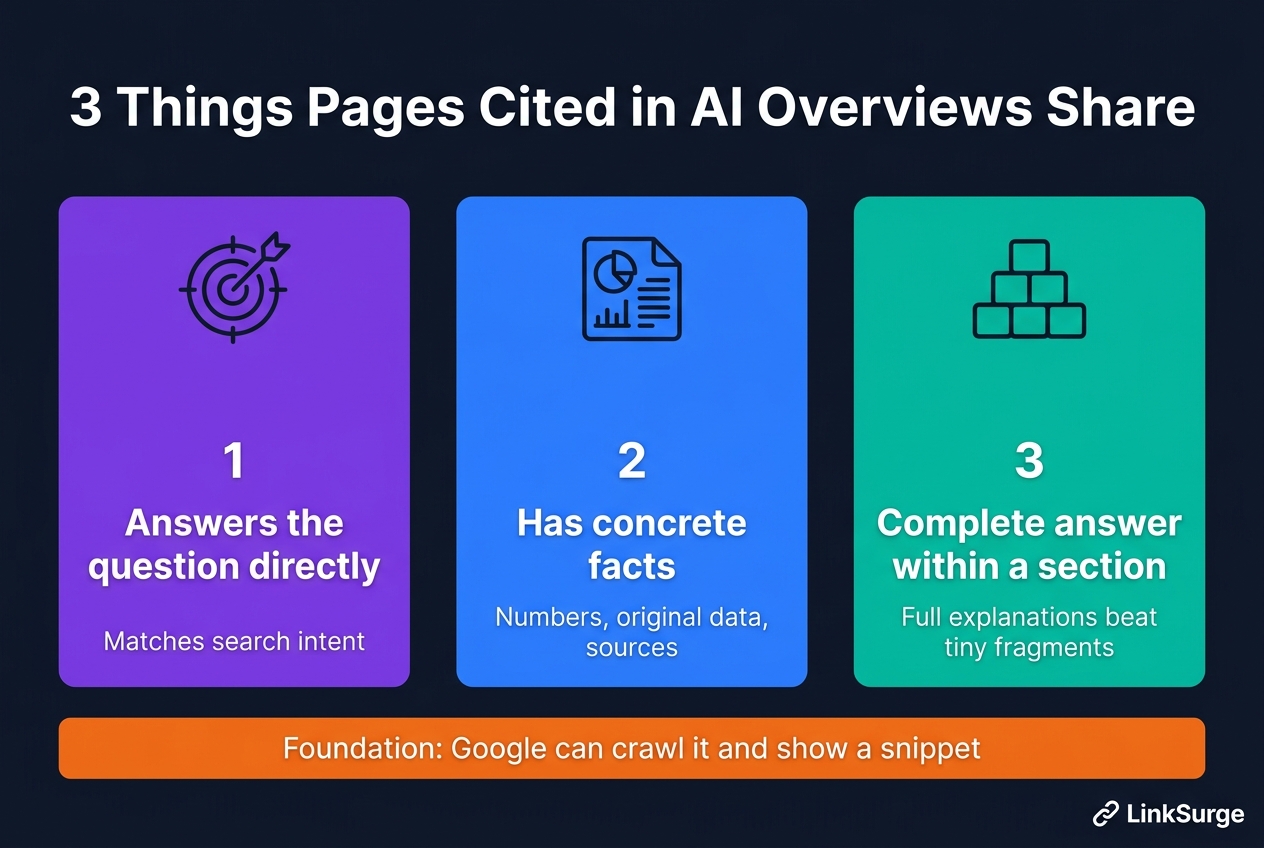
So what do the pages that actually get cited have in common? Here I draw on two sources: an expert survey and citation data we collected ourselves. Both describe tendencies among cited pages. Neither guarantees that doing these things will get you cited.
Trait 1: They answer the search question directly
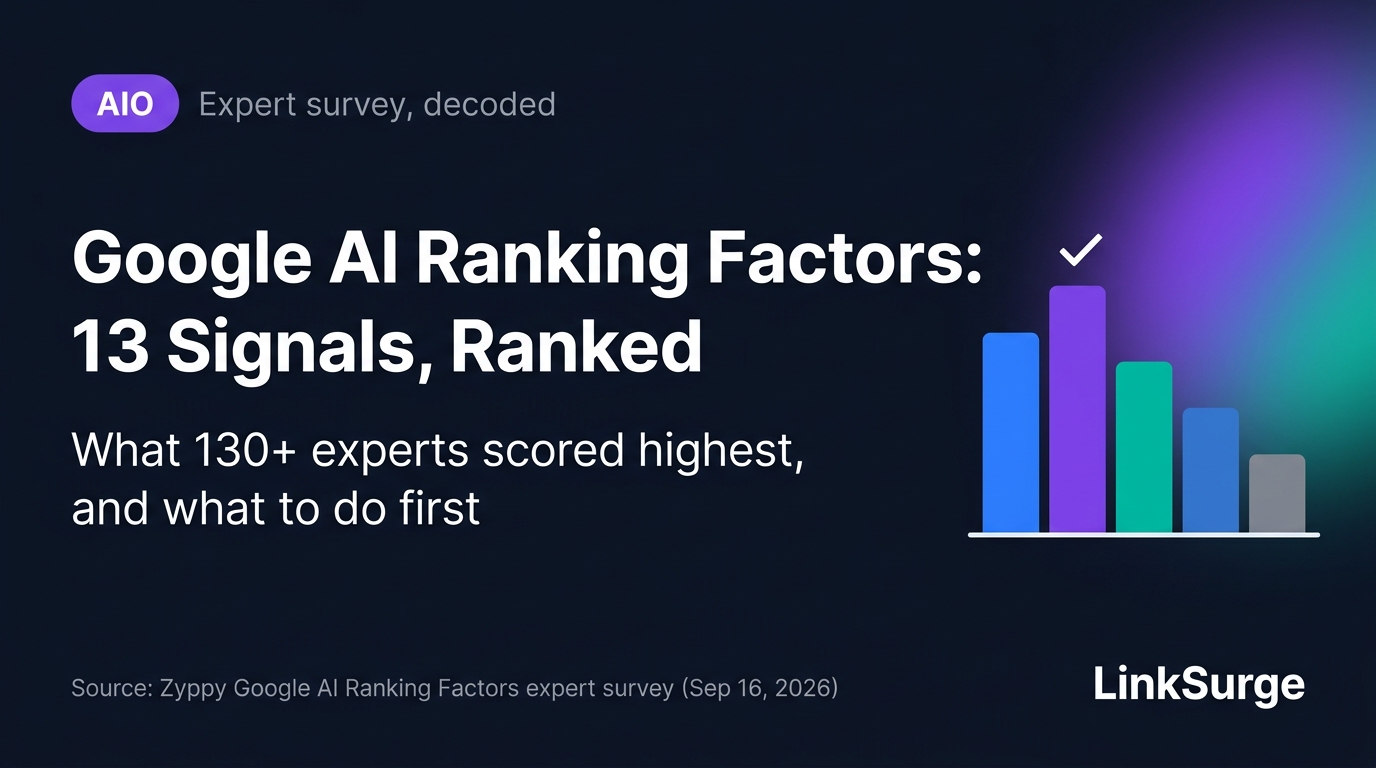
In a survey published by Zyppy (Cyrus Shepard) in September 2026, more than 130 SEO and AI search experts scored the factors that influence citations in AI Overviews and similar features. "Query-answer match" ranked near the top at +2.15.
Does the page answer what the searcher wants to know? It sounds obvious, but plenty of articles bury the answer below a long preamble or company introduction.
Trait 2: They include concrete facts or original information
The same survey scored "citable, specific facts" at +2.07 and "unique first-party information" at +1.85. Numbers, dates, steps, comparison tables and data you collected yourself are all material an AI can lift and reuse.
A page that says what every other page says gives the AI no reason to pick it.
Trait 3: Each heading section contains a complete answer
When we analyzed 277 real AI Overviews citations at the level of heading sections (blocks), 69.3% came from heading blocks in the body, not the page's opening lead. Cited blocks were also clearly longer, with a median of 476 characters versus 273 for uncited blocks.
So it isn't as simple as "put the conclusion at the top" or "chop content into small pieces." What matters is that each heading is answered fully within its own section. The full analysis is in "Where Does AI Search Actually Quote From?"
Foundation: Google can crawl it and show a snippet
All three traits assume the page is indexed and eligible for a snippet. Check in Search Console's URL Inspection tool that there's no accidental noindex or nosnippet, and that Google can load the page. Also check that Settings > Search generative AI isn't set to Exclude (it should be Include, or inherit Include from a parent property).
For the full list of 13 factors, see "Google AI Ranking Factors: What 130+ Experts Scored Highest."
Sources: Google AI Ranking Factors - Zyppy Signal Where Does AI Search Actually Quote From? We Analyzed 277 Real Citations - LinkSurge
3. Compare Your Page With the Ones That Get Cited
Knowing the three traits doesn't tell you what's missing from your own article. Staring at your page rarely reveals it. The most reliable method is to compare it with the pages actually cited for the same keyword.
Check these three things.
| Check | What to look for in cited pages | What to check in your article |
|---|---|---|
| Where the answer is | Does the answer come right after the heading? | Is your answer buried after a preamble? |
| How specific it is | Are there numbers, steps, comparisons, sources? | Does it stop at generalities? |
| How long the section is | How far does one heading section go? | Does your section end after a line or two? |
To do this by hand, search the keyword and open each page cited in the AI Overview. That works for one keyword, but results vary by person and time, and it gets slow across many keywords.
4. Step by Step: LinkSurge's AIO Optimization Analysis
Here's how the process looks in LinkSurge's AIO optimization analysis. The interface is in Japanese. If the keyword visibility analysis from the previous guide shows where your whole site appears, this feature looks closely at one keyword and one page. For an overview of the feature and how the 30-point and 100-point analyses differ, see the AIO optimization analysis feature page (in Japanese).

Step 1: Enter a keyword, and a URL if you want

There are two input fields.
- Keyword (required): the keyword whose AI Overview you want to check
- Target URL (optional): the page you want cited for that keyword
There are two ways to use it.
| Input | What you get | Points |
|---|---|---|
| Keyword only | Whether an AI Overview appears and which sites it cites | 30 points |
| Keyword + URL | All of the above, plus your page's citation status, a page analysis and an improvement report | 100 points |
If no AI Overview appears for the keyword, no points are used. The same goes when only "People also ask" appears. If you're new, start with a keyword-only check, confirm an AI Overview appears, then run the URL analysis.
Step 2: See which sources the AI Overview cites
Results appear from the top down as the analysis runs. First you'll see whether an AI Overview appears for the keyword.
If it does, you get a list of the cited sites with their position, site name, title and link. These are the pages to compare against, as described in section 3.
Step 3: Check your page's citation status and page analysis (with a URL)
If you entered a URL, you'll also see:
- Citation position: where your page appears among the AI Overview's citations (if it's cited)
- Competitors above and below: how many sites are cited before and after yours
- On-page analysis: title and meta description length, number of H1, H2 and H3 headings, content length, internal and external links, load time, mobile support and more, each with a rating
- On-page recommendations: fixes based on those metrics, labeled urgent, high, medium or low priority
Step 4: Read the AI optimization report (with a URL)
Finally, the tool builds an AI optimization report that pulls everything together. It includes a 0–100 score estimating how likely the page is to be cited, your page's strengths and weaknesses, changes you can make right away, sample text to add and a strategy based on your competitors.
You can revisit results from your history for 12 hours (up to 50 analyses).

LinkSurge
linksurge.jp
SEO・AIO・GEO統合分析プラットフォーム。AI Overviews分析、SEO順位計測、GEO引用最適化など、生成AI時代のブランド露出を最大化するための分析ツールを提供しています。
5. The Order to Fix Things In
The report lists a lot of suggestions, and trying to do everything at once tends to stall. For beginners, I recommend this order.
1. Move the answer up. Find the heading that matches the keyword you're targeting, and put the answer right after it. Move preamble and background below the answer.
2. Add concrete facts. Back the answer with numbers, steps, comparisons and sources. If you have data or experience no one else has, use it here. Information the cited competitors lack is exactly what gives the AI a reason to pick you.
3. Complete the answer within each section. If a section is too short, add what a reader would want to know next. If one heading covers several topics, split it.
4. Check the technical side. Make sure the page is indexed, eligible for a snippet and not too slow. Handle any "urgent" or "high" on-page recommendations here.
5. Save metadata and structured data for last. The report also suggests titles and meta descriptions, plus FAQ and structured data code. These help with how the page looks in search results, but Google says structured data isn't required for generative AI search. If citations in AI Overviews are your goal, finish steps 1–3 first.
After making changes, wait a few weeks, run the same keyword again and see whether your citation position changed.
6. Caveats
- AI Overviews vary by searcher and over time. Results reflect the moment you ran the analysis
- The report's score and suggestions are pointers for improvement. They don't guarantee a citation
- Each analysis covers one keyword. To target several, analyze each one. It's more efficient to first see where your whole site appears with the keyword visibility analysis
Frequently Asked Questions
Do I need a special writing style to get cited in AI Overviews?
No. Google's official guide says you don't need to break content into small pieces or write in a special way for generative AI. What matters is answering the search question directly, showing concrete facts or original information and completing each answer within its heading section.
Will adding structured data make AI Overviews more likely to cite me?
Google says structured data isn't required for generative AI search, and experts in the survey scored it well below the top factors. Structured data helps with how your page looks in search results, but if you're aiming for AI Overviews citations, fix how your content answers first.
How many points does the AIO optimization analysis use?
A keyword-only analysis uses 30 points, and a keyword + URL analysis uses 100 points. No points are used when no AI Overview appears, or when only "People also ask" appears.
How is this different from the keyword visibility analysis?
The keyword visibility analysis takes a domain and lists every keyword where your site is cited in AI Overviews. The AIO optimization analysis looks closely at one keyword and one page: who gets cited and what your page is missing. Start with the visibility analysis to see the big picture, then dig into the keywords you want to grow with the optimization analysis.
Conclusion: Put Your Page Next to the Cited Ones and Fix How It Answers
There's no trick to getting cited in AI Overviews. On a foundation of a page Google can crawl and show a snippet for, answer the question directly, show concrete facts and complete each answer within its section. That's the way of answering that cited pages have in common.
What your article is missing becomes clear when you put it next to the pages cited for the same keyword. Pick one important keyword and start by comparing. If you haven't yet checked which keywords your site appears for, start with "Is Your Site Showing Up in Google AI Overviews?"
LinkSurge's AIO optimization analysis shows the AI Overview's sources, your page's citation status and an improvement report, from just a keyword and a URL.