Where Does AI Search Actually Quote From? We Analyzed 277 Real Citations
目次
Key Takeaways: Four Assumptions the Data Challenged
"Put your conclusion at the top if you want AI search to quote you." You've heard this advice. I had too — but I'd never seen first-party data backing it up. So I ran the numbers on the AI Overviews citation data we've accumulated. Some of the conventional wisdom held. Some of it clearly didn't.
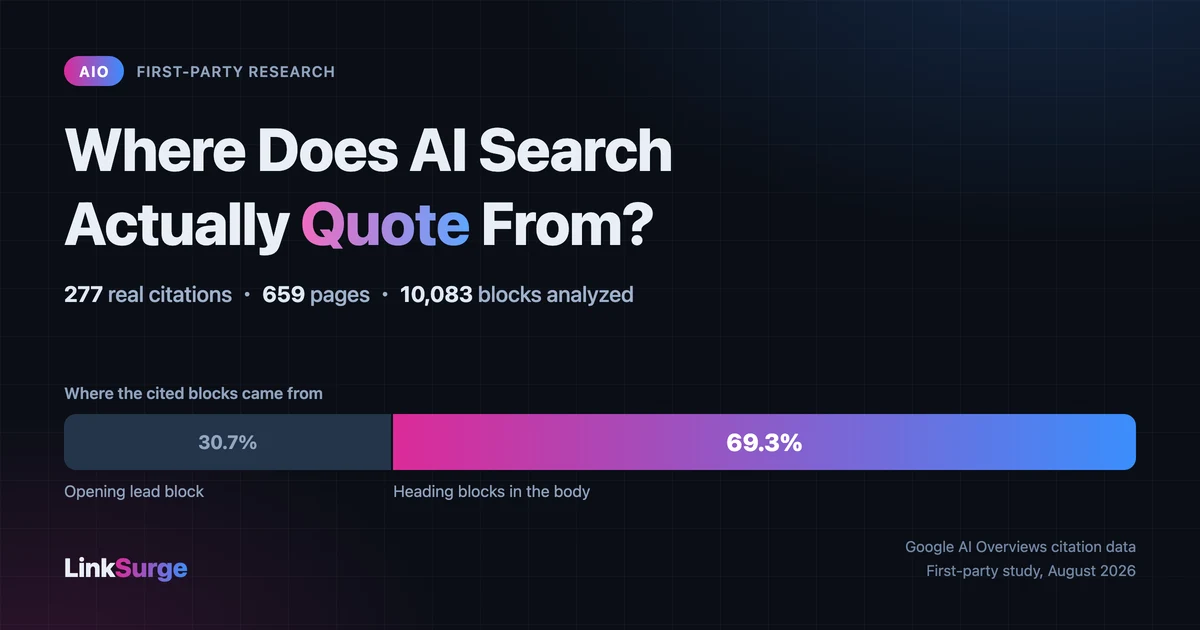
- Citations are spread across the whole page — Only 30.7% of cited blocks were the page's opening lead. The other 69.3% came from heading blocks in the body, and 12.6% came from the final fifth of the page
- Answer-first helps within a block, but it isn't decisive — 35.8% of citations started in the first 20% of a block. Meaningful, but 25.3% started from the middle. "No conclusion up front means no citation" overstates it
- Blocks that reference earlier context weren't penalized — Blocks starting with "this" or "that" were actually more common among cited blocks (2.3% vs 1.5%). The opposite of what we assumed
- Cited blocks are noticeably longer — 476 characters median for cited blocks versus 273 for uncited ones. Chopping content into tiny fragments isn't the win people assume it is
Let's walk through the method, the results, and the limitations.
1. Why We Ran This Study
This started as an internal argument about our own product.
We're currently building a tool that scores individual heading blocks for AI citation readiness — unreleased as of this writing. One of the scoring criteria was "does the opening one or two sentences state the conclusion?" Then a colleague pushed back:
"Putting the conclusion near the top of a page makes sense. But demanding that structure for every heading section — is that actually right?"
Fair question. When I traced the criterion back to its source, it came from a single GEO industry blog post. Plausible-sounding, never verified. Honestly, that's not good enough to ship as a scoring rule.
So we checked it against text that AI search had actually quoted.
"Plausible" and "verified" are different things
GEO moves fast, and secondary sources circulate as if they were primary ones. I'd absorbed an industry claim straight into our product design. It's like navigating without a map — you might be heading the right way, but you have no way to confirm it.
For the broader picture of how generative engine optimization works, see our Complete GEO Guide. This article zooms in on one specific question: which part of a page gets quoted.
2. Method and Data
What we used
We drew on Google AI Overviews citation data collected through our own AI search monitoring. AI Overviews returns a source URL alongside a snippet of the quoted text, which makes it possible to trace where on the page the quote came from.
| Metric | Count |
|---|---|
| URLs attempted | 700 |
| Pages successfully fetched | 659 (41 failed to fetch) |
| Citation snippets we tried to locate | 738 |
| Citations traced to a specific block | 277 (461 could not be matched) |
| Heading blocks parsed | 10,083 (257 of them cited) |
Note the two different denominators: 659 counts pages, while 738 and 277 count citations. A single page can carry several citations, and several citations can land in the same block — which is why 277 citations map to 257 distinct blocks.
One thing to be upfront about: the corpus is Japanese-language pages. Our monitoring covers the Japanese market, so that's what we could study. Whether these patterns transfer to English-language content is untested. Read the numbers with that in mind.
How the matching worked
- Extract URL and quoted-text pairs from the citation data
- Filter out page titles, table extractions, and bullet-list dumps — keep only prose snippets
- Fetch each URL and split the body into blocks at h2/h3 boundaries, excluding boilerplate like related-article widgets
- Search for the first 18 characters of the snippet inside each block and record which block it landed in and at what character offset
Step 4 is the important one. If you know where inside a block the quote begins, you get a direct answer to the answer-first question.
How we define "position"
So the numbers are reproducible, here are the two position metrics. Both are computed on whitespace-stripped text.
Position within the page (used in section 3) — relative position by HTML document order.
page position = block index ÷ (total blocks on that page − 1)
The first block is 0, the last is 1. We bucketed that into fifths. Indices are assigned after boilerplate blocks are excluded. Pages with a single block are treated as 0.
Position within the block (used in section 4) — where the quote starts inside the block's text.
block position = zero-based character offset of the quote ÷ block length in characters
The start is 0, and the value never reaches 1 — a quote starting at the final
character still yields (length − 1) ÷ length. This is a character offset, not a
word or line count. Where a snippet matched more than once, we take the first match.
What this study can't tell you
Before the numbers, here's what we can't claim.
- We matched 277 of 738 attempts. 62% failed. JavaScript-rendered pages and paraphrased snippets likely account for some of it, but we haven't verified whether the failures are systematically different
- Snippets are truncated at a median of 63 characters, with 86% ending in an ellipsis. We can identify where a quote starts, not its full extent
- Only AI Overviews returns quoted text. ChatGPT, Gemini, and Perplexity citations carry just a URL and title, so the same analysis isn't possible for them
This is an observation about Google AI Overviews in Japanese-language search. Not about AI search in general.
References: AI Features and Your Website - Google Search Central AI Overviews and AI Mode - Google Search Help
3. Finding One: Citations Spread Across the Page
Here's the answer to the opening question. We tallied where in the page each cited block sat.
| Position of cited block within the page | Share |
|---|---|
| First 20% | 53.4% |
| 20–40% | 13.0% |
| 40–60% | 14.4% |
| 60–80% | 6.5% |
| Last 20% | 12.6% |
There's a real skew toward the top. Just over half landed in the first fifth.
But break it down further and the picture shifts. The page's opening lead block accounted for 30.7% of citations. The remaining 69.3% came from heading blocks in the body. And 12.6% came from the last fifth of the page. The median position of a cited block was #2, on pages with a median of 13 blocks.
Optimizing only the opening leaves most of it on the table
The implication is straightforward. Polishing your opening still has value — but on its own it ignores roughly 70% of citation opportunities.
What I found genuinely interesting is how often the tail end of an article gets quoted. A summary or a supplementary section can turn out to be the best available answer for one specific sub-query. That mechanism — AI search fanning a single question out into multiple sub-queries — is covered in What Is Query Fan-Out?. It's a plausible explanation for the spread, though we measured the distribution, not the cause.
LinkSurge's AI Overview analysis shows which keywords your pages are being cited for, keyword by keyword.
4. Finding Two: Answer-First Helps, But Doesn't Decide
Next: where inside a block did the quote begin? This is the direct test of the answer-first rule.
| Position within the block | Raw | Adjusted |
|---|---|---|
| 0–20% (opening) | 56.0% | 35.8% |
| 20–40% | 14.4% | 21.1% |
| 40–60% | 17.3% | 25.3% |
| 60–80% | 7.6% | 11.1% |
| 80–100% | 4.7% | 6.8% |
The raw number looks like a strong endorsement: 56% of quotes started in the first fifth of a block, against the 20% you'd expect if position didn't matter.
Why we adjusted
There was a catch. 31.4% of citations started at character zero — the exact start of the block.
That may not mean "the conclusion was up front so it got quoted." It may simply mean Google's chunk boundary happened to align with the heading. A quote starting at the beginning of the unit it was cut from is close to tautological.
So we removed those 87 cases and recalculated. That's the "Adjusted" column. The opening bucket drops to 35.8% — still above the 20% chance baseline, but a much softer story. Meanwhile the middle of blocks (40–60%) sits at 25.3%, also above chance.
The honest read: quotes skew toward the front of a block, but a block without a front-loaded conclusion is not disqualified. Getting quoted from the middle of a section is common.
References: How AI Search Works: LLM Retrieval Explained 2026 AI Features and Your Website - Google Search Central
LinkSurge
linksurge.jp
SEO・AIO・GEO統合分析プラットフォーム。AI Overviews分析、SEO順位計測、GEO引用最適化など、生成AI時代のブランド露出を最大化するための分析ツールを提供しています。
5. Finding Three: Referring Back Wasn't a Penalty
This one surprised me most.
Within the same pages, we compared blocks that got cited against blocks that didn't.
The unit of comparison is the unique block. Deduplicated, the 277 citations map to 257 blocks (several citations can land in the same one), leaving the other 9,826 blocks across those same 659 pages as "not cited." Every percentage below uses those two denominators.
| Signal | Cited<br>(n=257) | Not cited<br>(n=9,826) |
|---|---|---|
| Opens with a demonstrative ("this," "that," etc.) | 2.3% | 1.5% |
| Contains a cross-reference ("as noted above," "see below") | 4.7% | 2.6% |
| Median character count | 476 | 273 |
Blocks opening with a demonstrative, and blocks referencing other sections, were more common among cited blocks. The reverse of our assumption.
Our tool had rules that deducted points for both. The data didn't support the direction of those deductions.
But don't over-read the gap
Being straight about it: there's a confound. Longer blocks are easier to match. A block holding more of the page's text is more likely to be the source of any given quote — and longer blocks are also more likely to contain a demonstrative or a cross-reference. The size of the difference isn't trustworthy.
What does hold is the absence of evidence for the penalty. Telling users to rewrite prose based on a rule we can't support is just noise in their workflow.
The length finding carries the same caveat, though a 476-character median for cited blocks lines up with a separate measurement we ran earlier (median 402 characters for blocks containing a cited passage). Slicing content into short fragments isn't what earns citations.
6. How We Changed Our Scoring Before Launch
We revised the scoring in the heading-block diagnostic we're building. Catching this before release was lucky — and we're publishing the inconvenient parts too.
| Criterion | Before | After | Reason |
|---|---|---|---|
| Standalone readability | 25 pts | 35 pts | If blocks are retrieved independently, reading standalone is the baseline requirement. Weight increased |
| Conclusion position | 25 pts | 15 pts or N/A | Front-loading skew is real but not decisive |
| Opening demonstrative | −20 pts | Removed | Cited blocks contained these more often |
| Cross-reference phrases | −15 pts | Removed | Same |
Why we added "not applicable"
The more consequential change was allowing conclusion position to be marked not applicable.
That criterion quietly assumes the block is structured as an answer to a question. When we classified real pages, only 6 of 44 blocks in our evaluation set (14%) fit that shape. The rest were term definitions, procedural steps, pricing tables, and reference link lists.
Take a block titled "Interest income" on a tax authority page. It is the definition. There's no conclusion to move to the front. Flagging it with "state your conclusion up front" means mechanically penalizing correctly written prose.
Blocks like that are now scored on standalone readability alone.
A bug we found along the way
The verification also surfaced a bug in our own code. Block indices become non-contiguous once boilerplate sections are filtered out, but the code ingesting the model's judgments assumed sequential numbering — so judgments for blocks at the end of a page were being silently discarded. Fixed now, but without auditing the criteria we'd have shipped it.
For more on how we think about AI-era content evaluation, see What Is LLMO?.
7. What to Actually Do With This
Turning the findings into practice.
Worth doing
- Check each heading section for standalone readability — can someone who skipped the previous section still follow this one? This is the most reliable guideline we have
- Don't coast through the middle and end of your article — 69.3% of citations came from outside the lead. Summaries and supplementary sections are live candidates
- Answer the heading's implied question inside that block — "we'll cover this later" breaks the block as a standalone unit
- Give each block enough substance — cited blocks ran to a 476-character median. Fragmenting isn't the goal
Safe to stop worrying about
- Mechanically front-loading a conclusion in every section — definitions, procedures, and pricing tables shouldn't be forced into that shape
- Avoiding sentences that start with "this" or "that" — if the referent sits inside the block, it's fine. We found no evidence for a penalty
Worth noting: Google states in its official AI optimization guidance that chunking and special schema aren't needed for AI Overviews or AI Mode. Meanwhile ChatGPT and Perplexity are reported to split pages at headings and score sections independently. Treat the Google axis and the LLM-retrieval axis separately — this study speaks only to the former.
For ongoing tracking, tools like LinkSurge let you monitor citation status over time rather than checking manually.
Frequently Asked Questions
Does AI search only quote from the top of a page?
No. In our analysis, the page's opening lead block accounted for 30.7% of cited blocks, while 69.3% came from heading blocks in the body. Even the final fifth of the page produced 12.6% of citations. There's a skew toward the top, but optimizing only the opening ignores roughly 70% of the opportunities.
Do I need to put a conclusion at the start of every heading section?
It helps, but it isn't required. After adjusting for chunk-boundary artifacts, 35.8% of citations began in the first 20% of a block — above the 20% chance baseline, but 25.3% began from the middle. Blocks that are definitions or procedural lists don't need to be rewritten into an answer-first shape.
Are sentences that start with "this" or "that" bad for AI citation?
Our data didn't show a penalty. Blocks opening with a demonstrative made up 2.3% of cited blocks versus 1.5% of uncited ones — slightly more common among the cited group. That said, if the referent lives outside the block, the section stops making sense on its own, which is a genuine problem.
Is shorter content more likely to get quoted?
The data points the other way. Cited blocks had a median of 476 characters against 273 for uncited blocks. Keep in mind the confound: longer blocks are easier to match, so don't take the size of the gap at face value.
Do these findings apply to ChatGPT and Perplexity?
Not directly. We could only analyze Google AI Overviews, because ChatGPT, Gemini, and Perplexity return citations as URL and title only — no quoted text to locate. The corpus is also Japanese-language pages. Treat engine behavior as distinct until tested.
Conclusion: The Value of Owning Your Data
The most useful outcome here wasn't any single number. It was gaining a way to interrogate a plausible-sounding rule.
"Put the conclusion first" turned out to be half right and half overstated. "Avoid sentences that start with a demonstrative" had no support in this dataset at all. Had that criterion stayed in the product as inherited industry wisdom, we'd have kept nudging users toward pointless rewrites.
GEO and AIO move fast, and unverified best practices take on a life of their own. Collect data you can observe yourself, and revisit your own criteria on a schedule. It's unglamorous work, and it's where the real differentiation comes from.
For a beginner-friendly walkthrough of applying these findings to your own articles, see "What Pages Cited in Google AI Overviews Have in Common." To check whether each of your sections stands alone, see "Can Each Section of Your Article Stand Alone?"
LinkSurge's AI Overview analysis shows which keywords are driving citations to your brand in real time. Start by finding out where your pages actually stand.