Over Half of Japan Now Searches With Generative AI: What a 9,278-Person Survey Says About AI Search, and What Site Owners Should Do
目次
Key Takeaways: AI hasn't replaced search. It now sits right next to it
On September 4, 2026, CyberAgent's GEO Lab, a research unit inside one of Japan's largest digital ad agencies, published its August 2026 survey on how people use generative AI. It's an online survey of 9,278 people aged 15 to 69 across Japan, and the latest wave of a tracking study that began in May 2025. After working through the numbers, here's what stands out.
- More than half now use generative AI to search — 52.3% use generative AI, including Google's AI Mode, for search. That's up from 21.3% in May 2025, a 31-point jump in about 15 months. People in their 40s crossed 50% (50.2%) for the first time
- Search engines are still the main door at 86.9% — Down gently from 91.9% in May 2025, but still far ahead of AI. AI didn't replace search; it moved in next door
- Three services dominate: ChatGPT, AI Mode, Gemini — ChatGPT is at 30.6%, AI Mode 28.4%, Gemini 23.2%. Among teens, AI Mode hits 48.8%. Google's own AI is now nearly as big an entry point as ChatGPT
- AI is used most when comparing options — In every category, AI usage at the comparison stage beat the information-gathering stage. Among people who use both, 46.6% say they've moved more than half of their searching to AI
- AI answers lead to clicks and purchases — 61.0% have clicked a URL shown in an AI answer, and 58.7% have bought or used something an AI recommended
Let's break each of these down.
1. About the Survey
Before reading any numbers, it helps to know who asked whom, when and how.
| Item | Details |
|---|---|
| Survey | Generative AI / AI Overview user survey (August 2026) |
| Run by | GEO Lab, Internet Advertising Division, CyberAgent |
| Fieldwork | Macromill |
| Sample | 9,278 men and women aged 15–69 across Japan |
| Method | Online survey |
| Fieldwork dates | August 7–10, 2026 |
| Series | Running since May 2025 (previous wave: February 2026) |
Three caveats worth keeping in mind
- It's an online panel — Heavy internet users are overrepresented, so AI usage may run higher than in the population overall
- It's self-reported — "Using AI for search" is the respondent's own judgment, not measured usage
- The publisher sells GEO services — The data is still valuable as a consistent tracking series, but check the interpretation yourself
Even so, the same method has been repeated for over a year. For reading direction and speed of change, I think it's a solid source.
References: CyberAgent GEO Lab survey on generative AI usage (August 2026) - CyberAgent (Japanese)
2. AI Search Usage Hits 52.3%, and People in Their 40s Pass 50%
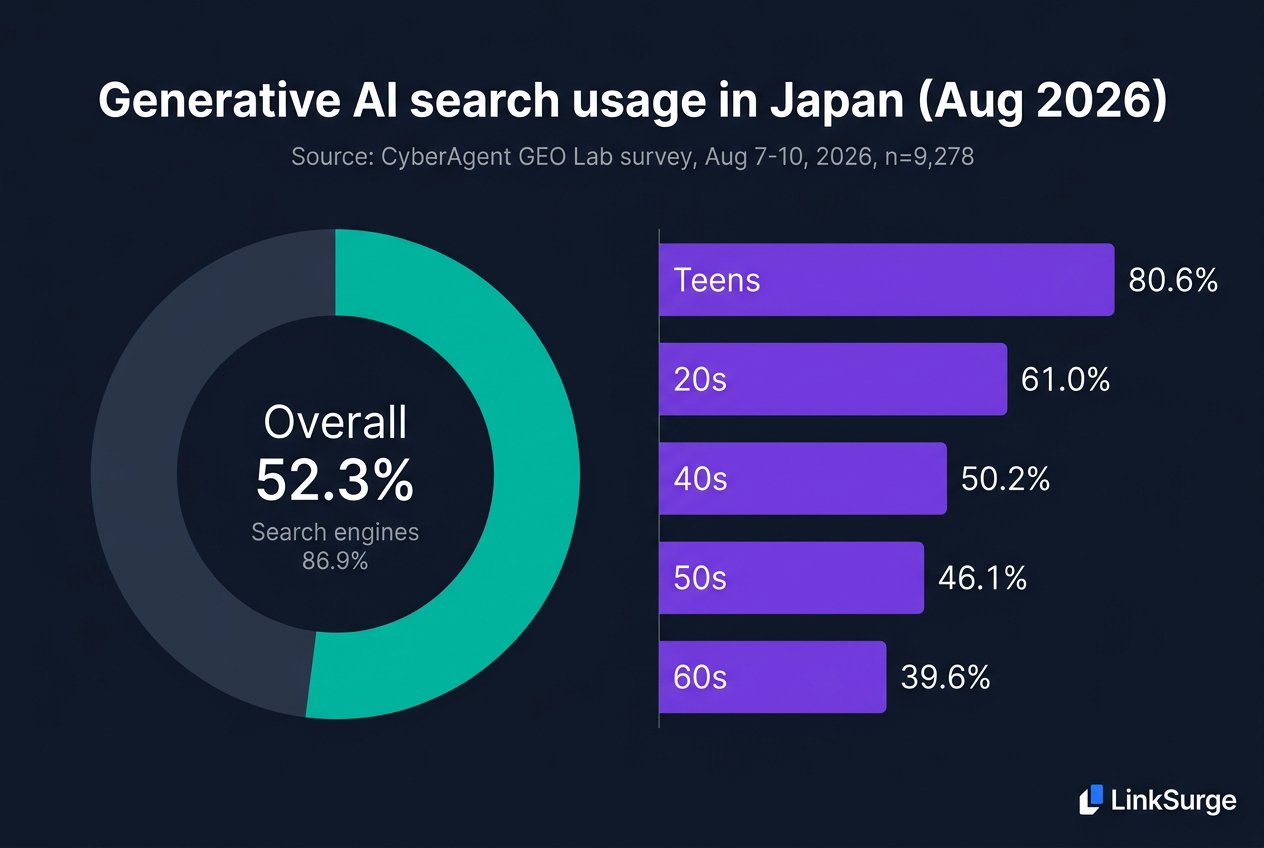
Generative AI search usage, including AI Mode, reached 52.3%, crossing 50% for the first time in the series.
| Period | Generative AI search usage | Search engine usage |
|---|---|---|
| May 2025 (first wave) | 21.3% | 91.9% |
| August 2026 | 52.3% | 86.9% |
By age group (change vs. February 2026 in parentheses):
| Age group | Generative AI search usage |
|---|---|
| Teens | 80.6% (+4.8pt) |
| 20s | 61.0% (+3.4pt) |
| 40s | 50.2% (+4.5pt) |
| 50s | 46.1% (+4.3pt) |
| 60s | 39.6% (+3.5pt) |
Note: the press release text doesn't state a figure for people in their 30s.
This surprised me: growth isn't slowing. Teens and people in their 20s, whose growth had looked like it was leveling off, kept climbing. People in their 50s and 60s each added around 4 points. "AI search is for young people" is no longer true in Japan.
Search engines still sit at 86.9%, more than 30 points ahead of AI. Traditional SEO is far from obsolete.
References: CyberAgent GEO Lab survey on generative AI usage (August 2026) - CyberAgent (Japanese)
3. Which AI? ChatGPT, AI Mode and Gemini
| Service | Search usage |
|---|---|
| ChatGPT | 30.6% (+1.5pt) |
| AI Mode | 28.4% (+2.6pt) |
| Gemini | 23.2% (+3.6pt) |
ChatGPT still leads, but AI Mode and Gemini are growing faster. Among teens, AI Mode reached 48.8% and Gemini 38.2%.
Google's own AI is now the second front door
Here's where it gets interesting. AI Mode lives inside Google Search, and its usage is now nearly level with ChatGPT's. The survey doesn't say where AI Mode users came from, but it's plausible that some people who used to run ordinary Google searches now get AI answers without leaving Google. At minimum, plan for an AI front door inside Google itself.
You can now see how often your pages appear in AI Mode and AI Overviews in Search Console. Here's how to read it: "How to Read Search Console's Generative AI Performance Report".
For ChatGPT specifically, start with "How to Get Cited by ChatGPT: The Complete 2026 Guide".
References: CyberAgent GEO Lab survey on generative AI usage (August 2026) - CyberAgent (Japanese)
4. How People Use It: Asking AI to Compare
Among people who use both search engines and AI, 46.6% say they've switched more than half of their searching to AI, up from 30.1% in May 2025.
AI shines at the comparison stage
The survey also asked which service people use first for different search goals. In every category, AI usage was higher at the comparison stage than at the information-gathering stage. Some examples of AI usage at the comparison stage:
| Comparison task | AI usage |
|---|---|
| Comparing product prices | 15.5% |
| Comparing hotels for travel | 14.8% |
| Comparing property conditions | 14.5% |
So people lean on AI less for "what is X?" and more for "should I pick A or B?" Instead of opening a comparison site, they ask AI to do the comparing.
For anyone selling a product or service, that's a big deal. The details AI uses to compare (pricing, specs, conditions, differences) need to be accurate and easy to find on your own site.
References: CyberAgent GEO Lab survey on generative AI usage (August 2026) - CyberAgent (Japanese)
5. What People Do After Reading an AI Answer
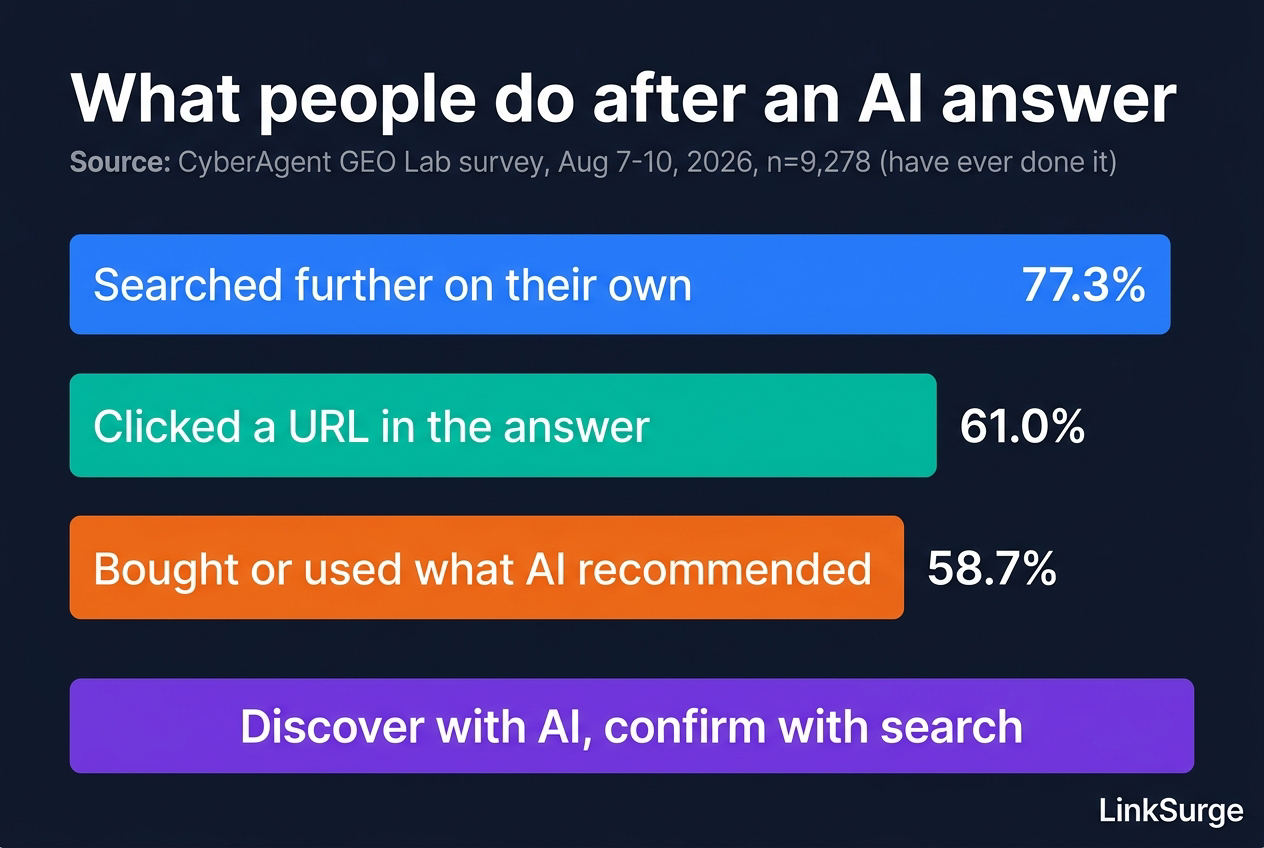
"If AI answers everything, nobody will visit my site." It's a common worry, and this survey speaks to part of it.
| Action after an AI answer | Share who have done it |
|---|---|
| Searched further on their own for a product or service AI recommended | 77.3% |
| Clicked a URL shown in an AI answer ("often" + "sometimes") | 61.0% |
| Bought or used a product or service because AI recommended it | 58.7% |
AI is the entry point; search and your site close the deal
The 77.3% figure is the one I keep coming back to. People find candidates through AI, then verify them with search and official sites before deciding. The journey doesn't end in the AI answer. It loops back to search.
Rakuten's September 2026 survey found something similar: 54.3% of Gen Z use AI when considering a purchase, yet search engines remain their most trusted source (42.1%). Details in "54% of Gen Z Ask AI Before They Buy, But Still Trust Search Most".
One caution. These numbers measure whether people have ever done something, not how often. Plenty of AI answers still end without a click. The practical reading isn't "AI visibility brings clicks." It's "if AI never mentions you, you won't make the shortlist people go on to search."
References: CyberAgent GEO Lab survey on generative AI usage (August 2026) - CyberAgent (Japanese)
6. What Site Owners Should Do Now
Here's how I'd translate the numbers into priorities.
1. Keep investing in search SEO
Search engines are at 86.9%, more than 30 points ahead of AI, and 77.3% of people go on to search after an AI answer. Pausing SEO to chase AI gets the order backwards.
2. Measure your visibility in AI Mode and AI Overviews
AI Mode is at 28.4% and closing in on ChatGPT. Check Search Console's generative AI performance report to see which pages appear. To see which keywords trigger those appearances, add keyword-level tracking like LinkSurge's AIO keyword visibility analysis.
3. Publish the details people compare, on your own site
AI is used most at the comparison stage. Put pricing, specs, conditions and how you differ from alternatives somewhere easy to find, with concrete numbers. When AI looks for comparison material, your official information should be there.
4. Count whether AI mentions your brand
58.7% have bought something because AI recommended it. Whether your name comes up in AI answers directly affects whether you make the shortlist. LinkSurge's AIO brand mentions shows the queries where AI answers mention your brand.
5. Compare your numbers with each new survey wave
This survey updates roughly every six months. Lining up each wave against your own AI impressions and traffic helps you separate market-wide shifts from the effect of your own work.
References: CyberAgent GEO Lab survey on generative AI usage (August 2026) - CyberAgent (Japanese) Generative AI performance report (Search) - Search Console Help
LinkSurge
linksurge.jp
SEO・AIO・GEO統合分析プラットフォーム。AI Overviews分析、SEO順位計測、GEO引用最適化など、生成AI時代のブランド露出を最大化するための分析ツールを提供しています。
Frequently Asked Questions
How many people in Japan use generative AI for search?
CyberAgent GEO Lab's August 2026 survey of 9,278 people aged 15–69 found 52.3% use generative AI, including AI Mode, for search. That's up from 21.3% in May 2025. Because it's an online survey, the figure may run somewhat higher than for the whole population.
Which AI search service is most used in Japan?
In the same survey, ChatGPT was at 30.6%, Google's AI Mode at 28.4% and Gemini at 23.2%. ChatGPT leads, but AI Mode and Gemini are growing faster, and AI Mode reached 48.8% among teens.
Does AI search make SEO unnecessary?
No. Search engine usage was 86.9%, well above AI, and 77.3% of respondents searched further on their own after an AI recommendation. People find candidates through AI and verify them through search, so being findable in search still matters.
Do AI answers send traffic to websites?
61.0% of respondents have clicked a URL shown in an AI answer. That measures whether they've ever done it, not how often. You can check how often your pages appear in Google's AI features in Search Console's generative AI performance report.
Conclusion: Make the Shortlist in Both Search and AI
The takeaway from this survey is that AI has settled in beside search rather than replacing it. People discover options through AI, then confirm them through search and official sites. Site owners need to show up in both.
Start with your own numbers. Check search and AI feature impressions in Search Console, and make sure the details people compare are accurate on your site. Then track whether AI answers mention your brand, on a regular schedule.
LinkSurge's AIO brand mentions lists the questions where AI Overviews and ChatGPT mention your brand.