54% of Gen Z Ask AI Before They Buy, But Still Trust Search Most: What Rakuten's Survey Means for GEO and SEO
目次
Key Takeaways: Build for "Shortlist with AI, Verify with Search"
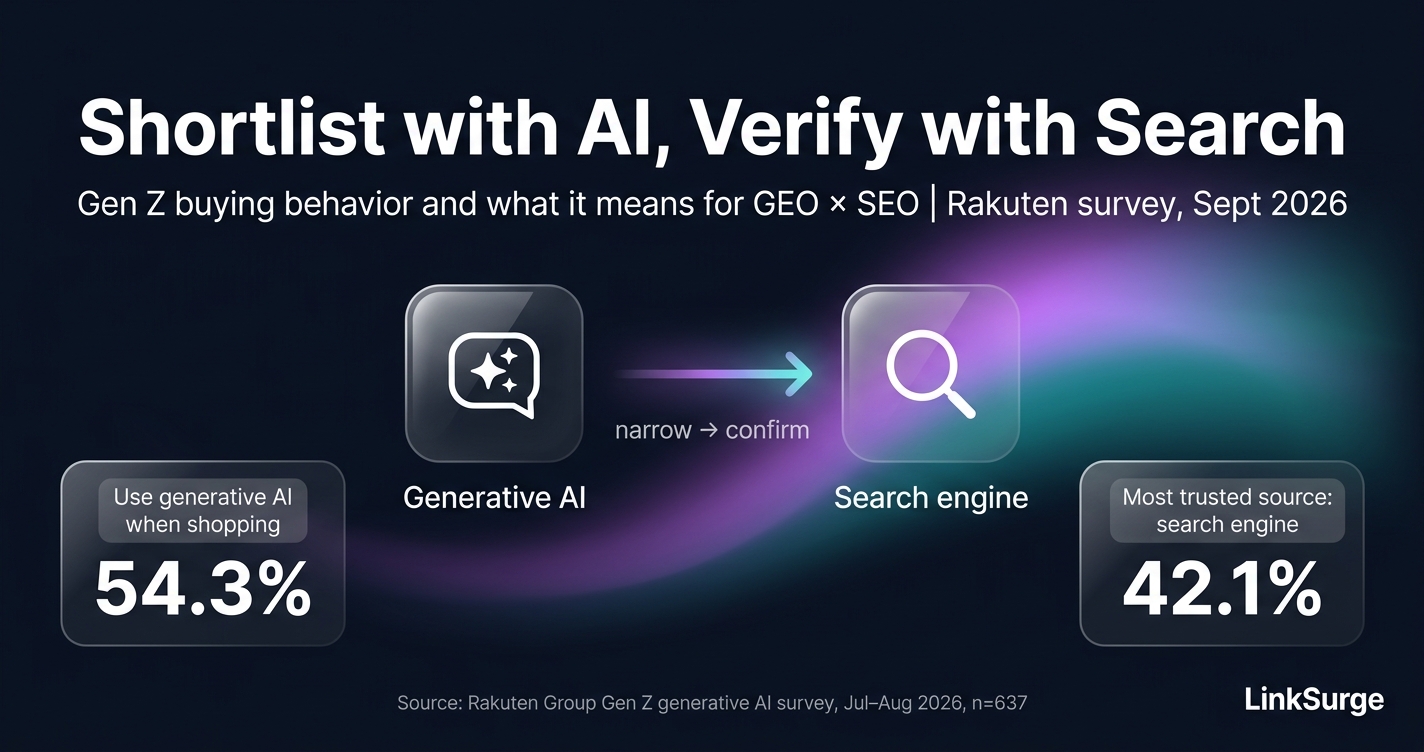
When I read the Gen Z survey Rakuten Group published on September 4, 2026, two numbers sitting side by side caught my attention. 54.3% of Gen Z respondents use generative AI when researching or buying products. Yet the source they trust most is not AI. It is the search engine, at 42.1%. That looks like a contradiction until you line it up with other 2026 surveys. Then a consistent pattern appears: people use AI to narrow the field, and search to confirm the pick. Here are the five things that follow from it.
- AI has become a shortlisting tool — The most common moment Gen Z reaches for AI is "narrowing down products I'm comparing" (44.4%), 1.6x more than "finding products I want" (27.8%). If your brand isn't in the AI's answer, you're eliminated before the comparison even starts
- The final call still gets verified in search — In PLAN-B's May 2026 survey, 87.4% of people who learned about a product through AI went on to verify it with Google or another search engine. Landing in the AI answer and then showing an empty brand SERP is where the funnel leaks
- Brand websites make up just 3% of observed ChatGPT shopping citations — Azoma's Q2 2026 analysis found ChatGPT's shopping citations were 41% earned media, 37% retailers, 19% UGC and 3% brand websites as a category. The other 97% came from third-party reviews, comparisons, retailers and UGC, which makes them your real sales collateral
- On purchase queries, classic search results still matter more than AI Overviews — Semrush tracked 600K+ US keywords from November 2025 to April 2026: AI Overviews on commercial queries grew 71%, while on transactional queries they fell 5%. The ten blue links are alive and well where the verification happens
- Measure both the AI answer and the SERP — Track mentions and cited sources across ChatGPT, Gemini, Perplexity and AI Overviews alongside rankings for brand and comparison queries. Watching only one side hides where the journey breaks
Let's break each of these down, starting with what Rakuten actually measured.
1. What Rakuten Found: Heavy Use, Guarded Trust
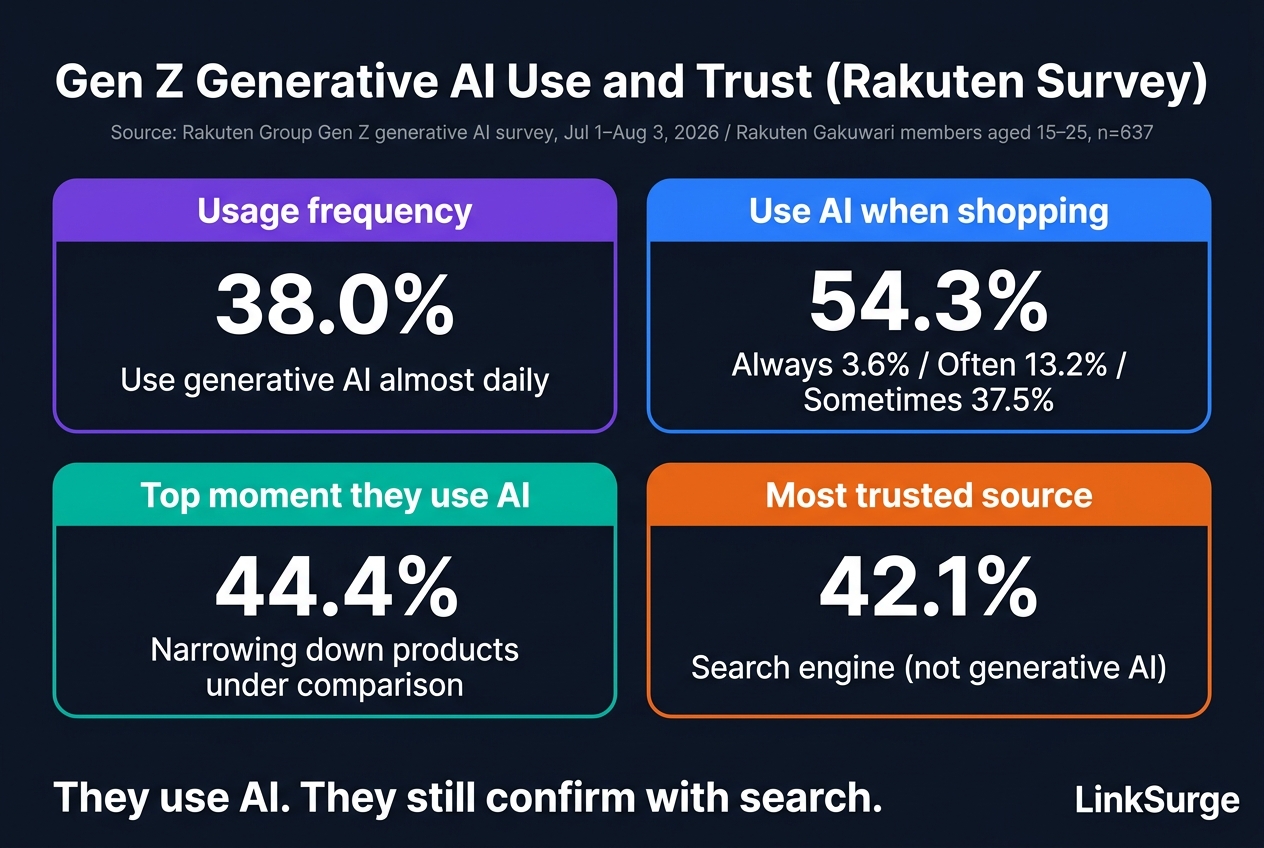
First, the primary source. Rakuten Group surveyed 637 members of its youth program "Rakuten Gakuwari" (ages 15 to 25) online between July 1 and August 3, 2026. Keep the sample in mind: these are registered members of one of Japan's largest e-commerce ecosystems, not a general population panel.
AI is already daily infrastructure
38.0% said they use generative AI almost every day. Top use cases were studying (62.6%), researching hobbies (47.0%) and getting advice on personal worries (30.9%). Within the studying use case, 48.5% said they trust the AI's information (7.8% "strongly," 40.7% "somewhat"). Nearly half trust it, and the other half hold back. That same split shows up in shopping.
How often, and when, they use AI for shopping
54.3% use generative AI when considering or buying products: 3.6% "always," 13.2% "often," 37.5% "sometimes." A majority use it, but fewer than one in five use it habitually.
| When they use AI (among users) | Share |
|---|---|
| Narrowing down products they're comparing | 44.4% |
| Finding products or services they want | 27.8% |
| While browsing an e-commerce site | 11.3% |
Here's what's interesting about that order. AI shows up less at the "start from zero" stage and more once a few candidates are already on the table. Only about one in ten use it side by side with an e-commerce site.
And yet the most trusted source is the search engine
Asked which source they trust most when evaluating products, 42.1% named search engines, the largest share. Rakuten's own reading: Gen Z uses generative AI to narrow choices, but still places its highest trust in conventional search for information gathering. Using AI and believing AI are two different things.
The release also covers attitudes toward Rakuten's own AI push. 40.8% view Rakuten's use of generative AI to improve services favorably, and 30.6% gather product information with AI before visiting Rakuten Ichiba or its other shopping properties (3.9% "always," 26.7% "sometimes"). Companies that deploy AI in their services get a favorable impression from 31.7%, with "innovative" (43.6%), "willing to take on challenges" (26.7%) and "fits our generation" (17.4%) as the top associations.
References: Rakuten Announces Results of Gen Z Generative AI Usage Survey (Japanese) - Rakuten Group
2. Three Other 2026 Surveys Point the Same Way
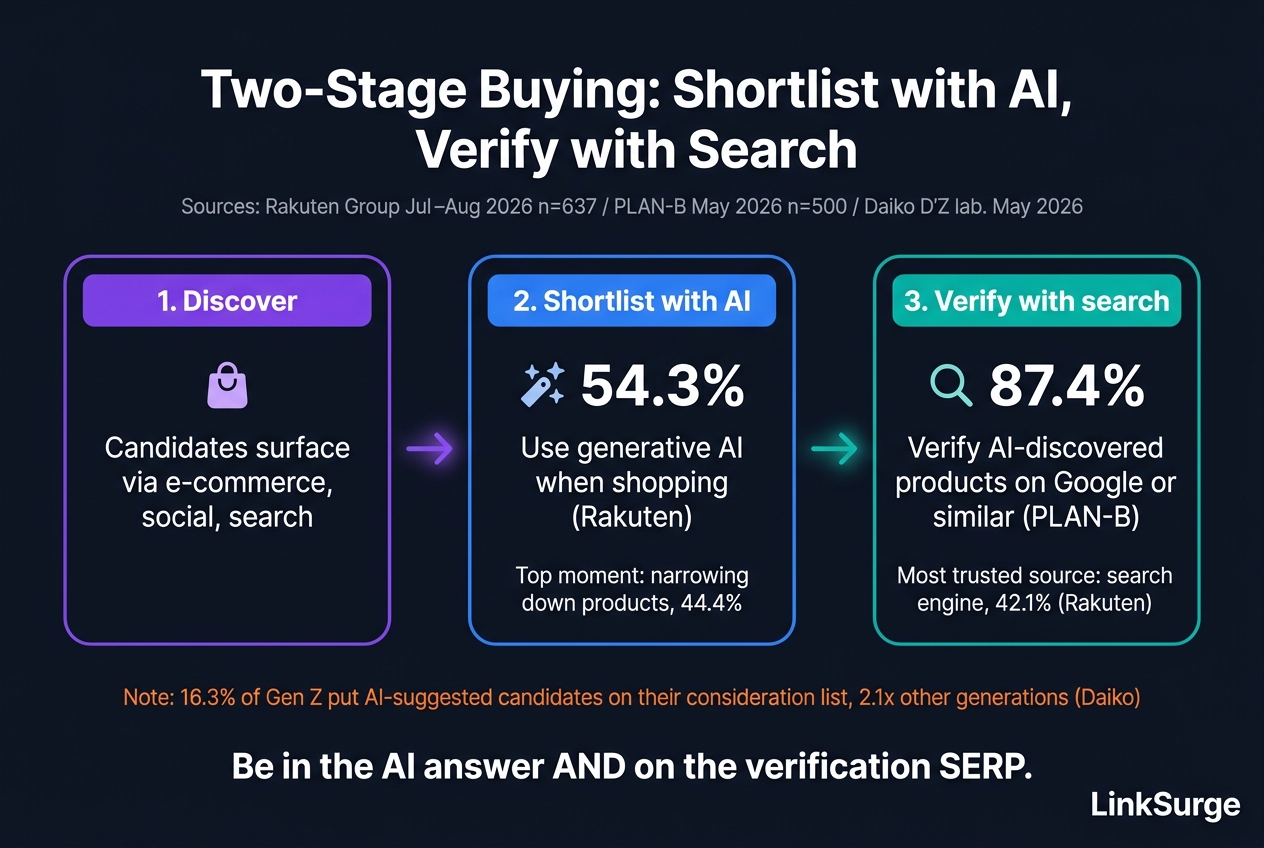
On its own, the Rakuten data describes one company's youth members. So I lined it up against three other Japanese surveys published in 2026. Different samples, different questions, so the figures aren't directly comparable. But the direction is remarkably consistent.
| Survey | Timing and sample | Key figures |
|---|---|---|
| Rakuten Group | Jul–Aug 2026, Gakuwari members 15–25, n=637 | 54.3% use AI when shopping; search engine most trusted at 42.1% |
| PLAN-B | May 11–16, 2026, daily AI users 10s–60s, n=500 | 54.1% have bought something AI prompted (+11.4 pts YoY); 87.4% verify with Google or similar |
| Daiko D'Z lab. | May 2026 quantitative, 4,034 analyzed | Gen Z AI usage 56.5% (about 1.45x other generations); 16.3% put AI-suggested candidates on their consideration list vs 7.6% for others |
| Excrie | Apr 24–27, 2026, monthly+ AI users 15–69, n=1,190 | 69.9% have used AI for shopping (n=1,190); of those, 61.3% bought something AI recommended (shopping-AI users, n=832) |
Why "shortlist with AI, verify with search" holds up
The clincher is PLAN-B's verification question. Among people who discovered a product through an AI conversation, 87.4% double-checked it via Google or another search engine, 34.4% via a marketplace like Amazon, and 34.1% via social media. Rakuten's "search is most trusted" and PLAN-B's "verify with search after AI" are the same behavior photographed from two angles.
Daiko adds a twist. 16.3% of Gen Z say they put a candidate the AI suggested on their purchase consideration list, 2.1x the rate of other generations (7.6%). So most people still verify, but AI suggestions make it onto the shortlist far more often for the young. Those two findings don't conflict. They mean being in the AI answer is worth more with every younger cohort.
In my own client work, I've watched branded search increasingly behave as the "check after asking AI" step. A brand lands in an AI answer, branded queries spike, and if that SERP is thin on reviews and comparisons, the traffic moves to a competitor. It's like picking a destination on the map and then turning back because you can't find the sign.
For the broader shift in how Gen Z searches, including TikTok as a search engine, see our TikTok SEO playbook.
A newer all-ages tracking survey points the same way. CyberAgent GEO Lab's August 2026 wave (n=9,278) found 52.3% of people in Japan now use generative AI for search, and 77.3% searched further on their own after an AI recommendation. Details in "Over Half of Japan Now Searches With Generative AI".
References: Over Half of Purchases Now AI-Triggered: Generative AI Purchase Behavior Survey 2026 (Japanese) - PLAN-B Gen Z AI Usage at 56.5%, 1.45x Other Generations (Japanese) - Daiko Generative AI in Daily Life and Shopping Survey 2026 (Japanese) - Excrie
3. What AI Actually Reads Before It Recommends a Product
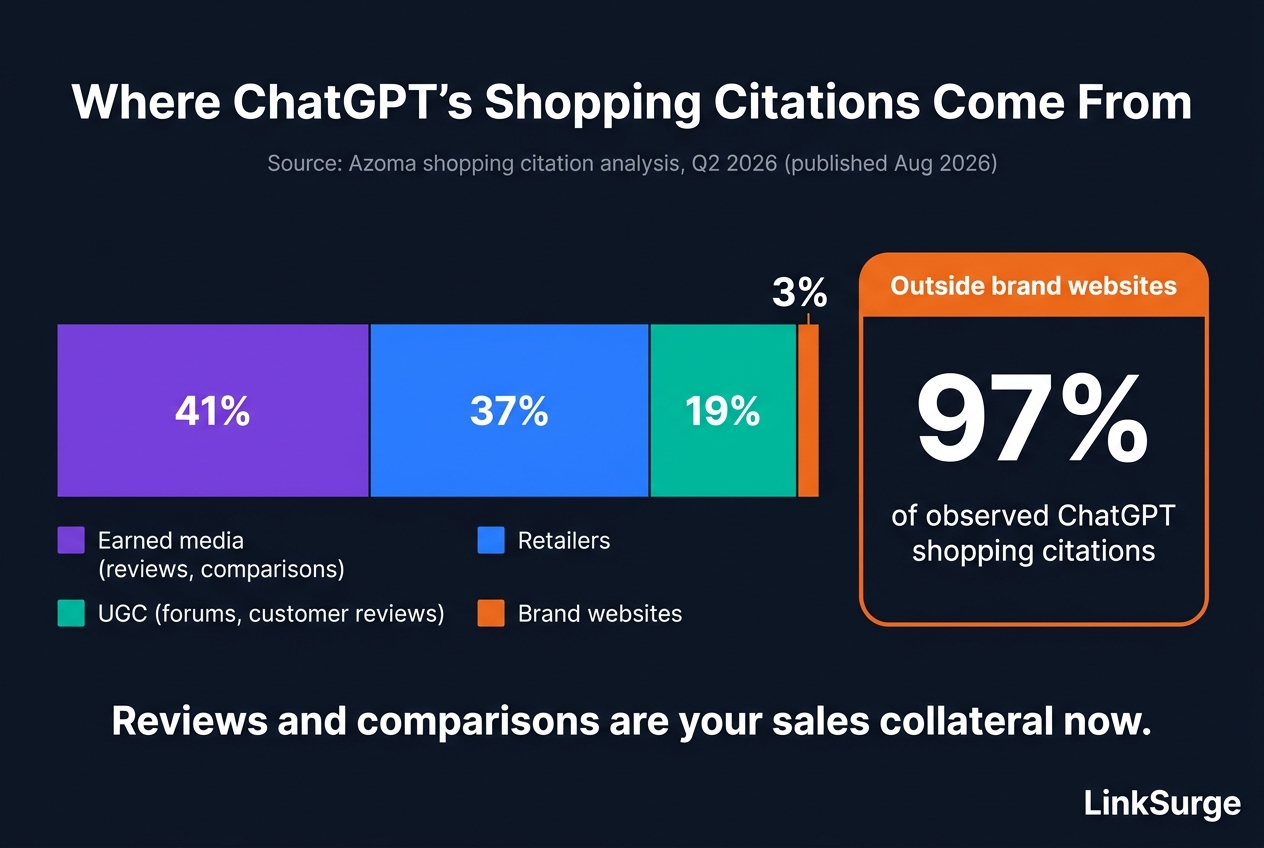
To get on the AI's shortlist, you need to know what it consults when it builds one. The best public data I've found comes from Azoma, an AI commerce analytics company, working with the Digital Shelf Institute.
Your website is 3%. The rest is in other people's hands
Azoma's analysis published in August 2026 broke down ChatGPT's citation sources for shopping questions: 41% earned media (review sites, editorial coverage), 37% retailers, 19% user-generated content, and 3% brand websites. The dataset covers millions of shopping agent citations from Q2 2026.
| Citation source | Share |
|---|---|
| Earned media (reviews, comparisons, specialist publications) | 41% |
| Retailers (marketplaces, e-commerce sites) | 37% |
| UGC (forums, communities, customer reviews) | 19% |
| Brand websites | 3% |
Honestly, that 3% is an uncomfortable number for most brands. It's the total for the brand-website category, not a per-brand figure, but with 97% of observed ChatGPT shopping citations coming from outside brand websites, polishing your product pages alone leaves most of the cited sources untouched. Azoma's own framing: a brand that invests only in retailer listings is addressing barely over a third of what ChatGPT cites.
Each AI agent has a different diet
The data behind Azoma's June 2026 framework, "The 5 C's of Agentic Commerce," shows how much this varies by agent. Amazon's Alexa for Shopping draws 86.5% of its citations from earned media, and Walmart's Sparky 76%. ChatGPT and Gemini lean much harder on retailers, at 37.1% and 41.6% respectively. Which AI you want to win determines which sources you should invest in.
How AI pulls in UGC, and why the mix shifts so fast, is covered in our guide to UGC and AI search citations. Remember that citation sources can flip within weeks. Promptwatch data reported by Search Engine Land shows Reddit's share of ChatGPT Search citations fell 86.4% in four days in August 2026, and the cause remains unconfirmed. Depending on any single platform is a risk in itself.
Tracking who gets cited requires recording AI answers on a schedule, not spot-checking. LinkSurge's GEO monitoring lets you register shortlist-style queries ("best X for Y," "A vs B") across ChatGPT Search, Gemini, Google AI Overviews, Claude and Perplexity, and logs whether your brand is mentioned and which URLs were cited, per platform. Once you know who's being cited, the review sites and comparison articles you need to go after become obvious.
References: What Sources Does ChatGPT Cite for Products? Azoma Publishes the Data - GlobeNewswire Azoma and Digital Shelf Institute Launch "The 5 C's of Agentic Commerce" - Business Wire Reddit's ChatGPT Search citations fell 86% in four days - Search Engine Land
LinkSurge
linksurge.jp
SEO・AIO・GEO統合分析プラットフォーム。AI Overviews分析、SEO順位計測、GEO引用最適化など、生成AI時代のブランド露出を最大化するための分析ツールを提供しています。
4. Surviving the Verification Search
Getting into the AI answer is only half the journey. Rakuten's 42.1% and PLAN-B's 87.4% both say the same thing: Gen Z goes to a search engine afterward to check. That's classic SEO territory, but AI Overviews have changed what the SERP looks like, so let's get the current picture straight.
How far have AI Overviews spread into shopping queries?
Semrush's study, published July 2, 2026, tracked more than 600,000 keywords in its US desktop database across ten industries from November 2025 to April 2026. Over those six months, the share of commercial-intent SERPs showing an AI Overview rose 71%. On transactional queries, it fell 5%. Consideration-stage queries ("best," "compare") are getting AI Overviews; purchase-stage queries ("buy," "price," "in stock") mostly aren't.
That's US data. Rates vary a lot by industry and query type in other markets, so check your own priority queries directly. LinkSurge's AI Overview analysis takes a keyword and your URL and returns whether an AI Overview appeared, the full list of cited URLs, and whether your page is among them.
The three query types people use to verify
From what I've seen, the searches that fire after an AI recommendation fall into three buckets.
| Query type | Examples | What the SERP needs to show |
|---|---|---|
| Brand + reputation | "brand reviews," "product complaints" | Third-party reviews, Q&A threads, an official FAQ |
| Comparison | "A vs B," "product X alternative" | Comparison articles, spec tables, price rationale |
| Purchase conditions | "product price," "product shipping," "product in stock" | Accurate product pages, structured data, marketplace listings |
A brand-plus-reputation SERP that shows only your own pages reads, to a Gen Z shopper, as "couldn't verify." Whether third-party reviews and comparisons appear on page one deserves the same monitoring cadence as your AI mentions.
For the wider view of what's changed on the results page itself, see how AI search is reshaping SEO.
References: AI Overviews are expanding across commercial intent search [Study] - Semrush
5. What Rakuten's In-App AI Concierge Signals for Retail
Rakuten's release doesn't stop at the survey. It also describes "Rakuten AI," an agentic assistant built into the Rakuten Ichiba app since December 2025. Shoppers describe budget, purpose and use case by text, voice or image, and the concierge proposes products from a catalog of roughly 500 million items, asking follow-up questions to surface needs the shopper hasn't articulated.
When the marketplace's own AI is the front door, product pages become source material
What's happening here is that AI shortlisting has moved inside the marketplace. A shopper might be narrowed down by ChatGPT, narrowed again by the in-app concierge, and finally verify in search. Product descriptions, specs and reviews are no longer just copy for humans. They're the raw material an in-store agent uses to decide who makes the cut.
Recall from Azoma's data that retailer sources account for 37.1% of ChatGPT's citations and 41.6% of Gemini's. Accurate, complete marketplace listings pay off twice: inside the marketplace's agent and in external AI answers. Stale prices, missing stock status, or specs buried in an image rather than written in text are exactly the kind of gaps that get a product dropped.
The same logic applies to US and European marketplaces rolling out shopping agents, from Amazon's Alexa for Shopping to Walmart's Sparky. LinkSurge's AI Ready audit checks structured data, heading hierarchy, llms.txt and other machine-readability signals for any URL, so you can score your product pages and comparison content side by side and decide which to fix first.
References: Rakuten Announces Results of Gen Z Generative AI Usage Survey (Japanese) - Rakuten Group
6. A 30-Day Plan
Let's turn this into a schedule. The goal is to show up in both places: the AI shortlist and the verification SERP.
Week 1: Design your monitoring queries and take a baseline
- Write down 10 to 20 shortlist-style queries for your category ("best [category] for [use]," "[A] vs [B]," "[category] recommendations")
- Run each in ChatGPT, Gemini, Perplexity and Google AI Overviews. Record whether you're mentioned and which URLs are cited
- Record rankings for the same queries plus your branded queries, and note which third-party pages sit on page one
Manual is fine for the baseline. If you plan to repeat it weekly, automate the AI-answer capture. The volatility is high enough that spot-checks will mislead you.
Week 2: Identify the third-party sources being cited
- Group Week 1's cited URLs by domain into review sites, comparison publishers and UGC
- Prioritize domains where competitors are cited and you aren't
- Decide the play per domain: review outreach, briefing a specialist publication, answering on community sites
Week 3: Fix your own pages and listings
- Put specs, price, availability and "how it differs from X" in the body text of product pages, not just images
- Add Product, Offer and FAQPage structured data and make sure it matches the visible content
- Publish an official FAQ page that answers brand-plus-reputation queries directly
Week 4: Check the verification path and lock in measurement
- Confirm that branded and comparison SERPs show third-party corroboration, not just your own pages
- Put AI mention rate, cited domains and branded rankings in one table and switch to weekly tracking
- Search for your products inside the shopping agents of your key marketplaces and note whether you appear
Frequently Asked Questions
How much does Gen Z use generative AI when shopping?
In Rakuten Group's survey of 637 Rakuten Gakuwari members aged 15 to 25, conducted July to August 2026, 54.3% use generative AI when considering or buying products: 3.6% always, 13.2% often and 37.5% sometimes. The most common use is narrowing down products under comparison, at 44.4%.
If they use AI, why is a search engine their most trusted source?
In the same Rakuten survey, 42.1% named search engines as their most trusted source for product research, the largest share. PLAN-B's May 2026 survey found that 87.4% of people who learned about a product through AI verified it with Google or a similar search engine. Across multiple studies, AI serves as a shortlisting tool while the final decision is checked in search.
What sources does ChatGPT cite when recommending products?
Azoma's analysis of Q2 2026 data, published in August 2026, found ChatGPT's shopping citations were 41% earned media, 37% retailers, 19% user-generated content and 3% brand websites. That 3% is the total for the brand-website category. Optimizing only your own site leaves most of the observed citations untouched, so review sites, comparison articles and marketplace listings need to be part of the plan.
Do AI Overviews appear on shopping keywords?
Semrush tracked over 600,000 US keywords from November 2025 to April 2026. The share of commercial-intent SERPs with an AI Overview rose 71%, while transactional-intent SERPs fell 5%. AI Overviews are spreading on "best" and "compare" queries but remain limited on "buy" and "price" queries. Rates vary widely by industry, so check your own priority terms.
Should I prioritize AI mentions or search rankings?
Track both in the same table. Watching only AI mentions hides the case where you make the shortlist but vanish at verification. Watching only rankings hides the case where you were never on the shortlist at all. Log AI mention rate and cited domains for shortlist queries alongside rankings for branded and comparison queries, weekly.
Conclusion: Get Shortlisted by AI, Then Confirmed by Search
Rakuten's survey doesn't say Gen Z trusts AI blindly. It says they've assigned AI and search different jobs: AI narrows, search confirms. Because purchases move in that order, being strong on only one side means the journey breaks halfway through.
Start by finding out who AI cites for your category's shortlist queries. With 97% of observed ChatGPT shopping citations coming from outside brand websites, earning coverage on review sites and in comparison articles ranks at least as high as improving your product pages. In parallel, make sure branded and comparison SERPs show third-party corroboration on page one.
LinkSurge's GEO monitoring records your brand's mentions and cited sources across ChatGPT, Gemini, Perplexity, AI Overviews and Claude on a schedule, with competitor comparison built in. If you want the AI side and the search side on one screen, pair it with the 30-day plan above.