TikTok SEO Playbook: Winning the Search Engine 65% of Gen Z Has Used (2026)
目次
The TL;DR: Five things to know about winning TikTok in 2026
TikTok isn't a "dance app" anymore. Adobe's consumer survey published in February 2026 found that 65% of Gen Z has used TikTok as a search engine, and 49% of all US consumers have (up from 41% in 2024). Here's what struck me after going through both English and Japanese algorithm docs alongside the latest engagement benchmarks:
Updated September 3, 2026: The original version of this post (April 2026) leaned on the "40% of Gen Z" figure, which traces back to a 2022 remark by a Google executive. It has been replaced with Adobe's 2026 survey. AI Overviews prevalence, zero-click rates, and engagement benchmarks have been refreshed to 2026 figures, and the claim about a "Perplexity × TikTok integration" was inaccurate and has been corrected (see Section 4).
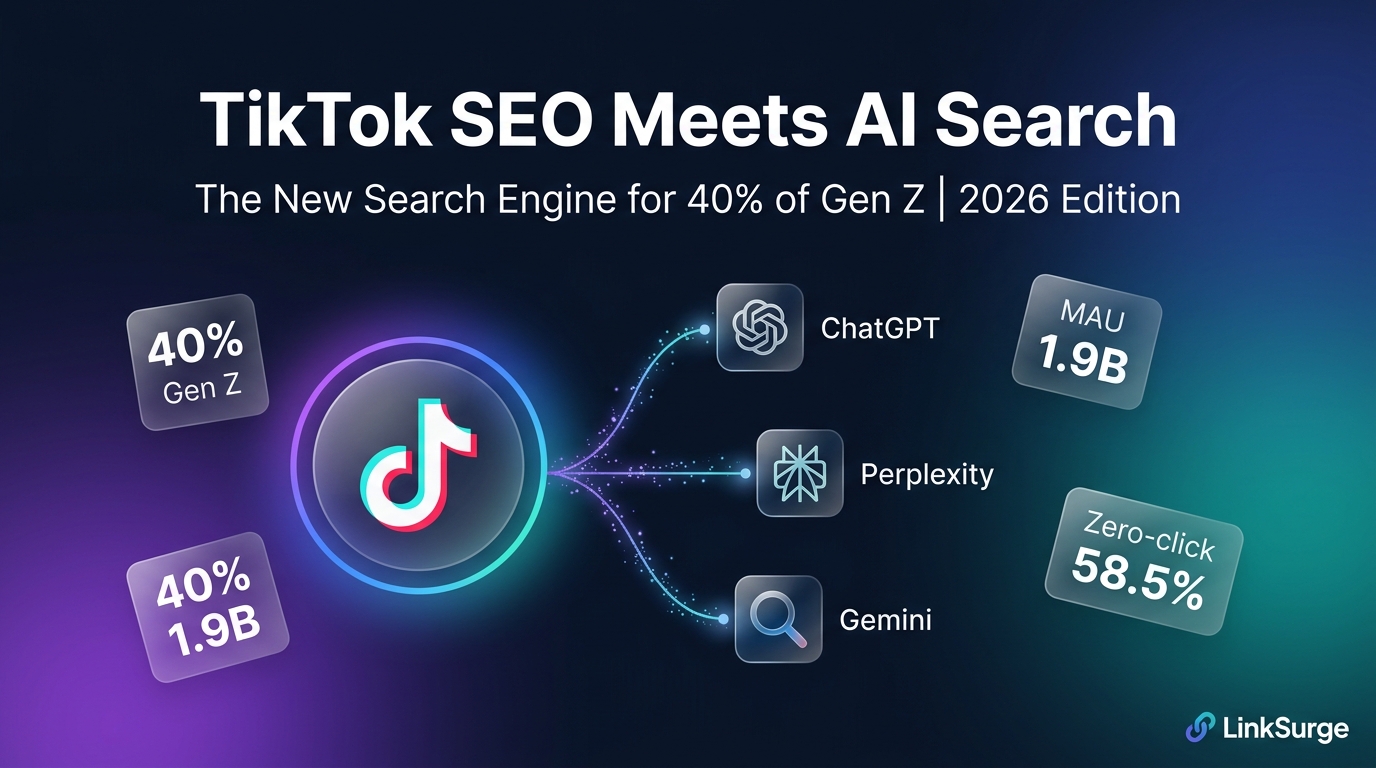
- TikTok is now a search surface, but not a Google replacement — 65% of Gen Z has searched on TikTok, yet only 4% say they rely on TikTok more than Google (down from 8% in 2024), and 89% name Google as their preferred search tool. Monthly actives are estimated at 1.9 billion (the last official figure was 1 billion in September 2021). With US zero-click search at 68.0% in January–April 2026 and AI Overviews appearing on roughly 43–48% of Google queries, owning search surfaces outside Google matters more than ever.
- The 2026 algorithm ranks on Completion, Share, and Re-watch — Not likes, not follower counts. If viewers drop off in the first 1–3 seconds, you're done. These three metrics carry outsized weight now.
- TikTok SEO is a 4-layer stack, plus keyword controls since April 2026 — Search Insights → Captions → Hashtags → On-screen text/captions, and now you can review, block, and suggest the search keywords TikTok auto-assigns to each video. Skipping the overlay text and auto-captions is leaving visibility on the table because the algorithm reads them too.
- AI search citations of TikTok are small and volatile, not "rising" — In an analysis of 350,000+ citations from January–February 2026, Reddit alone accounted for more than half of social citations, YouTube came next, and TikTok was not among the major sources. Then in mid-August 2026 ChatGPT slashed social citations, with TikTok URLs down 72%. Treat AI citations as a side effect of TikTok SEO, not its goal.
- Engagement benchmarks depend on the denominator — Socialinsider's 2026 benchmark (2 million videos) puts TikTok's engagement rate by views at a 4.2% average for 2025, slipping to 3.85% in Q2 2026. Beating that takes hook design × TikTok SEO × edutainment; posting more videos alone no longer moves the needle.
Let me unpack each of these.
1. Why TikTok SEO matters right now — TikTok as a search engine
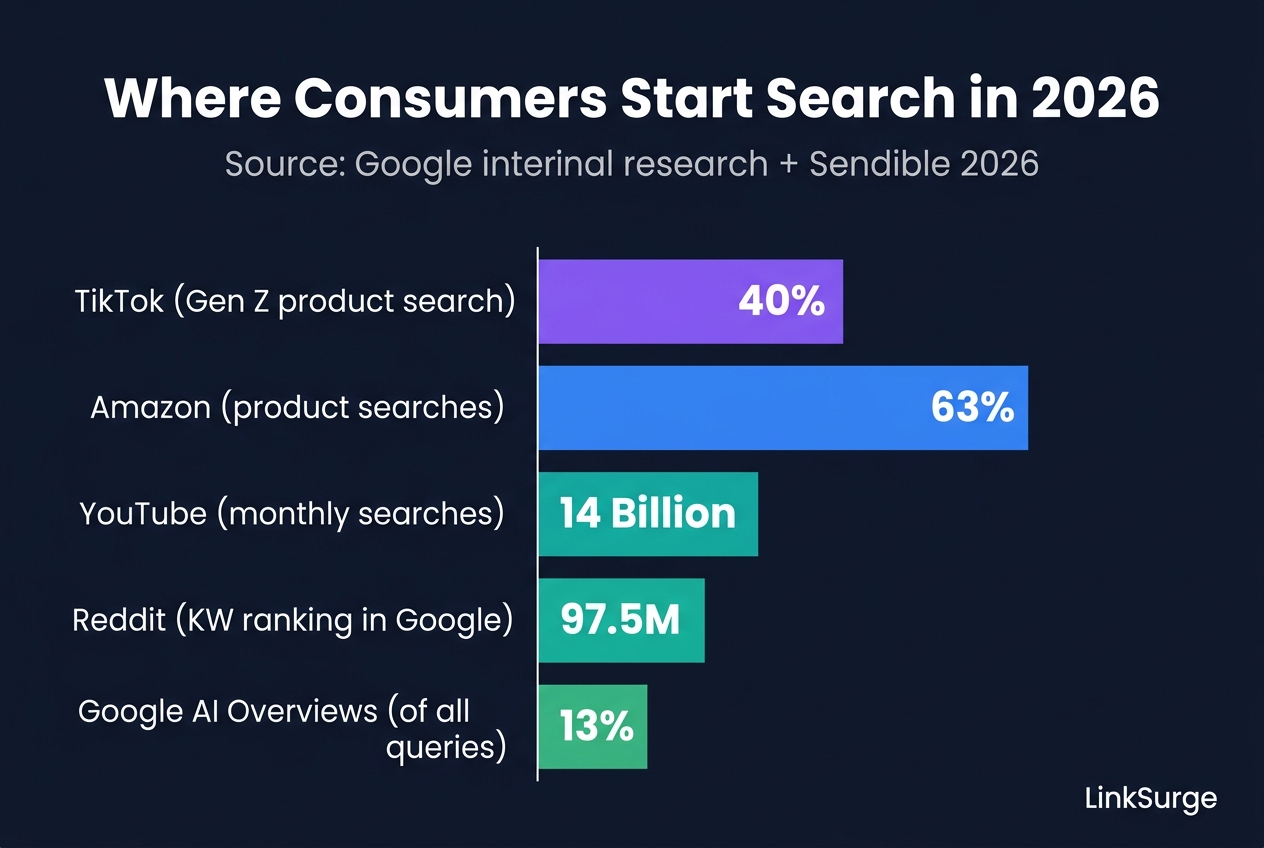
Honestly, the "social is not SEO" framing is outdated. But the most-quoted number in this conversation — "40% of Gen Z searches on TikTok or Instagram instead of Google" — deserves scrutiny. It comes from a remark by Google SVP Prabhakar Raghavan at Fortune's Brainstorm Tech in July 2022. Google later clarified it was based on an internal survey of US users aged 18–24, and the quote was specifically about "looking for a place for lunch." That's too old and too narrow to anchor a 2026 strategy on.
The current picture comes from Adobe Express's survey published in February 2026 (fielded by SurveyMonkey in January 2026 with 807 US consumers and 200 small business owners):
| Metric (US) | 2026 | 2024 |
|---|---|---|
| Have used TikTok as a search engine (all consumers) | 49% | 41% |
| Same, Gen Z | 65% | — |
| Gen Z who say they rely on TikTok more than Google | 4% | 8% |
| Gen Z who name Google as their preferred search tool | 89% | — |
| Gen Z who find TikTok effective for finding information | 25% | — |
In other words, usage keeps climbing while the share of people who would replace Google with TikTok is shrinking. TikTok is a search surface that runs alongside Google, not a substitute for it — and that framing holds throughout this post.
Japan tells a similar story from a different starting point. A January 2026 survey by hotice Inc. with RASA JAPAN (528 respondents) found 65.5% of teens and 71.0% of people in their 20s use TikTok almost daily, with 45–52% daily usage even among people in their 30s and older. But only 21.1% of respondents named "researching products or services" as a reason they use it — in Japan, discovery still outweighs search. NTT Docomo's Mobile Society Research Institute (February 2026, 7,279 respondents) found teens turn to YouTube (68%), X (48%), and Instagram (48%) for hobby information ahead of TikTok (36%). TikTok search in Japan is still early.
The scale numbers
Business of Apps estimates TikTok's monthly active users at roughly 1.92 billion as of Q1 2026 (Sprout Social puts it near 1.99 billion based on ad reach). Keep in mind that ByteDance's last official disclosure was "1 billion" in September 2021; everything since is a third-party estimate, and definitions vary widely — eMarketer, for example, estimated about 1.04 billion as of May 2024. Treat "about 1.9 billion" as a range, not a fact. Socialinsider's benchmark published in April 2026 (2 million videos, January 2024–December 2025) puts TikTok's engagement rate by views at a 4.2% average for 2025, well above Instagram and X (more in Section 5).
Then there's the zero-click problem. SparkToro's 2024 study found 58.5% of US and 59.7% of EU Google searches ended without a click; its June 2026 follow-up (Similarweb clickstream data, January–April 2026, US) put the figure at 68.0%. AI Overviews prevalence has climbed from the 13–20% range in 2025 to roughly 43% (Similarweb) or 48% (Semrush) of queries as of July 2026 — both third-party measurements, not Google figures. Traditional organic rankings have been losing value for a while. If you're protecting search traffic, you need assets outside of Google too.
TikTok blends search and discovery
What makes TikTok different is that it's both an active search surface and a passive discovery feed. Queries like "best coffee shops nearby," "Excel shortcuts," or "skincare routine" used to go to Google. Now they go to TikTok because users want to feel the texture, see the motion, hear the tone — things text can't carry.
The algorithm playbooks for X, Instagram, and LinkedIn are in our sister post "AI Search Optimization for X, Instagram, and LinkedIn (2026)". TikTok's design philosophy is different enough that it deserves its own treatment, which is what this post tries to do.
How AI platforms treat video UGC is a 2026 story worth tracking — but as Section 4 shows, TikTok URLs are still a small share of AI citations, and ChatGPT cut them sharply in August 2026. For how text-UGC (Reddit, Yahoo!知恵袋, note) fits into AI search citations, see "UGC Fuels AI Search".
References: Using TikTok as a search engine - Adobe Express (February 2026) TikTok Revenue and Usage Statistics (2026) - Business of Apps Google exec suggests Instagram and TikTok are eating into Google's core products - TechCrunch (July 2022) Google zero-click searches reach 68% in early 2026 - Search Engine Land About Half Of Google Searches Have AI Overviews - Search Engine Roundtable (July 30, 2026) 2026 survey: TikTok usage among 528 Japanese respondents - syncAD (Japanese) Younger generations use more digital information sources - NTT Docomo Mobile Society Research Institute (June 2026, Japanese) Gen Z's TikTok-Over-Google Preference Fell 50% - ALM Corp
2. The 2026 TikTok algorithm — Completion, Share, Re-watch
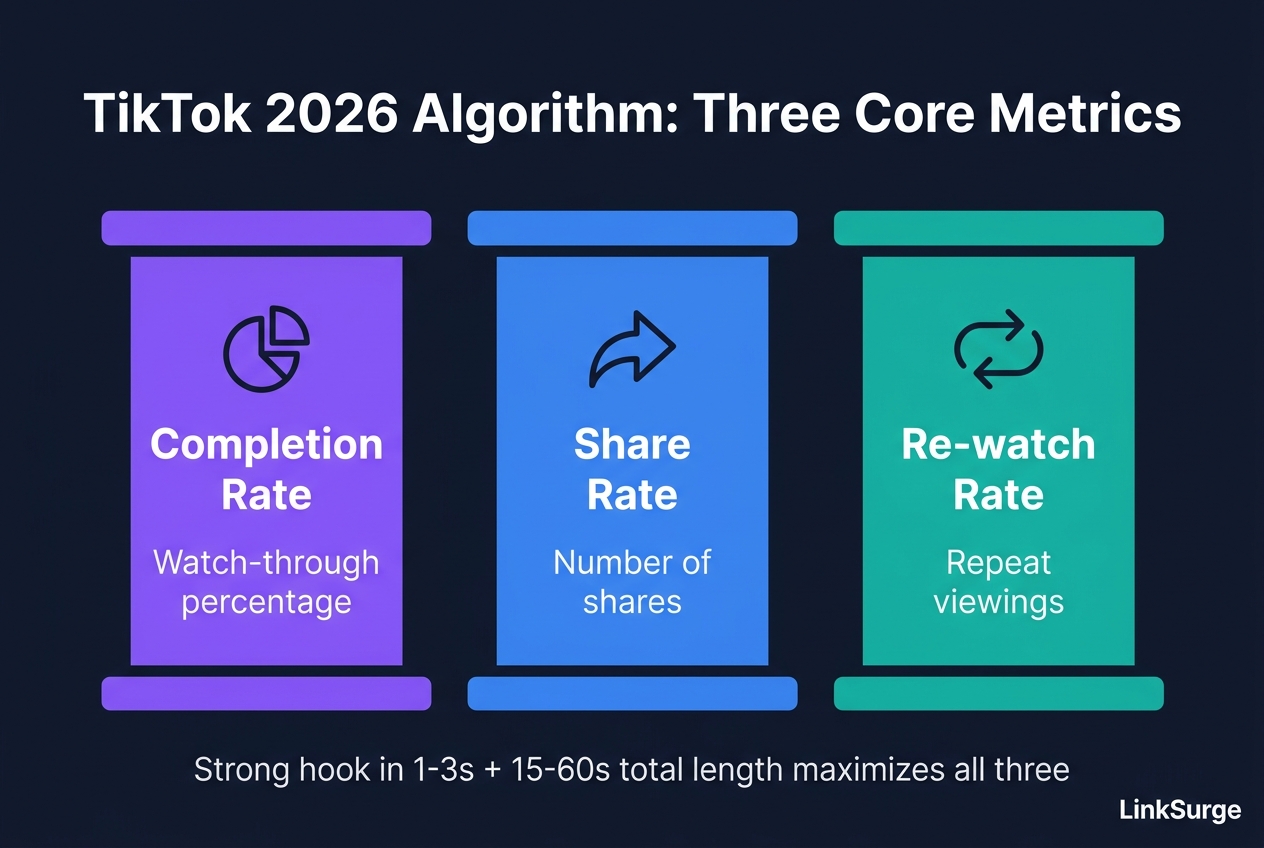
TikTok reordered its signal priorities in late 2025. Cross-referencing Virvid's January 2026 breakdown with Japanese-market explainers from Shuttlerock and Shubihiro, here's what actually gets weighted now:
The three metrics
| Metric | What it measures | Algorithmic weight |
|---|---|---|
| Completion Rate | Share of viewers who watch to the end | Highest. 15–60s videos optimize this |
| Share Rate | Forwards via DM or to other platforms | Several times the weight of a "like" |
| Re-watch Rate | Same video watched repeatedly | Powerful feed-expansion booster |
Likes and follower count have been downweighted. It makes sense when you think about it — likes are reflexive, but completion means the user invested time, and a share or re-watch is active evidence that the content had value. The algorithm is preferring active signals, which is a natural evolution.
The first 1–3 seconds decide everything
To drive completion, the opening 3 seconds do the heavy lifting. Threadpost catalogued the hook patterns that work:
- "Here's the secret behind [X]" (information promise)
- "You'll lose out if you don't know this" (loss aversion)
- "Most people don't realize this about [Y]" (gap/curiosity)
- "TL;DR: The answer is [Z]" (answer-first)
Videos that start with context before getting to the point almost always lose viewers. Andthen's March 2026 analysis of top-performing videos confirmed that "the subject is stated within the first second" was a near-universal pattern.
Keep the length between 15 and 60 seconds
Too long kills completion, too short doesn't trigger re-watches. Multiple Japanese operator blogs (Boosttech, Shubihiro, Chaptertwo) converge on the 15–60 second window as the sweet spot, with 30 seconds being the pragmatic center.
The exception is content designed to be saved — recipes, tutorials, how-to explainers — where 60+ seconds still performs well because users return to it. Category matters; tune accordingly.
Side note: the US algorithm has been run separately since January 2026
On January 23, 2026, TikTok announced the establishment of TikTok USDS Joint Venture LLC, with Oracle, Silver Lake, and MGX as managing investors at 15% each and ByteDance retaining 19.9%. Per the announcement, the joint venture "will retrain, test, and update the content recommendation algorithm on U.S. user data," and the algorithm "will be secured in Oracle's U.S. cloud environment." The announcement says nothing about users outside the US beyond noting that interoperability gives US users "a global TikTok experience." The practical implication: with the US algorithm now updated under a separate structure, "what went viral on US TikTok" and how feeds behave in Japan or elsewhere may drift apart over time. When you read English-language algorithm breakdowns, check whether they describe a US-specific change or a global one.
References: Announcement from the new TikTok USDS Joint Venture LLC - TikTok Newsroom (January 2026) TikTok Algorithm 2026: 3 New Rules You Must Follow - Virvid TikTok Algorithm Complete Guide (2026) - Andthen TikTok Algorithm Complete Guide 2026 - Shubihiro TikTok SEO Complete Guide - Shuttlerock
3. The 5-step TikTok SEO implementation
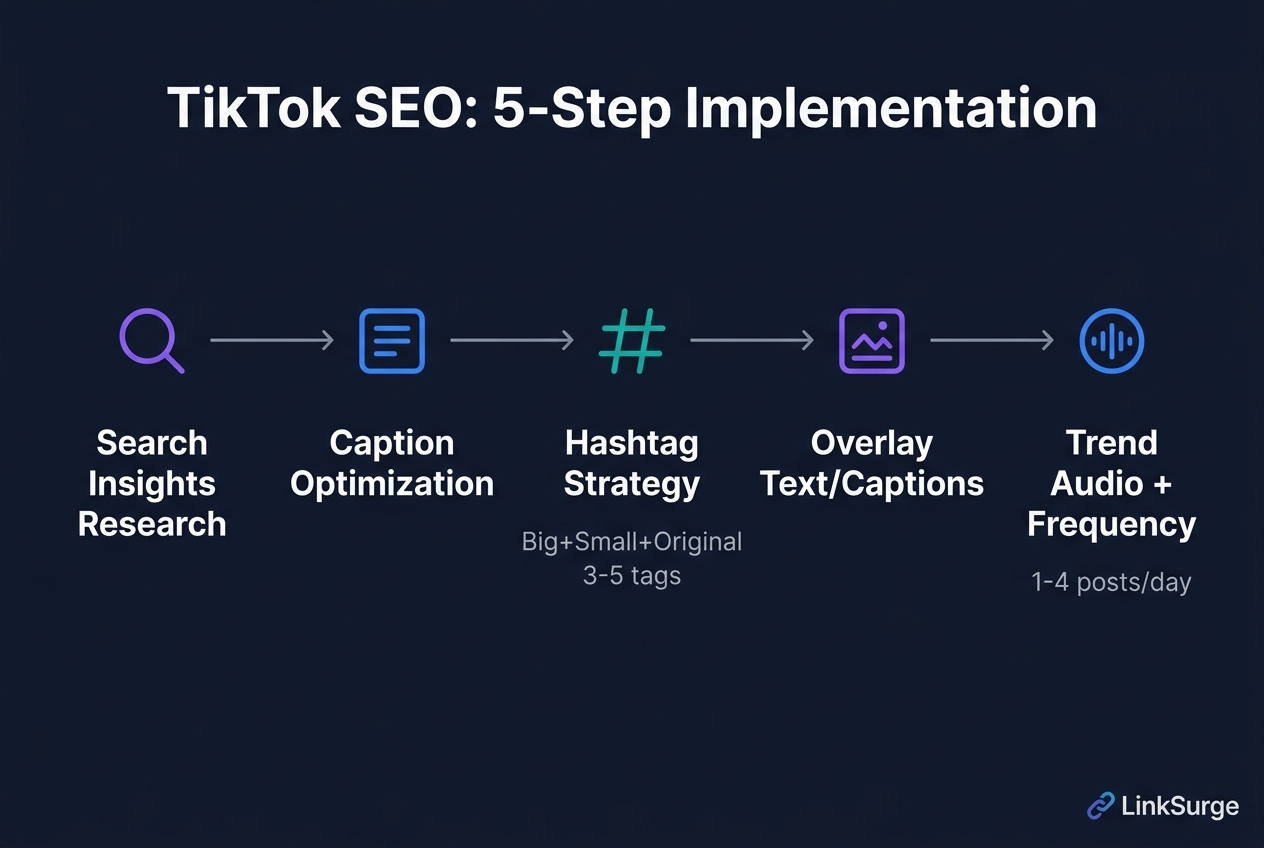
Now the operator playbook. TikTok SEO answers the question "how do we make videos that get searched?" — optimized across these five layers:
Step 1: Mine demand with Search Insights
TikTok's in-app tool "Creator Search Insights" shows what your target audience is actually typing. Think of it as TikTok's answer to Google Keyword Planner. Use it before you lock a video concept, not after. TikTok positions it as an in-app tool: search "Creator Search Insights" in the app's search bar or open it from your creator tools.
Honestly, the thing I see wasted most often is this step — teams skipping it and planning videos by gut. A weekly Creator Search Insights review alone materially improves concept quality.
Step 2: Place keywords naturally in captions
Once you have keywords, embed them in the caption without stuffing. Active-note's framing is the right one: describe the content using the keywords, don't list the keywords.
| Don't | Do |
|---|---|
| "coffee Tokyo trendy cheap wifi outlet" | "3 quiet Tokyo cafés that actually have Wi-Fi and outlets for work" |
| "diet easy one week meal" | "The easy-enough-to-stick-with 1-week meal plan for busy weeks" |
Step 3: Mix 3–5 hashtags strategically
Boosttech's "three-type mix" framework is pragmatic:
- Big tags (millions+ posts): #dance, #recipe. For discovery feed reach
- Small tags (thousands posts): #tokyocafehopping. Less competition, easier to rank on
- Original brand tags: Your own tag. For series identity and UGC collection
Keep the total at 3–5 tags. Above 10 risks spam signals and can actively hurt visibility.
Step 4: On-screen text and captions are SEO assets too
Easily missed: TikTok's algorithm reads on-screen text (overlay captions) and auto-generated subtitles as well. Repeating your target keyword in overlay text and captions layers the SEO signal on top of the main caption.
Since most TikTok viewing happens on silent, overlay text serves both completion (people can follow without audio) and SEO. It's genuinely a two-for-one move.
New in April 2026: manage the search keywords on your videos
In April 2026 TikTok rolled out keyword controls for creators. Each post now shows "keywords automatically added by TikTok based on popular searches," and you can block irrelevant ones or suggest keywords you want the video to rank for. TikTok keeps final say, so this isn't a stuffing opportunity — it's a guided tool.
Until now, "which searches is this video attached to?" was a black box. This gives you a way to rescue videos stuck in low-view cycles because they were mapped to the wrong queries. Start by auditing the auto-assigned keywords on your top videos and checking whether they match what your captions and overlay text are targeting. Regional availability wasn't specified at launch, so check whether the option appears on your account.
Step 5: Trending audio × posting frequency
Finally, using trending audio in a timely way and posting 1–4 times per day maintains algorithmic visibility. Shubihiro's February 2026 data showed accounts posting less than 3 times per week saw gradual visibility decay.
That said, this isn't quantity-over-quality. Socialinsider's 2026 benchmark found that from 2024 to 2025, average posting frequency on TikTok rose 40% across every follower tier while views per video fell 23% and follower growth dropped 33%. More posts are spreading reach thinner, and brute-force frequency has already stopped working. Forcing volume that compromises completion rate backfires, because lower completion drops algorithmic scoring. The right frequency is "the most you can produce without quality loss."
References: TikTok lets users add relevant keywords to metadata - Social Media Today (April 2026) 2026 TikTok Benchmarks - Socialinsider TikTok Hashtag Complete Guide - Boosttech TikTok SEO Opportunity - Active-note TikTok Algorithm Complete Guide 2026 - Shubihiro TikTok Latest Algorithm Explained - pamxy
LinkSurge
linksurge.jp
SEO・AIO・GEO統合分析プラットフォーム。AI Overviews分析、SEO順位計測、GEO引用最適化など、生成AI時代のブランド露出を最大化するための分析ツールを提供しています。
4. Where TikTok stands in AI search citations — smaller than hoped, and volatile
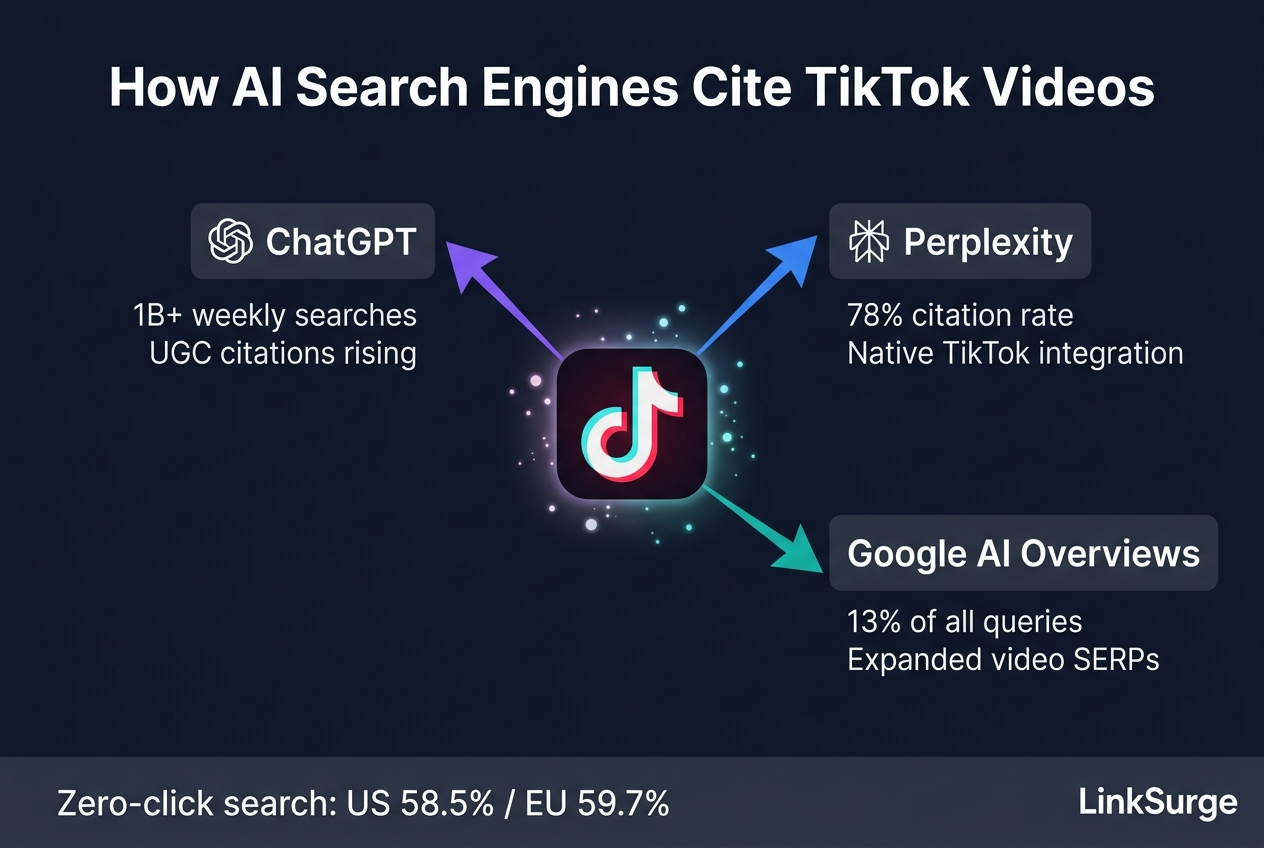
The original version of this section argued that "AI search engines are starting to cite TikTok videos." Measured data since then calls for a rewrite. The short version as of September 2026: TikTok citations in AI answers are a small share, and they swing hard whenever a platform changes its retrieval policy without notice.
Correction: there is no Perplexity × TikTok integration
The original post said Perplexity "announced a strategic integration with TikTok in 2026." That was wrong. What actually happened: in January 2025 Perplexity submitted a proposal to ByteDance to merge with TikTok's US operations, and in March 2025 it published a vision titled "Rebuilding TikTok in America" (open-sourcing the recommendation algorithm, adding citations and annotations to TikTok videos, and so on). The proposal was not accepted. TikTok's US business moved to a joint venture led by Oracle, Silver Lake, and MGX in January 2026 (see the side note in Section 2), and Perplexity is not part of it. The companion stat — "Perplexity ties every claim to a source on 78% of complex research questions versus ChatGPT's 62%" — is also withdrawn, because the underlying methodology was never published.
Measured data: YouTube and Reddit dominate social citations, TikTok is a bit player
Wellows analyzed more than 350,000 citations across ChatGPT, Gemini, Perplexity, AI Overviews, and AI Mode from January–February 2026. Reddit alone accounted for more than half of all social-platform citations, with YouTube next after growing 55% month over month from January to February. The six platforms broken out individually were Reddit, YouTube, LinkedIn, Quora, Facebook, and Instagram. TikTok did not register as a major source. A separate 2026 roundup notes that Gemini cites only four social platforms at all — YouTube, Reddit, LinkedIn, and TikTok — so TikTok can be cited, but the volume is tiny.
August 2026: ChatGPT slashed social citations
Then, in mid-August 2026, ChatGPT's citation mix shifted abruptly. Petra Labs measured social URL citations falling 88% for YouTube, 81% for Reddit, and 72% for TikTok, with LinkedIn down 36% and Facebook down 28%. Promptwatch's tracking shows Reddit's share of ChatGPT citations dropping from a 3.83% average (July 18–August 7) to 0.52% (August 14–17). The slack was picked up by brand websites, review sites, help centers, and product documentation. OpenAI has not explained the change. Promptwatch noticed ChatGPT's use of site: operators in its internal searches jumping sharply from August 8 and reads it as "a change in how ChatGPT decides which sites to ask, not a Reddit-specific penalty," but the cause has not been confirmed.
The lesson: do not make AI citations the primary KPI of your TikTok program. One retrieval change on the AI side wiped out 70–90% of accumulated social citations in a week. It really happened.
Where each AI surface stands (September 2026)
- ChatGPT: OpenAI reported "over 1 billion web searches per week" in April 2025. Since August 2026, social URL citations have dropped sharply, as above.
- Google AI Overviews: Prevalence around 43% (Similarweb) to 48% (Semrush) of queries as of July 2026, per third-party tracking. Over half of its social citations go to YouTube; TikTok's footprint is limited.
- Perplexity: No TikTok integration. Reddit is its dominant social source.
- TikTok's own AI summaries: TikTok experimented with AI-generated overviews beneath videos in the US and the Philippines, then scaled the feature back in May 2026 after a run of wildly inaccurate descriptions, narrowing it to product suggestions. Even inside TikTok, "AI summarizes the video and answers" isn't stable yet.
What TikTok videos AI engines still tend to cite
With so few examples, nothing here is definitive, but the TikTok videos that do get cited tend to share these traits:
- Information is spoken clearly in the audio (so auto-transcription makes it indexable)
- Caption keywords match overlay text keywords (the topic is easy to extract as text)
- High completion rate plus active comment discussion (social proof signals quality UGC)
These overlap almost entirely with what ranks in TikTok's own search. So "make videos that get found in TikTok search" is also the best available move for AI citations — while a campaign built purely to chase AI citations is not worth the effort. For the broader picture of how generative AI search is reshaping SEO, see "How Generative AI Search is Rewriting SEO: 7 Practical Responses".
References: Rebuilding TikTok in America - Perplexity (March 2025) Perplexity submits a new bid for TikTok - TechCrunch (January 2025) Social Media in AI Citations (2026): Reddit & YouTube Dominate - Wellows ChatGPT slashes citations from Reddit, YouTube, and TikTok: Petra Labs - Adgully (August 2026) Why Did ChatGPT Stop Citing Reddit? - Promptwatch (August 2026) OpenAI introduces shopping to ChatGPT with 1 billion weekly searches - PPC Land (April 2025) TikTok rows back AI video descriptions in US after absurd errors - AOL (May 2026)
5. Three strategies to beat the 5.3% engagement rate
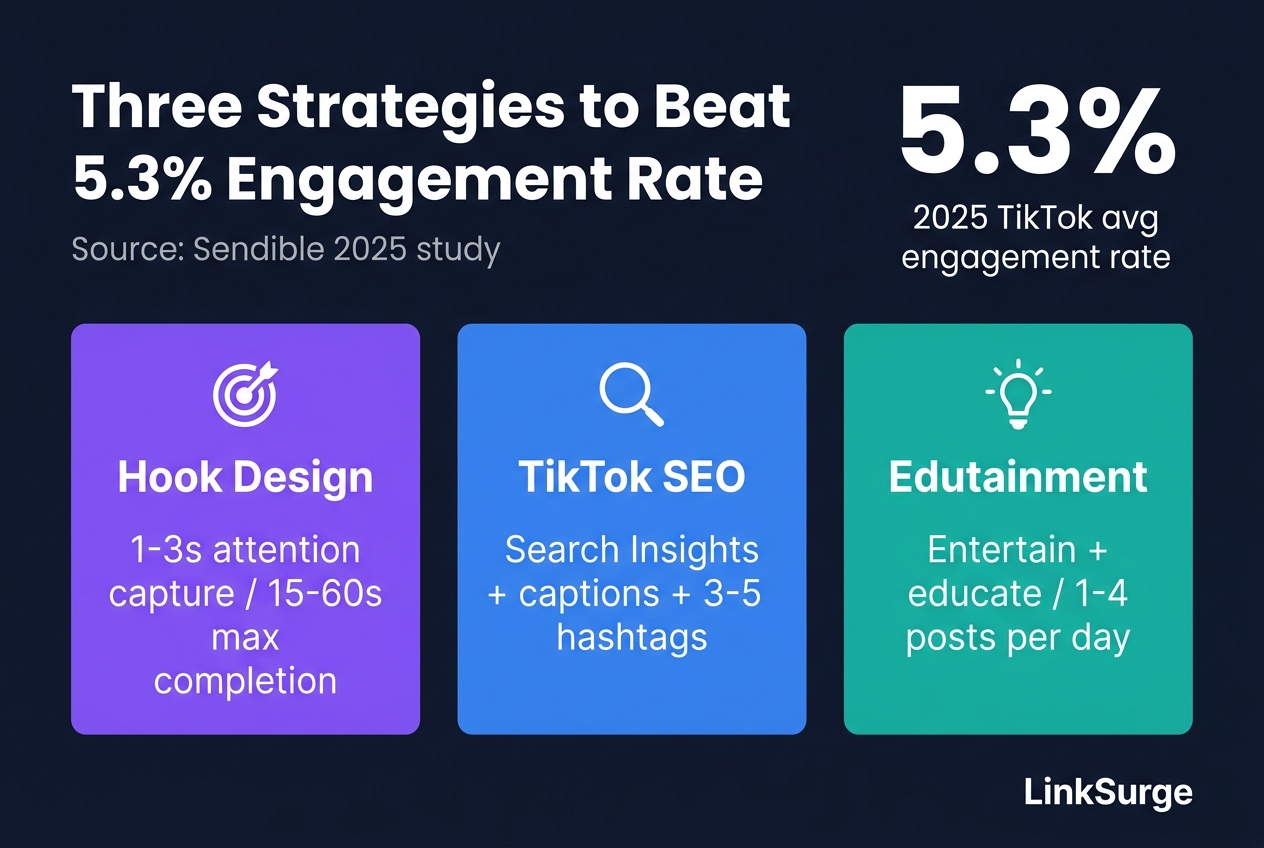
Threadpost cites a Sendible 2025 figure of 5.3% as TikTok's industry-average engagement rate. Before you benchmark against it, know that engagement rate swings a lot depending on the denominator. Socialinsider's 2026 benchmark (2 million videos from 214,507 profiles, January 2024–December 2025) measures engagement by views (engagements ÷ views) and reports a 4.2% average for 2025, up 9% from 3.85% in 2024. Quarterly, it held at 4.2–4.3% from Q1 2025 through Q1 2026 and then fell 8% to 3.85% in Q2 2026. By follower tier (also by views): 4.4% for 1–5K, 3.9% for 10–50K, 3.95% for 100K–1M. Sendible's 5.3%, by contrast, doesn't state its denominator, so the two aren't directly comparable.
Compare your numbers using the same denominator first. With that in place, here's Threadpost's three-part strategy, reorganized based on what I've seen work:
Strategy 1: Over-invest in hook design
Spend 30–40% of your production effort on the first 3 seconds. The longer the body script, the weaker the opening hook tends to be. When I'm reviewing concepts, the first thing I look at is the thumbnail and what's on-screen in second one.
Strategy 2: Apply TikTok SEO consistently
Apply the 5 steps from Section 3 to every video. The "double placement" tactic — matching keywords in both the caption and the overlay text — is underused by competitors and is a real differentiator.
Strategy 3: Lead with edutainment
Straight promotional content tends to accumulate "not interested" signals. Chaptertwo's January 2026 survey of growing accounts found that the entertainment-plus-education (edutainment) blend was the dominant pattern.
If I were pitching LinkSurge on TikTok, "here are our features" wouldn't travel. But something like "3 specific conditions that get a page cited by Google AI Overviews" — actionable, useful, free — that spreads.
KPIs and measurement frame
| KPI | Beginner | Intermediate | Advanced |
|---|---|---|---|
| Completion rate | 25%+ | 40%+ | 60%+ |
| Engagement rate | 2%+ | 5%+ | 8%+ |
| Share/re-watch ratio | 0.5%+ | 2%+ | 5%+ |
| Posting frequency | 3/week | 5/week–1/day | 2–4/day |
Numbers are the medians I pull from Andthen and Shubihiro's 2026 reports and use operationally. The engagement-rate row is a practical guide; against Socialinsider's by-views benchmark (4.2% average for 2025), the 5% intermediate line reads as "a bit above industry average."
What happens after Gen Z finds a product on TikTok? Rakuten's September 2026 survey suggests they shortlist with AI and verify in search before buying. We break that journey down in "54% of Gen Z Ask AI Before They Buy, But Still Trust Search Most."
References: 2026 TikTok Benchmarks - Socialinsider (April 2026) Three strategies to beat 5.3% engagement on TikTok - Threadpost (Japanese) TikTok Growth Strategy 2025 - Boosttech TikTok Latest Algorithm Change 2026 - Chaptertwo TikTok Growth Strategy: Breaking the 200-view Barrier - Traum 15 SEO and AI Predictions for 2026 - Digital Web Solutions
6. Measurement and KPI design — Run TikTok alongside Google
Measuring TikTok SEO purely inside TikTok misleads you. Search in 2026 is multi-platform by nature.
Three-layer measurement frame
- Inside TikTok: Completion rate, share rate, re-watch rate, profile visits, follow conversion
- Spillover to Google search: Branded search volume trend, TikTok video citations in Google SERPs
- AI search citations: How often ChatGPT / Perplexity / AI Overviews reference your TikTok URLs
The third layer is hard to measure by hand — you need dedicated tooling. LinkSurge's GEO monitor tracks how often your brand or URL gets cited across AI search surfaces, so you can visualize AI-search spillover from TikTok campaigns. But as Section 4 showed, AI platforms change their citation behavior without warning — August 2026 being the clearest example. Treat layer three as a monitoring signal for detecting change, not a KPI to grow, and judge success on layers one and two.
Five metrics to review weekly
Pick a day, make it a recurring review, check:
- Engagement rate by post over the past 7 days (diff the top 3 vs bottom 3)
- Completion rate trend (if falling, rework the hook)
- Reach by hashtag (rotate out the underperformers)
- New trending keywords in Search Insights
- Branded search volume (Google Search Console + Google Trends)
FAQ
Does TikTok SEO replace Google SEO?
No — think of it as parallel, not replacement. Adobe's 2026 survey makes the point: 65% of Gen Z has searched on TikTok, but only 4% rely on it more than Google, and 89% name Google as their preferred search tool. 2026 search is distributed across Google, TikTok, YouTube, Amazon, and AI search engines, so depending on any one is risky. The pragmatic path is to keep your Google SEO and layer TikTok on top, starting with Gen Z audiences or topics that are easier to show than describe. For the YouTube side — where OtterlyAI's research found 94.3% of AI citations go to long-form — see "YouTube Video SEO Meets AI Search".
How often should I post?
1–4 times per day is the recommended range, and a minimum of 3 times per week to maintain algorithmic visibility. But forcing volume at the cost of quality backfires because lower completion rate drags everything down. Post as often as you can without sacrificing completion.
Are more hashtags better?
No — 3–5 is optimal. Above 10 can trigger spam signals and actually reduce visibility. Mix the three types (big, small, original) for the most leverage.
Are shorter videos always better?
15–60 seconds is the sweet spot; too short hurts re-watch, too long hurts completion. 30 seconds is a safe default for most topics. Saveable content like recipes and tutorials can exceed 60s because return viewers offset the drop in single-session completion.
What makes a TikTok video likely to be cited by ChatGPT or Perplexity?
There's no confirmed formula yet, but the patterns I've observed are: information spoken explicitly in the audio, caption keywords that match on-screen text, and high completion rate paired with active comment engagement. Think of it as giving the AI multiple consistent signals that say "this video is about X." Keep expectations in check, though: YouTube and Reddit make up most social citations in AI answers, TikTok is a tiny share, and ChatGPT cut TikTok citations by 72% in August 2026 (Petra Labs). Don't build a TikTok program around AI citations.
Can I set the search keywords attached to my videos?
Since April 2026, yes. TikTok shows the keywords it automatically adds to each post based on popular searches, and creators can block irrelevant ones or suggest keywords they want to rank for. TikTok makes the final call, so unrelated terms won't stick. Start by auditing the keywords on your existing top videos and checking whether they match your targets. Check your account to see whether the option is available in your region.
Putting TikTok next to Google
For 2026 marketers, TikTok isn't "another social channel" — it's a search engine running in parallel to Google. 65% of Gen Z has searched there, and 89% still prefer Google, so it complements rather than replaces. AI search citations of TikTok are small and volatile for now, so judge your TikTok program first on in-app search and discovery, then on branded-search lift. The 5-step framework and 3-strategy playbook in this post are grounded in 2025–2026 data from Adobe, Socialinsider, TikTok's own announcements, and operator reports. Start folding them into tomorrow's posting plan.
LinkSurge's GEO monitor tracks brand citations across ChatGPT, Perplexity, and Google AI Overviews continuously. If you want early warning when citation behavior shifts — the way it did in August 2026 — give it a look.