YouTube Video SEO Meets AI Search: The 94.3% Long-Form Shock and the Shorts Playbook for 2026
目次
The TL;DR: Five things that changed for YouTube in 2026
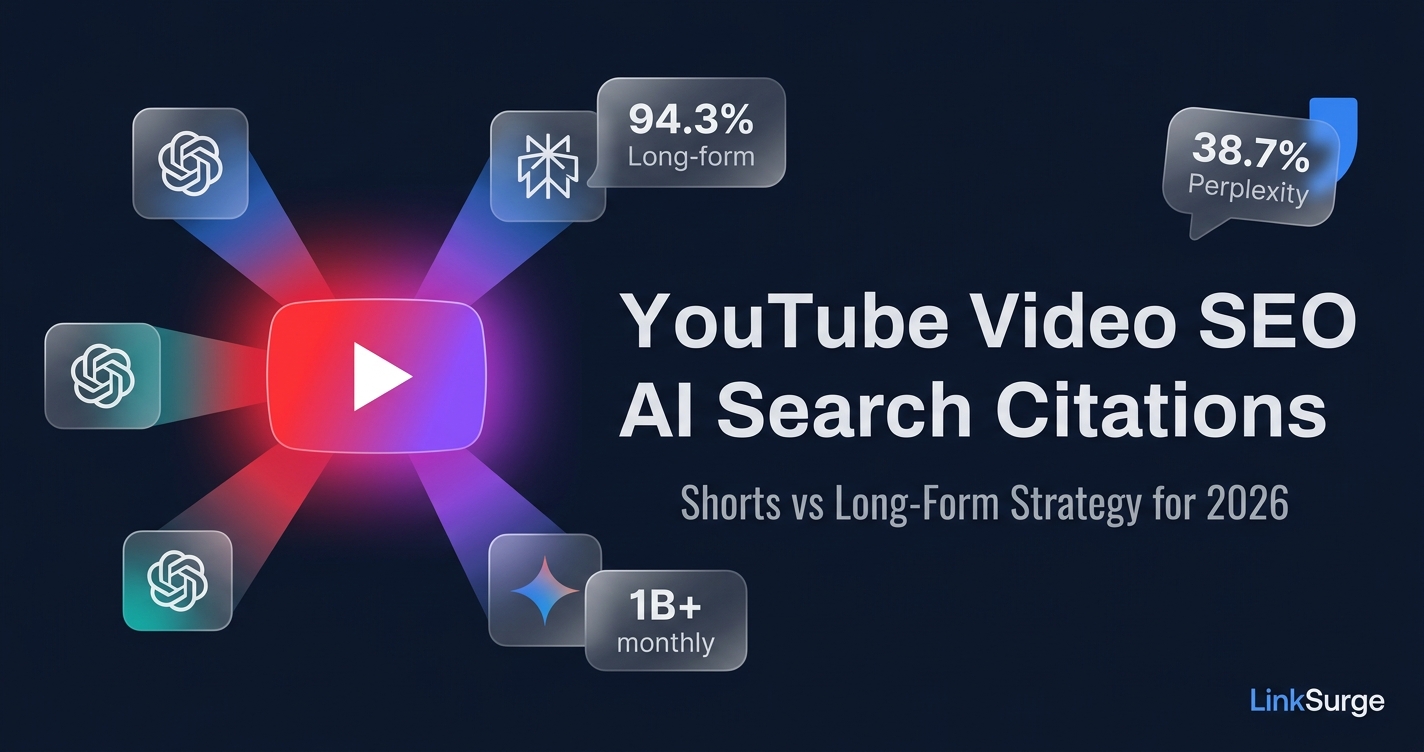
Video marketing conventional wisdom quietly flipped in 2026. OtterlyAI's 100M+ citation analysis showed that 94.3% of AI-search citations to YouTube videos go to long-form content, and only 5.7% to Shorts. Reading that study alongside YouTube's January 2026 Shorts algorithm update surfaced five practical takeaways:
- YouTube is now the most-cited video source in AI search — Ahrefs' April 2026 Brand Radar analysis puts YouTube as the top-cited domain outside the top 100 organic results for AI Overviews. Perplexity alone accounts for 38.7% of YouTube AI citations.
- The signal that predicts AI citations isn't views — it's structure — OtterlyAI's correlation analysis showed near-zero correlation (r = -0.03) for subscriber count, while description length was the strongest positive signal at r = 0.31. Wild stat: 40.83% of AI-cited videos had fewer than 1,000 views.
- Long-form is the primary asset, Shorts are repurposing and discovery — Shorts earn only 5.7% of AI citations, but with the January 2026 introduction of a Shorts-specific search filter, they matter for social discovery. A two-tier model — long-form as the hero asset, Shorts as repurposed clips — is what makes sense economically.
- Chapters get indexed as individual rich results — Timestamped chapters receive independent citations in AI Overviews, which means one structured video can surface across multiple queries via Google's query fan-out system.
- The January 2026 Shorts update introduced "Viewed vs Swiped Away" as a core KPI — Completion rate, replay rate, and swipe-away rate now drive ranking, and Gemini analyzes semantic video content. Audio quality and on-screen text quality suddenly matter a lot more.
Let me unpack each of these.
1. Why YouTube became the AI citation king
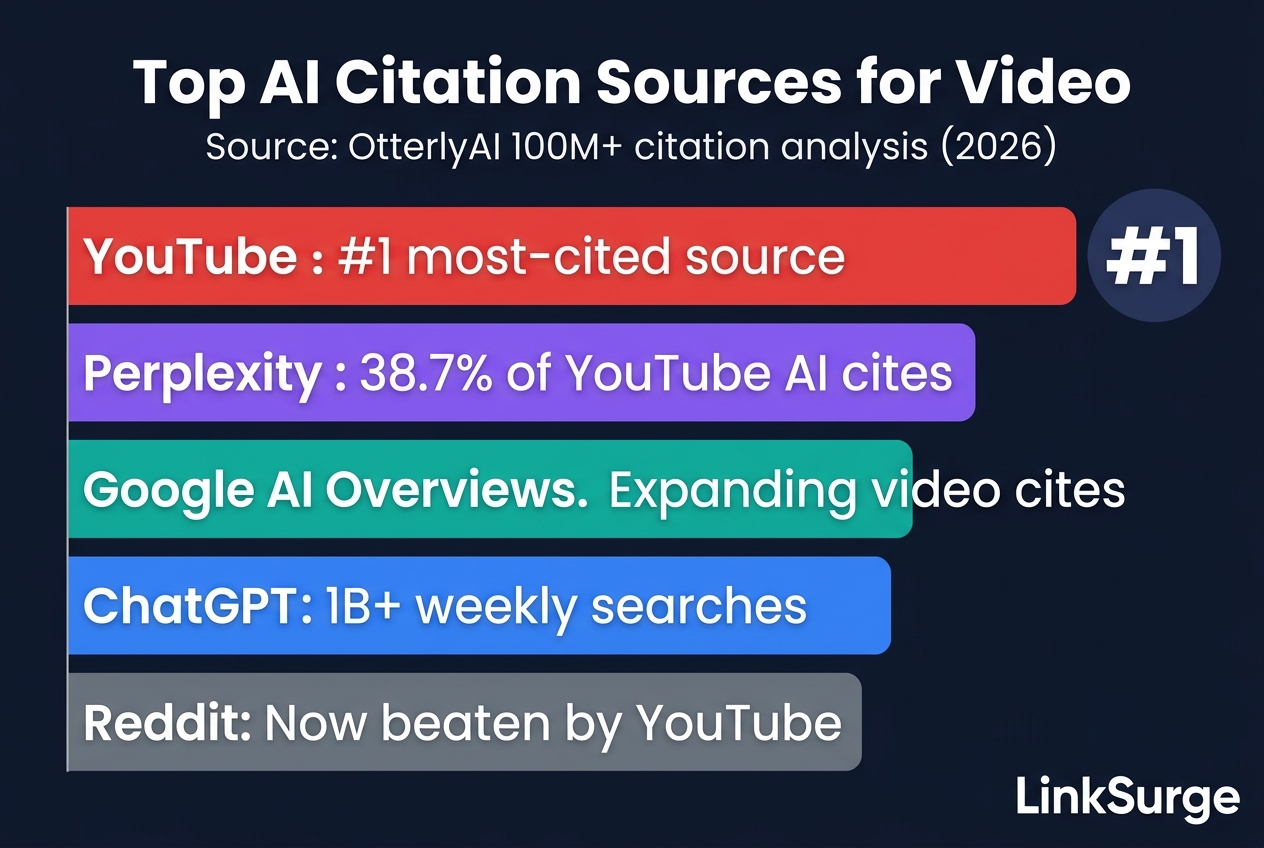
Honestly, the shift in AI citation sources during 2026 has been faster than I expected. Ahrefs' April 2026 Brand Radar ranked YouTube as the top-cited domain in AI Overviews from outside the top 100 organic rankings. Six months earlier, Reddit topped most ChatGPT-source analyses. In 2026, YouTube overtook it.
What the OtterlyAI study actually found
OtterlyAI's March 2026 publication — drawn from over 100M AI citations — revealed these numbers:
| Metric | Value |
|---|---|
| Share of AI-cited YouTube content that is long-form | 94.3% |
| Share that is Shorts | 5.7% |
| Perplexity's share of all YouTube AI citations | 38.7% (largest single platform) |
| AI-cited videos with fewer than 1,000 views | 40.83% |
| Correlation: description length × citation frequency | r = 0.31 (strongest) |
| Correlation: subscriber count × citation frequency | r = -0.03 (effectively zero) |
What's striking is that views and subscriber count have almost no relationship to AI citation frequency. AI isn't picking the most popular videos — it's picking the ones that are structurally easiest to parse.
Why AI prefers YouTube
Radyant breaks down three structural reasons AI engines lean on YouTube:
- High-accuracy auto-transcription — Google's speech recognition makes audio indexable by default, so LLMs can extract context reliably
- Chapters become independent rich results — A single video gets treated as multiple candidate answers
- Detailed descriptions serve as rich metadata that improves AI comprehension
I covered how TikTok's algorithm handles short-form video in our sister post "TikTok SEO Playbook: Winning the Search Engine 40% of Gen Z Actually Uses". YouTube operates on a completely different logic — TikTok is short-length × completion × share, while YouTube is structured × long-length × chapters when it comes to getting cited by AI. For the text-UGC side of AI citations (Reddit, Yahoo!知恵袋, note), see "UGC Fuels AI Search".
References: OtterlyAI Study: 94% of YouTube AI Citations Go to Long-Form - VEED.IO YouTube now beats Reddit in AI citations - Radyant AI Citation Domains TOP 10 (April 2026) - Ahrefs YouTube Is Now the Top AI Citation Engine - Ajkumar
2. Long-form 94.3% vs Shorts 5.7% — Where the real AI citation battle happens
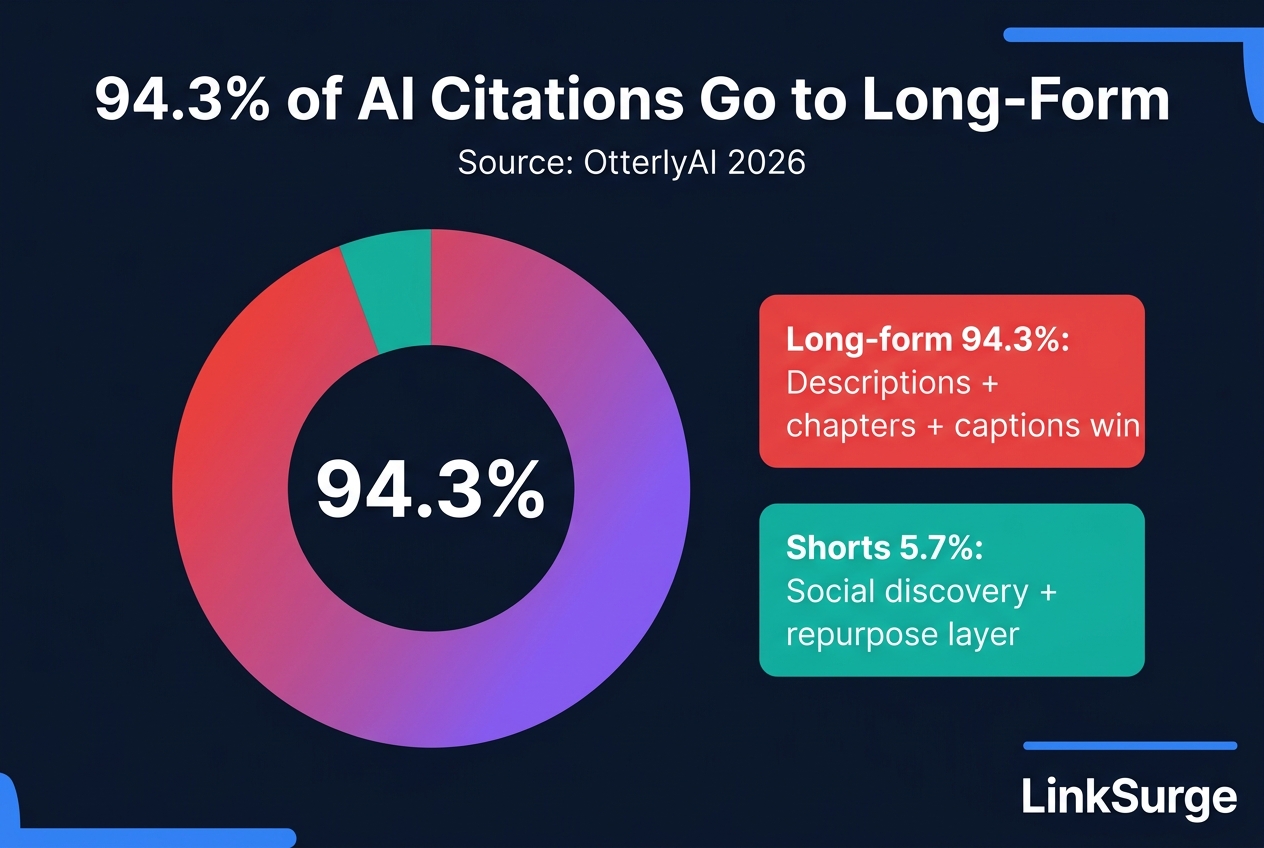
Here's the most important call in this entire post: if you're chasing AI-search traffic, over-investing in Shorts production is inefficient. The OtterlyAI data makes that fairly unambiguous.
The structural reasons Long-form wins
The 94.3% long-form citation share isn't a fluke — it's the structural output of how LLMs select video evidence:
- Context depth — To cite a video as "the answer to a question," the LLM needs enough in-video explanation
- Chapter structure — Longer videos naturally carry more chapters, each a separate citation candidate
- Detailed descriptions — Long-form videos tend to have longer descriptions, which maps to the r = 0.31 correlation
The 5.7% for Shorts doesn't mean "Shorts are worthless." It means in the specific lens of AI citation, long-form is overwhelmingly dominant.
But Shorts still have a real job
The role of Shorts has sharpened in 2026. VEED.IO's report highlights these use cases:
- Social search discovery — Shorts compete with TikTok and Instagram Reels in social video search
- Long-form repurposing — Clips from your structured long-form serve as highlight assets
- Top-of-funnel brand exposure — High-reach surface for volume-driven awareness
If you over-index on Shorts and never make long-form, you're missing the primary AI-citation asset. If you only make long-form, you miss social-discovery opportunities. Build both, but for different reasons.
Practical weekly allocation
The production-hour split I actually run looks like this:
| Asset | Production-hour share | Purpose |
|---|---|---|
| Long-form (10–20 min) | 60–70% | AI citation authority, SEO weight |
| Shorts (clipped from long-form) | 20–30% | Social discovery, repurposing |
| Other (community posts, etc.) | 10% | Fan engagement |
"One long-form → three to five Shorts repurposed" is the ROI sweet spot in my experience.
References: OtterlyAI Study: 94% of YouTube AI Citations Go to Long-Form - VEED.IO YouTube AI Citations: Turn Videos Into Search Assets - UpGrowth First Large-Scale Study by OtterlyAI - Globenewswire
3. Designing videos that earn AI citations
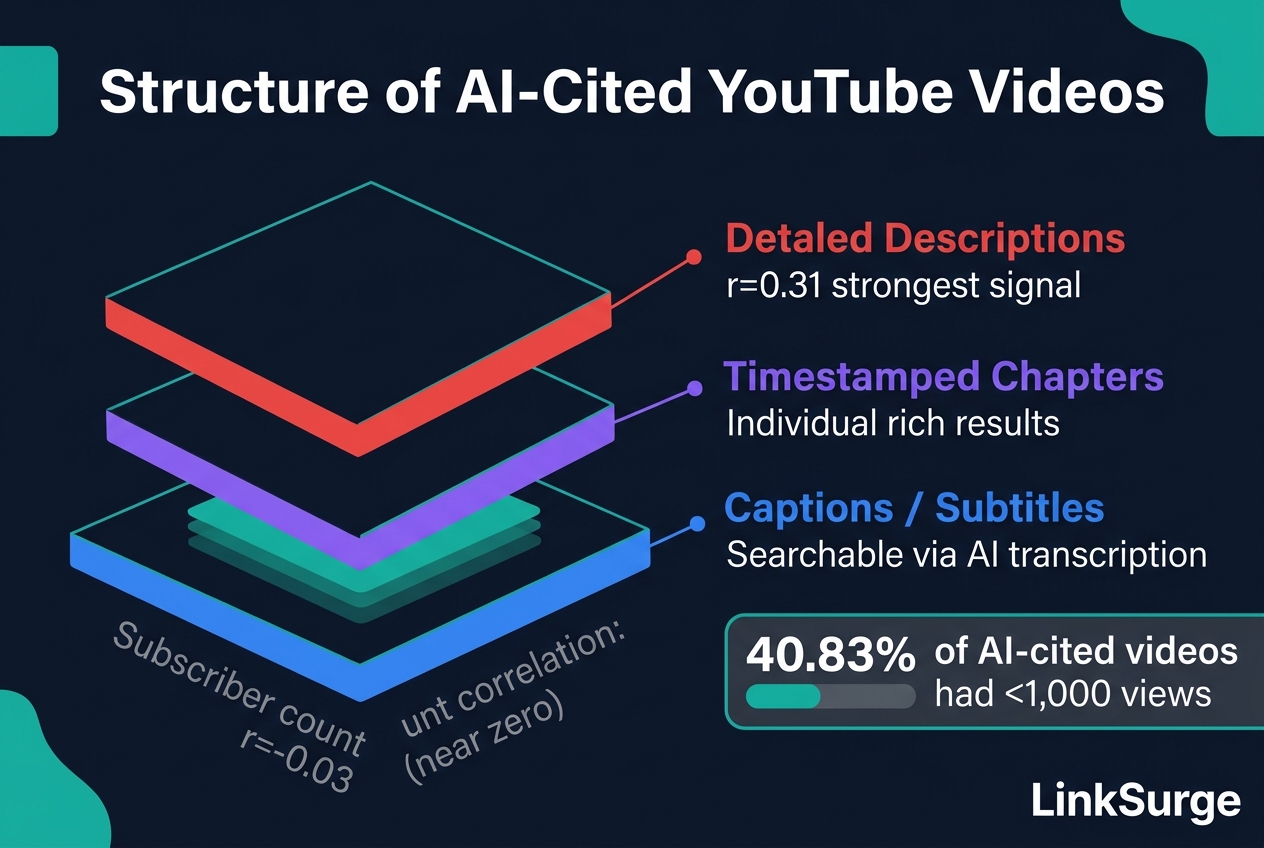
Saying "structure is everything" sounds reductive, but the OtterlyAI numbers really do point there. Here's what to actually structure, in order:
Step 1: Write descriptions at article length
A description-length correlation of r = 0.31 sounds ordinary until you realize what it means operationally: top-performing channels write 300–500 word minimum descriptions, and occasionally push past 1,000 words of article-grade content.
Marketing Agent's February 2026 guide lays out the description template:
- Video summary (~100 words)
- Timestamped chapter list
- Section-by-section detail with headings (~100–200 words each)
- Related links and citations
- Hashtags (3–5)
Step 2: Always add timestamped chapters
This is honestly the most under-utilized element of 2026 YouTube SEO. Ahrefs' citation analysis shows that videos with timestamped chapters earn multiple AI citations far more often than videos without.
The reason is structural: Google treats chapters as individual rich results. One video becomes an independent citation candidate for Query A, Query B, and Query C — this is the "query fan-out effect."
Chapter design best practices:
- Each chapter: 2–5 minutes
- Titles in search query format ("What is X?", "How to X")
- Minimum 5 chapters per video
The query fan-out mechanic itself is covered in "What Is Query Fan-Out? Beginner's Guide".
Step 3: Tune the captions
Auto-transcription handles the baseline, but manually correcting the captions noticeably improves AI comprehension. Proper nouns and domain-specific terms are often mis-recognized, and that gap shows up in citation outcomes.
Step 4: Title and first 15 seconds deliver the answer
AI search cites "answers to questions." Include question-form or answer-form keywords in the title, and front-load the conclusion in the first 15 seconds. Narrative structures that save the point for the end make it harder for AI to identify what to cite.
The AI-citation-ready video template
| Element | Specification |
|---|---|
| Length | 10–20 minutes |
| Description | 300–1,000 words |
| Chapters | 5+ chapters, 2–5 min each |
| Captions | Manually reviewed |
| Title | Question-form or "how to X" |
| First 15 seconds | Conclusion stated up-front |
References: YouTube AI Citations: Turn Videos Into Search Assets - UpGrowth Building A Search-First YouTube Content Strategy - Marketing Agent Video SEO Best Practices in 2026 - VdoCipher Why AI Search Prefers YouTube - Torro

LinkSurge
linksurge.jp
SEO・AIO・GEO統合分析プラットフォーム。AI Overviews分析、SEO順位計測、GEO引用最適化など、生成AI時代のブランド露出を最大化するための分析ツールを提供しています。
4. YouTube → AI search citation pathways
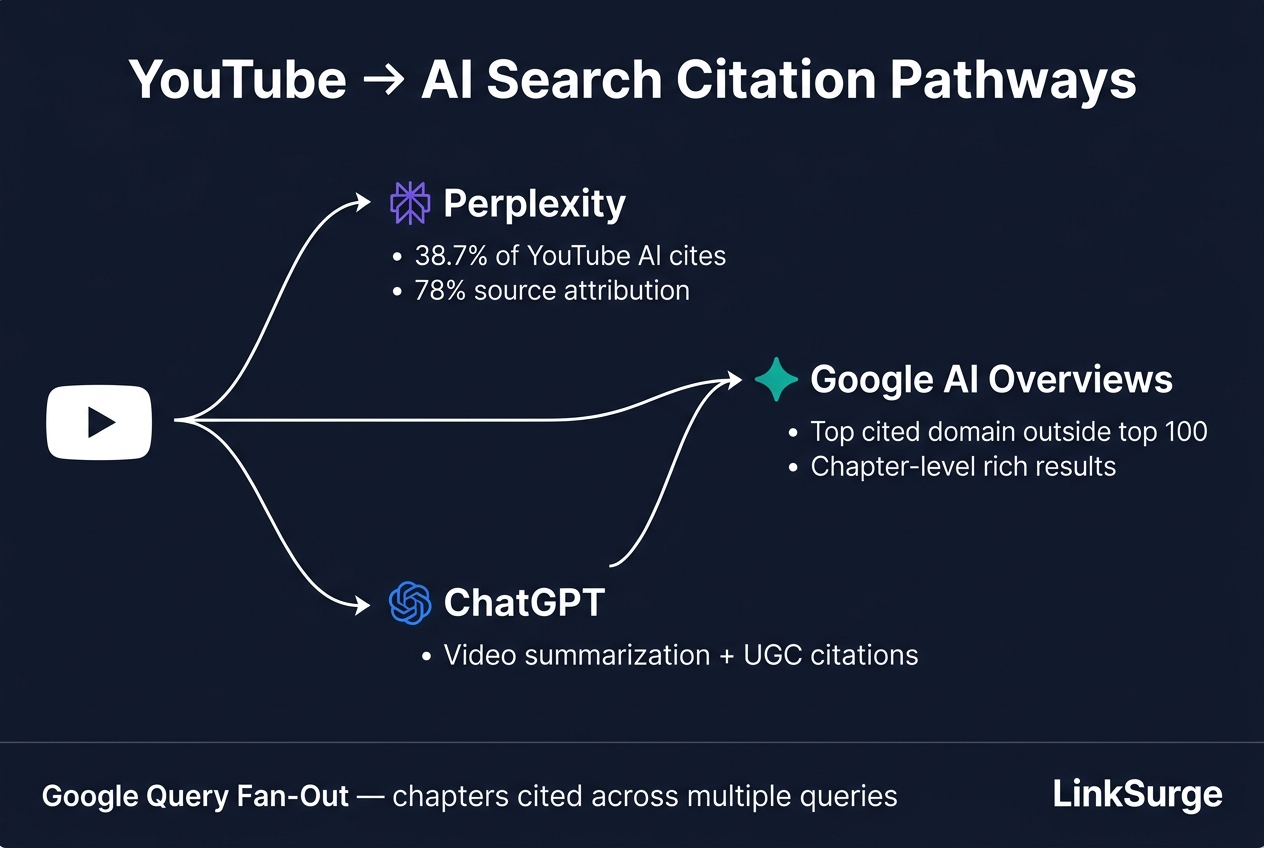
The flow from YouTube into AI search looks different depending on the platform. Here's what's actually happening at Perplexity, Google AI Overviews, and ChatGPT:
Perplexity: 38.7% of YouTube AI citations
The OtterlyAI study shows 38.7% of YouTube AI citations come through Perplexity — the largest share of any single platform. Perplexity attributes 78% of claims in complex research questions to specific sources, which makes it the cleanest surface on which to become a "cited video."
Common traits of Perplexity-cited YouTube videos:
- Clear chapter structure
- Speaker is positioned as an expert (channel description and creator profile signal authority)
- Specific numbers and facts are verbalized inside the video
Google AI Overviews: Chapter-level citation
Search Engine Land's 2026 analysis confirms Google AI Overviews treats YouTube as the top-cited domain outside the top 100 organic results. The interesting part is chapter-level citation — cases where three different chapters of a single video appear in AI Overviews for three different queries.
ChatGPT: Video summarization and direct citation
ChatGPT's 2026 UI strengthened the ability to summarize content when a YouTube URL is pasted. This increased how often ChatGPT cites video URLs as "video that explains X." The integration is actively used on the user side as well.
LinkSurge GEO monitor example
LinkSurge's GEO monitor tracks how often a given URL gets cited in ChatGPT, Perplexity, and Google AI Overviews. Registering your YouTube video URLs lets you quantify how the video is evaluated in AI search, which makes structural changes measurable.
References: YouTube is no longer optional for SEO in the age of AI Overviews - Search Engine Land YouTube Is Now the Top AI Citation Engine - Ajkumar Why AI Search Prefers YouTube - Torro
5. The Shorts × Long-form division-of-labor model
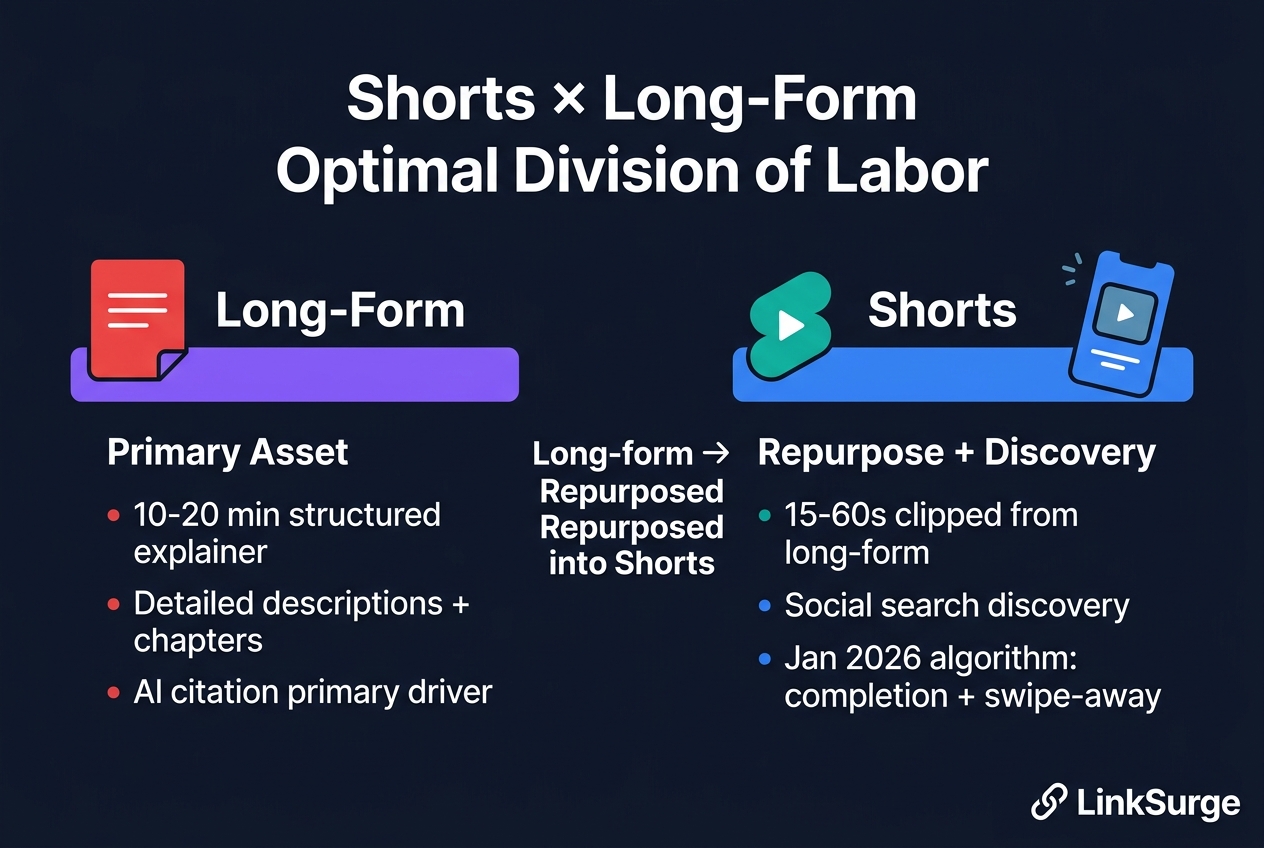
Now the new Shorts position and the concrete division-of-labor with long-form.
January 2026 update: How the Shorts algorithm shifted
Key changes YouTube rolled out in early January 2026:
| Change | Detail |
|---|---|
| Shorts-specific search filter | "Type" menu now has a "Shorts" filter — Shorts are now an SEO surface |
| "Viewed vs Swiped Away" core signal | Watched-through vs swiped-past is a new ranking KPI |
| Gemini semantic analysis | Tone, on-screen elements, and semantic meaning get analyzed — tags alone aren't enough |
| Increased weight on completion + replay | "Watched to the end" and "repeat watched" are top-priority signals |
Shorts now require more search-oriented and structural thinking than before. But for AI citations, long-form's 94.3% dominance is unchanged.
Implementing the division model
Here's the weekly production cycle I actually run:
- Monday — Research and outline (1–2 hours)
- Tue–Wed — Long-form shoot + edit, 10–20 min output (~10 hours)
- Thursday — Clip 3–5 Shorts from the long-form, edit (3–4 hours)
- Friday — Finalize description, chapters, titles; publish
- Sat–Sun — Daily Shorts drops; monitor long-form performance
Treat long-form as the "mother" and Shorts as the "children," and a single production investment yields multiple assets. That's how you maximize ROI per production hour.
Three Shorts priorities post-Jan 2026
- State the subject in the first second (counteracts swipe-away)
- Verbally state keywords clearly (Gemini semantic analysis reads audio)
- Always link to the long-form in the description (asset bridging)
References: YouTube Shorts Algorithm Update: January 2026 - Miraflow How Does the YouTube Shorts Algorithm Work in 2026? - vidIQ YouTube Shorts Algorithm Explained 2026 - Metricool
6. Implementation checklist and KPI design
A checklist for implementing and measuring 2026 YouTube strategy:
Pre-publish checklist
- Title is in question-form or answer-form with target keyword
- Length is 10–20 minutes (if targeting AI citations)
- Conclusion stated in the first 15 seconds
- At least 5 timestamped chapters
- Description is 300+ words
- Captions are manually reviewed
- Description links to a related long-form or Shorts asset
Three-layer KPI structure
| Layer | Metrics |
|---|---|
| Inside YouTube | Average view duration, retention, CTR, per-chapter dwell time |
| Spillover to Google | YouTube videos appearing in Google SERPs, branded search volume trend |
| AI search citations | URL citation counts across ChatGPT, Perplexity, AI Overviews |
The third layer cannot be tracked manually — you need dedicated tooling like OtterlyAI or LinkSurge.
Monthly review template
Run this once a month:
- AI-citation count trend (how many videos got cited this month)
- Chapter-level citation distribution (to verify query-fan-out effect)
- Description length × citation rate correlation (hypothesis validation)
- Long-form vs Shorts citation ratio (how close to 94.3:5.7)
- Branded search volume change (YouTube-viewing → search-behavior spillover)
FAQ
If I'm targeting AI citations, should I focus on long-form or Shorts?
Long-form, strongly. OtterlyAI's research found 94.3% of AI citations go to long-form — so if AI-search-driven traffic matters, the primary bet is producing structured 10–20 minute long-form. Shorts then serve as repurposed clips from that long-form.
Can videos with low views still get AI-cited?
Yes. The correlation between views and AI citations is essentially zero (r = -0.03), and 40.83% of AI-cited videos have fewer than 1,000 views. AI evaluates structure, not popularity, so small channels can compete.
What length warrants adding chapters?
Anything from 5 minutes up benefits; 10–20 minute long-form with 5+ chapters is the target. Keep each chapter 2–5 minutes and write titles in search-query form.
What should I do about the January 2026 Shorts algorithm changes?
Three priorities: (1) State the subject in the first second to fight swipe-away, (2) Verbalize keywords clearly in audio so Gemini's semantic analysis can pick them up, (3) Always link to the long-form in the description to promote cross-viewing.
How do I make YouTube videos more likely to be cited by Perplexity?
Structure chapters well, speak specific numbers and facts inside the video, and make speaker expertise clear in the channel description. Perplexity attributes 78% of claims in complex research to sources, so the shortcut is to provide statements that can be clearly pulled as citations.
Redesigning video SEO as "structure SEO"
2026 video marketing has crossed a subtle threshold: from "make it and ship it" to "structure it so it gets cited." OtterlyAI's 100M+ citation study makes it clear that AI engines don't pick the most-viewed videos — they pick the ones where descriptions, chapters, and captions make information explicit and parseable.
Shorts became a formal SEO surface with the January 2026 filter update and now play a real role in social discovery. But AI citations remain a long-form game. The 2026 fork in the road is whether your production pipeline can run both — with the division-of-labor model that lets one long-form produce multiple citation candidates and Shorts-sized discovery assets.
LinkSurge's GEO monitor tracks how often your content is cited across ChatGPT, Perplexity, and Google AI Overviews. If you're actively running AI-citation experiments on YouTube content, pair it with your production workflow to validate what's working.