UGC Fuels AI Search: How Reddit, Yahoo!知恵袋, and Reviews Shape AI Answers in 2026
目次
The TL;DR: Five facts about UGC in the AI search era
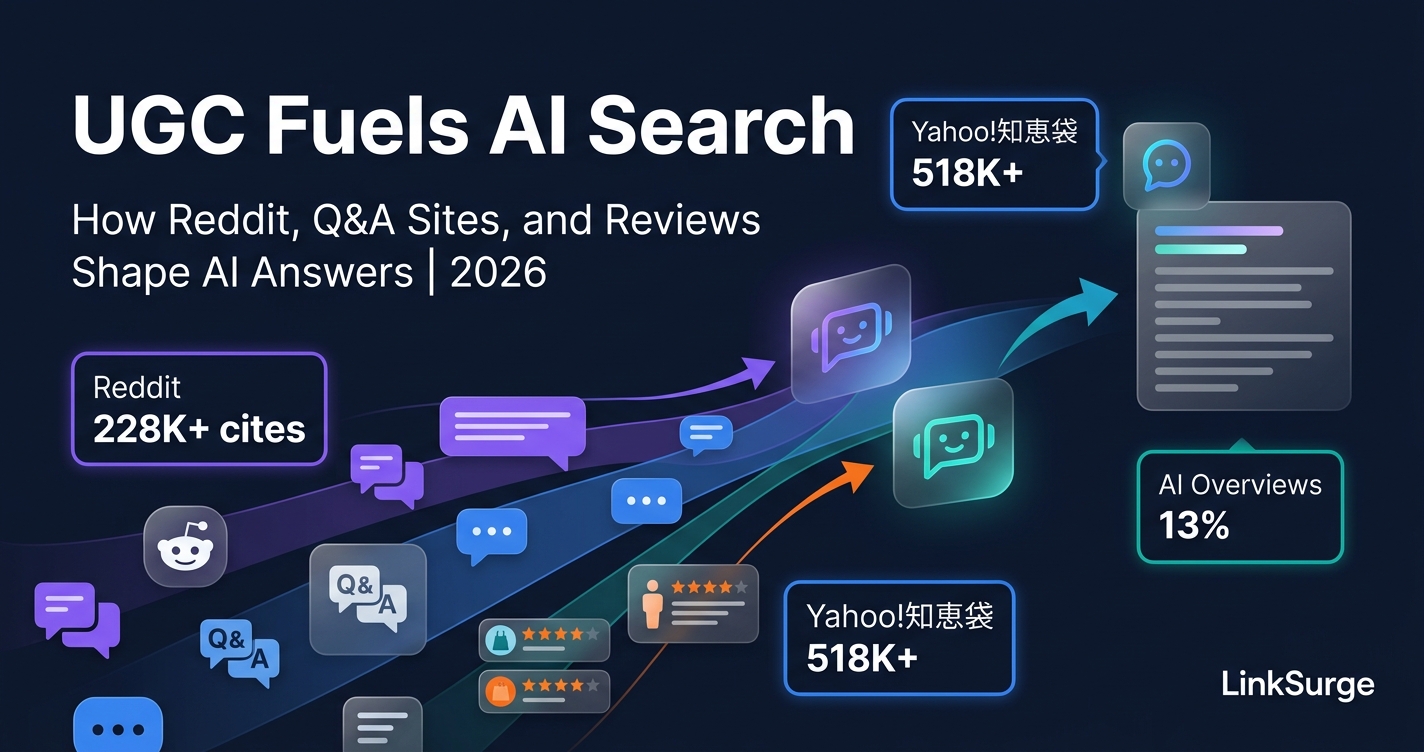
When I dug into AI-search source data, Ahrefs' 2025 Japan-market study stopped me in my tracks. In Japan, ChatGPT's most-cited source is Reddit (228,388 times), and Google AI Mode cites Yahoo!知恵袋 (Yahoo Answers Japan) 518,977 times — two-to-five times any other source across any other AI engine. What this means in plain terms is simple: AI engines aren't primarily feeding on corporate sites and news media. They're feeding on user-generated content. That arrangement is not fixed, though: August 2026 brought a sharp drop in Reddit citations on ChatGPT (details below). Here's what struck me after reading this alongside the English-market research:
Updated August 2026: Reddit's citation position has changed substantially. Per Search Engine Land (reporting Promptwatch data), Reddit's share of ChatGPT Search citations fell from an average of 3.83% (July 18–Aug 7) to an average of 0.52% across Aug 14–17 — an 86.4% drop in four days. Google's surfaces moved far more gradually: AI Overviews went from roughly 2.5% in early July to about 2.1% in August, and AI Mode followed a similar gentle decline. The cause is not established. Promptwatch states plainly that its analysis shows when the shift happened, not why, and that it cannot rule out data-collection issues. Some write-ups attribute it to Reddit blocking crawlers site-wide via robots.txt; that is inference on their part and we have not been able to verify it (Reddit blocks our requests for its robots.txt outright). The figures below are from May–September 2025. The ChatGPT numbers in particular may no longer hold.
- UGC is the dominant food source for AI search — In Japan-market Ahrefs data (May–Sept 2025), ChatGPT's #1 cite was Reddit and AI Mode's #1 was Yahoo!知恵袋. But Reddit's ChatGPT Search citations fell 86.4% in four days in August 2026 — depending on any single platform is itself the risk. UGC has taken the top slot.
- Each AI engine has a distinct UGC preference — Perplexity leans video (YouTube), Copilot leans encyclopedic (Wikipedia), and Google AI Mode leans overwhelmingly on Yahoo!知恵袋. ChatGPT leaned heavily on Reddit as of 2025 and then swung sharply in August 2026. That volatility is precisely why a cross-platform strategy matters.
- UGC ecosystems are fundamentally different by language — English-side is Reddit / YouTube / Quora-centric; Japanese-side is Yahoo!知恵袋 / note / Ameblo-centric. Japan expansion without Japanese UGC investment is essentially invisible to Google AI Mode.
- Brands "stimulate" UGC — they don't fabricate it — Self-generated UGC gets flagged as spam. Community building, review solicitation, expert Q&A answers, ambassador programs, and UGC templates are the five tactics that create the conditions for organic UGC.
- Track UGC-driven brand mentions in three layers — Platform mentions, AI-search citations, and branded search volume. You need all three to see the full ROI picture.
Let me unpack.
1. How AI search cites UGC — the RAG mechanic
The technical reason AI search cites UGC so heavily is RAG (Retrieval-Augmented Generation). ChatGPT, Perplexity, Google AI Mode, and Copilot all use RAG — they search the web in real time before generating an answer. Ahrefs' analysis shows AI evaluates sources along four axes: trust, accuracy, freshness, and engagement, and picks what to cite based on those signals.
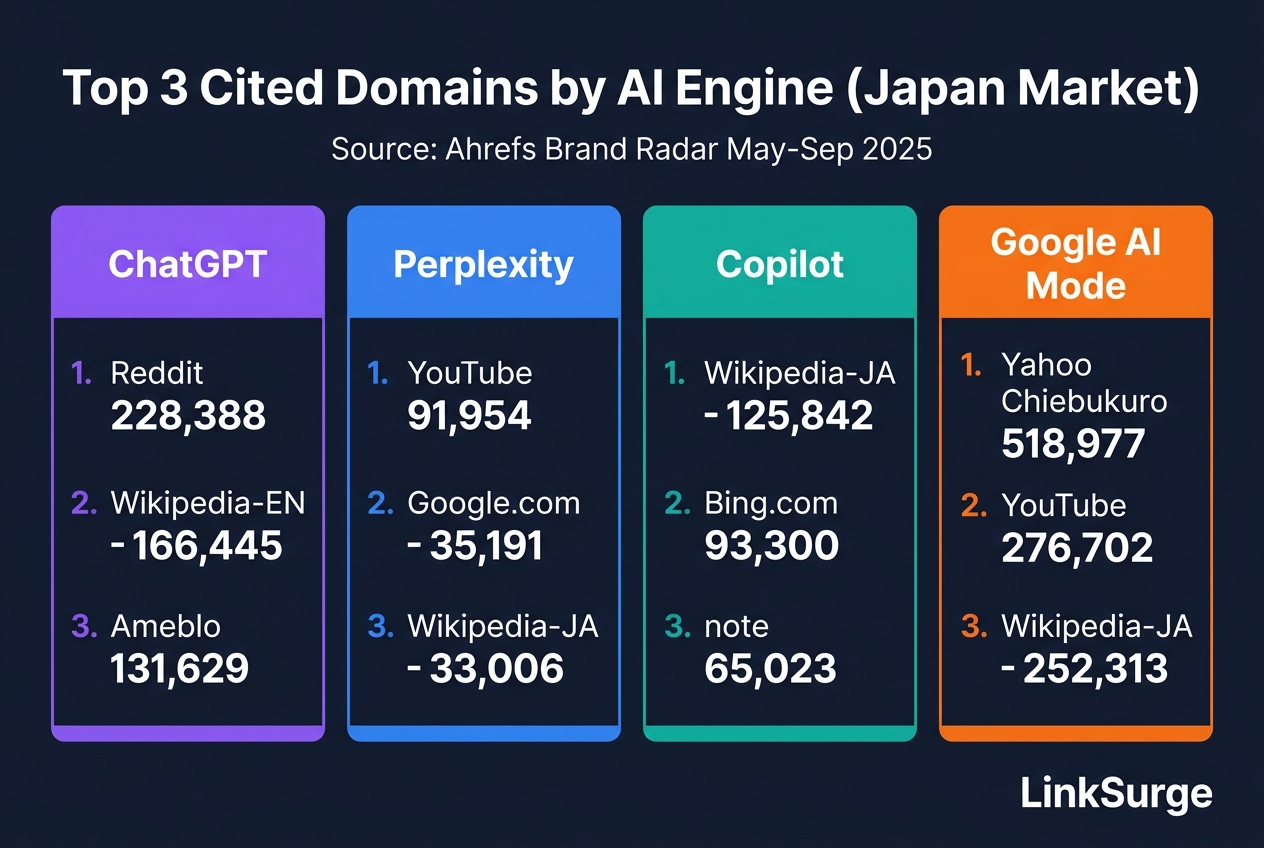
AI engine citation source top 3 — Japan market
Ahrefs ran their Brand Radar analysis between May and September 2025 on Japanese queries. Here's the condensed view — these are point-in-time figures, and the ChatGPT/Reddit row in particular should be read against the August 2026 drop noted above.
| AI engine | #1 | #2 | #3 |
|---|---|---|---|
| ChatGPT | Reddit (228,388) | Wikipedia EN (166,445) | Ameblo (131,629) |
| Perplexity | YouTube (91,954) | Google.com (35,191) | Wikipedia JA (33,006) |
| Copilot | Wikipedia JA (125,842) | Bing.com (93,300) | note (65,023) |
| Google AI Mode | Yahoo!知恵袋 (518,977) | YouTube (276,702) | Wikipedia JA (252,313) |
The Yahoo!知恵袋 anomaly
The 518,977 citations for Yahoo!知恵袋 in Google AI Mode is genuinely anomalous — 2-5x the top citation count any other AI engine gives to its top source. This isn't a fluke. Google is treating Yahoo!知恵袋's massive Q&A archive as the default answer source for Japanese queries.
It's actually logical when you think about it: 知恵袋 contains hundreds of millions of natural-language Q&A pairs in Japanese. For a RAG system trying to retrieve "past question similar to user's query and its best answer," it's nearly the ideal dataset shape.
Why Reddit dominates on the English side
English-market Reddit occupied the same structural position for a long stretch. According to a Search Engine Land 2026 study, AI search engines most frequently cite Reddit, YouTube, and LinkedIn.
Separately, xSeek reported that Reddit's AI Overview citations grew 4.5x over one quarter.
That dominance has been eroding through 2026, though. Conductor's data has Reddit's overall citation share falling from 2.02% in October 2025 to 1.01% by January 2026, and then the ChatGPT Search collapse described above hit in August 2026. "Post on Reddit and AI will pick it up" no longer holds — at least not for ChatGPT.
The Reddit/YouTube dynamics are covered in the sister post "YouTube Video SEO Meets AI Search" — worth noting that YouTube overtook Reddit in 2026 as the #1 social platform for AI citations, which itself is a notable shift.
References: Ahrefs Japan AI Citation Analysis - Valuesccg Manamina Top 10 Cited Domains by AI Search - Ahrefs AI search engines cite Reddit, YouTube, and LinkedIn most - Search Engine Land Reddit's 4.5x AI Overview Surge - xseek Reddit's ChatGPT Search citations fell 86% in four days - Search Engine Land Reddit AI Citation Decline - Conductor
2. The fundamental Japan vs US UGC ecosystem difference
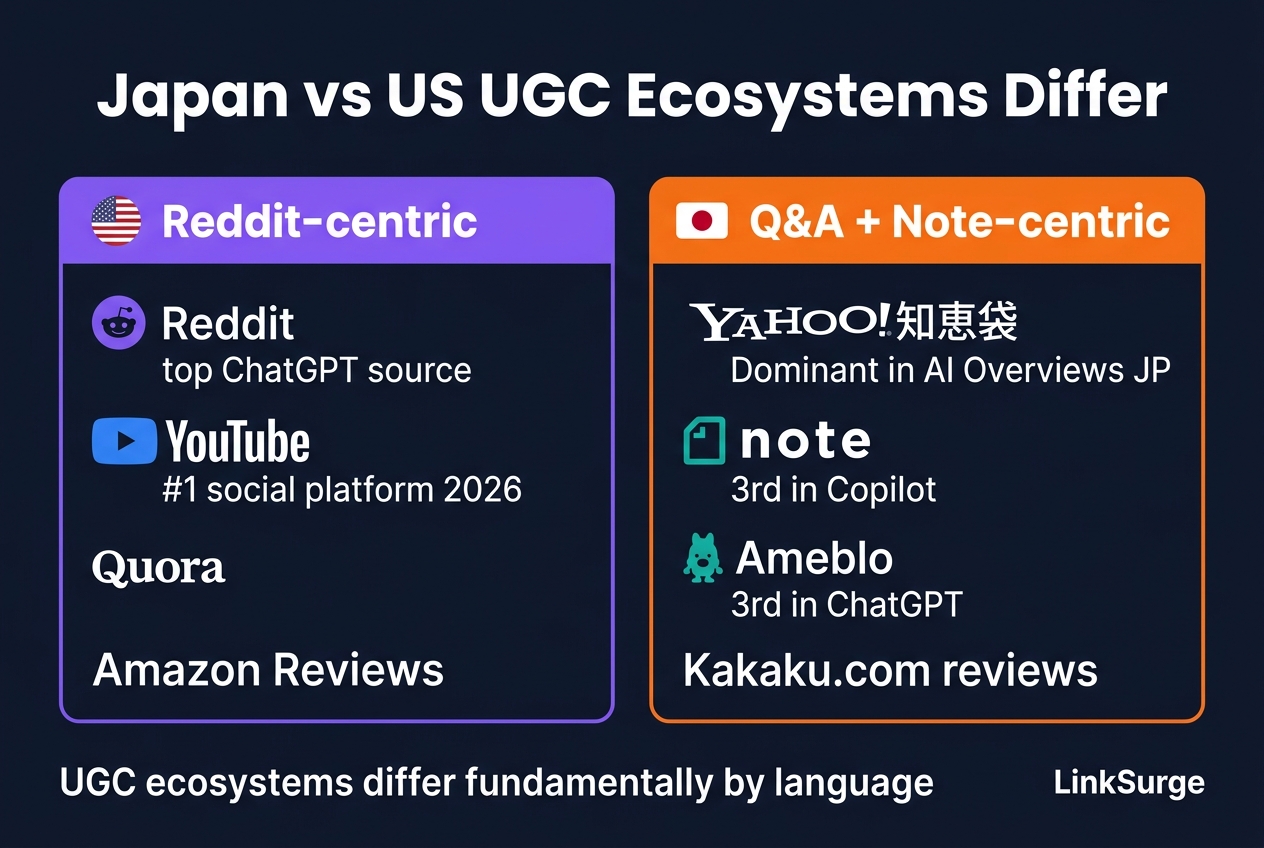
This is the critical point for any brand operating in Japan. Importing an English-market UGC playbook into Japan won't work — the ecosystems are different enough to require separate strategies.
Platform map by language market
| Category | English (US-centric) | Japanese market |
|---|---|---|
| Q&A primary | Reddit / Quora / Stack Exchange | Yahoo!知恵袋 / OKWave |
| Reviews primary | Amazon / Yelp / Google | Amazon.co.jp / Kakaku.com / @cosme |
| Blog UGC | Medium / Substack | note / Ameblo / Hatena Blog |
| Video UGC | YouTube / TikTok / Instagram | YouTube / TikTok / Niconico |
| Product SNS | Reddit / Twitter / Instagram | X / Instagram / LINE Open Chat |
Practical conclusions from the Ahrefs data (Japan market)
- Yahoo!知恵袋 is the top priority — Google AI Mode weighs it overwhelmingly. Systematically building category expertise answers here is high-leverage
- note works for Copilot-driven traffic — #3 in Copilot citations; pulls double weight for SEO and AEO
- Ameblo still matters — Third in ChatGPT citations. Blog SEO isn't dead; it's just in different shapes
- Reddit still counts — ChatGPT's #1 source is Reddit even for Japan queries, because many English-language sources get pulled into Japanese-language answers
A common Japan-market failure pattern
Honestly, when Japanese brands complain they "don't get cited in AI search," the root cause is usually under-investment in Japanese-language UGC. Focusing only on their own site's SEO while neglecting Yahoo!知恵袋 and note presence means being structurally invisible to Google AI Mode. It's genuinely one of the most common pitfalls.
The broader social-AI optimization story is covered in "AI Search Optimization for X, Instagram, and LinkedIn (2026)", but UGC is one layer deeper — user-initiated content across any platform, not just social.
References: Reddit and YouTube in AI Search: UGC Is the #1 Cited Source - Salespeak Ahrefs Study: 6 Months of AI Source Shifts - PR TIMES Get Brand Mentioned in ChatGPT and Perplexity - ZICY
3. Four criteria for UGC that gets AI-cited
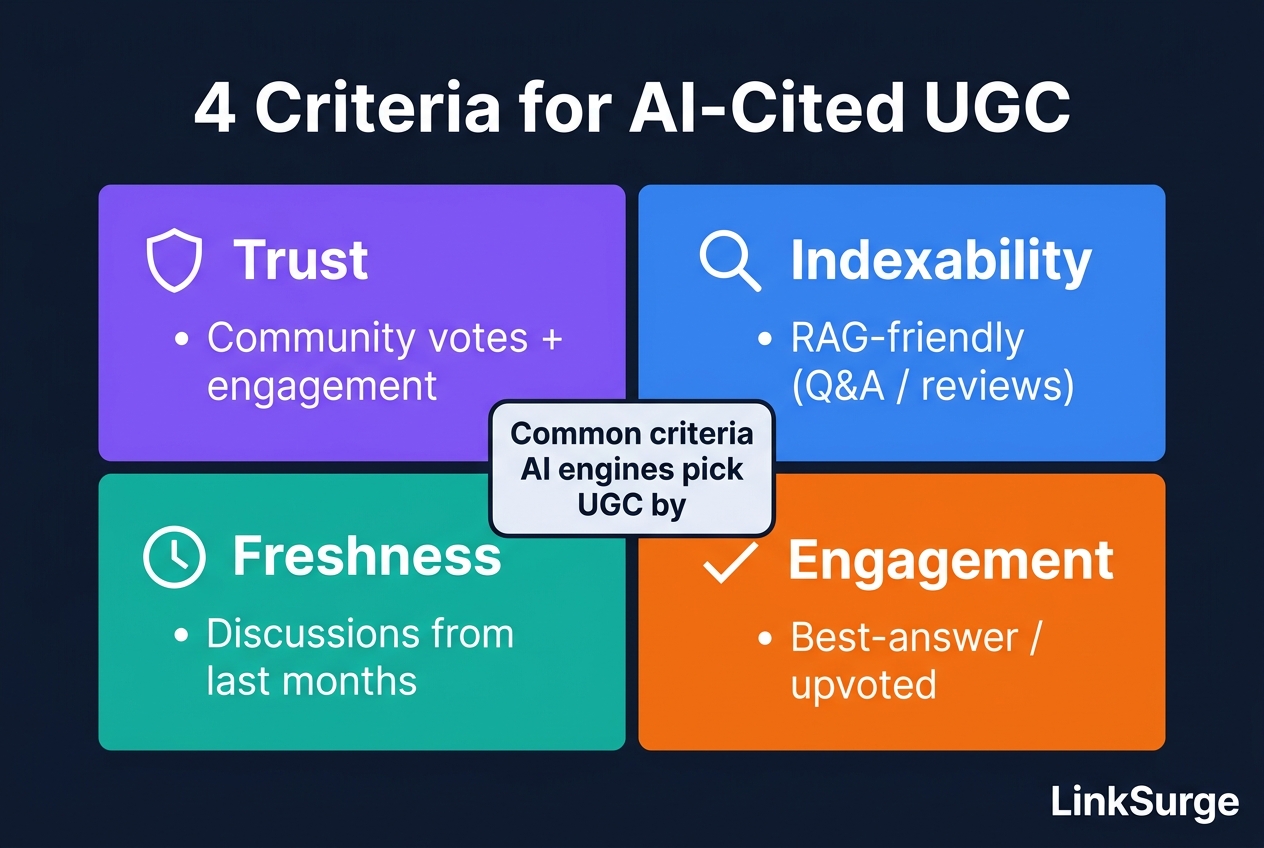
Ahrefs' analysis boils AI's UGC-selection logic to four axes. Understand these and the next section's tactics make more sense:
The four criteria
- Trust: Community votes and engagement. Reddit upvotes, 知恵袋 best-answer designations, and Quora upvotes function as direct trust signals
- Indexability (RAG-friendliness): Q&A or review-formatted UGC is easier for RAG to retrieve because the question-answer structure is preserved
- Freshness: Discussions from the past months tend to be prioritized. Multi-year-old posts lose out on freshness scoring
- Engagement: Comment counts, share counts, reaction volume. Active discussion signals "this is important" to AI
The template for AI-cited posts
Fuelonline's 2026 Reddit SEO analysis breaks down the pattern for AI-cited Reddit posts:
- Question-form title: "How do you actually use X for Y?" format
- Detailed answer body: 200–500 word specific experience accounts
- Concrete numbers and facts: "Used it for 3 months, sales up 28%" type quantitative data
- Active comment discussion: Original post + comment threads function together as one "answer set"
Applied to Japanese UGC
The same four criteria apply cleanly to Yahoo!知恵袋:
- Natural-language question-form titles (close to actual user search queries)
- Specific best answers with steps, numbers, and links in 200+ words
- Freshness of a few months to a year
- Community engagement — "helpful" ratings and comment counts
References: 9 Proven Reddit AI SEO Plays [2026 Guide] - ReddiReach Mastering Reddit SEO Strategy For UGC Success In 2026 - Fuelonline Reddit's Rise in AI Citations - CMS Wire
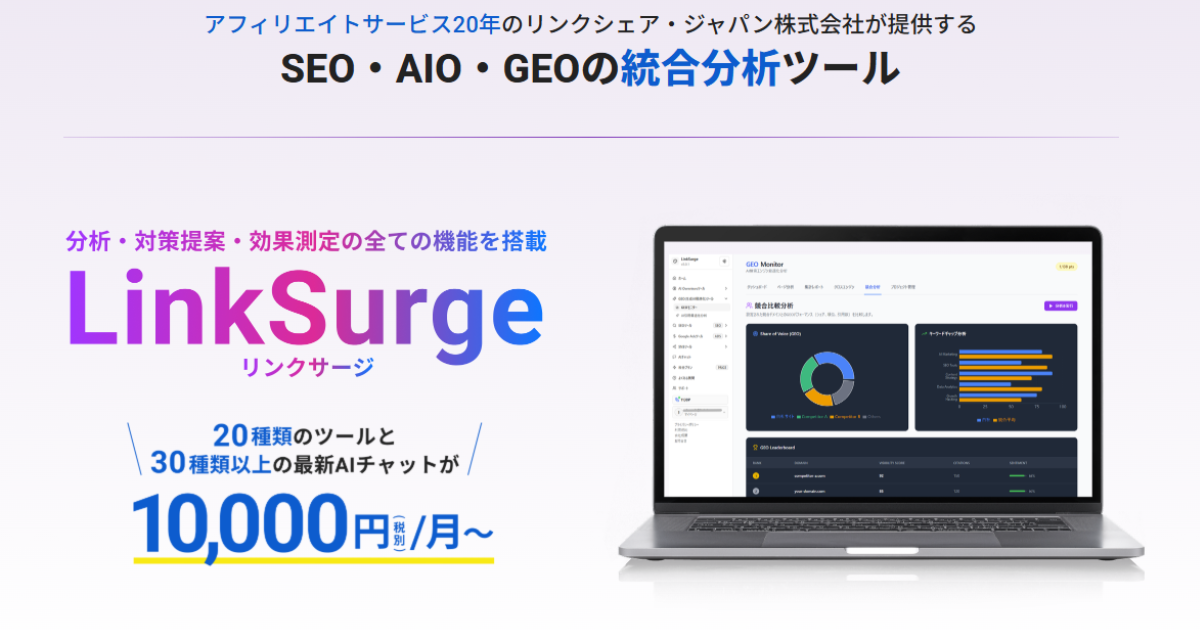
LinkSurge
linksurge.jp
SEO・AIO・GEO統合分析プラットフォーム。AI Overviews分析、SEO順位計測、GEO引用最適化など、生成AI時代のブランド露出を最大化するための分析ツールを提供しています。
4. Five tactics to stimulate brand UGC
This is the most misunderstood point. Cranking out fake reviews and sock-puppet posts in-house is fully anti-pattern. Platforms and AI engines have both been sharpening their spam-detection precision year over year.
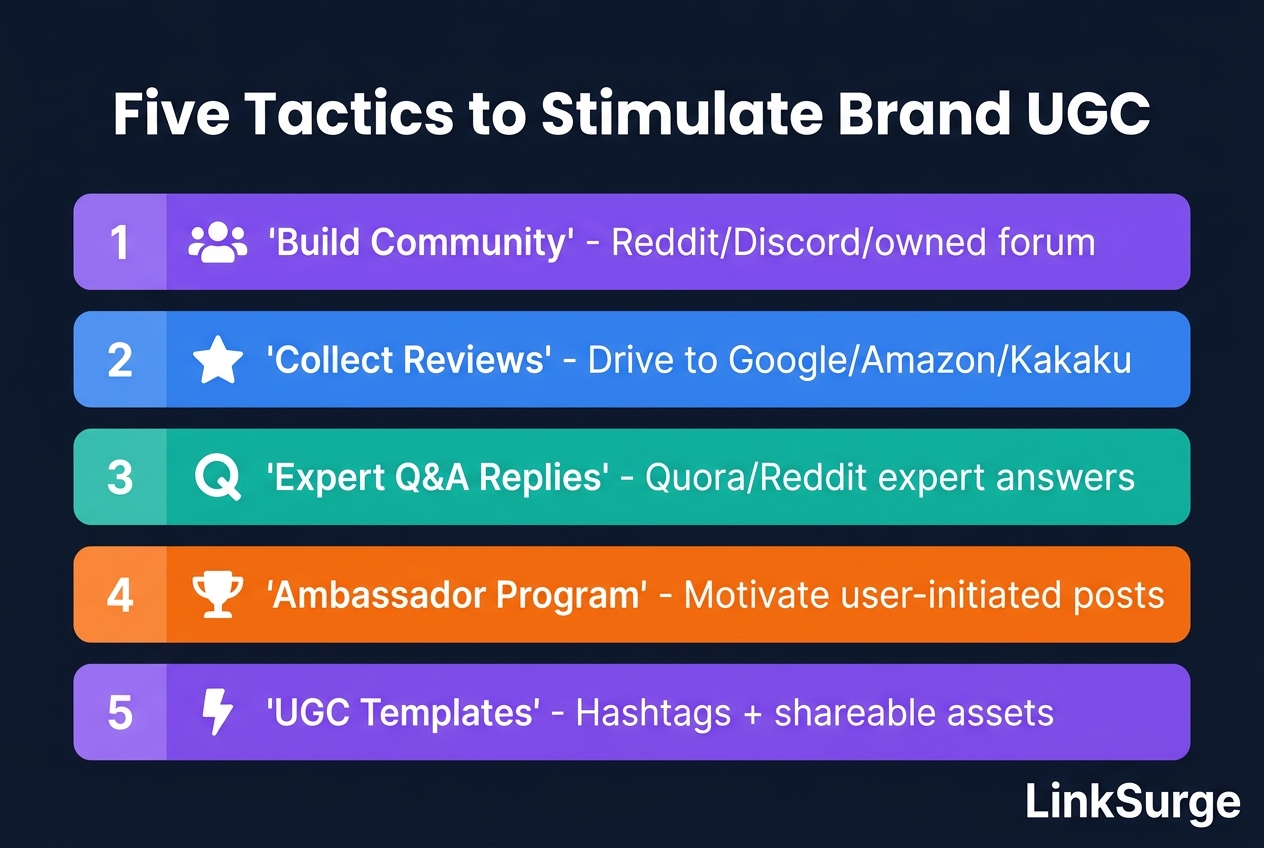
What brands should be doing isn't "make UGC" — it's "build the conditions for UGC to emerge organically." Five tactics work in practice:
Tactic 1: Build your own community
Create spaces where users discuss on their own terms — Reddit, Discord, owned forums, LINE Open Chat.
- Run your own subreddit — Official presence on brand or topic-themed subreddits
- Discord / private chat — Smaller-group discussion surfaces
- Owned forums — Particularly effective for SaaS brands
The key is "operate but don't force posts." Focus on creating conditions for voluntary discussion.
Tactic 2: Systematize review collection
Build pathways that let users write reviews voluntarily — post-purchase emails, in-app prompts, reviews-with-incentive offers.
- Post-purchase follow-up: Two-week-later "how's it going?" email
- Drive to Amazon/Kakaku.com/Yelp: Prefer third-party platforms over your own review surface
- Incentive design: Offer free samples/coupons in exchange for "honest reviews"
Tactic 3: Answer Q&A platforms as experts
Enable your staff to answer questions on 知恵袋, Quora, and Reddit as subject-matter experts.
| Platform | Tactic |
|---|---|
| Yahoo!知恵袋 | Leverage "category master" designation, consistent staff answers |
| Quora | Earn Topic Expert status, post detailed long-form answers |
| AMA (Ask Me Anything) format, subreddit moderation |
Crucial framing: "give genuinely helpful answers, not product pitches." Humans and AI both downgrade the moment they smell promotional intent.
Tactic 4: Run an ambassador program
Offer perks to power users to encourage voluntary posts, blogs, and videos.
The yutori case study (detailed in "How yutori Captured Gen Z with SNS-First Brand Strategy") is the canonical example: staff become brand ambassadors posting daily-life content, which flows through TikTok and Reels and eventually into AI citations. The compound loop is real.
Tactic 5: Provide UGC creation templates
Distribute hashtags, photo frames, shareable cards, and remix-ready assets — materials that make UGC easier to create.
- Official hashtags: Brand-specific tags that hit a billion views on TikTok
- Photo frames: Instagram Story-ready overlay assets
- Review templates: "Cover these 5 points and you're done" frames
The underlying idea: remove the psychological block of "I want to post but don't know what to say."
For a ChatGPT-specific playbook covering press wires, long-form platforms and Q&A sites, and the conditions that get a press release cited, see Using Press Releases, note and Q&A Sites for ChatGPT Citations.
The buying-behavior side backs this up. In "54% of Gen Z Ask AI Before They Buy, But Still Trust Search Most," we cross-check Rakuten's September 2026 survey with Azoma's citation data, which puts UGC at 19% of ChatGPT's shopping citations and brand websites at just 3%.
References: Reddit's Rise in AI Citations - CMS Wire AI Visibility in 2025 - Yext 9 Proven Reddit AI SEO Plays - ReddiReach
5. Three-layer monitoring for UGC-driven brand mentions
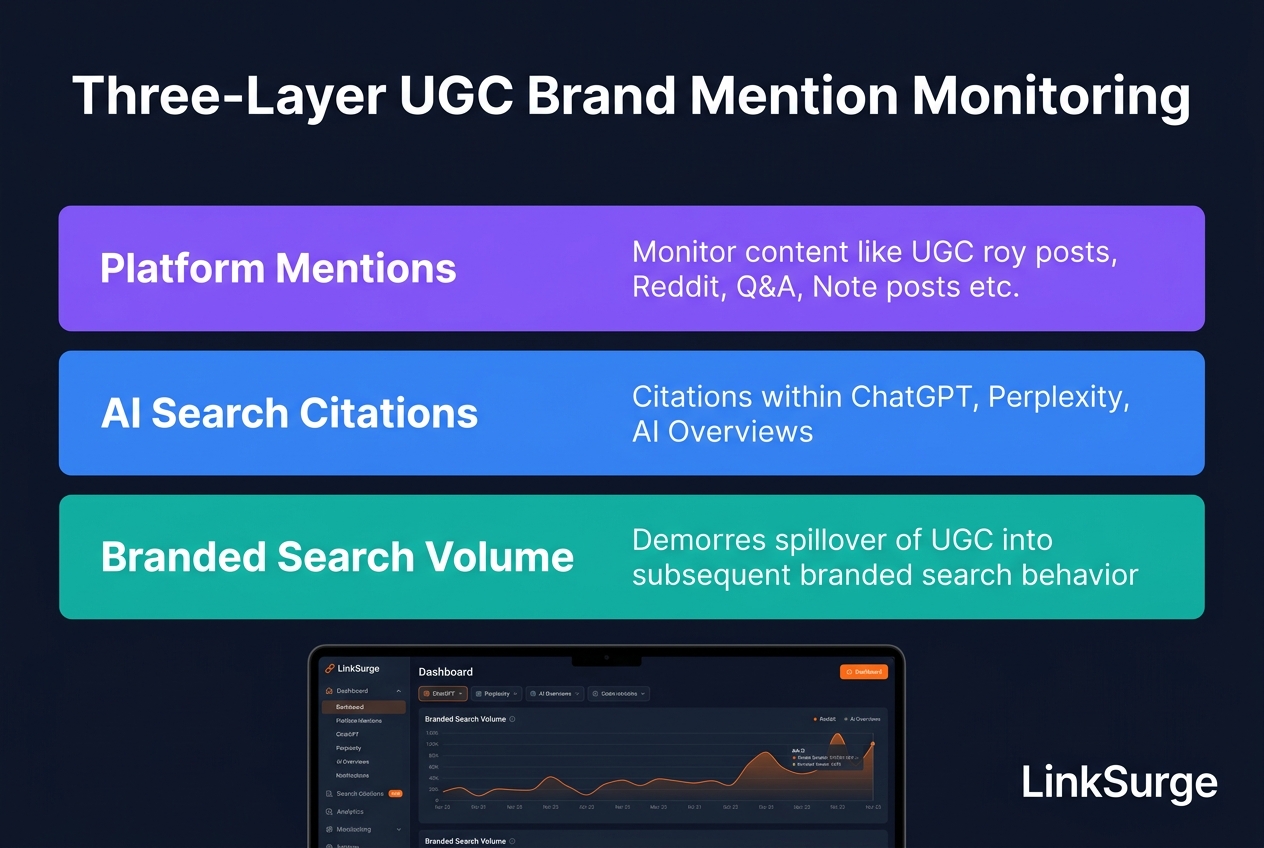
Once UGC tactics are running, it's time to measure. UGC-driven brand mentions need three-layer tracking to see the full picture.
The three-layer monitoring frame
| Layer | What to measure | How |
|---|---|---|
| Layer 1: Platform mentions | Brand mention count on Reddit / 知恵袋 / note | Platform search, API social listening tools |
| Layer 2: AI search citations | Citation count in ChatGPT / Perplexity / Google AI Mode | Purpose-built tools (e.g., LinkSurge) |
| Layer 3: Branded search volume | "Brand name + UGC-context" Google search volume | Google Search Console / Google Trends |
Layer 1: Platform mention measurement
Use site:reddit.com "brand name" search on Reddit, or official search on 知恵袋, to track question counts mentioning your brand per month. AI cites these, so growing this layer is the root.
Layer 2: AI citation counts
This is the hardest layer to measure. LinkSurge's GEO monitor tracks daily how often a brand or URL gets cited in ChatGPT, Perplexity, and Google AI Overviews, letting you visualize whether your UGC tactics are actually rippling into AI search.
Layer 3: Branded search volume
Users who discover you via UGC tend to follow up with Google searches for "brand name" or "brand name + related keyword." Tracking Google Search Console impressions and clicks for branded queries monthly validates the downstream result of UGC effort.
Five items to review monthly
Monthly checkpoint:
- Brand mention count per platform (Reddit, 知恵袋, note, Amazon, Kakaku.com)
- AI citation count per engine (ChatGPT, Perplexity, AI Overviews, Gemini)
- Citation quality mix (positive / neutral / negative ratio)
- Branded search volume trend
- Conversion attribution (UGC-originated inquiries and purchases)
6. Implementation checklist and KPI design
A practical checklist for deploying a UGC × AI search strategy:
First-month launch checklist
- Platform inventory across English and Japanese markets (Reddit / 知恵袋 / Quora / note / review sites)
- Baseline measurement of brand mentions on each platform
- Secure community management resources and an owner
- Assign expert Q&A answer responsibilities
- Design review-collection pathways (post-purchase emails, in-app prompts)
- Set up AI citation monitoring (LinkSurge etc.)
KPI design by phase
| Phase | Primary KPI |
|---|---|
| 3 months in | Monthly platform mentions up 10–20% |
| 6 months in | AI citation count 2x+ initial baseline |
| 12 months in | Branded search volume +20%+, UGC-attributed conversions visible |
Common failure modes and how to avoid them
- Self-posted UGC: Major spam-detection and reputational risk. Don't
- English-UGC-only focus: Japan-market brands need Yahoo!知恵袋 and note. Don't skip Japanese UGC
- One-off campaigns: UGC stimulation is a sustained investment — design for at least 12 months
- Inconsistent measurement layers: Don't celebrate just Layer 1. Track through Layers 2 and 3
FAQ
Why can't I just fabricate UGC?
Fake reviews and sock-puppet posts get detected by both platform spam-detection systems and AI-search trust-evaluation systems, which have both improved year over year. Detection results in penalties (account suspension, ranking drops, exclusion from AI citations) and brand damage. Growing organic UGC is faster long-term, even if it feels slower.
Is staff posting about our product on Yahoo!知恵袋 considered spam?
It depends on how. Obvious promotion and sock-puppet activity are out, but staff serving as "category experts" and mentioning the product within genuinely helpful answers is fine. The distinguishing factor is always "answering the asker's question genuinely, not pitching."
Should I prioritize English or Japanese UGC?
Depends on your market. For Japan-market businesses, Yahoo!知恵袋, note, and Ameblo should be top priority. For global expansion, Reddit and English Q&A platforms. If you're doing both, allocate resources proportional to market size.
How do I measure AI search citations?
Purpose-built tools like LinkSurge's GEO monitor are the realistic path. You can manually query ChatGPT or Perplexity with brand-name queries and count citations, but it doesn't scale to continuous tracking.
How long before UGC tactics show results?
Three months at the earliest; full effect typically 6–12 months. Community building, review accumulation, and consistent Q&A answering all take time — but once the machine is running, it compounds.
Designing UGC, not producing it
2026 AI search marketing can't be won by owned-content investment alone. Ahrefs data is unambiguous: AI engines are fed by Reddit, Yahoo!知恵袋, note, and other UGC, and competing on your own site alone means leaving AI-citation opportunities behind.
The five tactics in this post — community, reviews, Q&A, ambassadors, UGC templates — share a single underlying philosophy: design the conditions for users to generate UGC voluntarily. Stimulation, not production. That's the 2026 UGC thesis.
LinkSurge's brand mention tracker tracks daily brand citations across ChatGPT, Perplexity, and Google AI Mode. Pair it with the checklist above when you want to quantitatively validate UGC tactics.