How to Get Cited by ChatGPT: The Complete 2026 Guide to Search Architecture, Citation Sources, Tactics and Measurement
目次
Key Takeaways: Five Things You Need to Accept Before Optimizing for ChatGPT
Every time a client asks me about ChatGPT visibility, I start with the same request: put the Google playbook down for a minute. ChatGPT search has no rankings page. It splits your question into several internal searches, pulls dozens of pages, reads them, and cites two or three. This article is the hub of our ChatGPT optimization series. It lays out the whole picture, from architecture to measurement, based on OpenAI's official documentation and primary data published in 2026 by Ahrefs, Peec AI, Profound and Lily Ray. Here's what matters.
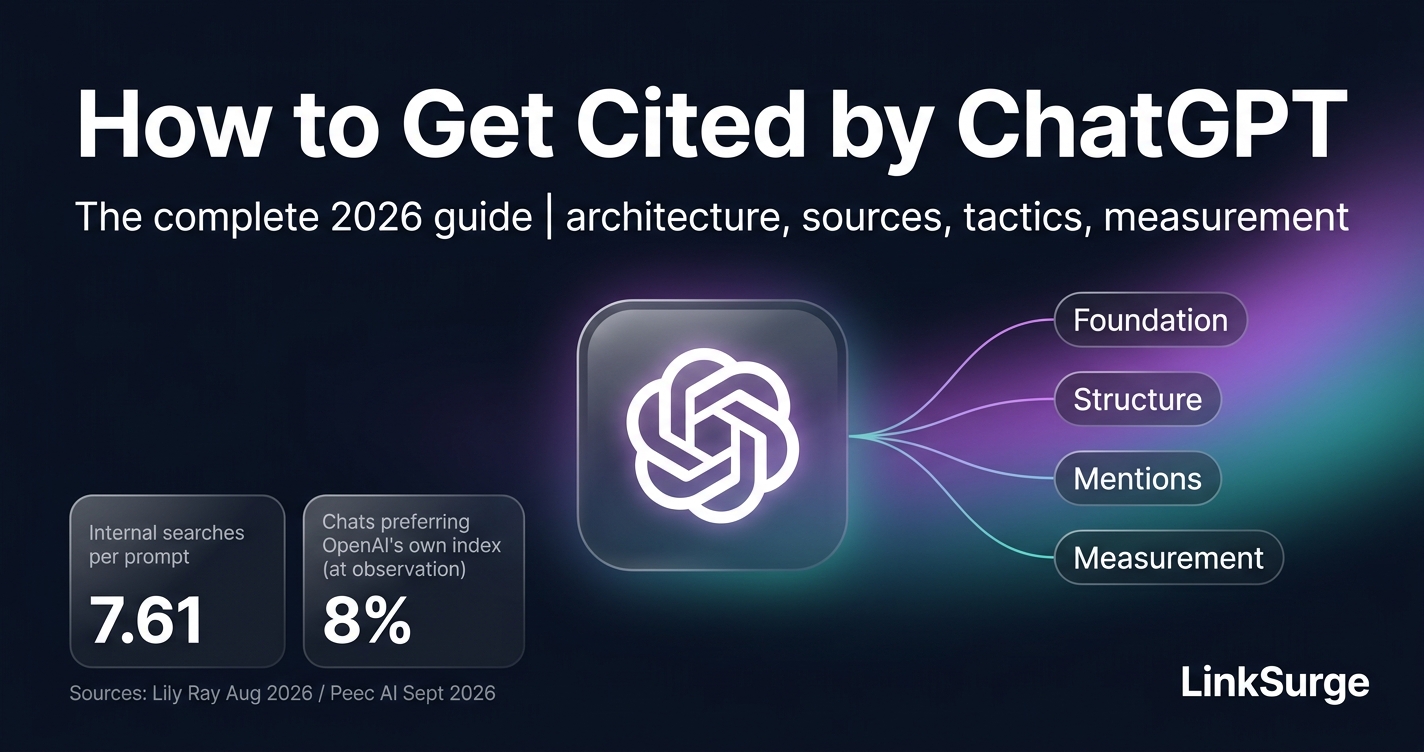
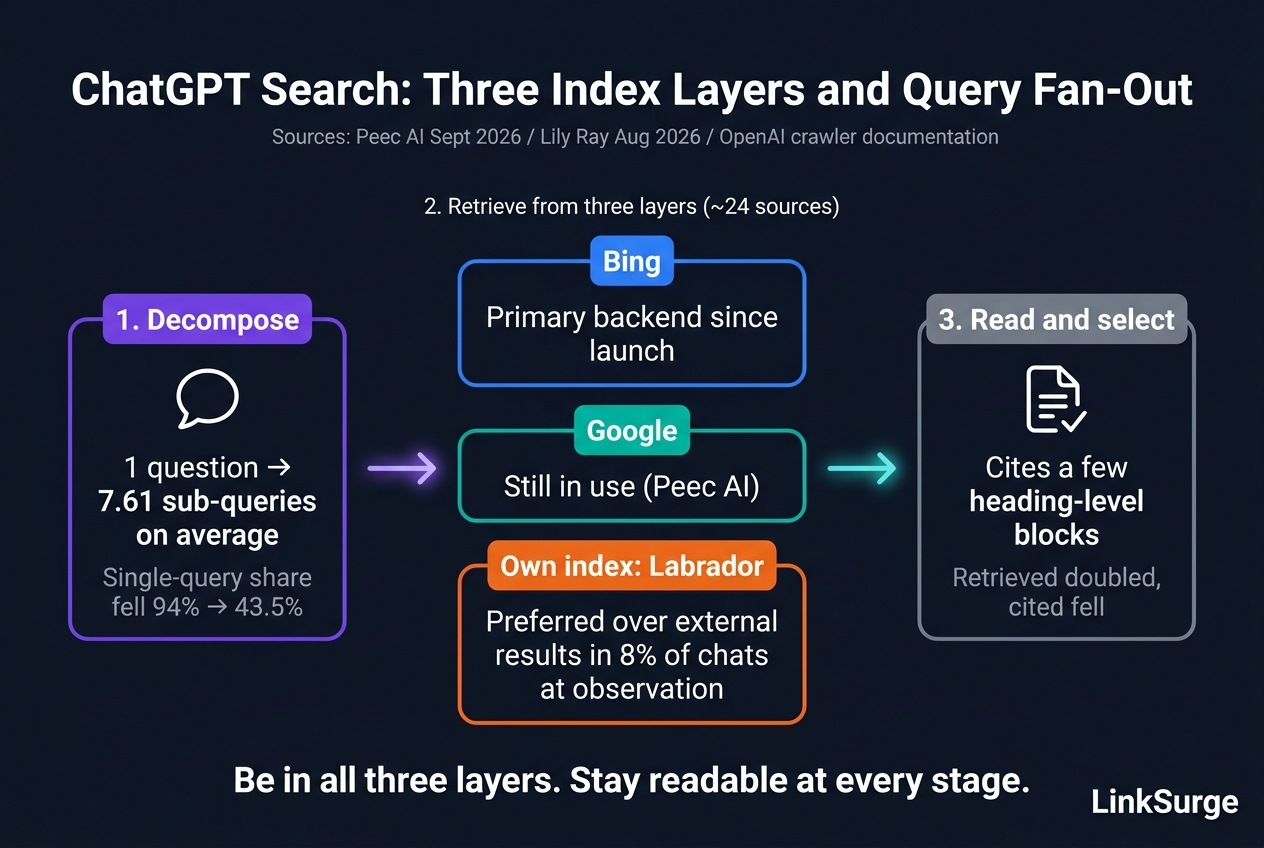
- ChatGPT search runs on three index layers — At launch in October 2024, Bing was the main search backend. By September 2026, Peec AI's analysis shows an experiment preferring OpenAI's own index (which Peec AI calls "Labrador"; OpenAI hasn't confirmed the name) over external search results in 8 percent of chats at the time of observation, with such experiments reportedly ranging from single digits up to 20 percent. You need to be in Bing, in Google, and crawlable by OAI-SearchBot, all at once
- One question becomes 7+ internal searches on average — Lily Ray's August 2026 observations show the share of prompts handled with a single query fell from 94% to 43.5%, while fan-outs per prompt rose from 2.17 to 7.61. And during the GPT-5.3 to 5.4 period in mid-2026, those sub-queries stopped appearing in the conversation interface
- Citation sources are volatile — In August 2026, Reddit's share of ChatGPT Search citations fell 86.4% in four days. Depending on any single platform is a risk. Strategy has to assume rotation and build in monitoring
- Shopping is a separate game with its own rules — Profound's July 2026 analysis found 87.3% of product information comes from web crawling and 12.7% from merchant feeds, and top-ranked product cards have more than twice the median review count of cards ranked fourth or lower. Instant Checkout was retired in March 2026, so discovery happens in ChatGPT and purchase happens on your site
- The work has four layers: foundation, structure, third-party mentions, measurement — Allow OAI-SearchBot and render server-side, build answer-extractable heading blocks, earn mentions on the sources ChatGPT actually cites in your market, and record mention rate and cited domains weekly. Do them in that order
Below, I walk through each layer and point to the deeper articles in the series.
1. How ChatGPT Search Actually Works
Honestly, the internals of ChatGPT search have changed almost monthly in 2026. Still, three parts of the skeleton are confirmable from public information.
Three index layers
OpenAI launched ChatGPT search on October 31, 2024, and the initial architecture leaned on Microsoft Bing as its primary search provider. Peec AI's analysis published September 4, 2026, built on server-sent event metadata collected from May 21 to July 21, OpenAI job postings, Google antitrust testimony, and crawl experiments on their own sites, reports that OpenAI has built a family of vertical indexes that Peec AI refers to as "Labrador" (OpenAI hasn't confirmed the name). It covers general web, PDFs, YouTube, news (bucketed by 1 day, 7 days, older), arXiv, Wikipedia, local, finance, legal, medical, shopping and images. An experiment named prefer-index-over-serp-v3 was applied to 8 percent of chats at the time of observation (mid-August 2026), and Peec AI describes such experiments as ranging from single digits up to 20 percent. The same analysis states plainly that "Google and Microsoft still matter" and that the system "is still being rebuilt week to week."
The practical conclusion is simple. Be indexed in Bing. Be indexed in Google. Be crawlable by OAI-SearchBot. Being in one of the three is not enough.
Query fan-out
ChatGPT doesn't search your question verbatim. It decomposes it into sub-queries, runs each, and synthesizes the results. The ChatGPT-specific twist in 2026 is that a mid-year model update multiplied the number of fan-outs while simultaneously hiding them from the browser. Full details in What Happened to ChatGPT's Query Fan-Out.
Retrieved is not cited
In Lily Ray's data, sources retrieved per response roughly doubled from about 12 to about 24 after the update, while the number actually cited moved the other way. Being read by ChatGPT and being cited by ChatGPT are two different outcomes. Treat the foundation (getting read) and the structure (getting picked) as separate workstreams.
For a deeper look at the architecture, see Inside ChatGPT Search: Bing, Google and the "Labrador" Index.
References: ChatGPT built its own search index - Peec AI What We Can Learn from Evolving ChatGPT Fan-Out Queries - Lily Ray ChatGPT search officially launches - Search Engine Land
2. Foundation: Let OpenAI's Crawlers Read You
If this layer is broken, nothing above it matters. OpenAI documents four bots.
| Bot | Purpose | robots.txt behavior |
|---|---|---|
| OAI-SearchBot | Crawls to surface your site in ChatGPT search results | Allow it to appear in search answers. Disallowed sites may still show as navigational links but not in search answers |
| GPTBot | May use content to train foundation models | Disallow to opt out of training. Independent of search visibility |
| ChatGPT-User | Fetches pages when a user asks ChatGPT or a custom GPT | User-initiated, so robots.txt rules may not apply |
| OAI-AdsBot | Verifies ad landing pages for safety and relevance | Only relevant if you advertise |
The key point: "don't train on me, but do show me in search" is a valid configuration. Disallow GPTBot, allow OAI-SearchBot. OpenAI says robots.txt changes take about 24 hours to propagate, and publishes IP ranges for each bot as JSON.
Server-side rendering is a prerequisite
OpenAI's documentation describes what each crawler does, how robots.txt applies and which IP ranges it uses, but it doesn't specify whether the crawlers execute JavaScript. That leaves content that only exists after client-side rendering at risk of not being read at fetch time. Server-side rendering or pre-rendering puts the content in the initial HTML response, which is the safe configuration. Write numbers and tables as text rather than baking them into images.
For the emerging practice of serving machine-readable Markdown to AI agents, see Cloudflare Markdown for Agents and the AI-Ready Web.
References: Overview of OpenAI Crawlers - OpenAI
3. Structure: Make Your Content Extractable
Once you're readable, the next job is getting picked out of the dozens of pages retrieved. This is an area we research ourselves, so I'll separate what we've confirmed from what we haven't.
What's confirmed
When we analyzed 277 real Google AI Overviews citations, 69.3% came from heading blocks other than the lead paragraph. That study measured Google AI Overviews, not ChatGPT Search. But since ChatGPT also reads retrieved page content and picks passages to cite, we expect a self-contained 40 to 60 word answer directly under each heading to work in the same direction, and we'll test it on ChatGPT in this series' measurement article. Details in Where Does AI Search Actually Quote From?.
MJ Cachón's August 2026 study of 723 API runs on brand prompts found 23.8% of sub-queries contained exact-match quotes and 19.6% contained a year. Spelling out proper nouns and years in headings and body text gives those sub-queries something to land on.
What's not confirmed
FAQ schema and other structured data have not been shown to increase ChatGPT citations. In our controlled test, ChatGPT's change after adding schema (+2.2%) was indistinguishable from noise. Implement structured data when you have a search-engine goal such as rich results, not as a ChatGPT lever. The full story is in Does FAQ Schema Really Get You Cited 3.2x More?.
For heading design and atomic answers, see our beginner's guide to LLMO.
References: A study of query fan-out in ChatGPT using brand searches - MJ Cachón
4. Third-Party Mentions: Match the Sources ChatGPT Cites in Your Market
This is where market matters most. Here's what the data looks like for Japan, the market we track most closely, and why the lesson generalizes.
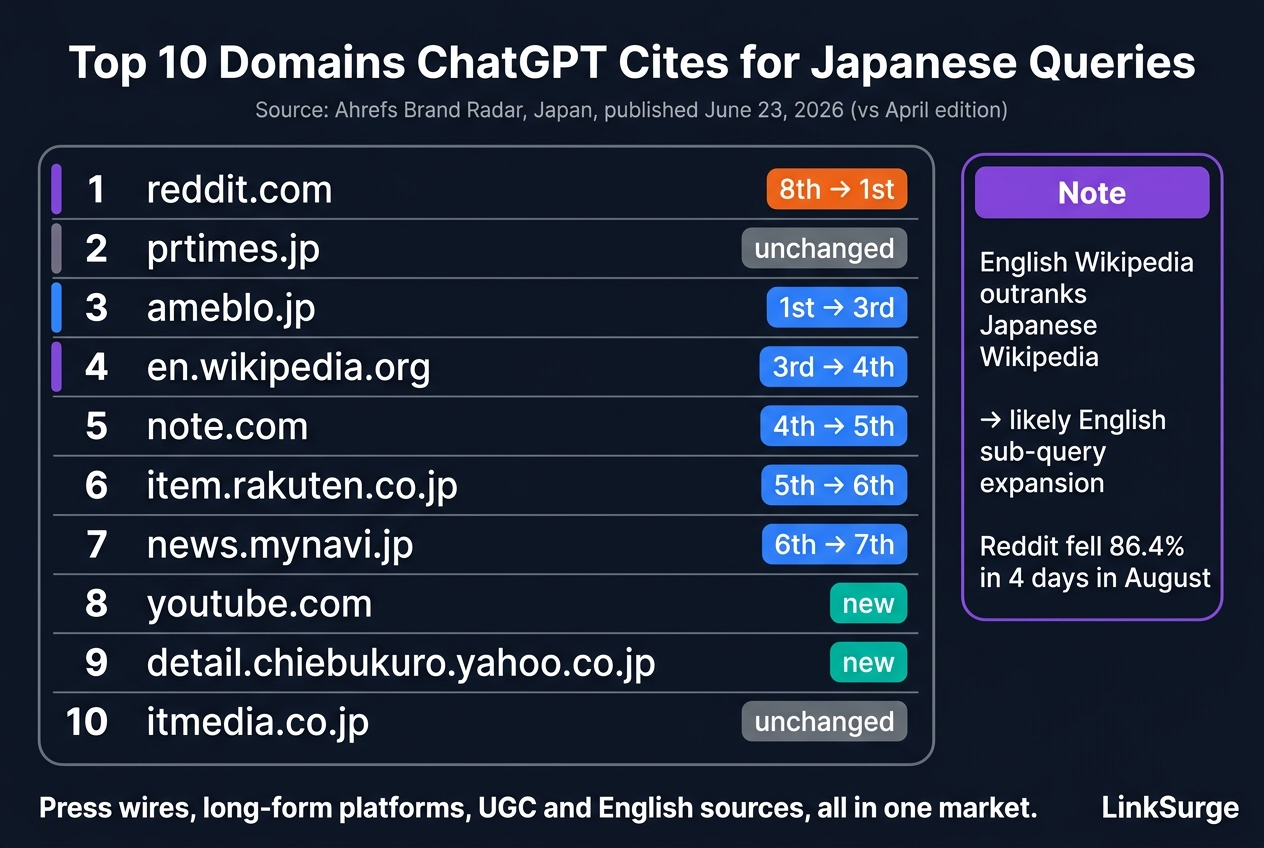
Ahrefs' June 23, 2026 data for Japanese queries ranked the domains ChatGPT cites as follows.
| Rank | Domain | Change from April |
|---|---|---|
| 1 | reddit.com | Up from 8th |
| 2 | prtimes.jp (press release wire) | Unchanged |
| 3 | ameblo.jp (blog platform) | Down from 1st |
| 4 | en.wikipedia.org | Down from 3rd |
| 5 | note.com (long-form platform) | Down from 4th |
| 6 | item.rakuten.co.jp (marketplace) | Down from 5th |
| 7 | news.mynavi.jp | Down from 6th |
| 8 | youtube.com | New |
| 9 | detail.chiebukuro.yahoo.co.jp (Q&A) | New |
| 10 | itmedia.co.jp | Unchanged |
What struck me: English Wikipedia outranks Japanese Wikipedia for Japanese queries. Ahrefs' explanation is that ChatGPT likely expands Japanese questions into English sub-queries internally. MJ Cachón's study found 27.3% of sub-queries for international brands contained English vocabulary. A site that exists only in the local language is invisible to those English sub-queries.
The generalizable lesson is that ChatGPT's citation mix in any market is a blend of a few global UGC and reference sources, plus the local press-release wire, local long-form platforms, marketplaces and Q&A sites. Find the equivalent list for your market and treat it as your outreach map.
Reddit and the volatility problem
Reddit jumped to first place in June and then, in August, Promptwatch data reported by Search Engine Land showed its share of ChatGPT Search citations falling 86.4% in four days (cause unconfirmed). Petra Labs, analyzing 126,500 ChatGPT responses from August 9 to 18, saw YouTube, Reddit and TikTok citations drop 70 to 90 percent in the same window. UGC platforms can matter a lot, and they can vanish overnight. Don't build a strategy around one of them. The August shift and how to design for it are in ChatGPT's Citation Sources Moved 86% in Four Days; the time-series and industry structure of citation sources is in The Domains ChatGPT Cites in Japan; and the press-wire, long-form and Q&A playbook is in Using Press Releases, note and Q&A Sites for ChatGPT Citations. Our guide to UGC and AI search citations covers how to stimulate mentions across platforms.
Brand consistency and site: searches
Lily Ray's data shows the share of fan-outs using the site: operator jumped from 0.3% to about 23% after the model update. In MJ Cachón's study, 69.8% of sub-queries were open searches, but of the 30.2% using site:, 55.1% targeted the brand's own domain, meaning 16.6% of all sub-queries searched the official site by name. For brand prompts, a meaningful share of searches goes straight to your own domain. Whether your site clearly states which page is official and what you offer now matters directly. See Entity Authority in AI Search.
References: Top Japanese domains cited by AI, June 2026 (Japanese) - Ahrefs Top 10 domains cited by AI search, April 2026 update (Japanese) - Ahrefs Reddit's ChatGPT Search citations fell 86% in four days - Search Engine Land ChatGPT slashes citations from Reddit, YouTube, and TikTok: Petra Labs - Adgully
LinkSurge
linksurge.jp
SEO・AIO・GEO統合分析プラットフォーム。AI Overviews分析、SEO順位計測、GEO引用最適化など、生成AI時代のブランド露出を最大化するための分析ツールを提供しています。
5. Shopping and Branded Queries: What Gets a Product Picked
If you sell products, ChatGPT Shopping needs its own plan. Profound's July 2026 analysis (201,137 prompts and 812,190 product cards from June 18 to 25) found 87.3% of product information came from web crawling and 12.7% from merchant-supplied feeds. Cards ranked first had a median of 787 reviews versus 352 for cards ranked fourth or lower.
Instant Checkout, launched in September 2025, was retired in March 2026 according to reporting by CNBC and Forbes, and ChatGPT shifted back to "discover in the chat, buy on the merchant's site." What survived as ranking conditions: accurate product pages and third-party validation like review volume.
Rakuten's 2026 survey found 54.3% of Gen Z use generative AI when shopping yet still trust search engines most. Read together, that means you need to appear both in the AI shortlist and in the verification search that follows. See 54% of Gen Z Ask AI Before They Buy.
References: Breaking down how ChatGPT Shopping works behind the user experience - Profound OpenAI revamps shopping experience in ChatGPT after struggling with Instant Checkout offering - CNBC Why OpenAI's Checkout Retreat Spells Trouble For Its Commerce Strategy - Forbes Rakuten Announces Results of Gen Z Generative AI Usage Survey (Japanese) - Rakuten Group
6. Measurement: Replace Invisible Fan-Outs with Visible Mention Rates
With fan-outs hidden, you can no longer watch which sub-query picked you up. What you can watch is the outcome: for a set of questions in your category, how often ChatGPT mentions or cites you, and who else it cites.
Three weekly metrics
- Mention rate — Across 20 to 30 category questions, the share of answers that include your brand name or URL
- Cited domains — URLs cited in the answers, grouped by domain and classified as review sites, press releases, UGC, or competitors
- Competitor gap — The same questions, competitor mention rate, and the difference
ChatGPT answers vary run to run, so a single check misleads. LinkSurge's GEO monitoring registers watch queries across ChatGPT Search, Gemini, Google AI Overviews, Claude and Perplexity, and logs mention presence, position, cited URLs and competitor comparison. We use the same setup to measure this series, and we'll publish the results in follow-up articles.
If you want to see the fan-outs themselves, OpenAI's Responses API still returns them in the action.queries array. Steps are in What Happened to ChatGPT's Query Fan-Out.
7. A 30-Day Starting Order
Here's the sequence, week by week.
| Week | Do | Verify with |
|---|---|---|
| 1 | Allow OAI-SearchBot in robots.txt and decide your GPTBot policy. Confirm key pages have their content in the initial HTML. Check Bing and Google indexation | curl the HTML and look for body text. Bing Webmaster Tools and Search Console |
| 2 | Design 20 to 30 category questions and take a baseline of ChatGPT mention rate and cited domains | GEO monitoring or manual logging |
| 3 | Add 40 to 60 word answer blocks under each key heading. Spell out proper nouns and years. Consider English summary pages | Re-run the citation log |
| 4 | Work the press-release wires, long-form platforms and review sites where competitors are cited and you aren't | Track cited-domain changes weekly |
Each article in this series expands one row of that table.
Frequently Asked Questions
Where should I start if I want ChatGPT to cite my site?
Allow OAI-SearchBot in robots.txt and confirm your key pages' content is present in the server-rendered initial HTML. OpenAI's documentation states that sites disallowing OAI-SearchBot won't appear in search answers. Then confirm indexation in both Bing and Google. Only once that foundation is in place do content structure and third-party mentions pay off.
Does ChatGPT use Bing or Google?
Both, plus its own index. Peec AI's September 2026 analysis identified an experiment called prefer-index-over-serp-v3 that prefers OpenAI's own index (which Peec AI calls "Labrador"; OpenAI hasn't confirmed the name) over external results in 8 percent of chats at the time of observation, while also reporting that Google and Microsoft search remain in use. You need to be present in all three.
Why do English sources get cited for non-English queries?
Ahrefs' June 2026 data for Japan shows English Wikipedia and Reddit among ChatGPT's top cited domains, and Ahrefs suggests ChatGPT expands non-English questions into English sub-queries internally. MJ Cachón's study found 27.3% of sub-queries for international brands contained English vocabulary. A site that only exists in the local language can't be found by those sub-queries.
Will FAQ schema or structured data get me cited by ChatGPT?
Not in our testing. After adding structured data, the change in ChatGPT citations was indistinguishable from noise. Implement schema for search-engine goals like rich results, not as a ChatGPT tactic. What does show an effect is self-contained answer blocks under each heading and explicit proper nouns and years.
How do I measure my ChatGPT citation rate?
Design 20 to 30 questions for your category and log, weekly, the share of ChatGPT answers that mention your brand or URL, the domains cited, and competitor mention rates. Because answers vary between runs, log multiple runs. A tool like LinkSurge's GEO monitoring that registers watch queries across several AI platforms and records mentions and citations automatically keeps you from being misled by volatility.
Conclusion: In a World Without Rankings, Be Read and Then Be Chosen
ChatGPT has no rankings page. It has dozens of pages retrieved from three index layers, and a handful of citations chosen from them. To be chosen, first be readable, then build heading-level answers, then earn mentions on the sources that actually get cited in your market, and finally record mention rate and cited domains on a schedule. Those four layers, in that order, are the shortest path as of September 2026.
Citation sources rotate within days and the index is rebuilt week to week. That's exactly why this can't be a one-time project. Build the measurement loop and adjust. The rest of this series goes deep on architecture, fan-out, citation sources, shopping and measurement design.
LinkSurge's GEO monitoring records your brand's mentions and cited sources across five AI platforms including ChatGPT Search, with competitor comparison built in. Use the AI Ready audit to check the foundation.