Inside ChatGPT Search: Bing, Google and OpenAI's Own "Labrador" Index, and How to Build for a System Rebuilt Week to Week
目次
Key Takeaways: A Three-Layer System That Retrieves, Decomposes and Selects
Read enough ChatGPT SEO articles and you'll find some insisting "ChatGPT uses Bing" and others insisting "ChatGPT has its own search engine." After lining up the public evidence, my conclusion is that both are right, and the system is mid-migration. Here's what the evidence supports.
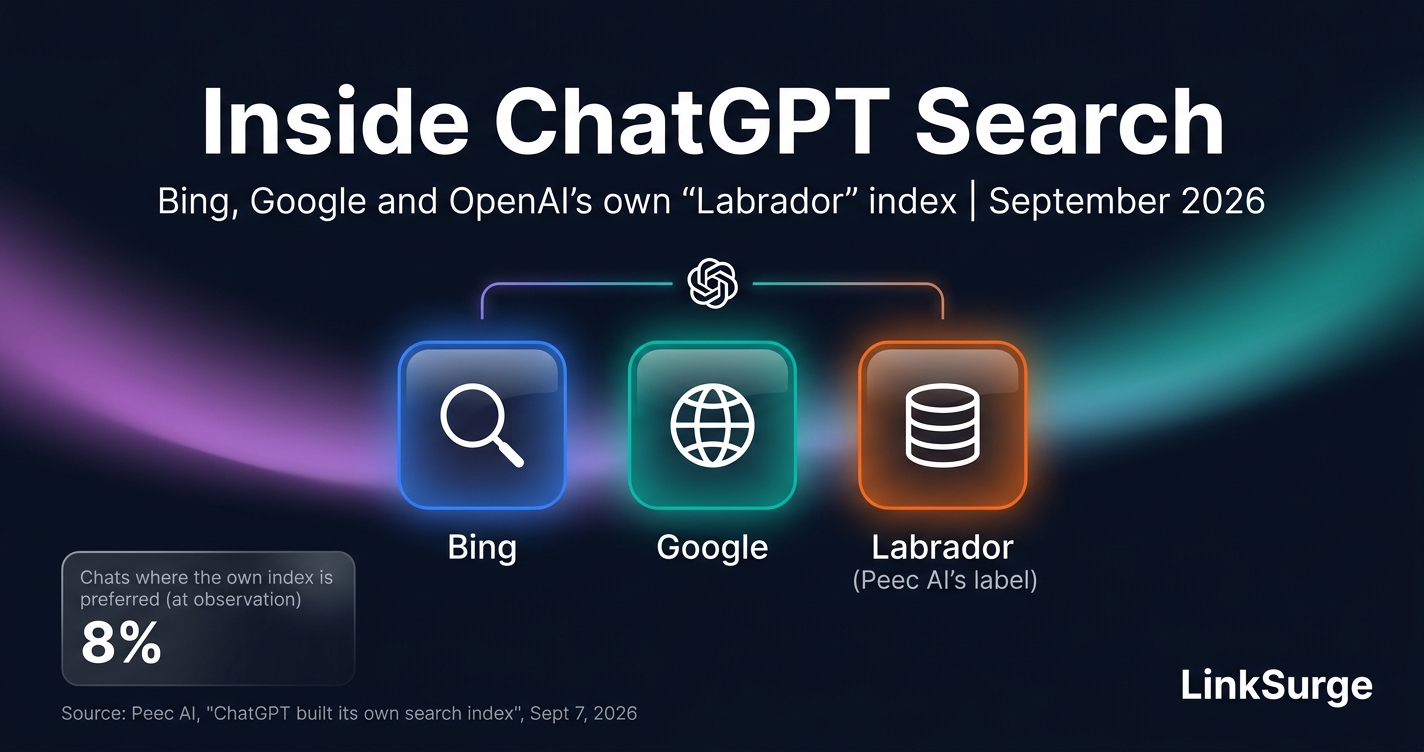
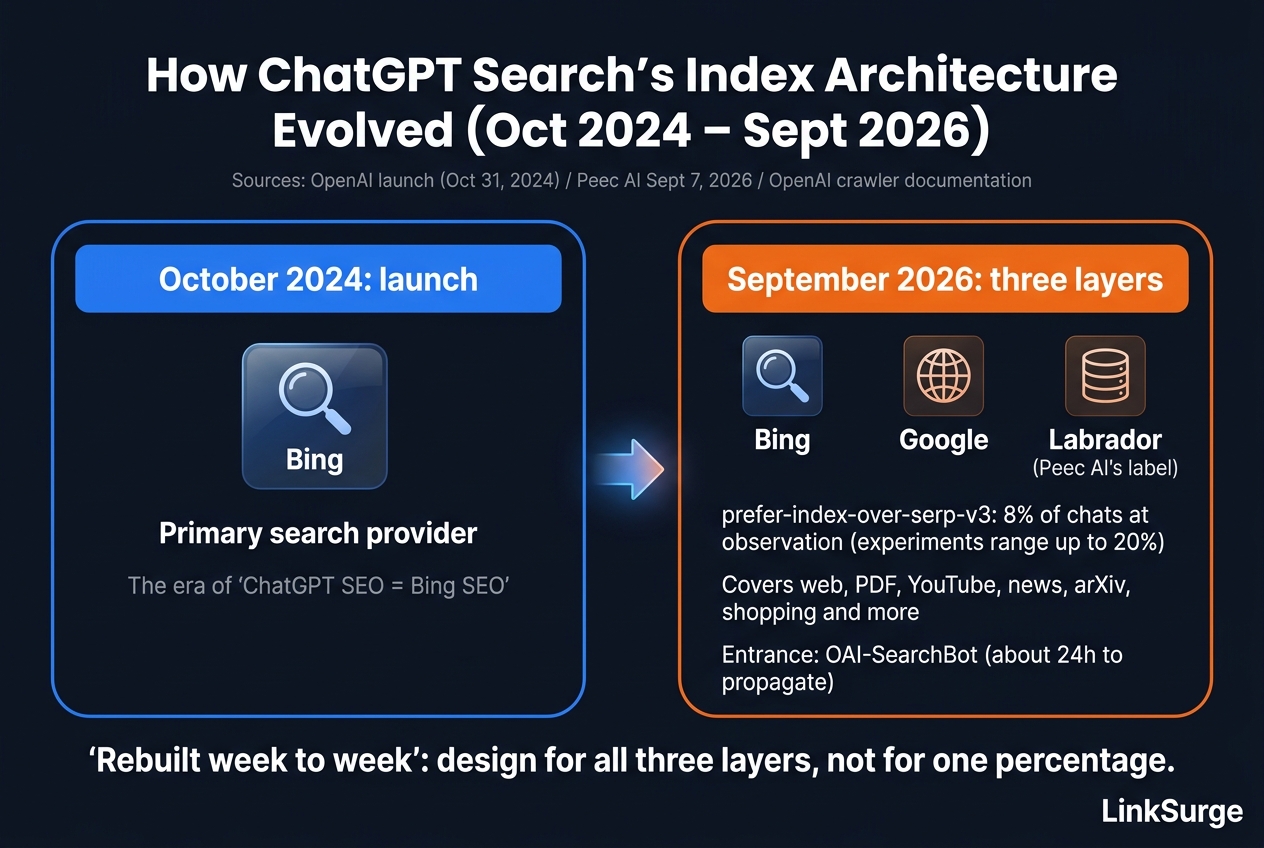
- The index has three layers — Bing was the primary backend at launch in October 2024. Peec AI's September 2026 analysis identifies an experiment preferring OpenAI's own index (which Peec AI calls "Labrador"; OpenAI hasn't confirmed the name) over external search results in 8 percent of chats at the time of observation, with such experiments reportedly ranging from single digits up to 20 percent. Google and Bing are still in use alongside it
- Processing runs in three stages: retrieve, decompose, select — The question is split into sub-queries (fan-out), candidate pages are pulled from the indexes, and after reading them the model cites a few. There is no rankings page. Selection happens at the heading-block level, not the page level
- Retrieved and cited are moving in opposite directions — After the mid-2026 model update, sources retrieved per response doubled from about 12 to about 24, while the number cited fell. More chances to be read, harder competition to be picked
- Four crawlers, and OAI-SearchBot is the one that matters for search — It's independent of GPTBot (training), ChatGPT-User (user-initiated fetches) and OAI-AdsBot (ads). You can opt out of training and stay in search
- Design for a system that is "still being rebuilt week to week" — That phrase is Peec AI's own caveat. Don't optimize for a specific experiment name or percentage. Be in all three layers and readable at every stage. That's the only stable strategy
Let's walk through each stage.
1. From 2024 to 2026: Bing-Centric to Three Layers
The launch architecture
OpenAI launched ChatGPT search on October 31, 2024. The search model pulled from multiple search providers and data partners, with Microsoft Bing widely reported as the center of that setup. The "ChatGPT SEO is Bing SEO" advice from that period comes from this architecture.
2026: the "Labrador" index
The picture changed with Peec AI's analysis published September 4, 2026. They collected server-sent event metadata from ChatGPT between May 21 and July 21, 2026, and combined it with OpenAI job postings, testimony from Google's antitrust trial, crawl experiments on their own sites, and Search Console traffic analysis. Their findings:
| Item | Detail |
|---|---|
| Internal index name | Labrador (Peec AI's label for a family of vertical indexes; not a name OpenAI has confirmed) |
| Components | General web, PDF, YouTube, news (within 1 day, within 7 days, older), arXiv, Wikipedia, local, finance, legal, medical, shopping, images |
| Key experiments | prefer-index-over-serp-v3 (applied to 8 percent of chats at the time of observation, mid-August 2026; Peec AI says such experiments range from single digits up to 20 percent), shopping-index-q2qb, shopping-hqi-v2 and others |
| Relationship to external search | "Google and Microsoft still matter." Migration to the own index is gradual |
| Author's caveat | "This system is still being rebuilt week to week." Mostly verifiable evidence, partly inference |
Here's what's interesting about the experiment name itself. prefer-index-over-serp-v3 states its intent, prefer the internal index over external search results, and it's already on its third version. The cluster of shopping experiments also lines up with what practitioners had suspected for a while: ChatGPT treats product search as a priority.
What this means for your site
Which layer serves a given query depends on the question type and experiment assignment, neither of which you control. So the only robust position is to satisfy all three at once: indexed in Bing, indexed in Google, and crawlable by OAI-SearchBot so you're in the internal index.
References: ChatGPT built its own search index - Peec AI ChatGPT search officially launches - Search Engine Land
2. Stage One: The Crawlers Read
Of the three layers, the one you directly influence is the entrance to OpenAI's own index: the crawlers. OpenAI's documentation defines four.
| Bot | Role | Your decision |
|---|---|---|
| OAI-SearchBot | Crawls to surface your site in ChatGPT search results | Allow it if you want to appear in search |
| GPTBot | May use content to train foundation models | Disallow if you want to opt out of training. Doesn't affect search |
| ChatGPT-User | Fetches pages when a user asks ChatGPT or a custom GPT | User-initiated, so robots.txt may not apply |
| OAI-AdsBot | Verifies ad landing pages for safety and relevance | Only relevant if you advertise |
OpenAI says robots.txt updates take about 24 hours to take effect and publishes each bot's IP ranges as JSON, so you can verify a real OAI-SearchBot in your logs by IP rather than trusting the user-agent string.
Beginners can start with Where Does ChatGPT Get Its Information?, which explains training data versus live web search.
The JavaScript rendering trap
This is the problem I see most often in audits. OpenAI's documentation describes what each crawler does, how robots.txt applies and which IP ranges it uses, but it doesn't specify whether the crawlers execute JavaScript. That leaves content that only appears after client-side rendering at risk of not being read at fetch time. The safe configuration is server-side rendering or pre-rendering so the content is in the initial HTML. Write tables and numbers as text rather than images.
The full foundation checklist is in section 2 of How to Get Cited by ChatGPT: The Complete Guide.
References: Overview of OpenAI Crawlers - OpenAI
3. Stage Two: The Question Is Decomposed (Query Fan-Out)
ChatGPT doesn't search your question as written. It splits it into sub-queries, searches each, and merges the results. This stage changed dramatically in summer 2026.
Lily Ray's August 17, 2026 observations compare before and after the model update.
| Metric | Before | After |
|---|---|---|
| Share of prompts handled with a single query | 94% | 43.5% |
| Fan-outs per prompt | 2.17 | 7.61 |
| Sources retrieved | ~12 | ~24 |
Share using the site: operator | 0.3% | ~23% |
MJ Cachón's study the same month (189 brand prompts, 723 runs via OpenAI's API) found an average of 2.6 sub-queries per run, rising to 10.3 distinct sub-queries when the same prompt was run four times. 93.4% of sub-queries contained the brand name and 30.2% used site:. Of those, 16.6% targeted the brand's own domain, 7.9% group domains, 5.6% third parties, and just 0.1% competitors.
The reading: for brand prompts, site: searches targeting the brand's own domain now make up 16.6% of all sub-queries (the other 69.8% are open searches). Your official site's structure and content feed the answer more directly than before.
Fan-out details, including how to retrieve the now-hidden sub-queries through the API, are in What Happened to ChatGPT's Query Fan-Out. For Google's version, see What Is Query Fan-Out?.
References: What We Can Learn from Evolving ChatGPT Fan-Out Queries - Lily Ray A study of query fan-out in ChatGPT using brand searches - MJ Cachón
LinkSurge
linksurge.jp
SEO・AIO・GEO統合分析プラットフォーム。AI Overviews分析、SEO順位計測、GEO引用最適化など、生成AI時代のブランド露出を最大化するための分析ツールを提供しています。
4. Stage Three: Read Everything, Cite a Few
From the dozens of pages retrieved, ChatGPT reads the content and picks a handful to cite. Two observations matter here.
Retrieved and cited diverge
Lily Ray points out that while sources retrieved doubled, sources cited moved in the opposite direction. More chances to be read, tougher competition to be picked. "ChatGPT is reading us" does not mean "ChatGPT is citing us." Measure the two separately.
Selection happens at the block level
In our analysis of 277 real Google AI Overviews citations, 69.3% came from heading blocks other than the lead paragraph. That study measured Google AI Overviews, not ChatGPT Search. Whether a self-contained answer under each heading wins at ChatGPT's selection stage too is, for now, our working hypothesis rather than a measured result. See Where Does AI Search Actually Quote From?.
Sources rotate within days
Selection outcomes aren't stable. In August 2026, Promptwatch data reported by Search Engine Land showed Reddit's share of ChatGPT Search citations falling 86.4% in four days (cause unconfirmed). Ahrefs' Japan data shows ChatGPT's top cited domains reshuffling substantially between the April and June editions. That volatility is consistent with Peec AI's observation that index layers and experiment assignments change weekly. The August shift is covered in ChatGPT's Citation Sources Moved 86% in Four Days.
References: Reddit's ChatGPT Search citations fell 86% in four days - Search Engine Land Top Japanese domains cited by AI, June 2026 (Japanese) - Ahrefs
5. How to Build for a Moving Target
Now that we've covered the stages, here's how to act on them.
Don't
- Optimize for a specific experiment name or percentage such as "8 percent at the time of observation." It will likely be different next week
- Assume "Bing is enough" or "Google is enough." You don't control which layer serves a query
- Count being retrieved (read) as a result. Measure citations and mentions separately
Do
- Be in all three layers — Check indexation in Bing Webmaster Tools and Search Console, and allow OAI-SearchBot in robots.txt
- Stay readable at every stage — Server-side rendering, numbers and tables as text, self-contained answers under headings
- Make the official site survive a search by name — With
site:sub-queries above 20 percent, product, pricing, comparison and FAQ pages need to be findable heading by heading within your domain - Log mention rate and cited domains weekly — Volatility is the baseline, so this is a standing measurement, not a one-off check. LinkSurge's GEO monitoring records mentions and cited URLs across five platforms including ChatGPT Search and compares you against competitors
Frequently Asked Questions
Does ChatGPT just use Bing's search results?
Bing was the primary backend at launch in October 2024. Peec AI's September 2026 analysis identifies an experiment preferring OpenAI's own index (which Peec AI calls "Labrador"; OpenAI hasn't confirmed the name) over external search results in 8 percent of chats at the time of observation, while Google and Bing remain in use. The accurate description today is a three-layer system.
What is "Labrador"?
The label Peec AI uses, in its September 2026 analysis, for a family of OpenAI's own search indexes. It is not a name OpenAI has confirmed. It reportedly covers general web, PDFs, YouTube, news, arXiv, Wikipedia, local, finance, legal, medical, shopping and images. OpenAI hasn't announced the name officially; Peec AI identified it from SSE metadata and job postings.
What's the difference between OAI-SearchBot and GPTBot?
OAI-SearchBot crawls to surface your site in ChatGPT search results; disallow it and you won't appear in search answers. GPTBot may use content to train foundation models; disallowing it doesn't affect search visibility. You can opt out of training while staying in search. robots.txt changes take about 24 hours to propagate.
Will a JavaScript-rendered site get cited by ChatGPT?
If the content only exists after client-side rendering, the crawler's fetched HTML lacks it and the page is unlikely to become a citation candidate. Server-side rendering or pre-rendering puts the content in the initial HTML. Tables and numbers in images aren't read either, so write them as text.
How often does ChatGPT search change?
Peec AI describes the system as "still being rebuilt week to week," and the summer 2026 model update raised fan-outs per prompt from 2.17 to 7.61 in a short span. Cited sources rotate within days. Rather than matching a specific spec, the stable design is to be present in all three layers and readable at every stage.
Conclusion: Don't Match the Spec, Stay Readable Under Any Spec
ChatGPT search retrieves from three layers (Bing, Google and the "Labrador" index), decomposes questions into 7+ sub-queries on average, reads the results and cites a few. And it's being rebuilt week to week.
That's why the durable strategy isn't tuning for a particular experiment. It's being indexed in all three layers, keeping content crawlable in the initial HTML, making answers self-contained at the heading level, and making the official site hold up when searched by name. Then log mention rate and cited domains weekly and adjust with volatility as the baseline.
LinkSurge's AI Ready audit checks robots.txt, heading hierarchy, structured data and llms.txt item by item. For scheduled tracking of mentions and cited sources in ChatGPT Search, use GEO monitoring.