What Happened to ChatGPT's Query Fan-Out: From 2.17 to 7.61 Sub-Queries per Prompt, and Then Hidden
目次
Key Takeaways: Fan-Out Didn't Disappear. It Tripled and Went Invisible
Until spring 2026, I could open Chrome DevTools, watch ChatGPT's internal search queries scroll by, and tell a client exactly which sub-query had picked up their page. By summer, that was gone. At the same time, fan-out itself more than tripled. Here's what the data shows.
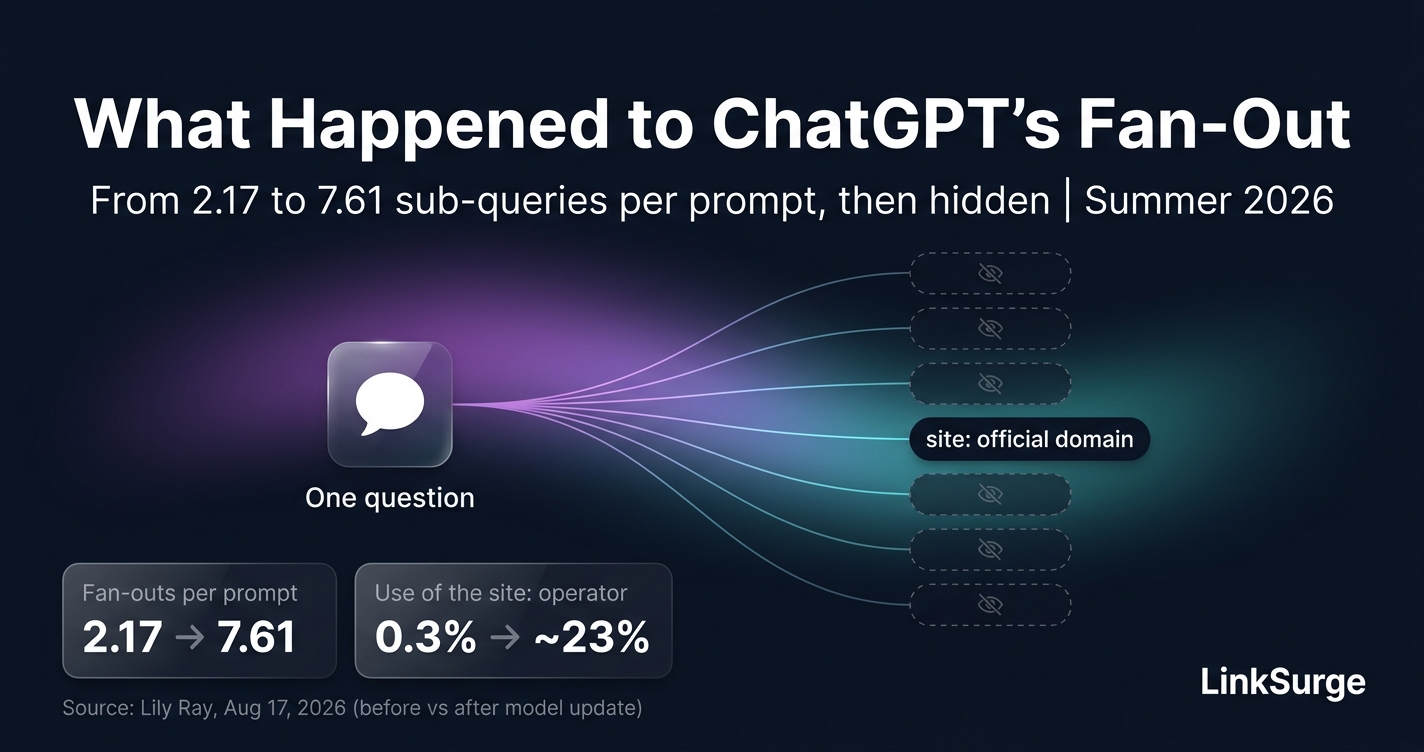
- Fan-outs more than tripled — Lily Ray's August 2026 observations put fan-outs per prompt at 7.61, up from 2.17, with the share of prompts handled by a single query falling from 94% to 43.5%. MJ Cachón's brand-prompt study measured 2.6 sub-queries per run and 10.3 distinct sub-queries when the same prompt was run four times
- Sub-queries disappeared from the conversation interface — In mid-2026, when GPT-5.3 became the default, the
search_model_queriesfield disappeared from the conversation response, and it wasn't observed in GPT-5.4 either. Little Green Agency's later update reports it reappearing in GPT-5.6, so visibility varies by model version - The API still returns them — With the web search tool enabled in OpenAI's Responses API, the
action.queriesarray contains the sub-queries. That's the route for studying how your category's questions get decomposed - Sub-queries have clear habits — In brand prompts, 93.4% contain the brand name, 30.2% use the
site:operator (55.1% of those targeting the brand's own domain), 23.8% carry exact-match quotes, 19.6% carry a year. For international brands, 27.3% mix in English vocabulary - Optimize for what you can't see by covering patterns and measuring outcomes — Stop chasing individual sub-queries. Build a heading block for each decomposition pattern (related topics, implicit questions, comparisons, recency, rephrasings) and log mention rate and cited domains weekly
Let's go through the timeline, the API method and the tactics.
1. What Fan-Out Is and How ChatGPT Does It
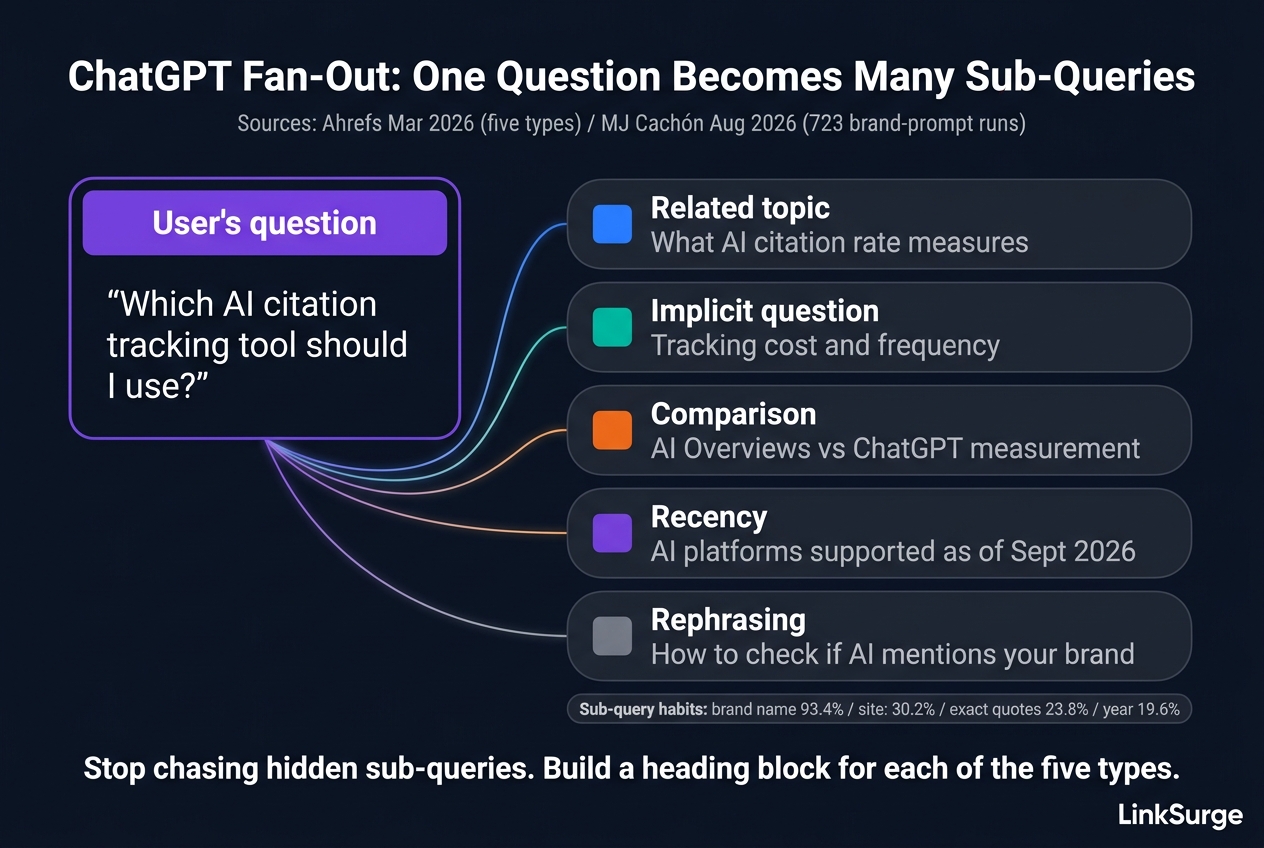
Query fan-out is the mechanism where an AI splits a single question into several sub-queries, searches them in parallel, and merges the results. Google AI Mode made the term famous. ChatGPT search works the same way.
Ahrefs' March 2026 breakdown identifies five fan-out types.
| Type | What it does | Example |
|---|---|---|
| Related topics | Adds context from adjacent subjects | "meal prep containers" → "easy meal prep recipes" |
| Implicit questions | Anticipates concerns the user didn't voice | "solar panels" → "installation cost," "install time" |
| Comparisons | Side-by-side evaluation | "Asana vs Monday" |
| Recency | Time-sensitive searches | "best phones 2026" |
| Rephrasings | Same intent, different wording | "reduce bounce rate" → "keep visitors on site" |
The same analysis notes that more than 95% of fan-out queries never get searched again, so volume-based keyword optimization doesn't map onto them. For the Google side of the story, see What Is Query Fan-Out?.
The ChatGPT-specific part starts here.
References: What is Query Fan-Out? Understanding the Hidden Queries Driving AI Search - Ahrefs
2. What Changed in Summer 2026
Fan-outs more than tripled
Lily Ray's August 17, 2026 post compares behavior before and after a model update.
| Metric | Before | After |
|---|---|---|
| Share of prompts handled with a single query | 94% | 43.5% |
| Fan-outs per prompt | 2.17 | 7.61 |
| Sources retrieved | ~12 | ~24 |
Share using the site: operator | 0.3% | ~23% |
Honestly, the fairest description is that ChatGPT moved closer to Google AI Mode. Ahrefs measured AI Mode at 5 to 11 sub-queries for 59% of prompts and 12 to 19 for 24%. ChatGPT's 7.61 average now sits inside that range.
And they went invisible
According to Little Green Agency's July 2, 2026 article, you could previously filter Chrome DevTools' network tab by conversation ID and read the sub-queries from the search_model_queries field in the raw JSON. According to that article, the field left the conversation interface they tested when GPT-5.3 became the default model, and it wasn't observed in GPT-5.4 either. The article's later update reports it reappearing in GPT-5.6, so visibility depends on the model version.
So fan-out grew while, depending on the model version, becoming harder to observe reliably. For SEOs, that means you know what's happening in general but can't directly see which sub-query picked up your page.
References: What We Can Learn from Evolving ChatGPT Fan-Out Queries - Lily Ray ChatGPT Has Hidden Its Fan-Out Queries. Here's How to Get Them Back with n8n - Little Green Agency
3. What Sub-Queries Look Like: Measured on Brand Prompts
Hidden or not, API-based research has mapped the habits. MJ Cachón's study, published August 25, 2026, ran 189 brand prompts across three projects (healthcare, sports retail, hotels) 723 times through OpenAI's API on GPT-5.5.
| Metric | Value |
|---|---|
| Sub-queries per run (average / max) | 2.6 / 13 |
| Distinct sub-queries when the same prompt is run 4 times (average) | 10.3 |
| Sub-queries containing the brand name | 93.4% |
Using the site: operator | 30.2% |
| Of which: own domain / group / third party / competitor | 16.6% / 7.9% / 5.6% / 0.1% |
| Containing exact-match quotes | 23.8% |
| Containing a year | 19.6% |
| Containing English vocabulary (all / international brands) | 8.9% / 27.3% |
| Runs completing in 2 searches or fewer | 63.9% |
Three things stood out to me. First, 69.8% of sub-queries are open searches, but of the 30.2% using site:, 55.1% target the brand's own domain and almost none target a competitor's. For brand prompts, 16.6% of all sub-queries search the official site by name. Second, exact-match quotes and years appear in roughly a fifth of sub-queries, so spelling out proper nouns and years in headings and body text gives them a landing spot. Third, more than a quarter of sub-queries for international brands contain English. That lines up with Ahrefs' Japan data, where English Wikipedia outranks Japanese Wikipedia among ChatGPT's cited domains, and it means a site that exists only in one local language is invisible to English sub-queries.
References: A study of query fan-out in ChatGPT using brand searches - MJ Cachón Top Japanese domains cited by AI, June 2026 (Japanese) - Ahrefs
LinkSurge
linksurge.jp
SEO・AIO・GEO統合分析プラットフォーム。AI Overviews分析、SEO順位計測、GEO引用最適化など、生成AI時代のブランド露出を最大化するための分析ツールを提供しています。
4. Retrieving Hidden Sub-Queries Through the API
They're gone from the browser, but OpenAI's Responses API includes them when the web search tool is enabled. For studying how your category's representative questions get decomposed, this is enough.
Steps
- Get an OpenAI API key and send a Responses API request with the web search tool enabled
- In the response output, find the item representing the web search call
- Its
action.queriesarray holds the sub-queries that actually ran - Run the same prompt several times and take the distribution. One run is skewed
Little Green Agency published an n8n workflow that automates this with an HTTP request node. By hand, running 10 to 20 representative prompts five times each and sorting the sub-queries into the five types gives you the list of landing spots your content needs.
Caveats
- The API model and the ChatGPT web app don't decompose identically. Use this to understand tendencies, not to match exact queries
- Sub-queries change run to run. Deciding to "optimize for this sub-query" from a single run will miss
- Retrieved isn't cited. Being picked up by a sub-query doesn't guarantee a citation in the answer
5. Optimizing When You Can't See the Sub-Queries
With the sub-queries hidden, the axis shifts from "chase the sub-queries" to "cover the decomposition patterns" and "measure outcomes on a schedule."
Cover the patterns
For each topic, build a heading block for each of the five types. If the topic is "AI citation tracking tools," the landing spots look like this.
- Related topic: "What AI citation rate actually measures"
- Implicit question: "How much tracking costs and how often to run it"
- Comparison: "How measurement differs between Google AI Overviews and ChatGPT"
- Recency: "AI platforms supported as of September 2026"
- Rephrasing: "How to check whether AI mentions your brand"
Under each heading, put a self-contained 40 to 60 word answer. In our analysis of 277 real Google AI Overviews citations, 69.3% came from heading blocks other than the lead paragraph. That study measured Google AI Overviews rather than ChatGPT, so applying it to ChatGPT is a working hypothesis we're designing around. Details in Where Does AI Search Actually Quote From?.
Make the official site survive a search by name
With more than half of site: sub-queries targeting the brand's own domain, product, pricing, comparison and FAQ content needs to be findable heading by heading within your site. Lily Ray recommends optimizing the official domain, stating "official" in meta descriptions, and monitoring site: queries in Search Console.
Consider English landing pages
International brands see English in 27.3% of sub-queries, and English Wikipedia ranks among ChatGPT's top cited domains even for Japanese queries. Whether or not you operate internationally, English summaries of your key pages create a path in from English sub-queries.
Log mention rate and cited domains weekly
The sub-queries are hidden. The outcomes aren't. For 20 to 30 questions in your category, log weekly how often ChatGPT mentions or cites you and which domains it cites. Answers vary between runs, so log multiple runs. LinkSurge's GEO monitoring registers watch queries across ChatGPT Search, Gemini, Google AI Overviews, Claude and Perplexity and records mention presence, position, cited URLs and competitor comparison. We use the same setup to measure this series.
For the full strategy, see How to Get Cited by ChatGPT: The Complete Guide. For the architecture, see Inside ChatGPT Search.
Frequently Asked Questions
What is ChatGPT's query fan-out?
The mechanism where ChatGPT splits one user question into several internal search queries (sub-queries), searches each, and synthesizes the results. In Lily Ray's August 2026 observations, ChatGPT generated an average of 7.61 sub-queries per prompt, and only 43.5% of prompts were handled with a single query.
Why can't I see ChatGPT's sub-queries anymore?
In mid-2026, when GPT-5.3 became the default model, the search_model_queries field disappeared from the response JSON in the conversation interface Little Green Agency tested, and it wasn't observed in GPT-5.4 either. Previously you could read it in Chrome DevTools' network tab. Their later update reports it reappearing in GPT-5.6, so visibility varies by model. OpenAI hasn't stated a reason.
Is there still a way to see ChatGPT's sub-queries?
Yes. With the web search tool enabled in OpenAI's Responses API, the response's action.queries array contains the sub-queries that ran. Run the same prompt several times to get a distribution. Note that the API model and the ChatGPT web app don't decompose questions identically, so use it to understand tendencies.
What do ChatGPT's sub-queries look like?
In MJ Cachón's August 2026 study (189 brand prompts, 723 runs), ChatGPT generated 2.6 sub-queries per run on average and 10.3 distinct sub-queries across four runs of the same prompt. 93.4% of sub-queries contained the brand name, 30.2% used the site: operator, 23.8% contained exact-match quotes and 19.6% contained a year. site: targeted mainly the brand's own domain and almost never competitors. For international brands, 27.3% contained English vocabulary.
How do I optimize if I can't see the sub-queries?
Build a heading block for each of the five decomposition patterns (related topics, implicit questions, comparisons, recency, rephrasings) with a self-contained answer under each. Make product, pricing, comparison and FAQ content findable heading by heading on your official site, and spell out proper nouns and years. Then log ChatGPT mention rate and cited domains weekly and adjust with volatility as the baseline.
Conclusion: Stop Chasing and Start Covering
ChatGPT's fan-out grew from 2.17 to 7.61 sub-queries per prompt in summer 2026 and, for the GPT-5.3 to 5.4 period, disappeared from the conversation interface at the same time. The sub-queries have recognizable habits, brand names, site:, exact quotes, years and English, and the API still reveals the tendencies.
Instead of chasing what you can't see, lay out heading-level landing spots for the five decomposition patterns, make the official site hold up under a search by name, and record outcomes weekly. Build it that way and the next change to fan-out behavior won't move your strategy.
LinkSurge's GEO monitoring records mentions and cited sources across five platforms including ChatGPT Search on a schedule. Use the AI Ready audit to check the heading structure that serves as your landing spots.