Does FAQ Schema Really Get You Cited 3.2x More? We Removed the Number From Our Own Product
目次
Key Takeaways: Four GEO Claims We Put to the Test
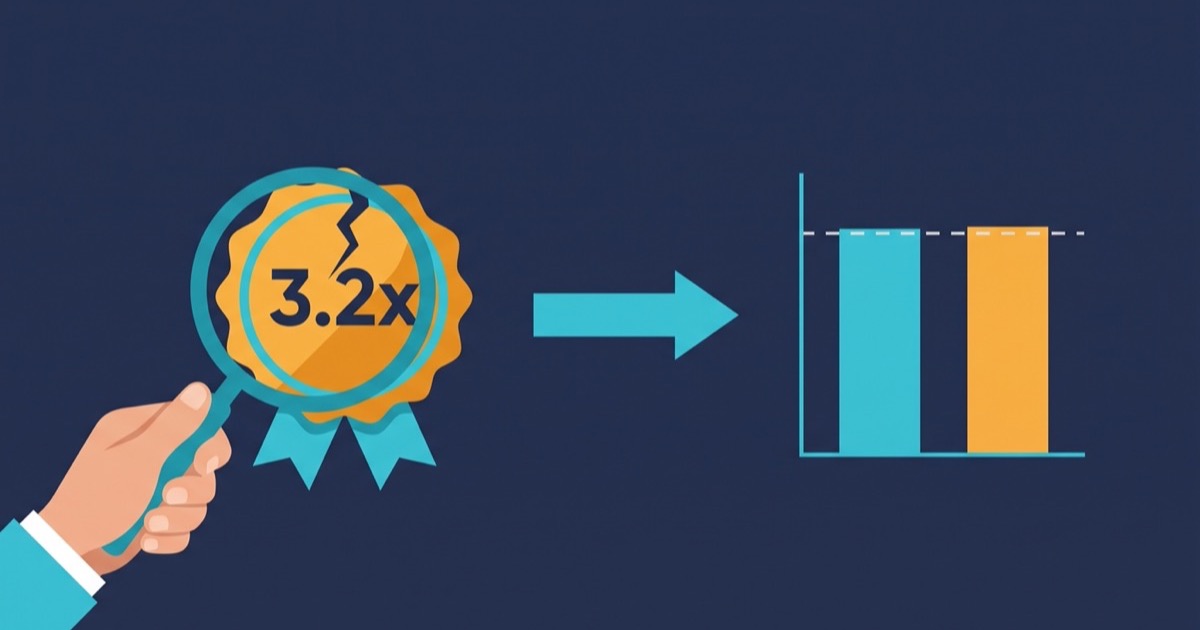
"Add FAQ schema and your AI citation rate goes up 3.2x." You've seen this number. We had it baked into our own scoring criteria — displayed to users, in production. Then we traced where it came from, and the foundation turned out to be far weaker than we assumed.
- Google says structured data isn't required — Their AI optimization guide states that structured data isn't required for generative AI search and there's no special schema.org markup you need to add. Note that this is about eligibility requirements, not a claim that Google ignores schema internally
- The 3.2x figure is correlation, not causation — In a controlled experiment (1,885 pages with schema added, ~4,000 matched controls), adding schema to already well-cited pages produced no increase in citations
- Allowing Google-Extended does nothing for AI Overviews — Google explicitly states it doesn't impact inclusion in Search and isn't a ranking signal. We had this wrong ourselves
- There's no ideal page length — Google's exact words. Thresholds like "at least 500 words" have no basis in their guidance
Here's what we checked, and how we fixed our own product.
1. It Started With an Expired Review Date
Our AI citation analysis tool carries a "criteria version." The idea is simple: every quarter, we review industry developments and update the scoring rules.
We'd blown past the review date by three months.
That's the part that matters. During those three months, Google published its AI optimization guide. Which means we kept serving diagnostics based on outdated criteria after the official position was public.
Honestly, this was a process failure. The review date lived as a constant in our codebase — nobody sees a constant. Writing down a deadline and having a mechanism that enforces it are two completely different things.
What Had Drifted
We audited what our product actually displayed. Three statements contradicted Google's published position:
- "Pages with FAQPage schema see roughly 3.2x higher AI citation rates, according to research"
- "Sufficient content length (500+ characters recommended)"
- "Presence of statistics and data points (30-40% citation lift)"
All three were visible to users.
2. What Google Actually Says
We went to the primary source first. No secondary coverage, no summaries — the actual document. I'll explain why that mattered shortly.
Google's AI optimization guide is unambiguous on four points:
| Topic | What Google says |
|---|---|
| Structured data | Not required for generative AI search. No special schema.org markup to add |
| Chunking | No requirement to break content into small pieces |
| llms.txt | Google Search doesn't use it |
| Page length | "There's no ideal page length" |
That last one is a direct quote. Given that sentence exists, telling people "aim for at least N words" as a Google-facing recommendation is simply wrong.
"Not required" ≠ "not used" — and it doesn't mean "pointless"
Two caveats matter here.
First, "not required" is not the same as "not used." Google says there are no additional requirements to appear in AI search. It does not say schema goes unread internally. A secondhand account reports a Google structured data engineer saying at Search Central Live that schema is served to models as context during query fan-out — that is an attendee write-up rather than Google primary documentation, so we do not treat it as settled. Either way, "Google said we can drop it" does not follow from what the official documentation actually says.
Second, these four points describe Google's axis, not AI search as a whole — and other platforms treat schema differently. Fabrice Canel, Principal Product Manager at Microsoft Bing, stated at SMX Munich that schema markup helps Microsoft's LLMs understand your content (reported by Search Engine Land, where Canel is said to have confirmed it in a LinkedIn comment). And in a published test across seven platforms Gemini successfully retrieved schema directly.
ChatGPT and Perplexity split pages into heading blocks and score them independently. Different mechanics, different prescriptions. We've since restructured our product to keep these two axes separate rather than blending them into one score. For the broader picture, see our complete GEO guide.
3. Tracing the 3.2x Figure
Our criteria file said this:
Pages with FAQPage schema see roughly 3.2x higher AI citation rates, according to research
Another internal document went further, describing "the 3.2x figure from our own testing" as an asset. If we'd measured it ourselves, that would genuinely be an asset.
We hadn't. No first-party measurement existed.
Where It Actually Came From
The number appeared in a literature review we compiled in February 2025. Check that document's reference list, and you find third-party SEO blog posts. So the chain went:
Third-party blog post
  → Our literature review (Feb 2025)
    → Our scoring criteria file
      → "According to research..." shown to users
Somewhere along that chain, the phrase "our own testing" crept in, and internally people treated it as first-party data. A game of telephone.
Separating Correlation From Causation
We also examined the number itself. The 3.2x figure circulates across several third-party write-ups; the one our literature review actually cited was Frase's article. All of them observe correlation: pages that have FAQ schema got cited more often than pages that don't.
Then there's a controlled experiment that added schema and measured before-and-after — Ahrefs published theirs in May 2026.
| Item | Detail |
|---|---|
| Method | Difference-in-differences |
| Treatment | 1,885 pages that added JSON-LD |
| Control | ~4,000 matched pages |
| Period | August 2025 – March 2026 |
| Result | AI Mode +2.4% / ChatGPT +2.2% / AI Overviews −4.6% |
The AI Mode and ChatGPT movements were indistinguishable from noise. The −4.6% on AI Overviews was statistically significant, but small in absolute terms and plausibly attributable to factors other than schema. It is not evidence that schema hurts you.
One condition matters enormously here. Every page in that dataset was already receiving 100+ AI Overviews citations before schema was added. So what the study establishes is narrow: adding schema to pages that are already well cited didn't increase citations. Whether it helps a brand-new, undiscovered page is untested.
Even so, it's far too weak a foundation for "add FAQ schema and citations go up." The 3.2x lift reported from correlational data did not reproduce.
So what is doing the work? Pages carrying FAQPage markup tend to have well-organized Q&A content already — but that's a plausible confounder, not a demonstrated cause. Having spent this article separating correlation from causation, I'm not going to assert the reverse causal claim either.
That distinction has real consequences. Lead with correlation, and your reader spends a sprint on JSON-LD implementation instead of fixing the substance of their pages.
4. We Confused Google-Extended With Googlebot
The review also caught an error in our own writing. Worse, it sat in exactly the place where we claimed to be separating Google's axis from the LLM axis.
Before the fix, our crawler section read:
AI crawlers are allowed (GPTBot, ClaudeBot, Google-Extended, etc.) — all training crawlers, none of which affect search citations
Looks reasonable. But Google's crawler documentation states:
Google-Extended does not impact a site's inclusion in Google Search nor is it used as a ranking signal in Google Search
Google-Extended is a token for Gemini Apps and the Vertex AI API — it doesn't even have its own user agent string. AI Overviews and AI Mode draw on the regular Google Search index, so the crawler that matters there is Googlebot.
Why This Mattered
Left alone, that confusion produces a recommendation to "allow Google-Extended so AI search can cite you" — advice that has nothing to do with search citations.
The correct breakdown:
| Goal | Crawler to check |
|---|---|
| Get cited in Google (AI Overviews / AI Mode) | Googlebot. Block it and Google can't read your content — a URL may still be indexed, but not on its merits |
| Get cited in ChatGPT search | OAI-SearchBot. OpenAI states that sites opted out of it "will not be shown in ChatGPT search answers" |
| Get cited in Perplexity / Claude | PerplexityBot / Claude-SearchBot (ClaudeBot is a training crawler) |
| (Separate) Allow model training | GPTBot. Not the same thing as ChatGPT search citations |
| (Separate) Allow Gemini grounding | Google-Extended. Unrelated to Google Search citations |
Whether to allow Google-Extended is a separate decision about letting your content feed Gemini's training and grounding. Search traffic shouldn't factor into it.
5. Is llms.txt Useless, Then?
The same separation applies to llms.txt. Our product said:
Sites without LLMs.txt, with poor structure, or thin metadata get ignored by AI — and lose customers to competitors
Overstated. Google explicitly doesn't consume llms.txt, and we've seen no measurement showing a citation lift.
That doesn't make it pointless, though. Anthropic, Perplexity, and Mistral all publish llms.txt for their own documentation, and IDE-based AI agents genuinely fetch it.
The use case is just different.
- Goal: more citations in search → no confirmed effect
- Goal: let AI agents read your documentation → actively used
We rewrote our copy to separate the two. For LLMO fundamentals, see our beginner's guide to LLMO.
The September 2026 expert survey points the same way: structured data scored +0.80 and llms.txt +0.05 for Google AI visibility, far below the leading factors (+1.65 to +2.20). See "Google AI Ranking Factors: What 130+ Experts Scored Highest".
6. How We Fixed the Product
Based on all of the above, we updated LinkSurge's AI citation analysis and shipped to production on August 15, 2026.
What We Deleted
| Removed | Reason |
|---|---|
| "FAQPage schema → 3.2x citation rate" | Correlation, not causation. Controlled experiment showed no distinguishable effect |
| "500+ characters recommended" / "2,000+ characters recommended" | Google states there's no ideal page length |
| "Statistics and data → 30-40% citation lift" | Couldn't identify a source |
We Swapped the Primary Signal
The biggest change: AI discoverability now centers on crawler access, not structured data.
The logic is simple. If you're blocking the crawler, the engine never reads what you wrote, so rewriting it changes nothing on that engine. Crawling, indexing, appearing in results, and being cited are four separate things — blocking the crawler breaks the first one, and everything downstream inherits the problem. It's a precondition, not an optimization. Our old scoring table gave "no structured data" a 0-49 score — which, for Google, actively misleads people.
We Built the Deadline Into the Product
The root cause was that nobody notices an expired date sitting in a source file. So now, when the review date passes, a warning appears in our admin dashboard.
Unglamorous, but this is the part that actually prevents a repeat.
7. What to Do With This
Turning all of that into practice.
You Don't Need to Rip Out Structured Data
To be clear, this isn't an argument for removing schema. Rich result eligibility, knowledge panel entity data — those traditional SEO use cases still hold.
What changes is the justification. Not "we're adding it so AI will cite us," but "we're adding BreadcrumbList because we want breadcrumbs in the SERP." If you can't name the concrete outcome, that effort belongs in your content instead.
Priority Order
- Verify crawler access —
Googlebotfor Google,OAI-SearchBotfor ChatGPT search,PerplexityBotfor Perplexity. Note these are distinct from the training-orientedGPTBotandGoogle-Extended. This is a necessary condition for your content to be read, not a guarantee of citation. Fail it and later improvements never reach the engine - Make questions and answers line up — not FAQPage markup, but Q&A content that's genuinely organized
- Check whether each heading block stands alone — ChatGPT and Perplexity extract at block level
- Add structured data with a purpose — implement it when you want a specific SERP behavior
Build the Habit of Interrogating Numbers
What struck me most: the more plausible a number sounds, the less it gets checked. "3.2x" is specific, appears sourced, and is easy to quote. That's exactly why it sailed through our review.
When you see a figure, check three things:
- Is it first-party? Who measured what, and when? Or is it a blog quoting a blog?
- Correlation or causation? "Pages with X scored higher" versus "adding X raised the score"
- Is there a control group? Were the compared populations actually matched?
AI search moves fast, and secondary sources get treated as primary. At LinkSurge, we've switched to reading the official documentation directly.
Frequently Asked Questions
Should I stop adding FAQ schema?
If your goal is AI citations, there's no confirmed benefit. Google states structured data isn't required for generative AI search — a statement about eligibility requirements, not a claim that Google ignores schema internally — and a controlled experiment adding schema to already well-cited pages found no increase in citations. Structured data in general remains useful for traditional SEO purposes like rich results. Note that Google discontinued HowTo rich results in 2023 and FAQPage rich results in May 2026. Types that still produce rich results include Article and BreadcrumbList (Product applies to product pages, and Review requires genuine user reviews or ratings of an eligible item — it is not valid on a general article). Decide based on whether you can name a specific outcome.
Are the studies reporting 3.2x wrong?
It's less that the studies are wrong and more that they're being read wrong. They observe a correlation — pages with FAQ schema get cited more often — not causation. Pages carrying FAQPage markup tend to have well-organized Q&A content already, which is a plausible confounder — though that explanation hasn't been tested experimentally either.
Can I leave Google-Extended blocked?
As far as Google Search and AI Overviews are concerned, yes. Google explicitly states that Google-Extended doesn't impact inclusion in Search and isn't a ranking signal. Allowing it is a separate decision about whether your content can feed Gemini's training and grounding.
The same split applies at OpenAI: OAI-SearchBot is what governs ChatGPT search citations, while GPTBot is for model training. Decide each on its own merits.
How long should my articles be?
Google states there's no ideal page length, and offers no universal target. Judge by whether the page covers what the topic requires. A short page that answers completely is fine; padding a page out doesn't make it more useful, and length alone won't earn a citation.
Should I set up llms.txt?
Depends on your goal. For search citations, no effect has been confirmed — Google says it doesn't use the file. For letting AI agents read your documentation, companies like Anthropic publish one and agents genuinely fetch it. Decide the use case first.
Conclusion: Build a Mechanism That Questions Your Own Criteria
The short version: unverified numbers made it into our scoring criteria, and users saw them in production.
Two things caused it. Secondary information turned into "our own testing" as it moved through the company. And a review deadline sat in a source file where nobody would ever look.
The first is solved by reading primary sources. The second we solved with an overdue warning in the admin dashboard. Neither is exciting, but in a field that moves as fast as GEO, that kind of discipline is what separates useful tooling from confident-sounding noise.
AI search optimization has no settled playbook yet. That's exactly why your decisions should rest on official documentation and data you can observe yourself — not on a number somebody quoted. Our own analysis of real citation data is in Where Does AI Search Actually Quote From?.
LinkSurge's AI Overview analysis shows which keywords your pages are being cited for in AI search. Start with what's actually happening, not what you assume is happening.