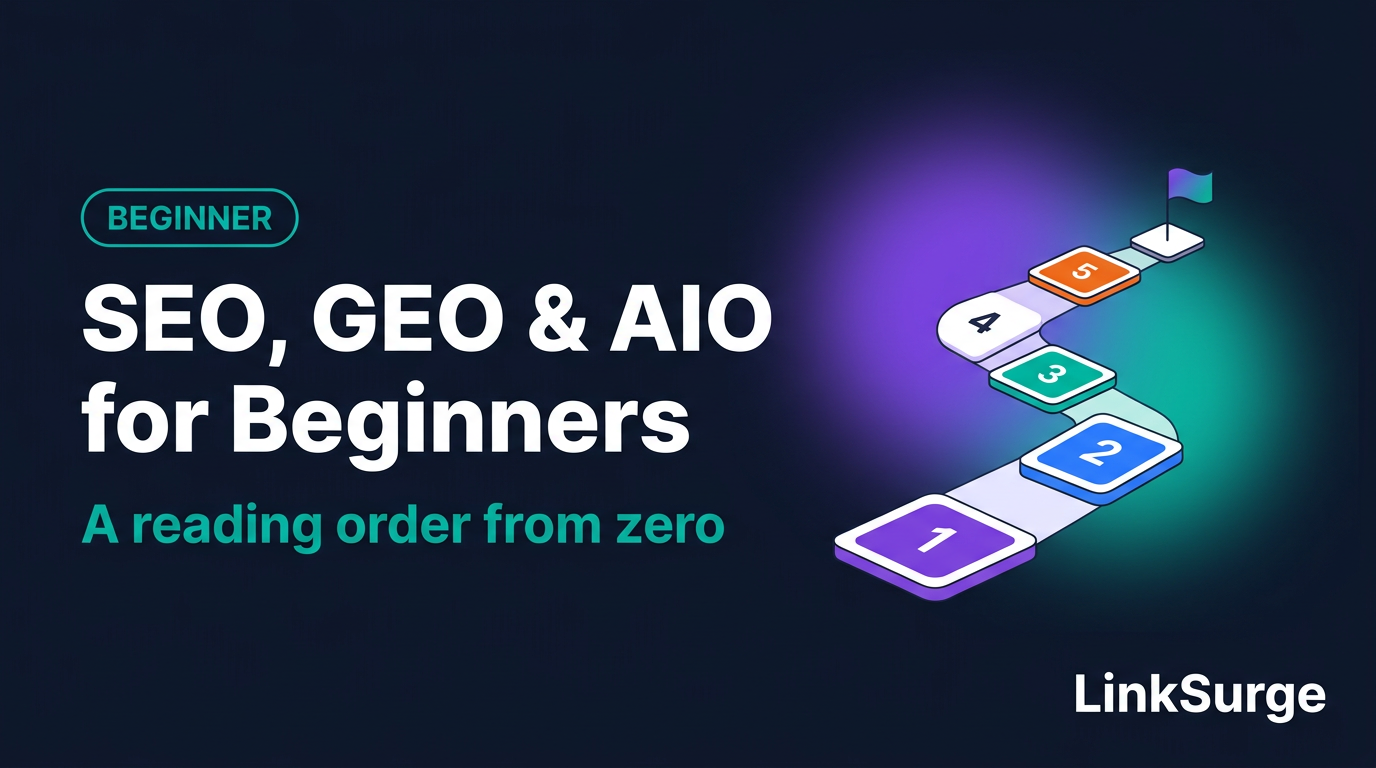
SEO, GEO and AIO for Beginners: A Reading Order From Zero
目次
Key Takeaways: Learn SEO in this order: how search works, getting found, what earns trust, reading the numbers, then AI
SEO (search engine optimization, the work of helping people find your site through Google and other search engines) trips up beginners in predictable places. When I look back at the questions I get from people who just inherited a website, most of the confusion comes from reading things out of order. This curriculum fixes the order in five steps.
- Step 1: Understand how search works — Start with the three stages Google uses to find, store and rank pages. Once you know them, every later topic slots neatly into "which stage is this about?"
- Step 2: Get your pages into search results — Learn why a page might not show up at all, where the title and description in search results come from, and what to do before changing a URL. This step prevents the classic "my article isn't even in Google" problem
- Step 3: Learn what makes content trustworthy — E-E-A-T, YMYL and backlinks are the ideas behind how Google thinks about quality and reliability. They matter more than any quick trick
- Step 4: Read the numbers — Get comfortable with Search Console (Google's free tool for checking how your site appears in search), learn why rankings, impressions and clicks are three different things, and why rankings move every day
- Step 5: See what AI search changes — Learn what AI Overviews, AI Mode, zero-click searches and ChatGPT's sources are, then find out what has and hasn't changed now that AI answers appear in search results
Each step includes beginner guides from this series. Whenever a term stops you, jump to the SEO glossary for beginners and come back.
1. Who This Curriculum Is For
I built this for people who've heard the word "SEO" but don't really know what's behind it. If any of these sound like you, you're in the right place.
| You are | Your situation | What you want first |
|---|---|---|
| A new website or marketing hire | You just inherited the site, or got assigned to it | Vocabulary, how to read the numbers, where to start |
| A blogger or small business owner | You're teaching yourself | How search works, what to avoid |
| Someone following AI search news | You keep hearing "GEO" and "AIO" | What AI changed, and what it didn't |
What is SEO, in one sentence?
Google describes SEO as the process of helping search engines understand your content and helping users find your site and decide whether they should visit it through a search engine.
So SEO isn't about tricking a search engine. It's about describing your pages clearly so the right people can find them. Honestly, holding onto that one idea will save you from a lot of bad advice.
What you'll get from this page
- Which guide to read first, and in what order
- A one- or two-sentence summary of each guide
- Where to go once you've finished the basics
References: SEO Starter Guide: The Basics - Google Search Central
2. The Map: Five Steps and the Reading Order
Here's the whole thing in one table. Hiking without a map, you lose track of where you are. Learning SEO works the same way: knowing where each guide fits makes everything click faster.
| Step | Theme | What to read | What you'll be able to do |
|---|---|---|---|
| Prep | Learn the vocabulary | SEO glossary | Look up any unfamiliar term on the spot |
| 1 | How search works | How search engines work | Explain the find, store and rank stages |
| 2 | Getting into search results | Why pages don't get indexed / Title tags and meta descriptions / 301 redirects / Redesign mistakes / Domain migration checklist / Page speed and mobile basics / Structured data | Diagnose why a page isn't showing up |
| 3 | What earns trust | E-E-A-T / YMYL / Backlinks / Keyword research basics / Reading results before you write / Why no one can guarantee a #1 ranking | Tell trustworthy content and risky tactics apart |
| 4 | Reading the numbers | Search Console's first hour / Rankings vs. impressions vs. clicks / Why rankings change daily / Which numbers to watch / What to check after a ranking drop / Explaining a ranking drop | Read ups and downs without panicking |
| 5 | AI search | SEO vs. GEO vs. AIO vs. LLMO / AI Overviews / AI Mode / Zero-click search / Why AI cites some pages / Where ChatGPT gets its information / AI-written content / Branded search and brand mentions / 5 SEO basics that haven't changed | Connect AI search news to SEO fundamentals |
Each guide takes about 15 to 20 minutes. There are 31 in total, so one a day gets you through the whole set in about a month.
3. Step 1: Understand How Search Works
The first step covers how Google gets a page into its results. Skip it, and later topics like "not indexed" or "no ranking" will be hard to untangle.
Read this
- How search engines work: crawling, indexing and ranking — How Google's automated programs find pages (crawling), store what they find (indexing) and decide what to show for each search (ranking). This is the foundation for everything else
Google's own guide breaks search into three stages: crawling, indexing and serving search results. It also says plainly that meeting the requirements doesn't guarantee a page will be crawled, indexed or shown. When I first read that line, it struck me how well it captures SEO: there's no guaranteed formula.
Keep the glossary open
Bookmark the SEO glossary at the same time. Words like crawling, indexing and canonical come up again and again from here on.
References: In-Depth Guide to How Google Search Works - Google Search Central
4. Step 2: Get Your Pages Into Search Results
With the mechanics in place, step two is about getting your own pages to appear. You'll learn the most common reasons pages go missing and how your listing looks in results.
Read these
- Why your page isn't showing up in Google: noindex, robots.txt and canonical — A step-by-step checklist for "I published it, so why can't I find it?" It covers the single settings that can quietly remove a page from search
- Title tags and meta descriptions: the basics of getting clicked — Where the title and description in search results actually come from, and why Google sometimes rewrites them
- What is a 301 redirect? What to do every time you change a URL — How to send visitors and search engines from an old URL to a new one. Read it before any site migration or redesign
- 5 Website Redesign Mistakes That Wipe Out Search Traffic — The five most common ways a redesign loses search traffic, with checks for before, during and after launch
- A Domain Migration and URL Change Checklist — Step-by-step preparation, launch-day and post-move checks, based on Google's own site move guide
- Mobile Pages and Page Speed: Core Web Vitals Explained — How to read the three numbers for loading, responsiveness and layout shift, and how they really relate to rankings
- What Is Structured Data? — How to describe your page to search engines, and what structured data can and can't do
Why "getting found" comes before "quality"
You might wonder about the order. The reason is simple: a great article that isn't in search results can't be ranked at all. I've seen plenty of "why won't this page rank?" questions where the page turned out to be excluded from search by a single setting.
5. Step 3: Learn What Makes Content Trustworthy
Once your pages can appear, the next question is which pages Google treats as helpful and reliable. The guides in this step cover the area beginners misread most.
Read these
- What is E-E-A-T? Why "who wrote it" matters — Experience, expertise, authoritativeness and trustworthiness, explained in plain English. It also covers why E-E-A-T isn't a score you can measure
- What is YMYL? The higher bar for health and money content — Why topics that can seriously affect someone's health, finances or safety are held to a higher standard
- What are backlinks? Good links vs. risky links — What links from other sites mean, and how to spot links that break Google's rules, such as paid links
- Keyword Research Basics for Beginners — Why the words people search aren't the words you'd use, and how to close the gap
- Why You Should Look at Search Results Before You Write — How to read search intent straight from the results page before you start writing
- Why Nobody Can Guarantee a #1 Ranking on Google — Why rankings can't be promised, and what to ask an SEO provider instead
One thing to remember from this step
Google says E-E-A-T itself isn't a direct ranking factor. It also says that of the four elements, trust is the most important.
Here's the thing: many people read this as "raise your E-E-A-T score." It isn't a score. Adding an author name doesn't flip a switch. It's a way of describing something obvious: is this a page a reader can rely on?
References: Creating Helpful, Reliable, People-First Content - Google Search Central Spam Policies for Google Web Search - Google Search Central
6. Step 4: Read the Numbers
Now that you know what quality means, step four is about checking results with data. These skills feed straight into the reports and decisions you'll make in your role.
Read these
- Search Console's first hour: the only three screens you need — A short tour of Google's free Search Console, narrowed down to the three reports worth opening first
- Rankings, impressions and clicks are different things — Where you rank, how often you're shown and how often you're clicked are three separate numbers. Mixing them up leads to wrong conclusions in reports
- Why do search rankings change every day? — How to tell everyday ranking noise from movement caused by a major Google update. Read this before rewriting anything in a panic
- Which SEO Numbers to Watch, and Which to Ignore — Search Console and Google Analytics metrics sorted into must-watch, for-context and safe-to-ignore
- Rankings Dropped? What to Check First — Six checks, in order, before you change anything after a real drop
- How to Explain a Ranking Drop — How to narrow down the cause and report it to your boss or client without overpromising
Your site can appear in Google without Search Console. But it's the clearest view you'll get of how Google sees your site, and an hour spent with it early on pays off.
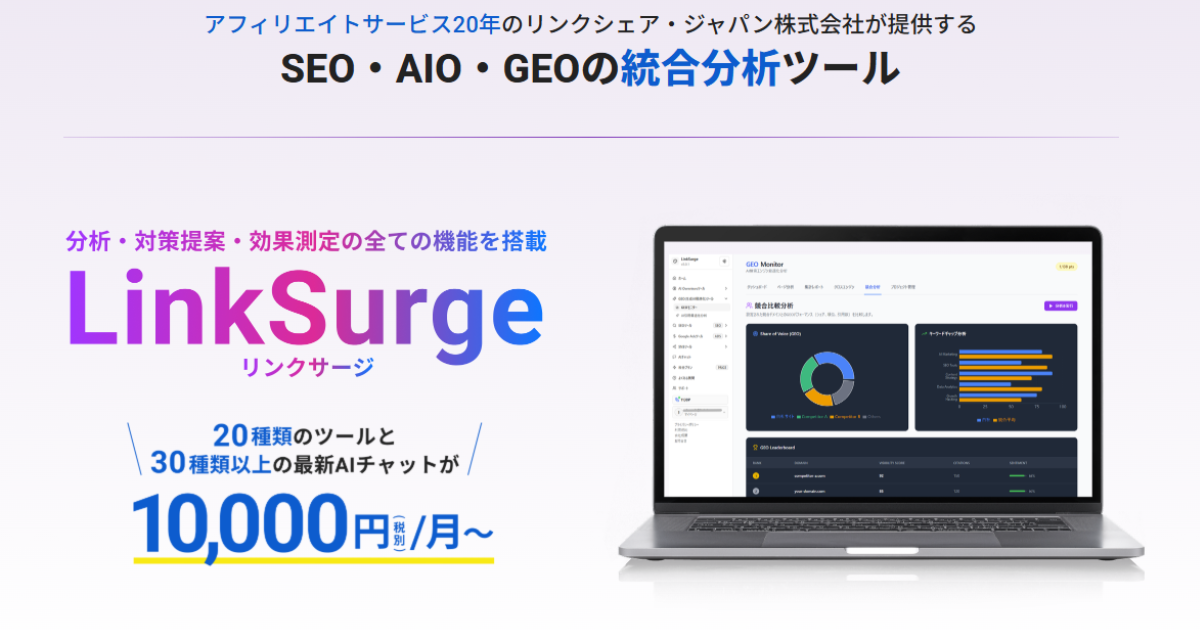
If you want to record rankings every day under the same conditions, a rank tracker such as LinkSurge is one option. It's far easier to compare like with like than to search by hand each morning.
References: About Search Console - Search Console Help What are impressions, position, and clicks? - Search Console Help
7. Step 5: See What AI Search Changes
The last step covers AI search, the topic everyone has been talking about. It comes last on purpose: AI search is much easier to understand once you have steps 1 to 4 behind you.
Read this
- SEO vs. GEO vs. AIO vs. LLMO: one-page comparison — Four look-alike acronyms, and what each one is actually trying to achieve. Once the terms are clear, industry news gets much easier to follow
- What Are Google AI Overviews? — How the AI answer at the top of search results is put together, and what site owners need to know about it
- What Is Google AI Mode? — How Google's conversational AI Mode differs from regular search and from AI Overviews
- What Is Zero-Click Search? — Why showing up in search still matters when more searches end without a click
- Why Some Pages Get Cited by AI and Others Don't — The basics of AI citations, with Google and ChatGPT-style tools kept separate
- Where Does ChatGPT Get Its Information? — Training data versus live web search, based on OpenAI's own documentation
- Does Google Penalize AI-Written Content? — What Google actually says about AI content, and what really separates good pages from bad ones
- Branded Search and Brand Mentions, Explained — Why being searched for and talked about by name matters more in the AI era
- 5 SEO Basics That Haven't Changed in the AI Era — A wrap-up of steps 1 to 5: the fundamentals that still hold. Read it last
Google says AI features don't need special optimization
Google says there are no additional requirements to appear in AI Overviews (the AI-written summary at the top of some search results) or AI Mode, and no special optimization is needed. It also says that, from its perspective, optimizing for generative AI search is still SEO. That assumes you haven't opted out with Search Console's Search generative AI control. Sites are included by default; if you exclude yours, it stays in regular Search but no longer appears in AI Overviews or AI Mode (rolled out to all sites on August 31, 2026).
That said, ChatGPT and other non-Google AI tools work differently, and Google's guidance doesn't automatically apply to them. Whenever I see an article treating the two as one, I think it's worth pulling them apart.
To check whether your site is cited in AI Overviews, tools like LinkSurge's AI Overview analysis show citations keyword by keyword.
References: AI Features and Your Website - Google Search Central Search generative AI control - Search Console Help Optimizing your website for generative AI features on Google Search - Google Search Central
8. Your Next Step: What to Read After the Basics
Once you've finished the beginner guides, these existing articles take you a level deeper. Each one assumes the basics you've just learned.
| Article | Best for |
|---|---|
| SEO in 2026: A Beginner's Guide to Modern Search Optimization | Turning what you learned into an actual to-do list |
| What Is Search Intent? The 4 Types and How They Shape SEO | Thinking about what searchers really want before you write |
| What Is LLMO? The Complete Beginner's Guide | Understanding how chat-based AI tools talk about your brand |
| What Is Query Fan-Out? A Beginner's Guide | Seeing how AI splits one question into many searches |
| How to Read Search Console's Generative AI Performance Report | Checking how often your pages appear in Google's AI features |
For a textbook-style overview of SEO as a whole, The Complete SEO Guide for 2026 is a good companion. It's denser than this series, so it reads best after you finish step 4.
9. Common Misconceptions and Mistakes
Here are five learning mistakes I see over and over.
Mistake 1: Starting with tricks to get faster results
Tips like "put X in your title" don't explain why they work or when they stop working. Without the basics from step 1, a collection of tricks falls apart the moment things change.
Mistake 2: Thinking you can pay Google to rank higher
Google states that it doesn't accept payment to crawl a site more often or rank it higher. The ads labeled "Sponsored" at the top of results are a separate system from organic results.
Mistake 3: Watching rankings and nothing else
A higher ranking on a keyword nobody searches for won't bring traffic. And a small ranking drop sometimes doesn't change clicks at all. Step 4 shows how to read the numbers together.
Mistake 4: Treating GEO and AIO as a separate discipline you must learn from scratch
As we saw, Google says optimizing for AI search is still SEO. What you learn in steps 1 to 4 stays useful in the AI era. Getting the basics down first feels slower, but it's the faster path.
Mistake 5: Expecting to remember everything after one read
Terms and ideas stick when you check them on your own site. After each guide, open Search Console and find the screens it mentions.
References: In-Depth Guide to How Google Search Works - Google Search Central
LinkSurge
linksurge.jp
SEO・AIO・GEO統合分析プラットフォーム。AI Overviews分析、SEO順位計測、GEO引用最適化など、生成AI時代のブランド露出を最大化するための分析ツールを提供しています。
Frequently Asked Questions
Can I follow this curriculum with zero SEO knowledge?
Yes. Every guide explains technical terms the first time they appear. If a word still trips you up, look it up in the SEO glossary and keep going.
What order should I read the guides in?
Start with "How search engines work" in step 1, then move through steps 2, 3, 4 and 5. Knowing how search works first makes it easy to place each later topic in the right stage.
How long does the whole curriculum take?
Each guide takes about 15 to 20 minutes to read. There are 31 guides, so one a day takes about a month.
I only care about GEO and AIO. Do I still need to start at the beginning?
If you're short on time, you can start with the step 5 guide comparing SEO, GEO, AIO and LLMO. Because Google says optimizing for generative AI search is still SEO, reading the step 1 guide on how search works will make the AI topics much clearer.
What should I do after finishing?
Add your site to Search Console and open the screens covered in the guides. Then move on to deeper articles such as "SEO in 2026: A Beginner's Guide" or "What Is Search Intent?"
Conclusion: Read One Guide Today
The trick with the basics is not trying to absorb everything at once. Today, read just How search engines work from step 1, and bookmark the glossary.
From tomorrow, take one guide a day through steps 2 to 5. Every guide ends with a link to the next one, and this page is always here if you lose your place.
When you're ready to start tracking your own site, LinkSurge's rank tracker records search rankings and AI Overviews citations in a single check.