Why Nobody Can Guarantee a #1 Ranking on Google, and What to Ask an SEO Instead
目次
Key Takeaways: Google decides rankings, not your SEO and not you
"We guarantee page-one rankings." "Number one on Google in 90 days, or your money back." If you've just inherited a website, you've probably seen pitches like these already. When I reread Google's own guidance on this topic, what struck me was how blunt it is. Here's what you need to know.
- Google says no one can guarantee a #1 ranking — Google's documentation for site owners states it in plain words, and advises you to find someone else if an SEO promises first place
- Google's systems rank pages, query by query — The meaning of the search, relevance, quality, usability, and the searcher's context all feed automated ranking systems. No outside party has a dial they can turn
- The algorithm and your competitors never stop moving — Google updates its ranking systems constantly and rolls out broad core updates several times a year. Other sites keep publishing and improving too
- Money only buys ad space — Google says it never accepts money to include or rank sites in organic results, and advertising has no effect on your organic presence
- Hiring an SEO is still a reasonable choice — The right question isn't "Do you guarantee rankings?" It's "What will you do, why, and how will we measure it?"
Let's break each of these down.
1. What does Google actually say about ranking guarantees?
"No one can guarantee a #1 ranking on Google"
Google Search Central (Google's official documentation for site owners) has a page called "Do you need an SEO?" It's written for people deciding whether to hire an SEO, and it's surprisingly candid.
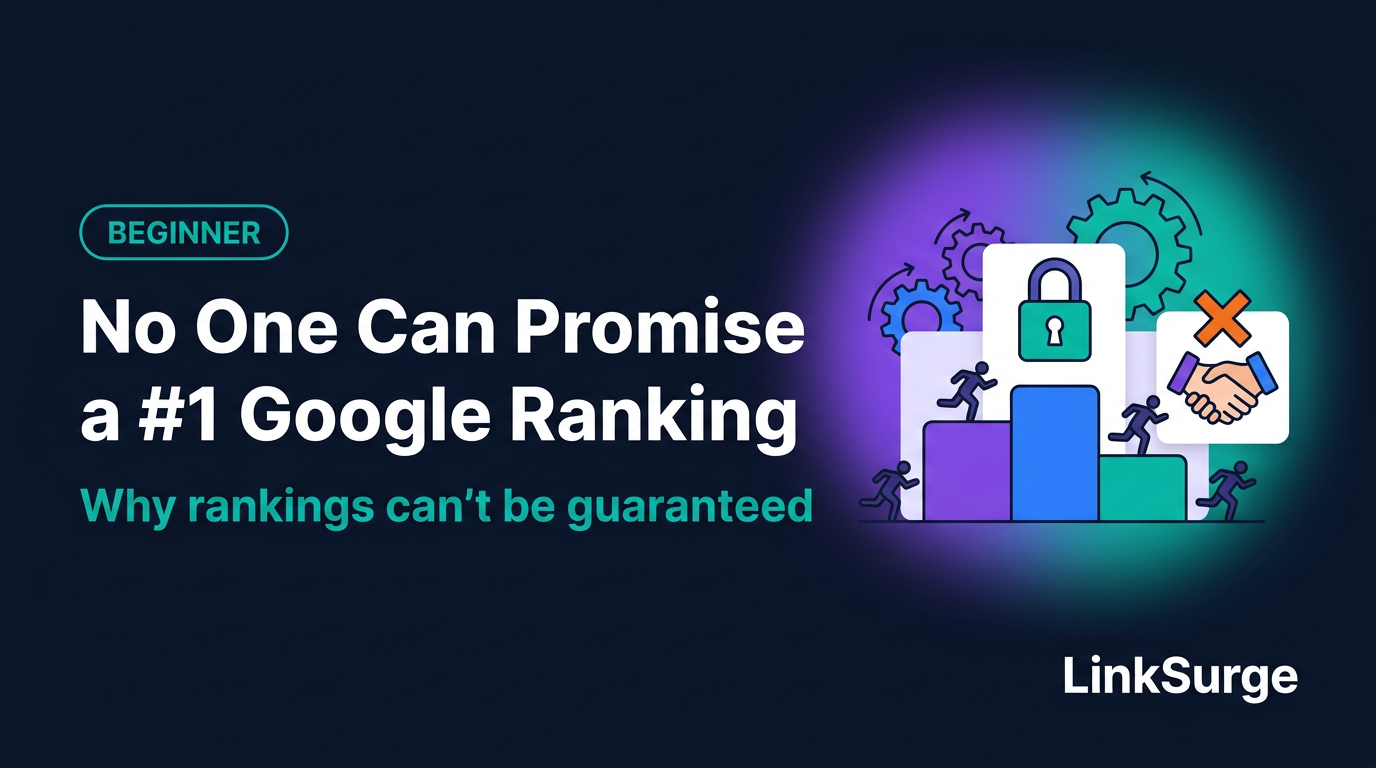
The key line is short: no one can guarantee a #1 ranking on Google. The page goes further. If an SEO guarantees that their changes will put you in first place, Google's advice is to find someone else. It also warns about anyone who claims a "special relationship" with Google or advertises a "priority submit" to Google.
Paying Google doesn't buy organic rankings either
The same page clears up how ads relate to regular results.
| What Google says | What it means for you |
|---|---|
| Advertising with Google won't affect your presence in search results | Buying ads doesn't lift your organic (unpaid) rankings |
| Google never accepts money to include or rank sites in search results | Not even Google will sell you a ranking |
| Appearing in organic results costs nothing | Showing up in regular results is free |
"Organic" just means the unpaid results. The listings labeled "Sponsored" are ads, and those are the only spots money can reliably buy. When I explain SEO to beginners, this is the first thing I put on the table.
References: Do you need an SEO? - Google Search Central How Google Search determines ranking results - Google Search
2. Why can't anyone guarantee rankings?
Now that we've covered what Google says, let's look at why. There are four main reasons.
Reason 1: Google's systems make the call
Nobody at Google hand-sorts results. Automated systems rank pages every time someone searches. Google's explainer on ranking lists the main factors:
- Meaning — what the searcher is actually looking for
- Relevance — whether the page's content matches that search
- Quality — signals of expertise, authoritativeness, and trustworthiness
- Usability — whether the page loads quickly and works well on mobile
- Context — the searcher's location, language, settings, and past searches
Google's SEO Starter Guide adds that it uses many ranking signals. How much weight each one gets isn't spelled out anywhere in the official docs. You can see the output, but nobody outside Google gets the controls.
Reason 2: The ranking systems keep changing
Google is always updating its algorithm, the set of rules that decides the order of results. Several times a year, it also ships a broad "core update."
So even if someone found a weakness in today's system, there's no promise it works next month. For how daily swings differ from core updates, see "Why Do Search Rankings Change Every Day?"
Reason 3: Your competitors and the web keep moving
Rankings are relative. Your page can stay exactly the same and still slip because someone else published something better.
Google uses a restaurant analogy in its core update guidance. A restaurant that drops on a "top 20" list didn't necessarily get worse. Other restaurants may simply have joined the list. Google also says rankings aren't static, because the open web itself keeps changing with new and updated content.
Think of a marathon. You can train harder, but you can't choose who else shows up or how fast they run.
Reason 4: "Number one" isn't the same for everyone
This one surprises a lot of people. Google tailors results using the searcher's location, language, search history, and settings. Its own example: search for "pizza" and you'll see places near you.
Here's the thing: "rank #1" means nothing until you define where, how, and for whom you're measuring. Two people typing the same words can see a slightly different order.
Even good changes take time, and may not show up
Google's Starter Guide says some changes take effect in a few hours, while others take several months. It suggests waiting a few weeks before judging impact, and notes that not every change will produce a noticeable result.
If even the person doing the work can't control when or how much things move, a guarantee doesn't make sense.
References: How Google Search determines ranking results - Google Search Google Search's core updates and your website - Google Search Central SEO Starter Guide - Google Search Central
3. Someone promised you rankings. What should you ask?
Given all of the above, a ranking guarantee almost always comes with fine print. You don't need to assume bad faith. You do need to ask what's actually being promised.
Ask: which keyword, which spot, measured how, and for how long?
| What to clarify | Common patterns behind a "guarantee" |
|---|---|
| Which search terms? | Terms almost nobody searches, or your own brand and product names, which tend to rank anyway |
| Which spot on the page? | Paid ad placement rather than organic results |
| Measured under what conditions? | A single check from one location, device, or moment |
| For how long? | "Success" counted the first day the page touched the top |
Branded searches are the classic example. A search for your company name plus your city tends to bring up your own site near the top anyway. When I hear a guarantee, the first thing I check is whether the target keywords include the brand name. Ranking for your name is fine. It's just not the same as ranking for what new customers type. "Keyword Research Basics for Beginners" covers how to tell the difference.
Ask them to explain the method
Google warns about SEOs that are secretive or won't clearly explain what they intend to do. It also notes that deceptive tactics can get a site removed from Google's index, the list of pages eligible to appear in search.
Be especially careful with anyone selling large numbers of links. "What Are Backlinks?" explains which links help and which ones put you at risk.
References: Do you need an SEO? - Google Search Central
4. Hiring an SEO is not the problem
After all that, you might feel suspicious of the whole industry. Don't be. Google itself doesn't tell you to avoid SEOs.
What an SEO can actually help with
Google lists services an SEO might provide, including:
- Reviewing your site's content or structure
- Technical advice on things like hosting, redirects, error pages, and JavaScript
- Content development
- Keyword research
- SEO training
- Expertise in specific markets and regions
- Optimizing for generative AI
None of these promises a ranking. They're about putting your site in better shape to earn one.
When is a good time to bring one in?
According to Google, the best time is when you're planning a site redesign (the earlier the better) or launching a new site. Fixing SEO problems after a site is built costs more. "5 Website Redesign Mistakes That Wipe Out Search Traffic" covers the usual traps.
For small local businesses, Google also suggests starting with its SEO Starter Guide and doing what you can yourself first.
References: Do you need an SEO? - Google Search Central
5. What to ask before you hire
So what should you actually ask? I've taken Google's suggested questions and added why each one matters. Honestly, this list covers most of what a beginner needs.
| Ask this | Why it matters |
|---|---|
| Can you show examples of past work and success stories? | You see what they've actually done |
| Do you follow Google Search Essentials? | You learn whether they work within Google's rules |
| What results do you expect, in what timeframe, and how will you measure success? | A good SEO explains measurement instead of promising rankings |
| What's your experience in my industry and my country or city? | You find out whether their advice fits your situation |
| Will you explain the reasons behind each change? | You stay in control instead of just following orders |
| How and how often will we communicate? | You know what reporting to expect |
Google also says to steer clear of SEOs who don't seem interested in you or your business. A good one asks lots of questions about your customers and products.
Start with read-only access in Search Console
If you're getting an audit, Google recommends granting read-only access to Search Console (Google's free tool for monitoring your site in search) at first, not write access. You don't have to hand over the keys on day one.
A tool's score is not Google's score
Agency reports often include scores from third-party tools. Google notes that it doesn't endorse any third-party SEO tools and that those tools don't have access to Google's internal ranking data. Check recommendations against Google's own documentation.
References: Do you need an SEO? - Google Search Central
6. If not a guarantee, what should you agree on?
If rankings can't be promised, what do you put in the contract? In practice, this is the part that matters most.
Agree on three things instead:
- The work — which pages get changed, what changes, and by when
- The measurements — impressions, clicks, and rankings for a short list of priority keywords
- The reporting — how often, and which numbers sit side by side
If rankings are the only yardstick, every daily swing turns into a crisis. "Which SEO Numbers to Watch, and Which to Ignore" sorts out what deserves your attention.
When you do track rankings, measure them the same way every time. A tool like LinkSurge's rank tracker records your chosen keywords daily under fixed conditions, so you can compare an agency's report with numbers you collected yourself.
7. Common misunderstandings and mistakes
Myth 1: "An SEO with a special relationship with Google can push us up"
Google explicitly warns about SEOs that claim a "special relationship." It doesn't take money for organic placement, so there's no special lane to sell.
Myth 2: "Running Google Ads will boost our organic rankings"
Google says advertising has no effect on your presence in search results. Treat ads and organic search as separate channels.
Myth 3: "An SEO who won't guarantee results lacks confidence"
It's the opposite. Since Google says nobody can guarantee rankings, declining to promise them is the honest answer. Judge people on how specifically they explain their plan.
Mistake 1: Never defining what "success" means
"Improve our rankings" sounds like a goal. Six months later, you get a report where some keywords went up and some went down, and nobody can say whether it worked. Write down the target keywords and the numbers you'll track before you sign.
Mistake 2: Switching agencies or tactics after a small drop
Rankings move every day. Changing direction every time they dip makes it impossible to know what worked. "Rankings Dropped? What to Check First" walks through the first steps.
8. How to check things for yourself
Whether or not you hire help, being able to read your own numbers makes every conversation more concrete.
- Set up Search Console — See impressions, clicks, and average position yourself. "Your First Hour in Google Search Console" shows how
- Pick 5 to 10 priority keywords — These become the shared yardstick with any agency
- Track those keywords under the same conditions — Manual searches drift with location and device
To see which keywords your domain already ranks for, LinkSurge's ranked keywords analysis lists them for any domain you enter.
LinkSurge
linksurge.jp
SEO・AIO・GEO統合分析プラットフォーム。AI Overviews分析、SEO順位計測、GEO引用最適化など、生成AI時代のブランド露出を最大化するための分析ツールを提供しています。
Quick Check
Q1. According to Google's own guidance, who can guarantee a #1 ranking on Google?
Answer: No one. Google advises looking elsewhere if an SEO guarantees first place.
Q2. Will spending money on Google Ads improve your organic rankings?
Answer: No. Google says advertising has no effect on your presence in search results, and it never accepts money to include or rank sites.
Q3. Instead of "Can you guarantee rankings?", what's a better question to ask an SEO?
Answer: "What results do you expect, in what timeframe, and how will you measure success?" Asking whether they'll explain the reasons for each change is another good one.
Frequently Asked Questions
Can anyone guarantee a top ranking on Google?
No. Google's documentation states that no one can guarantee a #1 ranking on Google. Rankings are set by automated systems that weigh many factors, and they shift as Google updates those systems and as competing pages change.
Should I avoid every SEO agency that offers a ranking guarantee?
Start by asking what exactly is guaranteed: which keywords, which spot on the page, measured how, and for how long. The answer often turns out to be low-volume terms, brand names, or paid ads. Google specifically warns about SEOs that won't explain their methods or claim a special relationship with Google.
When is the best time to hire an SEO?
Google says the best time is when you're planning a site redesign or launching a new site. For a redesign, the earlier you bring them in, the better.
How long does SEO take to show results?
There's no fixed timeline. Google's Starter Guide says changes can take anywhere from a few hours to several months to be reflected, and recommends waiting a few weeks before judging impact. It also notes that not every change produces a noticeable result.
Conclusion: Choose on explanation and measurement, not promises
A guaranteed top ranking is something Google itself says nobody can offer. Rankings come from automated systems weighing many signals, and they keep shifting as those systems and your competitors change.
When you bring in outside help, judge them on whether they can explain what they'll do, why, and which numbers will show progress. Open Search Console and write down your priority keywords first. That alone makes every conversation with an agency far more concrete.
This article is part of the series' third set, "Common Mistakes and What to Do When Things Go Wrong." The previous article is "How to Explain a Ranking Drop," and the next one, "Which SEO Numbers to Watch, and Which to Ignore," covers measurement. For how search works under the hood, read "How Search Engines Work." The full reading order lives in "SEO, GEO and AIO for Beginners," and the "SEO Glossary for Beginners" covers any unfamiliar terms.
LinkSurge's rank tracker records your chosen keywords under the same conditions every day, so you can follow the real trend.