Branded Search and Brand Mentions, Explained: Why Being Searched for and Talked About Matters More in the AI Era
目次
Key Takeaways: Measure "Searched For" and "Talked About" Separately
"Brand matters more than ever in AI search." You hear it constantly, but ask three people what it means and you'll get three answers. After reading Google's and OpenAI's official documentation side by side with the research out there, here's how I'd sum it up.
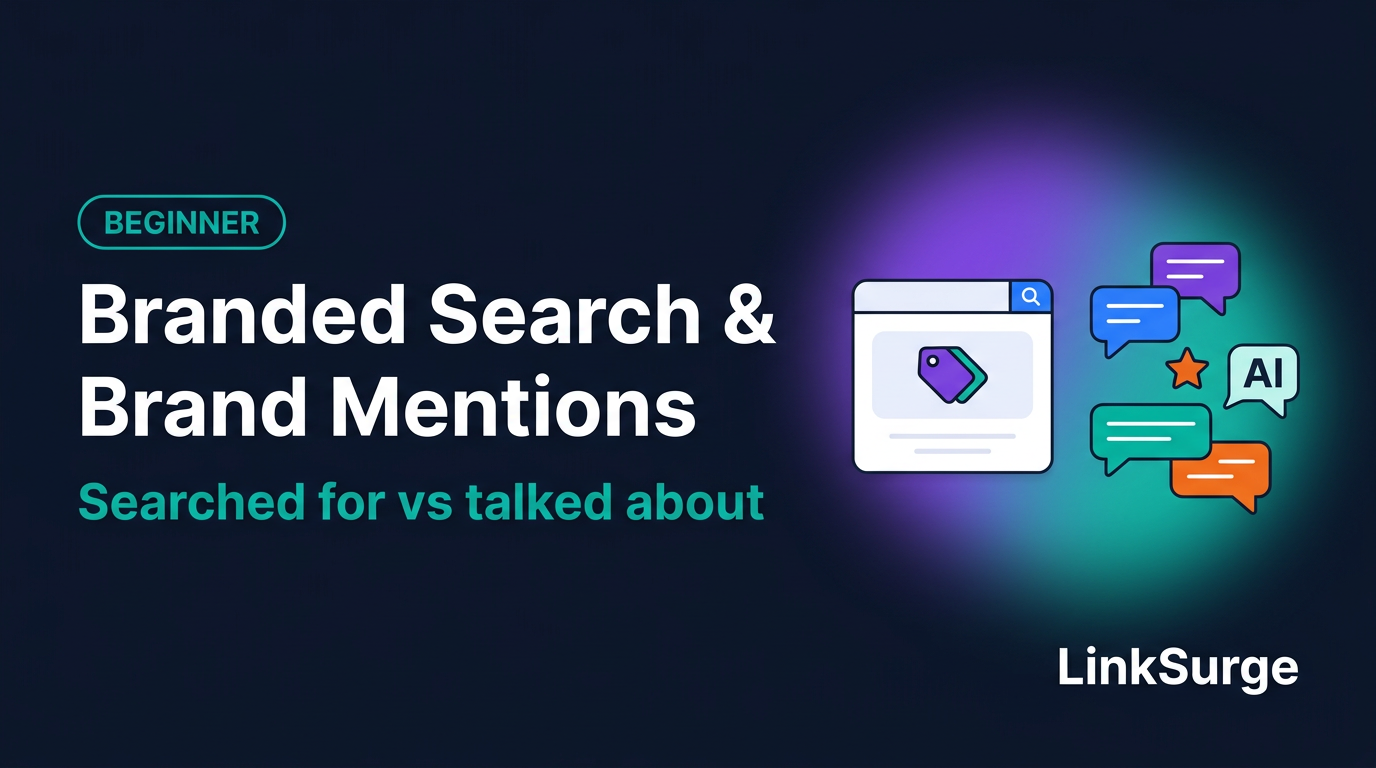
- Branded search and brand mentions are two different things — Branded search is when people search for your company or product by name. A brand mention is when your name comes up on someone else's site or inside an AI answer. One is being searched for. The other is being talked about
- Google gives you a tool to measure branded search — Search Console can split your traffic into branded and non-branded queries. Google states that this classification has no effect on how Search ranks your site
- Google says chasing inauthentic mentions doesn't help — Google's guide to generative AI features says seeking inauthentic "mentions" across the web isn't as helpful as it might seem. Mentions are earned, not collected
- Outside Google, you need to check mentions directly — ChatGPT and similar tools name brands inside their answers, sometimes with no link at all. That's why tracking mentions, not just citations, is useful
Let's start with what the two terms actually mean.
1. What Is Branded Search?
Branded search is when someone searches using a specific brand name: your company, product or service. You'll also hear it called a branded query.
Say you run a fictional running store called Stride & Co.
| What someone searched | Type | What it tells you |
|---|---|---|
| stride and co | Branded | They already know your store |
| stride and co hours | Branded | They're planning a visit |
| stryde and co (typo) | Branded | They half-remember your name |
| best running shoes for beginners | Non-branded | They may not know you exist yet |
How does Google define a branded query?
In November 2025, Google announced a branded queries filter for Search Console (Google's free tool for site owners), and in March 2026 it became available for all eligible sites. Google's announcement describes branded queries as:
- Queries that include your brand name
- Variations and misspellings of your brand name
- Queries for brand-related products or services (like Gmail for google.com)
The classification isn't based on a keyword list you write. Google uses an AI-assisted internal system, and it notes that some queries may be misclassified.
Why split branded from non-branded?
Google explains it this way. Branded queries usually show your top-ranking pages and get higher click-through rates. Non-branded queries show how new people, who weren't looking for you, found your content.
Here's an analogy. Branded search is someone getting in a cab and naming your store. Non-branded search is someone walking past, seeing your sign, and stepping in. Both matter, but they mean very different things. Look only at the combined total and that difference disappears.
References: Introducing the branded queries filter in Search Console - Google Search Central Blog Performance report (Search results): Common tasks and use cases - Search Console Help
2. What Is a Brand Mention?
A brand mention is any time your brand or product name comes up somewhere other than your own site: other websites, social media, reviews, forums, and AI-generated answers.
Several terms get mixed up here, so let's line them up.
| Term | What it means | Example |
|---|---|---|
| Backlink | A link from another site to yours | A comparison article links to the Stride & Co. website |
| Brand mention | Your name appears elsewhere, with or without a link | A forum post says "the staff at Stride & Co. really knew their stuff" |
| Mention in an AI answer | An AI tool names your brand in its answer text | "For beginners, stores like Stride & Co. are worth a look" |
| Citation in an AI answer | An AI tool links to your page as a source | Your blog post appears in the answer's source list |
Backlinks get their own article in this series: "What Are Backlinks?"
Mentions and citations don't always travel together
This is where beginners usually trip up. An AI answer can name your brand without linking to your site, often because it drew on comparison sites or reviews. The reverse happens too: your article gets cited, but your brand name never appears in the answer text.
3. What Google Officially Says
From here on, I'll keep Google and non-Google AI tools separate. Google first. Here's what I could confirm in Google's own documentation.
Point 1: Branded search is a reporting category, not a ranking lever
As covered above, Search Console lets you compare branded and non-branded queries. Google's help center says this helps you measure brand awareness and spot growth opportunities.
At the same time, Google states clearly that the filter exists to help you segment and analyze data, and that it doesn't affect how Google Search ranks sites.
Point 2: No special optimization for AI Overviews or AI Mode
For Google's AI features, AI Overviews and AI Mode, Google says there are no additional requirements to appear and no special optimization needed. Standard SEO best practices still apply.
Point 3: Chasing inauthentic mentions isn't as helpful as it seems
This one surprises people. Google's guide to optimizing for generative AI features lists "seeking inauthentic mentions" among the things you can ignore.
Google explains that its AI features can show what's being said about products and services across the web, including blogs, videos and forum discussions. But seeking inauthentic mentions isn't as helpful as it might seem, because Google's core ranking systems focus on high-quality content, other systems block spam, and the AI features depend on both.
What Google doesn't say
In the Google documentation I reviewed, I couldn't find anything describing branded search volume or brand mention counts as ranking factors. If someone tells you "more branded searches will boost your rankings," treat it as their theory, not Google's position.
References: Introducing the branded queries filter in Search Console - Google Search Central Blog AI features and your website - Google Search Central Optimizing your website for generative AI features on Google Search - Google Search Central
4. What We Can Say About Other AI Tools
With Google's position clear, let's turn to ChatGPT and other non-Google AI tools. They work differently, so they deserve their own section.
AI tools name brands in their answers
Ask "What's the best X?" or "How does X compare with Y?" and AI tools often answer with brand names. Whether yours shows up affects whether you make the shortlist. And since there may be no link, you'd never see it in your click data.
Where does ChatGPT learn brand names?
OpenAI's help center says the models behind ChatGPT learn from sources that include publicly available web content, and that this helps models recognize public figures and well-known entities.
When ChatGPT uses web search, it rewrites the question into search queries, finds pages and answers from what they say. So how other sites describe your brand may become raw material for its answers. The difference between learning and searching is covered in "Where Does ChatGPT Get Its Information?"
What does the research show?
One third-party study worth knowing: in an analysis of 75,000 brands published in December 2025, Ahrefs reported correlations of roughly 0.66 to 0.71 between branded web mentions and brand visibility in ChatGPT, AI Mode and AI Overviews.
Ahrefs itself adds the standard caveat: correlation isn't causation. Brands with lots of mentions may simply be better known to begin with. Nobody has shown that adding mentions will make AI tools name you. For a broader look at off-site visibility, see "91% of AI Answers Come From Sites That Aren't Yours."
Answers vary by tool and by day
One more thing: AI answers aren't fixed. Different tools work differently, so they name different brands. For ChatGPT specifically, OpenAI says the same question can produce different answers. Reading that changed how I check: a single look is never enough to celebrate or panic.
References: How ChatGPT and our foundation models are developed - OpenAI Help Center Searching the web with ChatGPT - OpenAI Help Center Top Brand Visibility Factors in ChatGPT, AI Mode, and AI Overviews (75K Brands Studied) - Ahrefs
5. Why Both Matter More Now
Let's connect the pieces from a practical angle.
As AI answers appear above search results and inside chat tools, more people get what they need without clicking. That's zero-click search (more in "What Is Zero-Click Search?"). Fewer clicks doesn't mean zero value. If people see your name in the answer, that's still a first impression. That's why it's worth tracking AI mentions.
Then, when someone who saw your name goes looking for you, they'll usually search for it by name. Whether that branded search shows your official pages and accurate information is the foundation for not losing them.
So the two do different jobs:
- Brand mentions — Is your name reaching people who don't know you yet?
- Branded search — Can people who know your name actually find you?
For Google, though, the official line is that no special "mention-building" is needed. In the end, both come back to the same thing: products and services people naturally want to talk about, and accurate, useful information.
6. Common Misconceptions and Mistakes
Here are five misunderstandings that trip beginners up.
Myth 1: "More branded searches will push my Google rankings up."
Nothing in Google's documentation says that. And Google explicitly says the branded queries filter doesn't affect ranking. Use branded search as a gauge of how well known you are.
Myth 2: "Pile up mentions and AI will start recommending me."
Google says seeking inauthentic mentions isn't as helpful as it seems. Paying for name-drops or writing fake reviews falls into that bucket. Google also notes that separate systems block spam, so relying on tactics like these is a shaky bet.
Myth 3: "Branded clicks are high, so our SEO is working."
Branded traffic comes from people who already know you. To see whether new people are finding you, look at non-branded queries. Splitting the two in Search Console exposes this blind spot fast.
Myth 4: "If I fix my own site, AI tools will describe us differently."
AI answers can draw on comparison sites, reviews and forums, not just your site. Old pricing or a complaint you've since fixed may still show up. Check how you're described off-site, too.
Myth 5: "AI named us once, so we're set."
Answers change by tool and by day. Ask the same questions on a regular schedule and keep a record.
7. How to Check Your Own Site
Here's how to measure both.
Branded search (Google)
- Open the Performance report in Search Console
- Use the Query filter to switch between Branded and Non-branded, and compare
- The Insights report also shows a breakdown of branded versus non-branded clicks
According to Google, the filter works only on top-level properties, not URL-path properties like https://example.com/path or subdomain properties, and only for sites with enough queries and impressions. If you don't see it, check those conditions. New to Search Console? Start with "Your First Hour in Google Search Console."
Mentions in AI answers (Google and beyond)
Ask a few AI tools the questions your customers would ask, like "What's the best…?" or "How does … compare?", and note whether your brand comes up. To make it a habit, fix a set of questions and record the answers on a schedule.
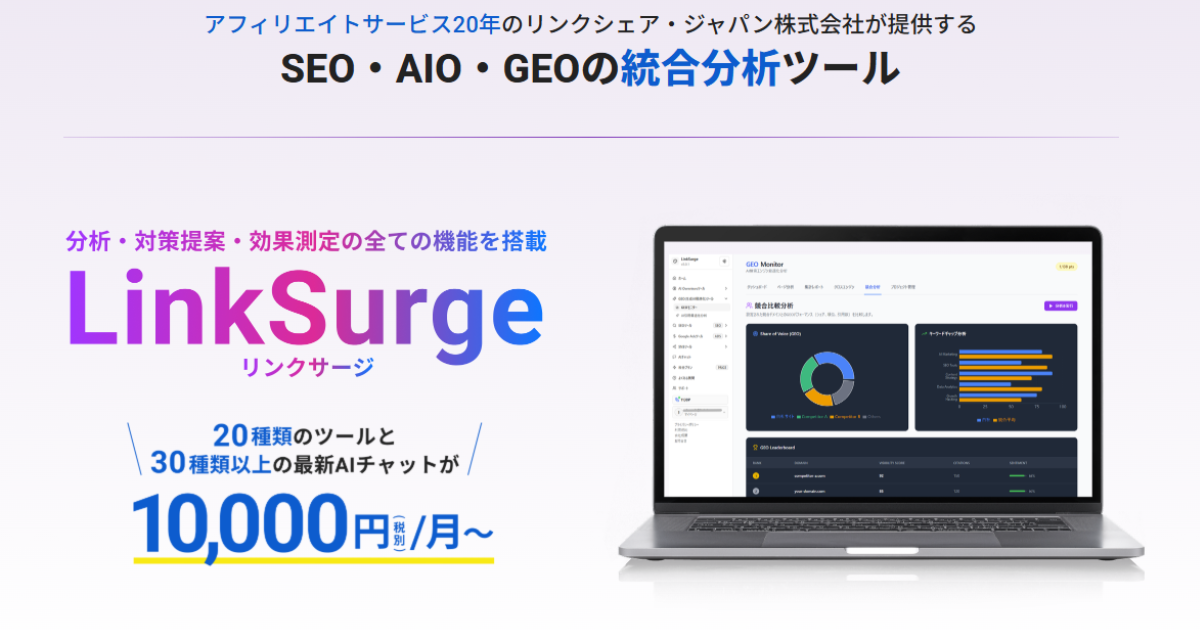
If doing that by hand gets old, tools like LinkSurge's AI brand mentions search AI answers for questions where your name appears, and its GEO monitoring sends the same questions to several AI tools on a schedule and records mentions and citations. For where these mentions tend to come from, "UGC Fuels AI Search" looks at the role of forums and reviews. Pairing a tool like LinkSurge with your own spot checks makes shifts easier to catch.
LinkSurge
linksurge.jp
SEO・AIO・GEO統合分析プラットフォーム。AI Overviews分析、SEO順位計測、GEO引用最適化など、生成AI時代のブランド露出を最大化するための分析ツールを提供しています。
Quick Check
Q1: In one sentence each, what are branded search and a brand mention?
Answer: Branded search is when people search for your brand by name. A brand mention is when your name comes up on another site or inside an AI answer.
Q2: Does using Search Console's branded queries filter affect your Google rankings?
Answer: No. Google says the filter exists to segment and analyze data, and it doesn't affect how Search ranks sites.
Q3: Can an AI answer name your brand without linking to your site?
Answer: Yes. AI tools can name a brand based on comparison sites or reviews without linking to it. That's why mentions need to be checked separately from citations.
Frequently Asked Questions
What is branded search?
Branded search is when someone searches using a specific company, product or service name. Google treats queries that include your brand name, its misspellings and variations, or brand-specific products as branded queries. These searches usually come from people who already know the brand.
What's the difference between a brand mention and a backlink?
A backlink is a link from another site to yours. A brand mention is your name appearing somewhere else, whether or not there's a link. In AI answers, your brand can be named with no link at all.
Where can I see my branded search data?
In Search Console's Performance report, use the Query filter to switch between Branded and Non-branded. It's available only for top-level properties, and sites with low search volume may not see it.
Do I need to build brand mentions specifically for Google?
Google says AI Overviews and AI Mode require no special optimization, and that seeking inauthentic mentions isn't as helpful as it might seem. The basics still apply: publish useful information and offer products or services people naturally want to talk about.
Conclusion: Track "Searched For" and "Talked About" With the Right Tools
Branded search and brand mentions both reflect how well known you are, but you measure them in different places. Branded search lives in Search Console. AI mentions only show up when you record the answers themselves. Google's official position is that no special tactics are needed, so put your effort into measuring and into giving people something worth talking about.
Start by comparing branded and non-branded clicks in Search Console to see how many new people are finding you. Then pick a handful of questions from your field, ask a few AI tools, and start recording whether your name comes up.
The previous article in this series is "What Is Google AI Mode?" Up next, the series wrap-up: "5 SEO Basics That Haven't Changed in the AI Era." For the full reading order, see the "SEO, GEO and AIO Beginner Curriculum," and keep the "SEO Glossary for Beginners" nearby. To go deeper on how entities shape AI visibility, "Entity Authority & AI Search Visibility" is a good next step.
LinkSurge's AI brand mentions lets you enter a brand name or domain and see the questions where AI answers mention you, along with the full answer text and cited sources.